


























Views
Downloads
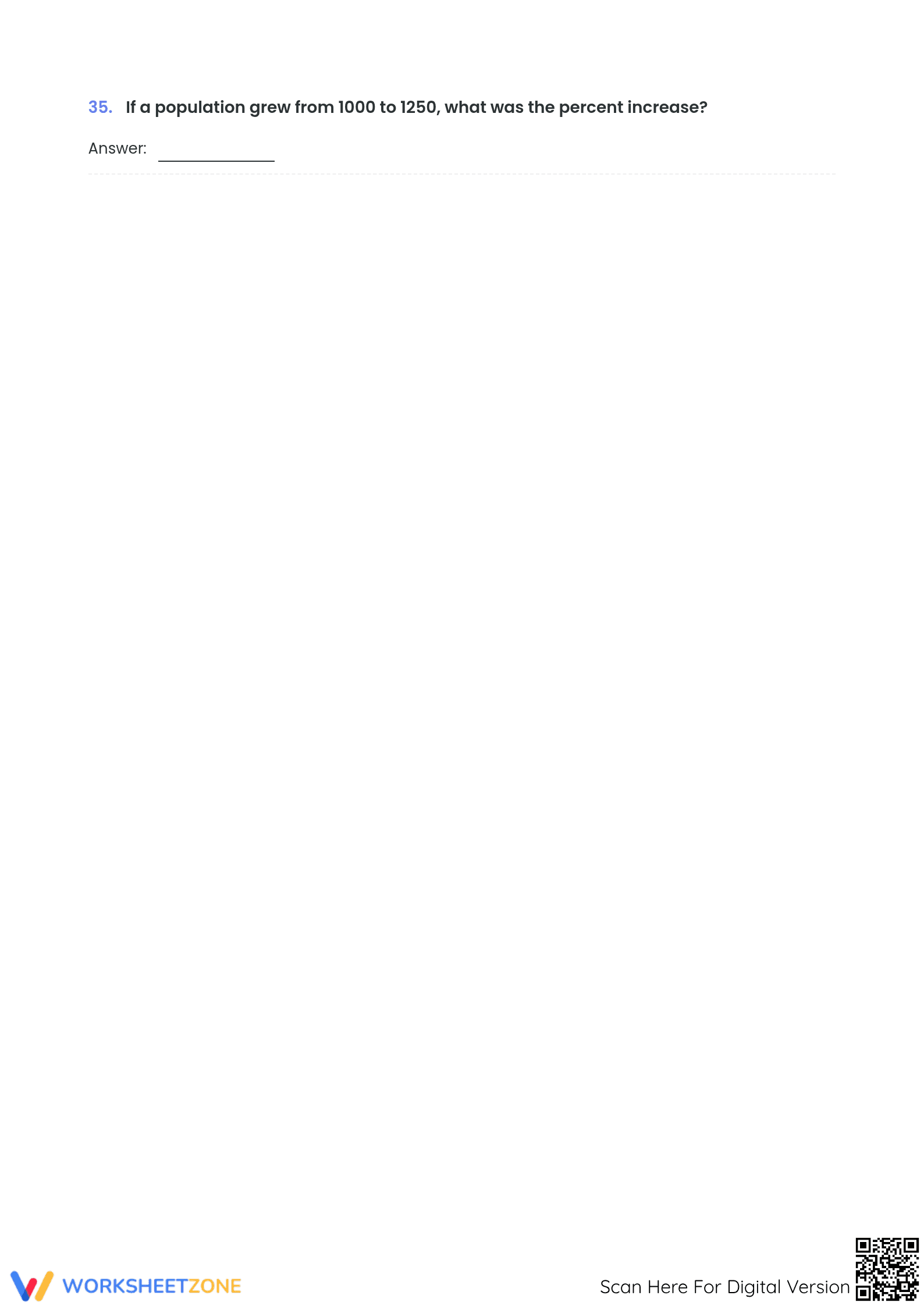

Essential Percent Proportion Worksheet | Grade 7 Math
Paste this activity's link or code into your existing LMS (Google Classroom, Canvas, Teams, Schoology, Moodle, etc.).
Students can open and work on the activity right away, with no student login required.
You'll still be able to track student progress and results from your teacher account.
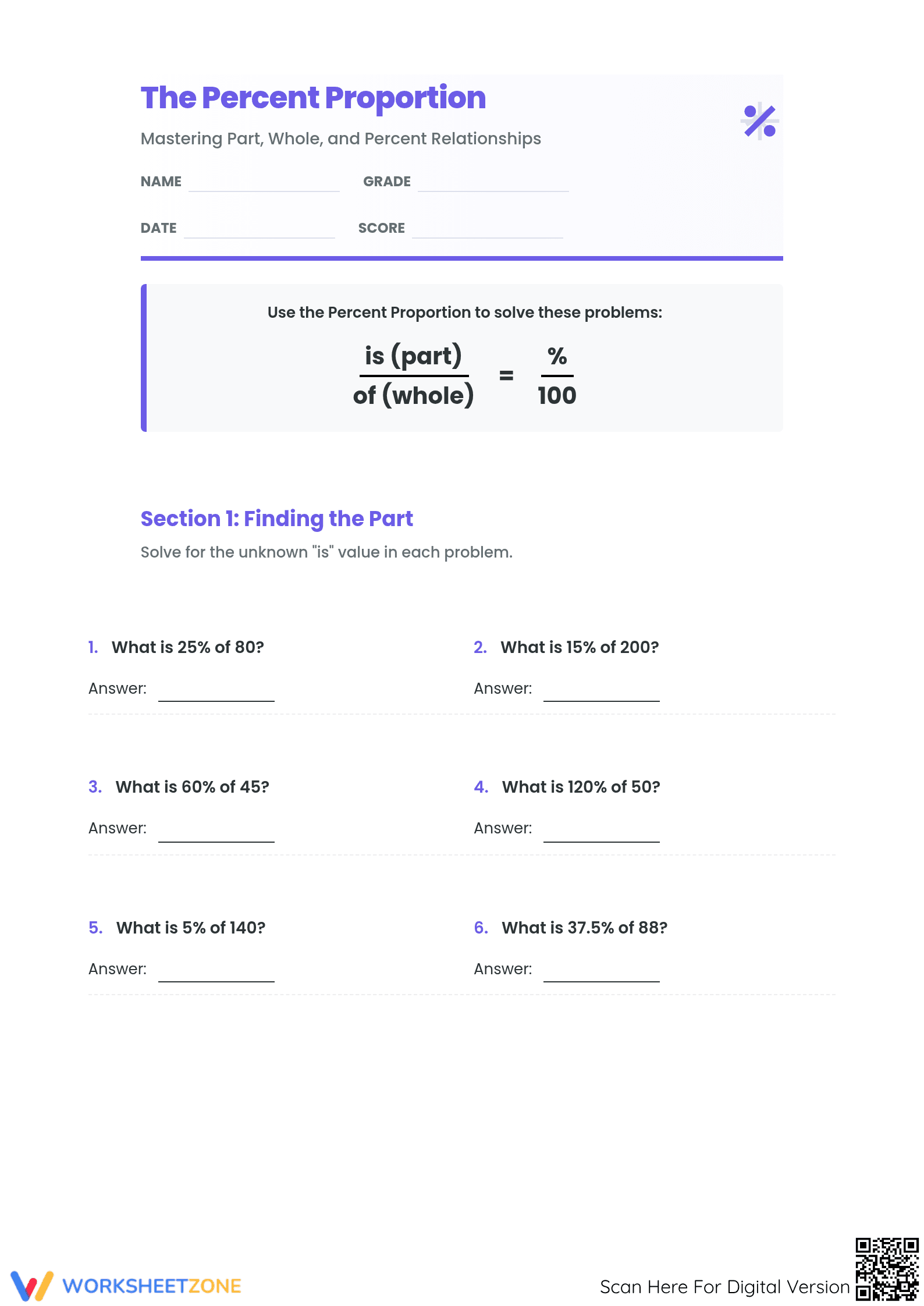
Mastering proportional reasoning is a critical milestone for middle school mathematicians. This comprehensive worksheet focuses on the percent proportion formula, guiding students through the process of setting up and solving equations. By engaging with these 30 structured problems, learners build the procedural fluency necessary for real-world mathematical applications.
At a Glance
- Grade: 7 · Subject: Math
- Standard:
7.RP.A.3— Use proportional relationships to solve multistep ratio and percent problems- Skill Focus: Percent Proportion formula application
- Format: 5 pages · 30 problems · Answer key included · PDF
- Best For: Middle school ratio and proportion units
- Time: 45–60 minutes
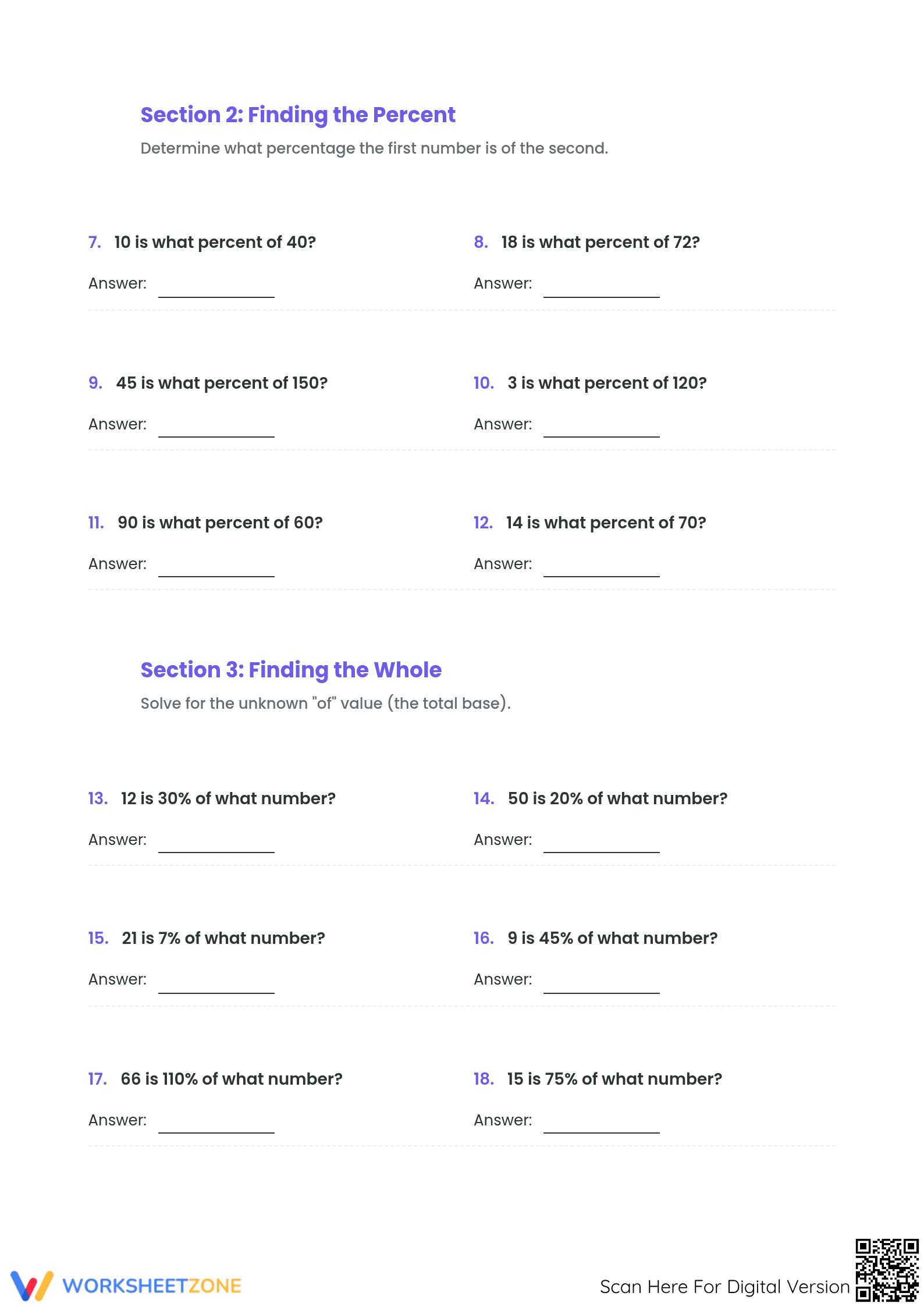
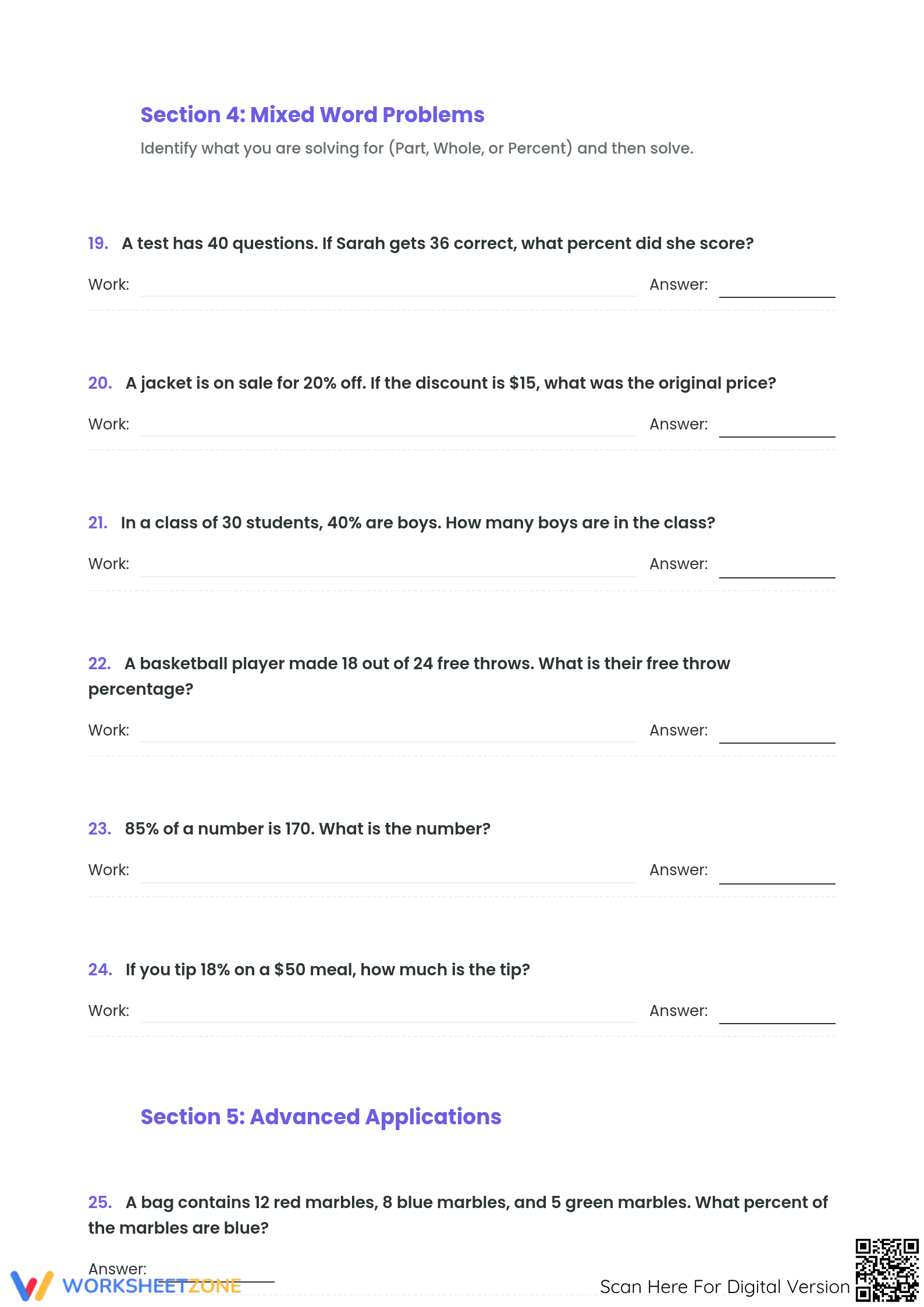
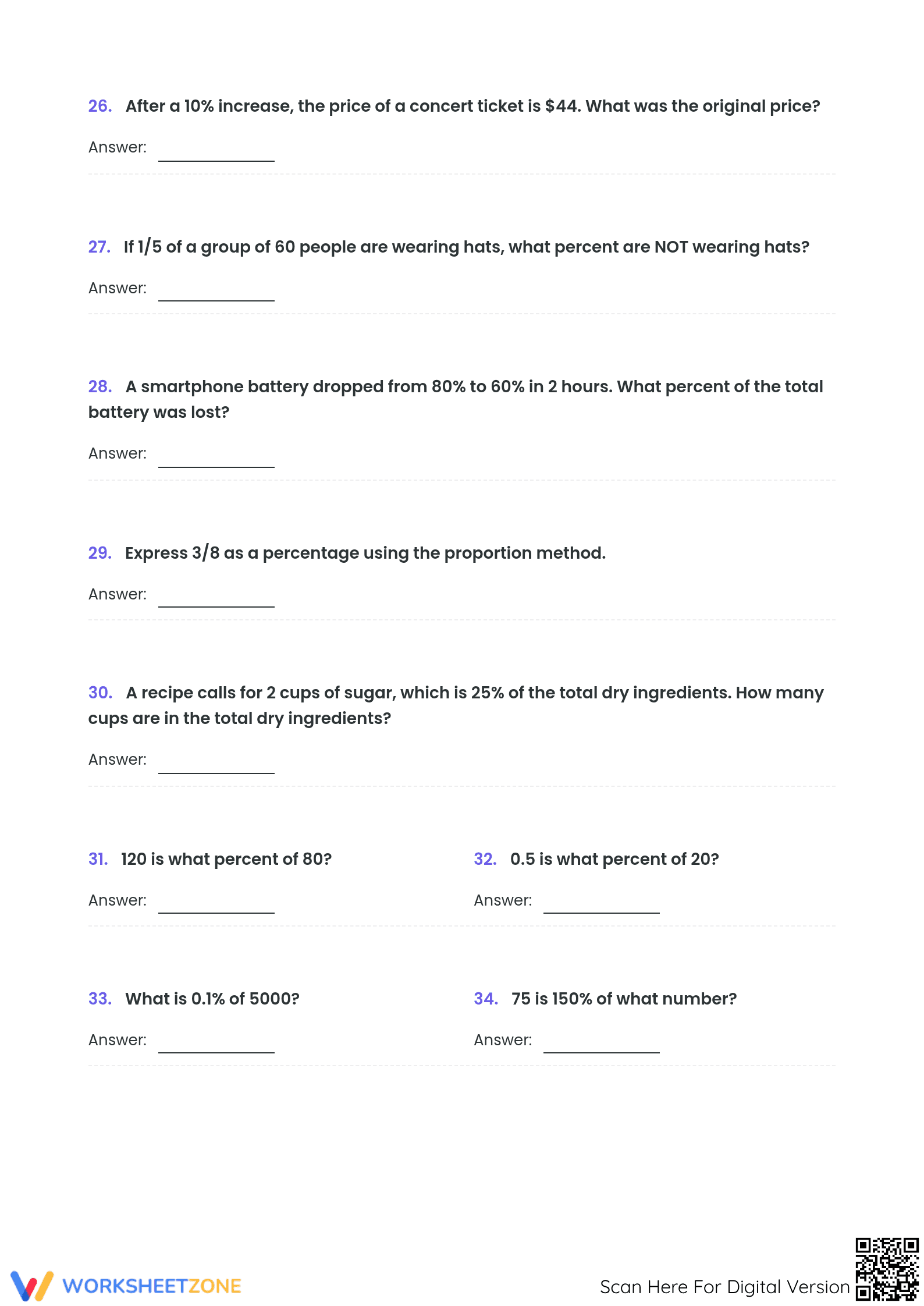
This resource consists of five content-rich pages featuring 30 unique mathematical tasks. Each page presents six problems, providing ample space for students to show their work and set up ratios correctly. The worksheet uses a consistent layout that minimizes cognitive load, allowing students to focus on the relationship between part, whole, and percent. A complete answer key is included.
Skill Progression
- Guided Practice: The initial set of problems focuses on standard "part-to-whole" setups where the percent is clearly defined, helping students establish the basic ratio relationship.
- Supported Practice: Middle-tier problems transition into finding the "whole" or the "percent," requiring students to rearrange their thinking and manipulate the cross-multiplication steps.
- Independent Practice: The final section challenges students to apply the proportion method to diverse numerical contexts without scaffolded prompts, ensuring deep mastery.
The curriculum design follows a gradual-release model, moving from predictable setups to more complex numerical configurations.
Standards Alignment
The primary alignment for this resource is CCSS.MATH.CONTENT.7.RP.A.3: "Use proportional relationships to solve multistep ratio and percent problems." Additionally, it supports CCSS.MATH.CONTENT.6.RP.A.3.C regarding finding a percent of a quantity. Both standard codes can be copied directly into lesson plans, IEP goals, or district curriculum mapping tools.
How to Use It
This worksheet is ideal for use during the practice phases of a lesson on percentages. Teachers can assign the first two pages as in-class practice, using the remaining pages for homework or formative assessment. One effective observation tip is to check the students' initial ratio setups before they begin cross-multiplying; identifying errors in the "part/whole" placement early prevents recursive mistakes. Completion typically takes 45 to 60 minutes.
Who It's For
Designed primarily for 7th-grade students, this resource also serves as an excellent intervention tool for 8th and 9th graders. It pairs naturally with a visual anchor chart displaying the percent proportion formula or a short video tutorial on cross-multiplication techniques for ratios.
According to the RAND AIRS 2024 report on mathematics instructional materials, structured practice that emphasizes the underlying ratio structure is superior to rote memorization of percentage rules. This worksheet implements these findings by requiring students to consistently apply the percent proportion formula across 30 varied tasks. By focusing on the relationship between part, whole, and percent (7.RP.A.3), students develop a mental model for proportions that extends beyond simple calculations. Research indicates that when middle schoolers visualize percentages as equivalent ratios, their success rate in high school algebra increases significantly. This resource provides the necessary repetition to move students from basic understanding to automaticity, ensuring they can solve complex, multi-step ratio problems with confidence. The inclusion of a detailed answer key allows for immediate self-correction, a practice shown to improve long-term retention of mathematical procedures.


