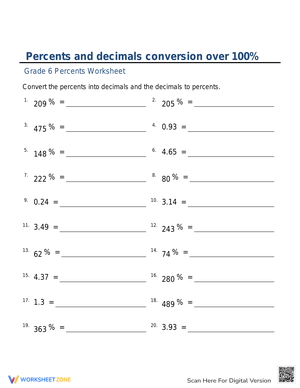
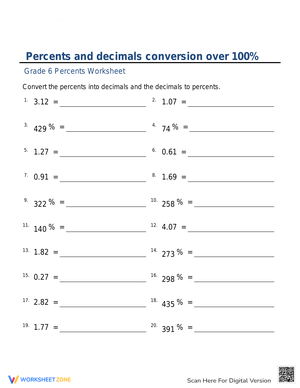
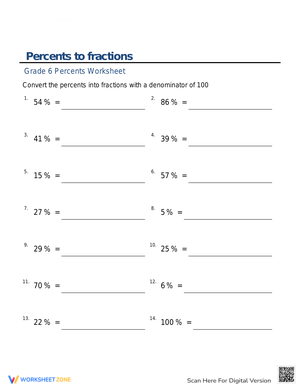
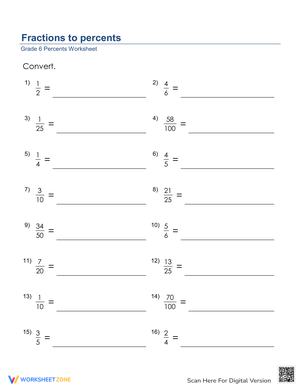
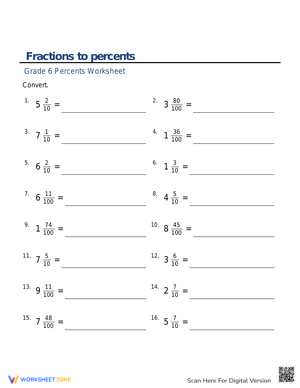
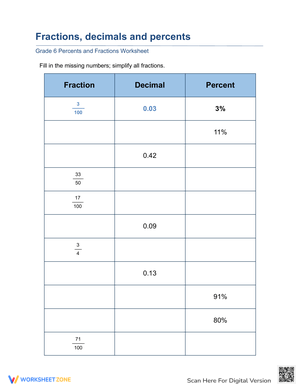
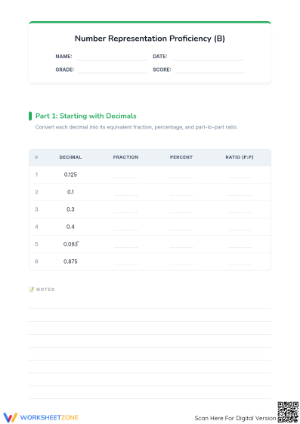
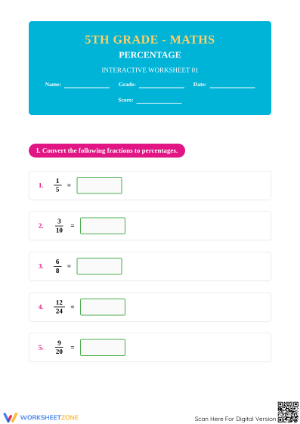
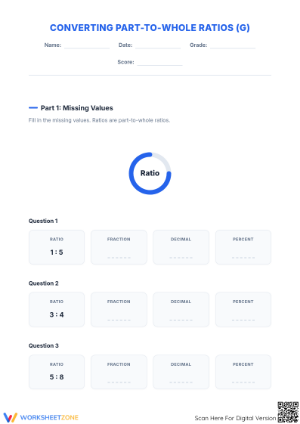
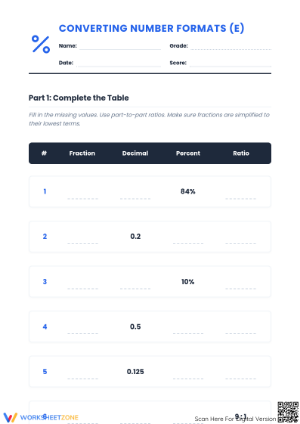
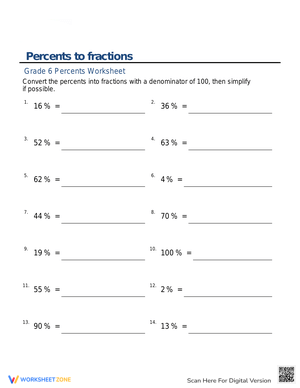
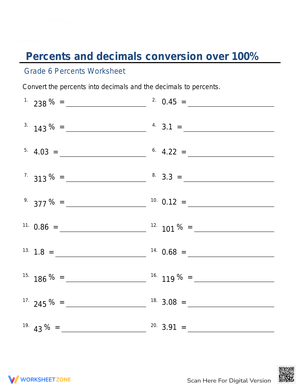
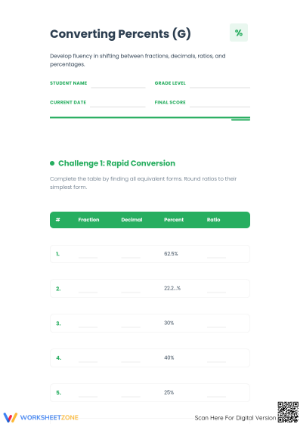
These converting percents decimals and fractions worksheets for 6th grade give teachers a structured way to address one of the trickiest fluency demands in the middle grades: moving among three forms of the same value without losing track of what each form means. The set covers all six conversion directions and includes both benchmark practice and mixed-format review.
The Specific Skills Targeted
Sixth graders arrive with fraction and decimal experience, but percent as a formal concept is still new territory for most of them. These worksheets anchor practice to the idea that a percent is a rate per 100, which connects directly to the hundredths place in decimal notation and to fractions with a denominator of 100. From that foundation, the work expands to non-benchmark values that require students to decide on a strategy rather than recall a memorized answer.
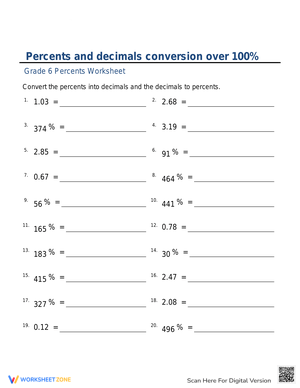
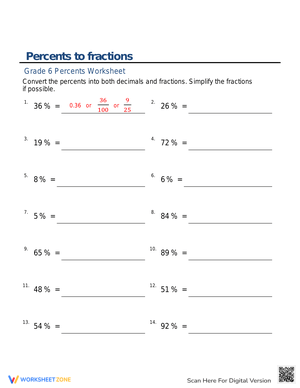
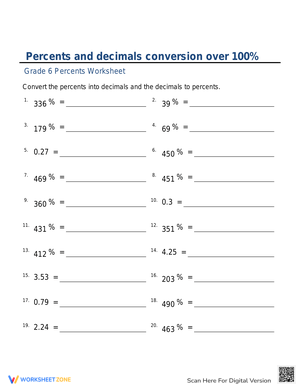
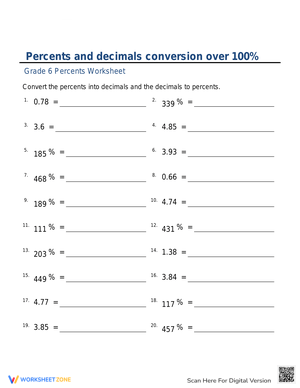
- Percent to decimal and back: students divide by 100 to convert from percent to decimal form, then multiply by 100 to reverse — with both directions practiced until the mechanic feels automatic rather than effortful.
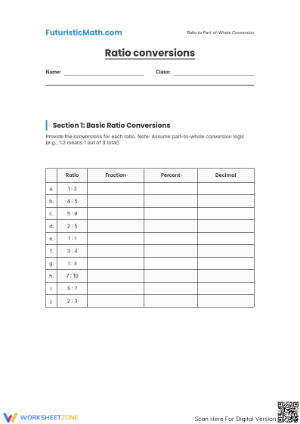
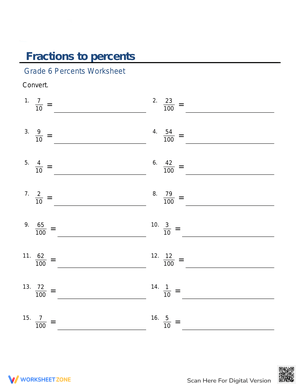
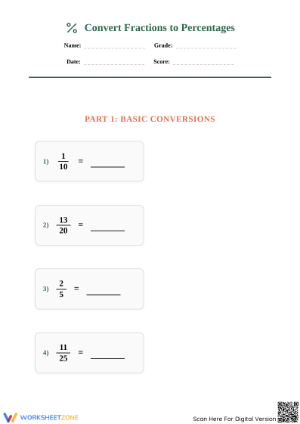
- Fraction to percent: students write equivalent fractions over 100 where possible, or use decimal conversion as a bridge for non-benchmark fractions such as 3/8 and 7/20.
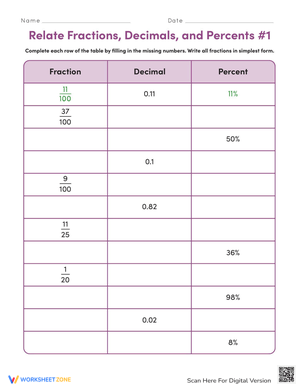
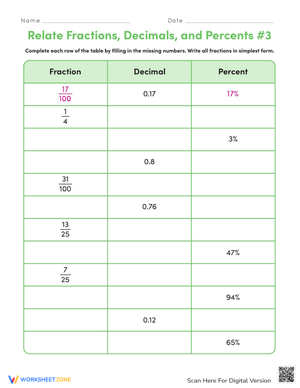
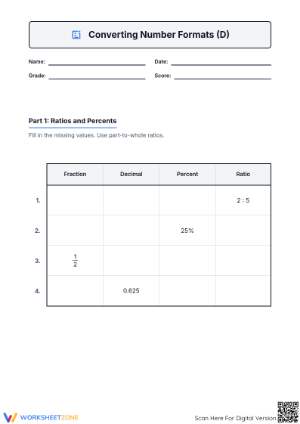
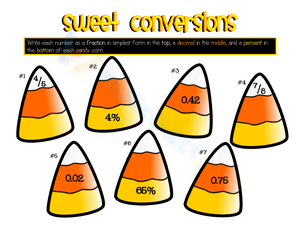
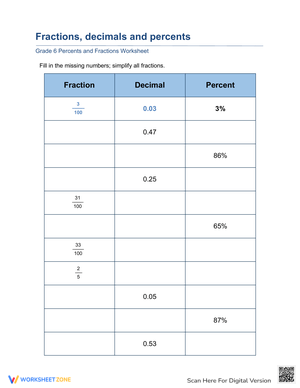
- Mixed-direction fill-in: each worksheet in the mixed set presents two of three forms and asks students to supply the missing one, requiring a strategy decision before any calculation begins.
- Fraction simplification: answers in fraction form must be reduced to lowest terms, so GCF reasoning runs alongside the conversion work throughout the set.
- Applied items: students interpret quiz scores, sale prices, and survey results expressed in one form and rewrite them in another, connecting the procedural work to contexts that appear regularly at this grade level.
The sequencing opens with benchmarks — 10%, 25%, 50%, 75%, 100% — before shifting to less familiar values. This matters because many students perform accurately on benchmarks during whole-class instruction and then fall apart on 37% or 0.125 the moment they work independently.
Common Student Mistakes Teachers Should Anticipate and Address
The decimal placement error is the most consistent one we see in 6th grade. A student who correctly writes 45% in the percent column will then write 4.5 when asked to express that same value as a decimal — moving the decimal one place instead of two. The error makes developmental sense: students have been dividing by 10 since 4th grade, and dividing by 100 feels like one step they do not yet trust. Making the operation explicit on each worksheet ("÷ 100 moves the decimal two places left") and spending a few problems on easy benchmarks before introducing unfamiliar values disrupts this pattern faster than reteaching the concept alone.
Unsimplified fraction answers are the second predictable problem. Students convert 60% to 60/100 — which is correct — and stop there, not recognizing that the task expects one more step. A quick intervention: before distributing the worksheet, circle or highlight the phrase "in simplest form" wherever it appears. That one physical cue dramatically reduces the number of half-finished responses.
The harder error to catch is directional confusion. Asked to write 0.6 as a percent, some students write 6% because they moved the decimal one place instead of two. These students are not confused about what a percent represents — the mechanics are just reversed. Sorting practice by conversion pathway before mixing directions helps considerably: five or six problems that all start from a decimal, then five that start from a fraction, gives teachers cleaner diagnostic data and helps students recognize that the starting form determines which operation comes first.
Fitting the Conversion Worksheets Into Your Lesson Sequence
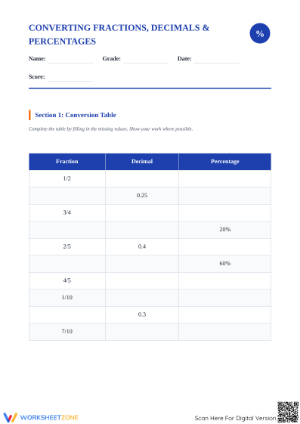
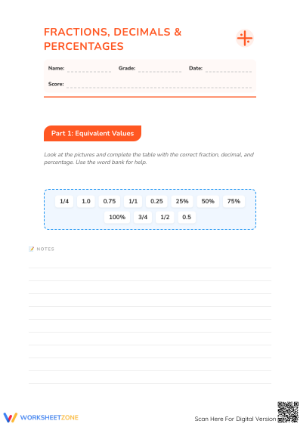
The strongest entry point is benchmark matching at the start of the unit. Before asking students to convert unfamiliar values, spend two or three days on the five or six equivalents that should become automatic: 1/4 = 0.25 = 25%, 1/2 = 0.50 = 50%, 3/4 = 0.75 = 75%. A benchmark worksheet used as a daily bell ringer for three mornings in a row does more for retention than a single long lesson ever will. A structured week built around converting percents decimals and fractions worksheets for 6th grade — one conversion pathway per day before combining all three — builds the representation flexibility that later lessons on discount, tax, and part-to-whole data interpretation assume students already have.
For station rotations, a 10-problem conversion worksheet keeps the pace brisk. Students finish in 8 to 10 minutes and still have time to verify one answer using an alternate method before the rotation timer signals a switch. For independent practice during a guided lesson, the mixed-direction worksheets fit best once students have demonstrated accuracy on at least two of the three conversion types in isolation.
Exit tickets drawn from this set are especially useful mid-unit, when it is hard to tell who has genuine fluency and who is imitating a neighbor's process. Three items — one percent-to-decimal, one fraction-to-percent, one mixed fill-in — take about four minutes and produce a cleaner picture of where understanding breaks down than any whole-class discussion at the end of the period.
Working With the Worksheets Across Different Readiness Levels
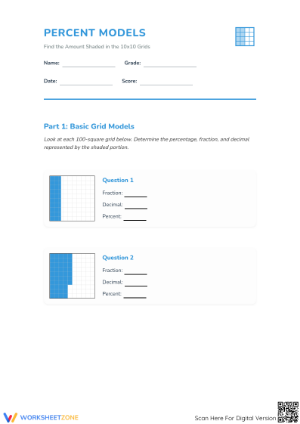
For students who need more support, start with benchmark-only worksheets and pair them with a reference chart students build themselves: a three-column table with fraction, decimal, and percent entries for 1/2, 1/4, 3/4, 1/5, and 1/10. Students who construct the chart by hand stop consulting it faster than students who receive one pre-filled — there is something about writing the values that moves them into memory. Hundred-grid models on the same worksheet reinforce the per-100 meaning concretely: students shade 35 squares and read off 35/100 and 0.35 directly from what they drew, which is more durable than hearing the relationship described.
On-level learners move to the mixed-direction worksheets and add a brief written explanation requirement. Asking students to write one sentence explaining why 3/4 equals 75% — rather than simply filling in the blank — catches students who have the answer memorized but cannot trace where it comes from.
At the advanced end, converting percents decimals and fractions worksheets for 6th grade function as reasoning tools rather than fluency drills. These students work with non-benchmark fractions like 7/16 and 11/25, multi-step real-world problems (a jacket is marked down 30%, then that new price is reduced by another 10% — what percent of the original does the buyer pay?), and data tables where values appear in mixed forms that students must standardize before drawing any comparison. The goal shifts from executing a procedure correctly to choosing a representation strategically.
Standard Alignment
These worksheets align to CCSS 6.RP.A.3c, which asks students to find a percent of a quantity as a rate per 100 and to solve problems involving finding the whole when a part and a percent are given. That standard belongs to the Ratios and Proportional Relationships domain, which means conversion fluency in 6th grade is not a standalone exercise — it is the entry point for unit rate reasoning, proportional comparison, and percent applications that run through the rest of 6th grade and into 7th. Teachers who lock in conversion fluency early consistently find that later lessons on tax, discount, and data interpretation move faster because students are not pausing to re-derive what 0.25 or 75% means every time a new problem type appears.
Frequently Asked Questions
What prior knowledge do students need before these worksheets will be productive?
Students should be comfortable with place value through hundredths, basic fraction simplification using GCF, and the understanding that a fraction represents a part of a whole. Benchmark fraction recall — knowing 1/2, 1/4, and 3/4 as fixed reference points that do not need to be computed each time — makes the practice move considerably faster. Without that foundation, converting percents decimals and fractions worksheets for 6th grade are most effective when introduced alongside brief direct instruction rather than assigned as unsupported independent work.
How long do these worksheets take to complete in class?
Benchmark-focused worksheets with 10 to 12 items run 7 to 10 minutes as a bell ringer. Mixed-direction worksheets with 18 to 20 items, including at least one applied context problem, run closer to 15 to 18 minutes during the independent work stage. Exit ticket formats with 3 to 5 targeted items take roughly 4 to 5 minutes. Students encountering a conversion type for the first time will move more slowly than those reviewing familiar ground — that timing gap is itself useful diagnostic information.
Do these worksheets work for small-group intervention?
Yes, with deliberate sequencing. Start intervention sessions with percent-to-decimal conversion only, and hold fraction conversion until students can move reliably between percent and decimal in both directions. Adding fraction equivalence too early overloads students who are not yet secure on the decimal placement mechanic. The benchmark-only subset works well for initial small-group work before students reintegrate into the full mixed-direction set alongside the rest of the class.













 Interactive Worksheet Maker
 Quiz Maker
 Word Search Maker
 Crossword Puzzle Maker
 Word Scramble Generator
 Sentence Scramble Generator
 Handwriting Worksheet Generator
 Name Tracing Generator
 Fill In The Blank Generator