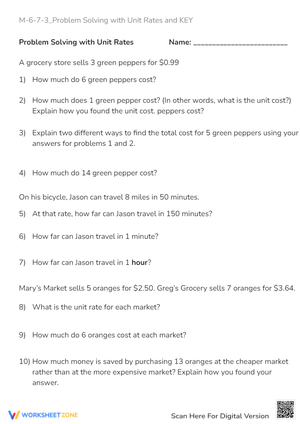
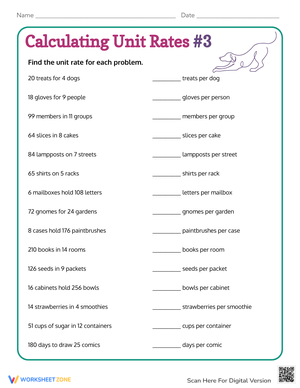
These 6th grade ratios proportions pdf worksheets give teachers a focused set of printable resources covering the full arc of ratio reasoning introduced at this grade level—from naming and writing ratios in multiple forms through solving unit rate problems in real-world contexts. Each worksheet targets a distinct skill or problem type, so teachers can assign exactly what a lesson requires rather than hunting through an entire packet to find the right worksheet. The set includes visual tasks, ratio tables, word problems, and mixed review materials structured to move with the lesson cycle.
What's Inside Each Worksheet
Ratio and proportion work in sixth grade covers more conceptual ground than it appears to on the surface. The formal language—part-to-part, part-to-whole, unit rate—is new to most students even when the underlying idea of comparison feels familiar from earlier grades. The worksheets build skill in a logical order:
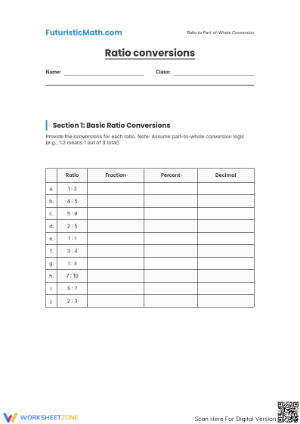
- Writing ratios three ways: words, colon notation, and fraction form, with tasks that ask students to match or convert between representations.
- Part-to-part vs. part-to-whole comparisons: distinguishing which kind of comparison a problem asks for, using both picture-based tasks and written prompts.
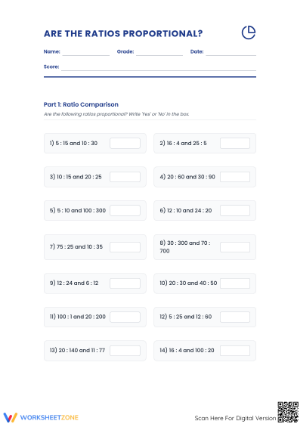
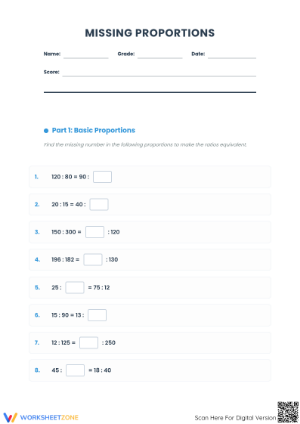
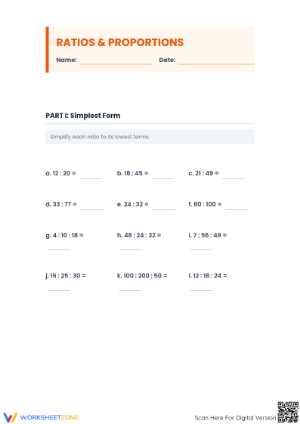
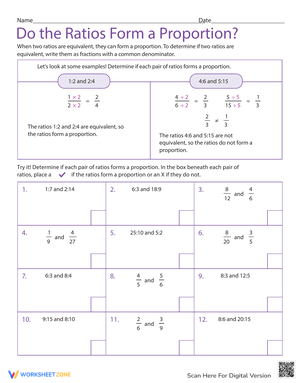
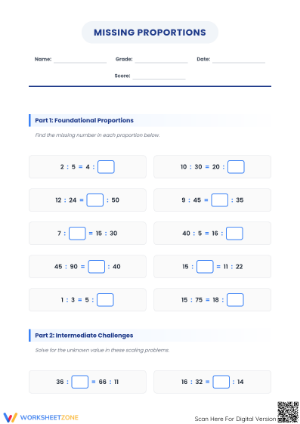
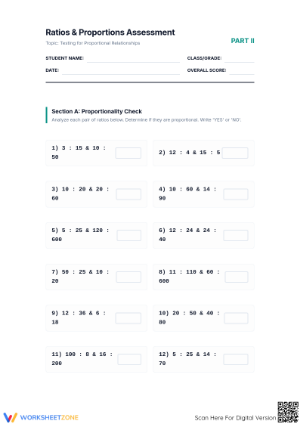
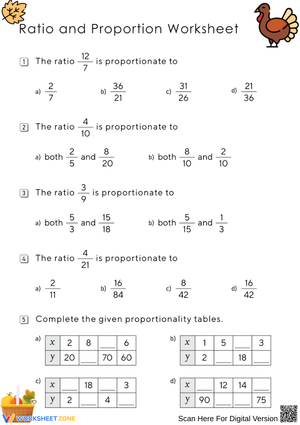
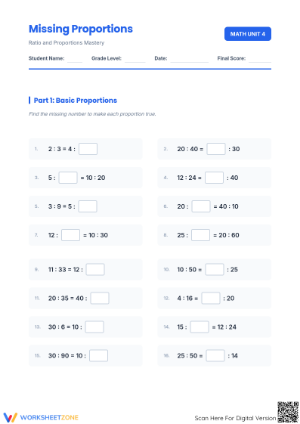
- Equivalent ratios: finding missing values, extending tables, and identifying scale factors—not just filling in blanks but explaining the relationship in writing.
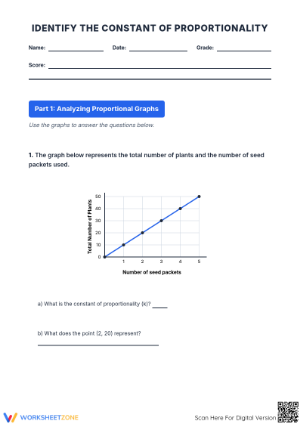
- Ratio tables: completing and interpreting tables with multiplicative patterns, including tasks where students work backward from a given total.
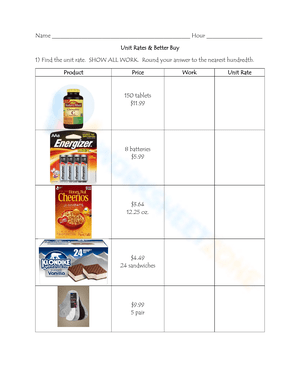
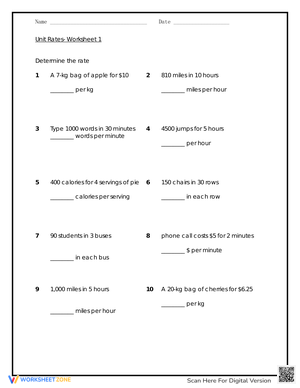
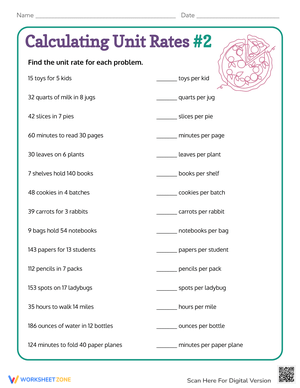
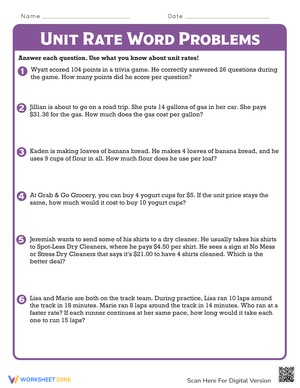
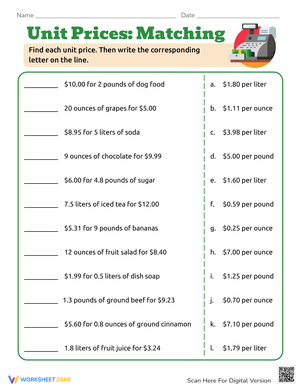
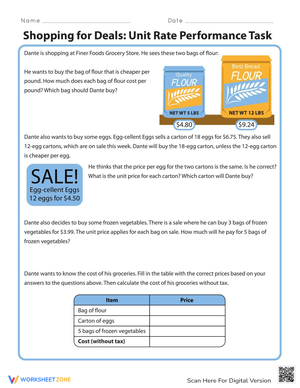
- Unit rate: cost per item, speed, and recipe scaling problems where students find and apply a single-unit comparison.
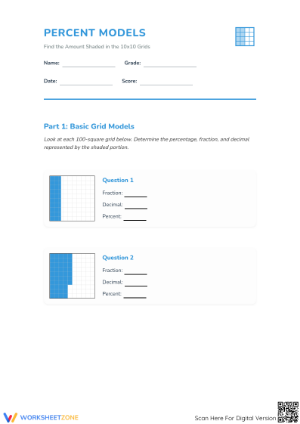
- Tape diagrams: reading and drawing visual representations that connect a ratio to an actual quantity split.
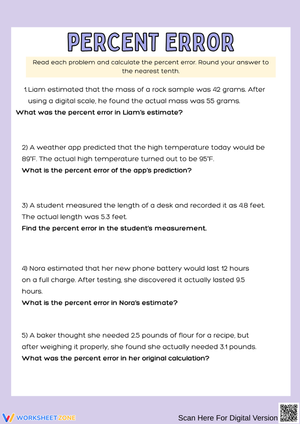
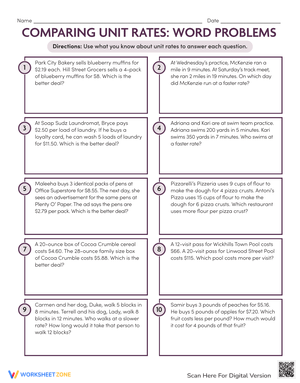
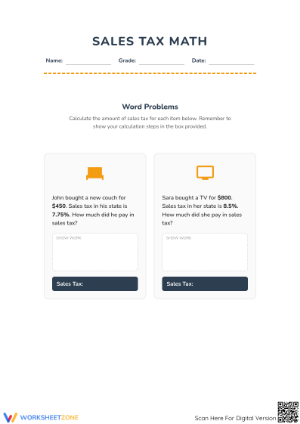
- Word problems with context: tasks where students identify what is being compared, write the ratio, solve, and interpret the answer in terms of the original situation.
- Mixed review: each worksheet in the review portion combines notation, tables, unit rates, and short application questions to check whether students can move between representations.
Mistakes Students Make That These Worksheets Help You Catch
The most consistent mistake in sixth-grade ratio work is additive thinking. When a student sees a ratio table with 2:5 and 4:10, they often extend it to 6:13—adding 2 to the first term and 3 to the second—instead of recognizing that each term was multiplied by the same factor. This is a fundamental shift from the additive patterns students relied on through most of elementary math, and more practice on the same problem type does not fix it. What usually helps is a table that makes the multiplication visible: a row for the original values, a row for the scale factor, and a row for the result.
The part-to-part versus part-to-whole confusion is nearly as common. A student reads "for every 4 red tiles there are 6 blue tiles" and writes the fraction of red tiles as 4/6 when asked what portion of the total is red. They answered a different comparison than the problem asked. Worksheets that require students to write both the part-to-part and the part-to-whole comparison from the same situation—then label what each one means—surface this error more reliably than standard fill-in-the-blank formats do.
A third pattern: students drop the context as soon as they start computing. In word problems, they find a numerically reasonable answer and stop, without checking whether what they computed matches what the problem asked. Asking students to write one sentence interpreting their result—not just circling a number—catches this quickly and builds the kind of mathematical communication sixth graders need for the rest of the year.
Getting the Most from These Worksheets Across a Ratio Unit
The most useful entry point is the window immediately after a mini-lesson—when students sit down for independent practice and you need to see quickly who understood the teaching point and who is still guessing. That first few minutes of individual work is genuinely diagnostic if the worksheet matches the lesson closely, which is why having separate worksheets per skill type matters more than having one long mixed review for every class period.
Bell ringers work well with ratio notation and language tasks. A three-problem warm-up at the start of Monday's class—asking students to write a given comparison in words, colon form, and fraction form—keeps vocabulary active without cutting into new instruction time. These 6th grade ratios proportions pdf worksheets print cleanly at any scale and copy quickly, so a short warm-up task carries almost no prep cost.
For stations, printing separate worksheets for each representation type—one station with tape diagrams, one with ratio tables, one with word problems—lets students rotate without the task types running together. Small-group reteach sessions benefit from starting with the visual and table-based worksheets using smaller whole numbers, then moving to missing-value problems and word problems once the multiplicative relationship feels stable. Sub plans built around one focused worksheet with worked examples in the margin require no verbal explanation—just a direction at the top of the worksheet.
Standard Alignment
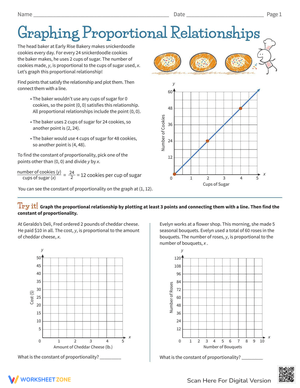
These worksheets align to CCSS 6.RP.A—Understand ratio concepts and use ratio reasoning to solve problems. The cluster includes three standards: ratio language and notation (6.RP.A.1), unit rate language and its connection to fractions (6.RP.A.2), and using tables, tape diagrams, double number lines, and graphs to solve ratio and percent problems (6.RP.A.3). In most sixth-grade programs, this cluster runs as a full opening unit because ratio reasoning underlies the percent, proportional graphing, and algebraic work that follow later in the year. The worksheets in this set address each standard individually and together in mixed review.
Working Across Different Readiness Levels in the Same Classroom
Students arrive in sixth grade at very different points in their proportional reasoning. Some still need to connect a visual comparison to its written ratio form before they can work symbolically; others are ready to handle multi-step problems with fractional unit rates. These 6th grade ratios proportions pdf worksheets address that range without requiring teachers to build entirely separate materials for each group.
For students who need additional support, the tape diagram and picture-based worksheets are the right starting point—use whole numbers smaller than 20, and keep the writing demand to matching, circling, or filling in one value at a time. Naming both numbers in a ratio aloud before writing anything helps these students slow down and think about what each quantity represents. For students working at grade level, the ratio table and unit rate worksheets provide the kind of repeated, structured practice that builds fluency while still requiring real thinking. For advanced learners, the word problem and mixed review worksheets include multi-step situations where students choose which comparison to write, solve for an unknown, and explain what the answer means in context. Keeping the mathematical goal consistent across groups while adjusting number size, response format, and problem complexity is generally more effective than assigning entirely different content.
Frequently Asked Questions
Do these worksheets cover both ratio concepts and proportion-solving?
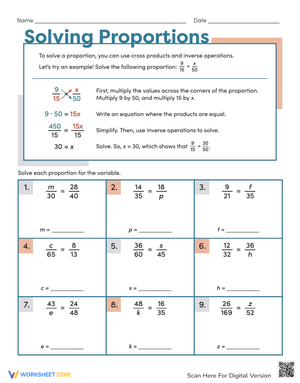
Yes. The set moves from ratio language and equivalent ratios through proportion-style missing-value problems. Earlier worksheets build ratio meaning using diagrams and tables; later worksheets ask students to recognize when two ratios describe the same relationship and solve for an unknown quantity.
Can I use individual worksheets out of sequence?
Each worksheet stands alone. Teachers who are reteaching a specific skill—equivalent ratios, for example—can pull that worksheet without starting at the beginning of the set. Because each worksheet targets one skill cluster, matching a worksheet to a specific lesson takes almost no time.
How do these work for students who are also learning English?
The visual and table-based worksheets reduce language load while keeping the mathematical content intact. Tape diagram tasks and ratio table worksheets give students a way to demonstrate ratio reasoning without relying heavily on reading comprehension. Word problem worksheets contain context-specific vocabulary that teachers can pre-teach or annotate before distributing.
Are these appropriate for students working below grade level in a 6th grade class?
The 6th grade ratios proportions pdf worksheets that focus on visual models, small whole numbers, and part-to-part comparisons are a solid starting point for students who need to build foundational ratio understanding before moving to symbolic work. Teachers supporting students well below grade level often find these worksheets a useful structured bridge before introducing missing-value proportion problems.













 Interactive Worksheet Maker
 Quiz Maker
 Word Search Maker
 Crossword Puzzle Maker
 Word Scramble Generator
 Sentence Scramble Generator
 Handwriting Worksheet Generator
 Name Tracing Generator
 Fill In The Blank Generator