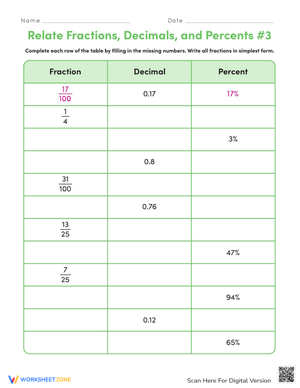
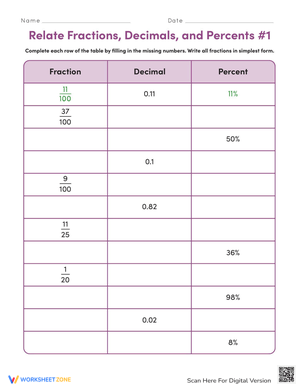
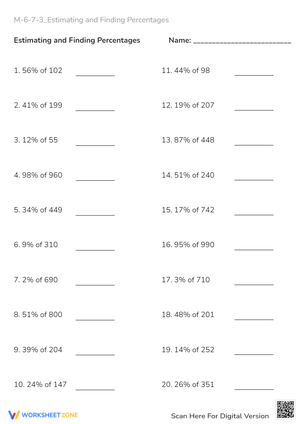
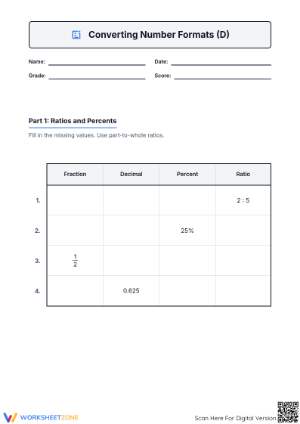
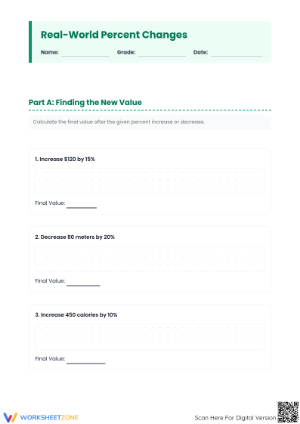
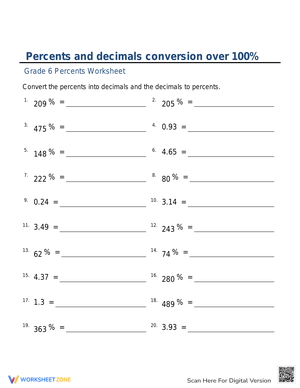
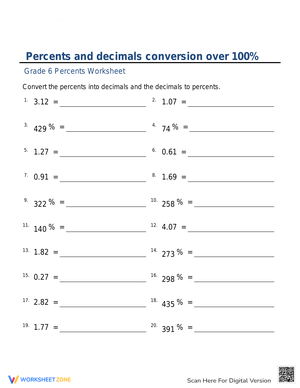
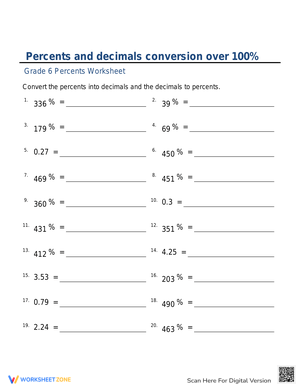
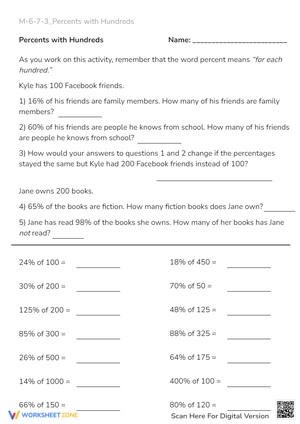
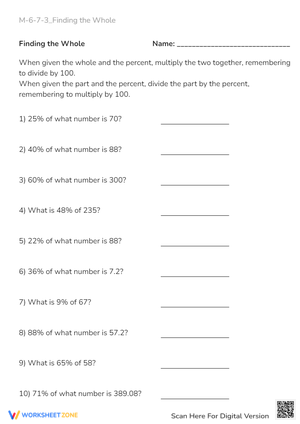
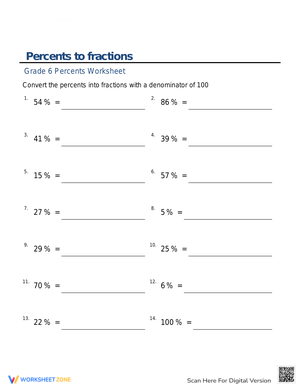
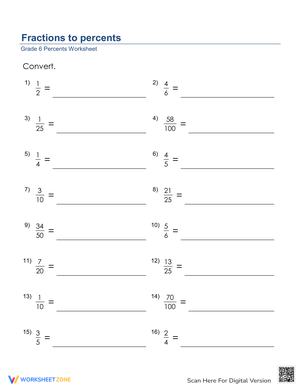
These percents worksheets for 6th grade are built around a single anchoring idea — that percent means "per 100" — because students who genuinely understand that relationship before moving on to procedures convert, compare, and apply percent far more reliably than students who memorize steps without that foundation. The set covers four skill areas across the standard 6th grade percent progression: reading and representing percent, converting among fractions, decimals, and percents, finding the percent of a quantity, and solving real-world problems using benchmark reasoning.
The Four Skill Areas Each Worksheet Covers
Each worksheet targets one of these areas or combines them in a structured review format. The progression is deliberate:
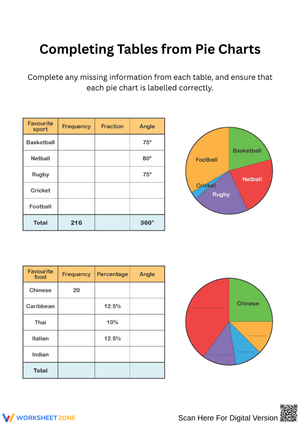
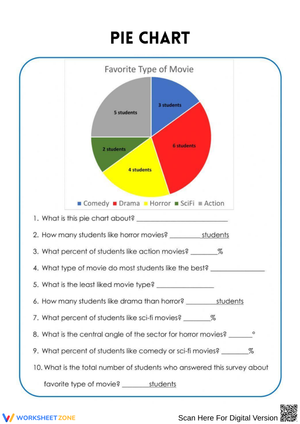
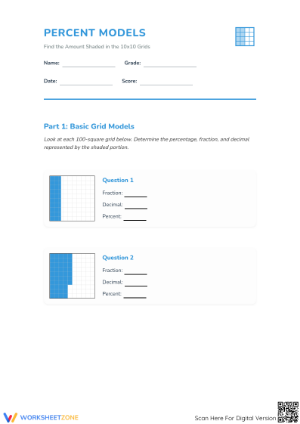
- Reading and representing percent: Students shade 100-grids, match visual models to percent notation, and identify what part and what whole a given percent describes.
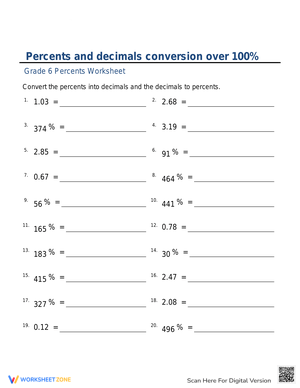
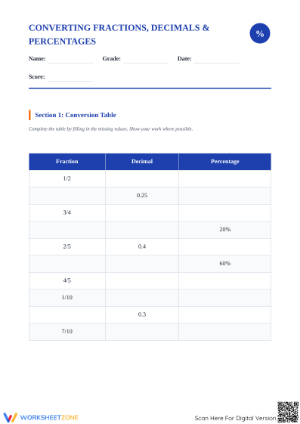
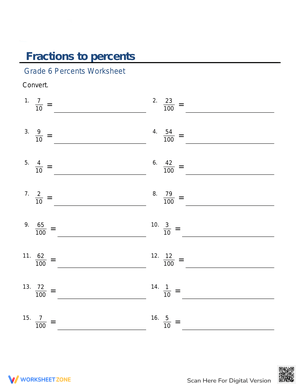
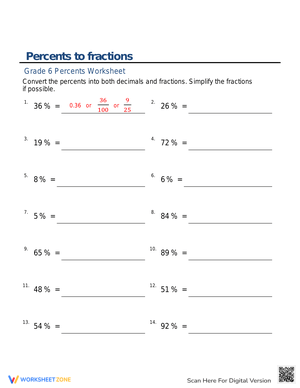
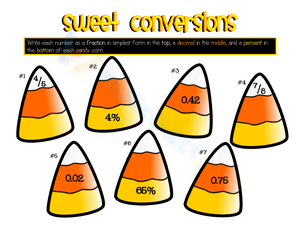
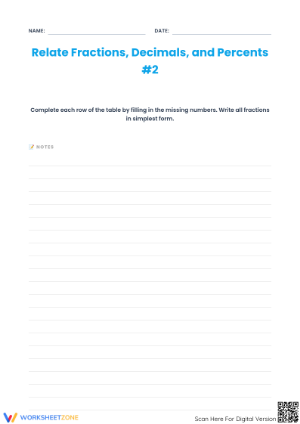
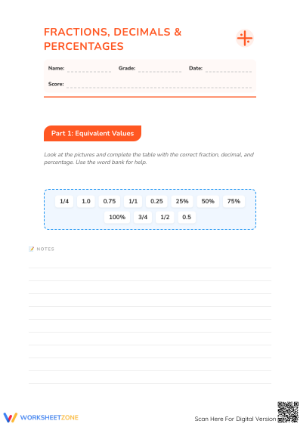
- Converting among equivalent forms: Practice starts with benchmark values — 1/4, 1/2, 3/4, 1/5, 1/10 — and extends to less familiar conversions like 3/8 or 0.06 once those are secure.
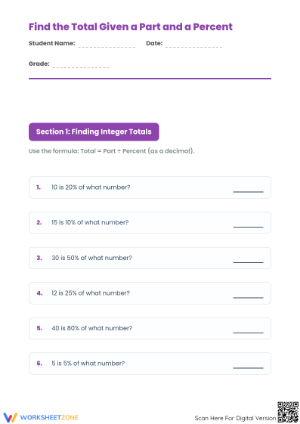
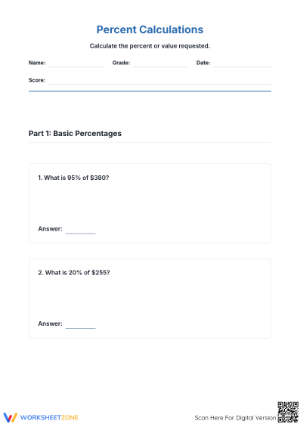
- Percent of a quantity: Students find 10% of 60, 25% of 40, or 30% of 150 using methods that build number sense: finding 10% first, using halves and fourths, or decomposing a percent into simpler parts.
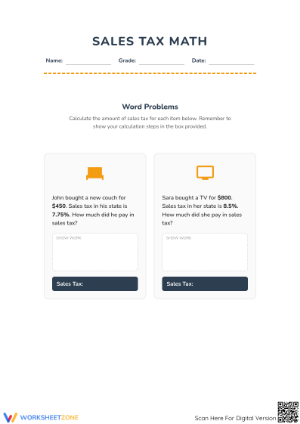
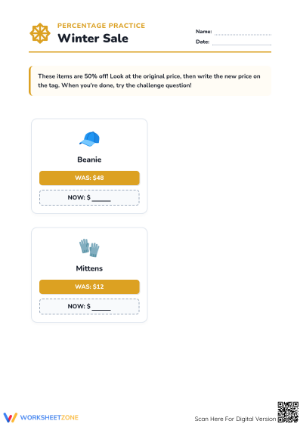
- Real-world application: Word problems draw on sale discounts, classroom survey results, sports statistics, and simple tip scenarios — one-step or straightforward two-step situations where the percent reasoning stays visible rather than buried in multi-stage arithmetic.
Students who jump straight to "find 23% of 84" without firm footing in benchmark reasoning often end up multiplying 23 × 84 and dividing by 100 as a memorized rule — arriving at correct answers while understanding very little. These worksheets delay that algorithm until the reasoning behind it is in place.
Errors in Student Work That Are Easy to Miss
The most common conversion error at this level is decimal placement. When asked to convert 0.4 to a percent, a significant number of 6th graders write 4% instead of 40% — they move the decimal one place rather than two. The fix is not to repeat the rule ("move two places to the right"). It's to show the fraction: 0.4 = 4/10 = 40/100 = 40%. Students who see it that way stop making the placement error because they're not relying on a direction to memorize; they're working from a relationship they can verify.
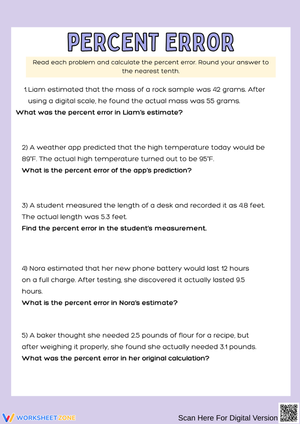
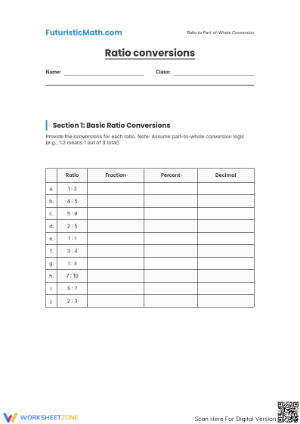
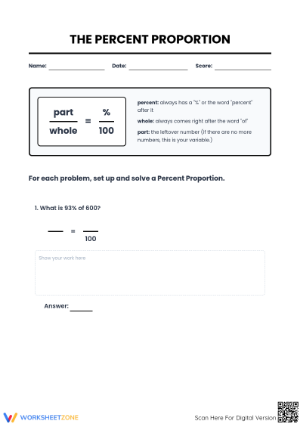
A second pattern surfaces in word problems. When the question is "What percent is 12 of 48?", students frequently invert the setup and divide 48 by 12, arriving at 4 — and then write 4% with complete confidence. The issue is not arithmetic; it's identifying which number is the whole. Asking students to underline the whole and circle the part before setting up any calculation reduces that inversion reliably. The worksheets in this set that use ratio tables make the part-and-whole structure explicit, which is why they tend to outperform plain-text word problem formats for students who are still building that conceptual map.
How to Work These Worksheets Into Your Unit Planning
The most reliable use pattern in a standard 6th grade block is assigning a focused worksheet during the last 12 to 15 minutes of class, immediately after a mini-lesson. Students are still holding the new idea in working memory, the teacher is circulating, and errors surface before they calcify. That window is considerably more productive than homework for percent work, because percent misconceptions compound quickly — a student who practices the wrong conversion method 20 times in the evening arrives the next morning more confused, not more skilled.
Other natural spots across the week:
- Monday warm-up: Three to five benchmark percent problems from last week's skill. Students mark each answer independently, then compare with a partner before the class reviews together.
- Centers or partner work: Keep two readiness levels of each worksheet type available. Students working above grade level can move into estimation and comparison tasks while others continue building fluency through structured repetition.
- Small-group reteach: The visual model worksheets — grid-shading, bar diagrams — are the right entry point for students still working out what the whole represents in a percent situation.
- Exit checks: Pull two or three problems from a worksheet and project them. Students respond on paper slips or mini whiteboards. The format matches what they've been doing, so the task doesn't feel new.
Standard Alignment
The anchor standard for this content is CCSS 6.RP.A.3c: "Find a percent of a quantity as a rate per 100 (e.g., 30% of a quantity means 30/100 times the quantity); solve problems involving finding the whole, given a part and the percent." In classroom terms, this standard sits at the end of the 6th grade ratio and proportional reasoning cluster. Students are expected to connect percent to their earlier work with rates and unit rates — not treat it as a freestanding skill. These percents worksheets for 6th grade address that connection by embedding percent problems within ratio contexts: part-to-whole tables, visual models, and rate language appear throughout the set rather than being confined to a single introductory worksheet.
Adjusting Each Worksheet for the Full Range of Student Readiness
Percent understanding in a single 6th grade class can span two or three grade levels of readiness. Some students arrive with solid benchmark fluency from 5th grade; others are still uncertain about what denominator 100 means in a fraction context. That range makes tiered worksheets a practical necessity rather than a supplemental option.
For students who need more time with the concept, the visual model worksheets — 100-grids, bar diagrams, labeled fraction strips — reduce the cognitive load enough that students can attend to the relationship between part, whole, and percent rather than managing symbolic notation and conceptual understanding at the same time. In a reteach group, establishing a consistent routine — name the whole, shade the part, write the fraction, convert to percent — prevents the guessing that characterizes struggling students' work in this unit.
For students ready to move beyond computation, these percents worksheets for 6th grade include word problems that require comparison and justification: Which is a better deal — 20% off $45 or 25% off $52? Why? That kind of task keeps stronger learners reasoning rather than simply running the same algorithm on different numbers.
Frequently Asked Questions
Which worksheet type should teachers assign first in a percent unit?
Start with the 100-grid and visual model worksheets before any numeric conversion or percent-of-a-number work. Students need a concrete image of "parts out of 100" before the symbolic notation carries meaning. Teachers who skip visual grounding tend to spend more time reteaching midunit than the introduction would have taken.
Are these worksheets appropriate for homework, or are they better used in class?
Short benchmark practice worksheets — ten problems or fewer on a familiar skill — translate reasonably well to homework after the concept has been introduced and practiced during class. Conversion worksheets and word problem worksheets work better in class, where a teacher can catch the decimal-placement and whole-identification errors before they become ingrained habits.
Are answer keys included?
Yes. Answer keys support self-checking during centers, allow paraprofessionals to assist students confidently, and make independent practice manageable during weeks when a teacher is running multiple small groups simultaneously. For the percents worksheets for 6th grade in this set, each worksheet includes a corresponding answer key.
How do these worksheets connect to 7th grade percent content?
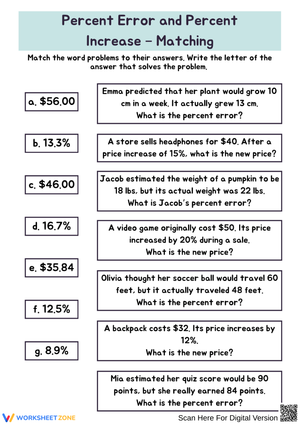
Seventh grade introduces percent increase, percent decrease, and simple interest — all of which require students to fluently find the percent of a quantity and reliably identify what the whole represents. Students who leave 6th grade with solid benchmark reasoning and dependable conversion skills hit those 7th grade concepts with far less friction than students who were only taught a procedural shortcut.













 Interactive Worksheet Maker
 Quiz Maker
 Word Search Maker
 Crossword Puzzle Maker
 Word Scramble Generator
 Sentence Scramble Generator
 Handwriting Worksheet Generator
 Name Tracing Generator
 Fill In The Blank Generator