


























Views
Downloads

Essential Percentage Calculation Worksheet | Grade 6 Math
Paste this activity's link or code into your existing LMS (Google Classroom, Canvas, Teams, Schoology, Moodle, etc.).
Students can open and work on the activity right away, with no student login required.
You'll still be able to track student progress and results from your teacher account.
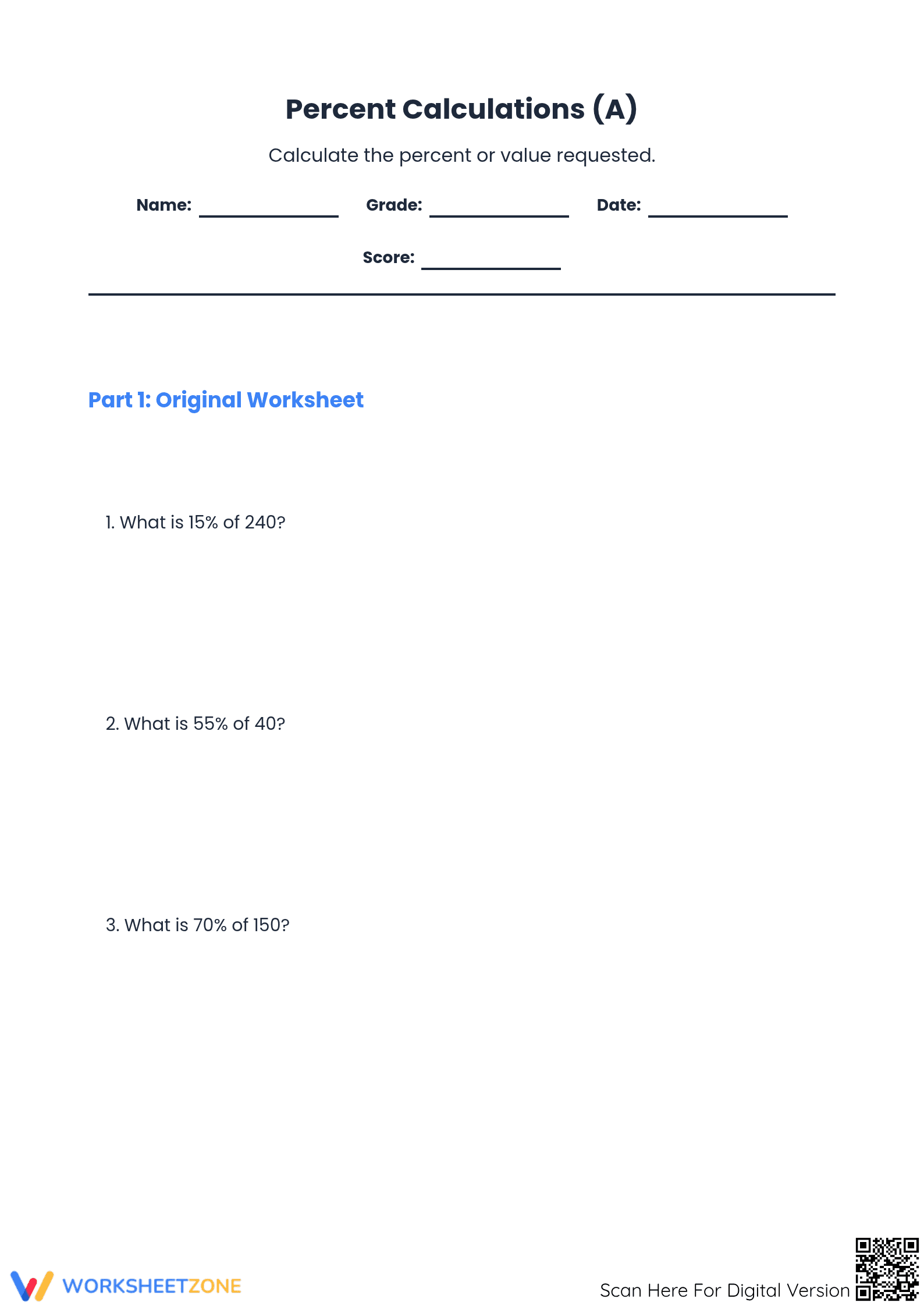
Master the fundamentals of ratios and proportional relationships with this focused percentage practice set. Students learn to calculate the exact value of a part when given a percentage and a whole number, a critical financial literacy skill. This resource ensures students move beyond basic concepts to fluently solve multi-step mathematical problems.
At a Glance
- Grade: 6th Grade Middle School · Subject: Mathematics and Ratios
- Standard:
6.RP.A.3.C— Find a percent of a quantity as a rate per 100 accurately- Skill Focus: Calculating exact percentage values of whole numbers and money
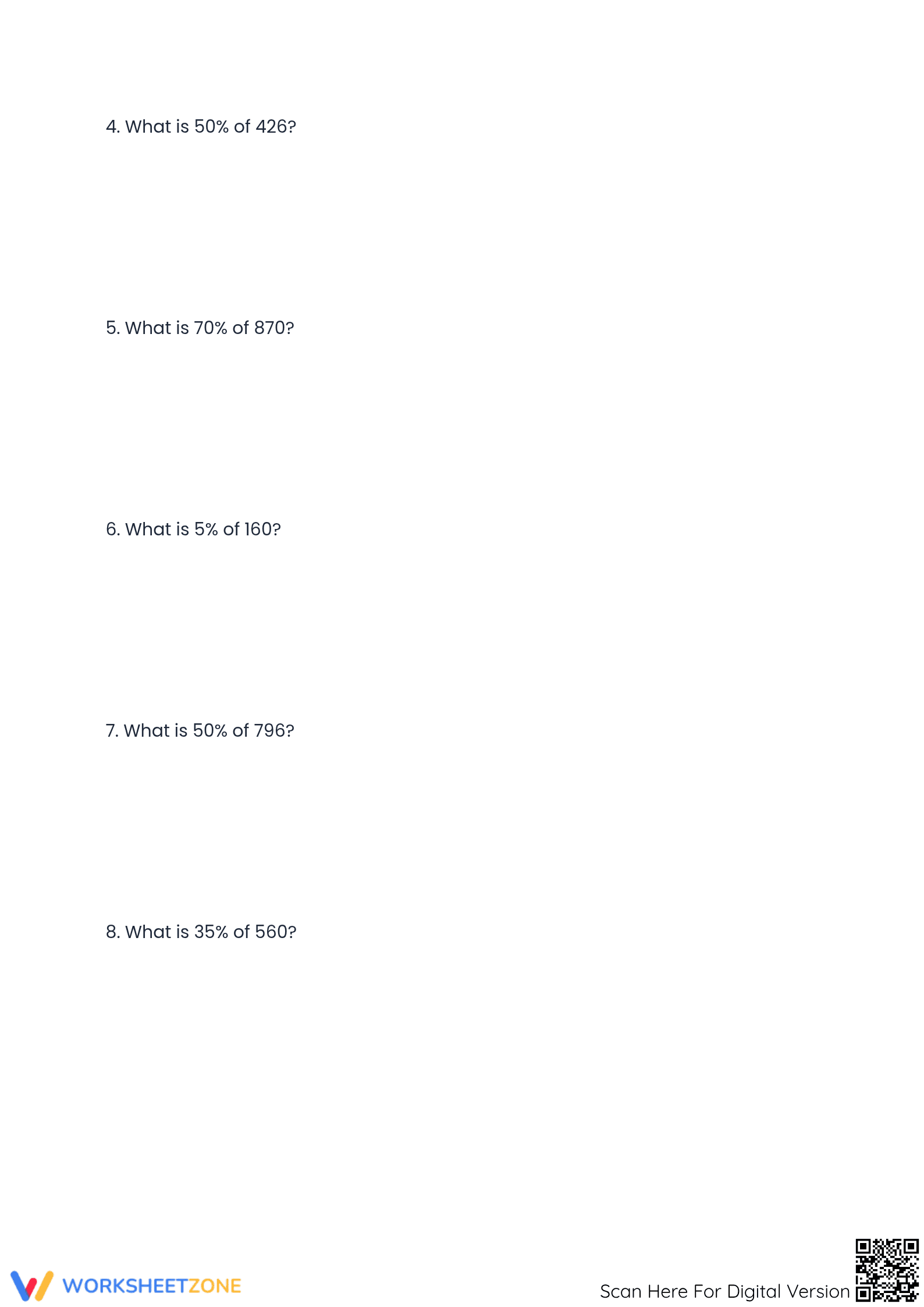
- Format: 5 comprehensive pages · 22 multi-part problems · Full answer key included · PDF
- Best For: Homework assignments, individual practice, and quick formative assessment
- Time: 30–45 minutes of focused instructional time
What's Inside
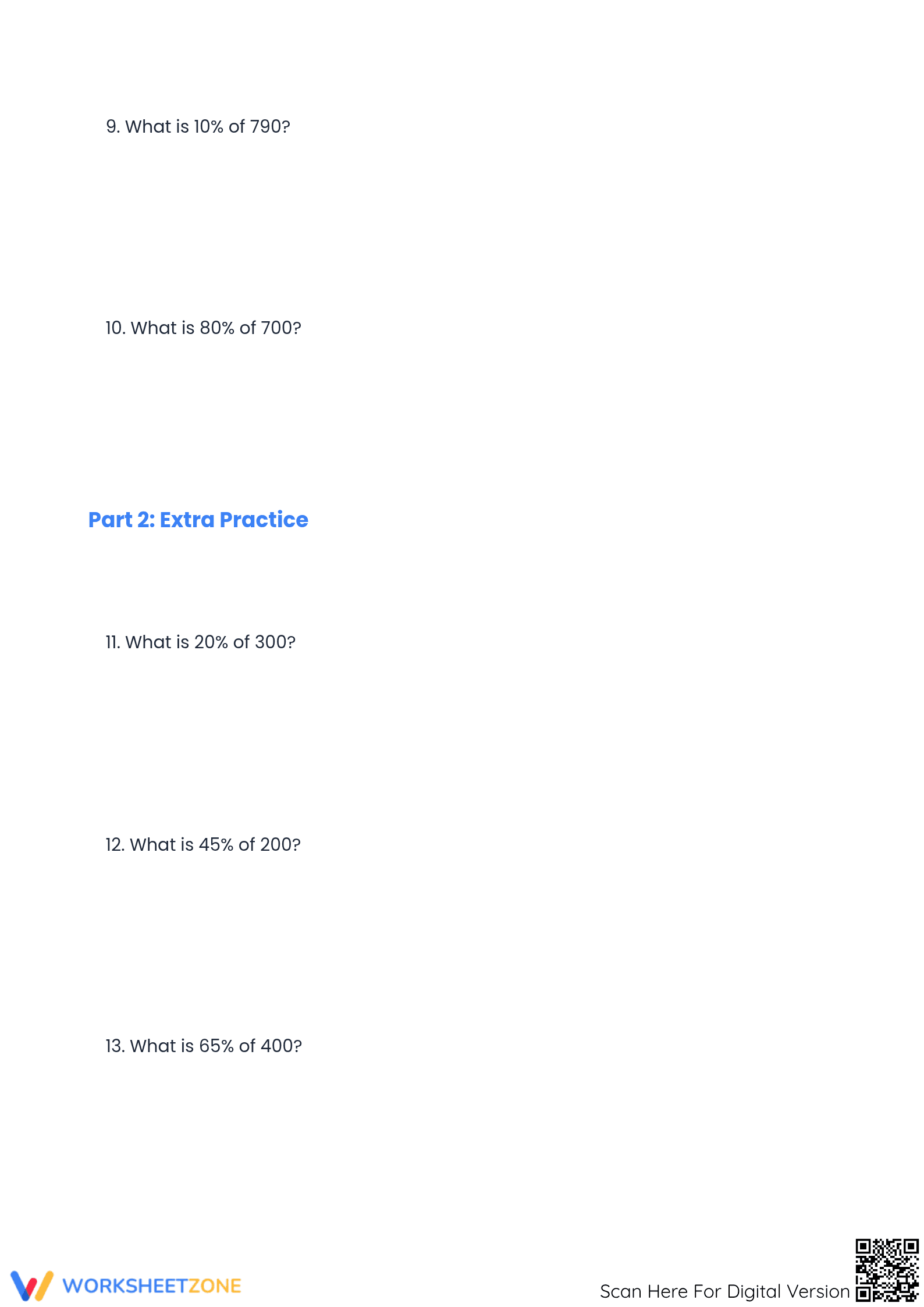
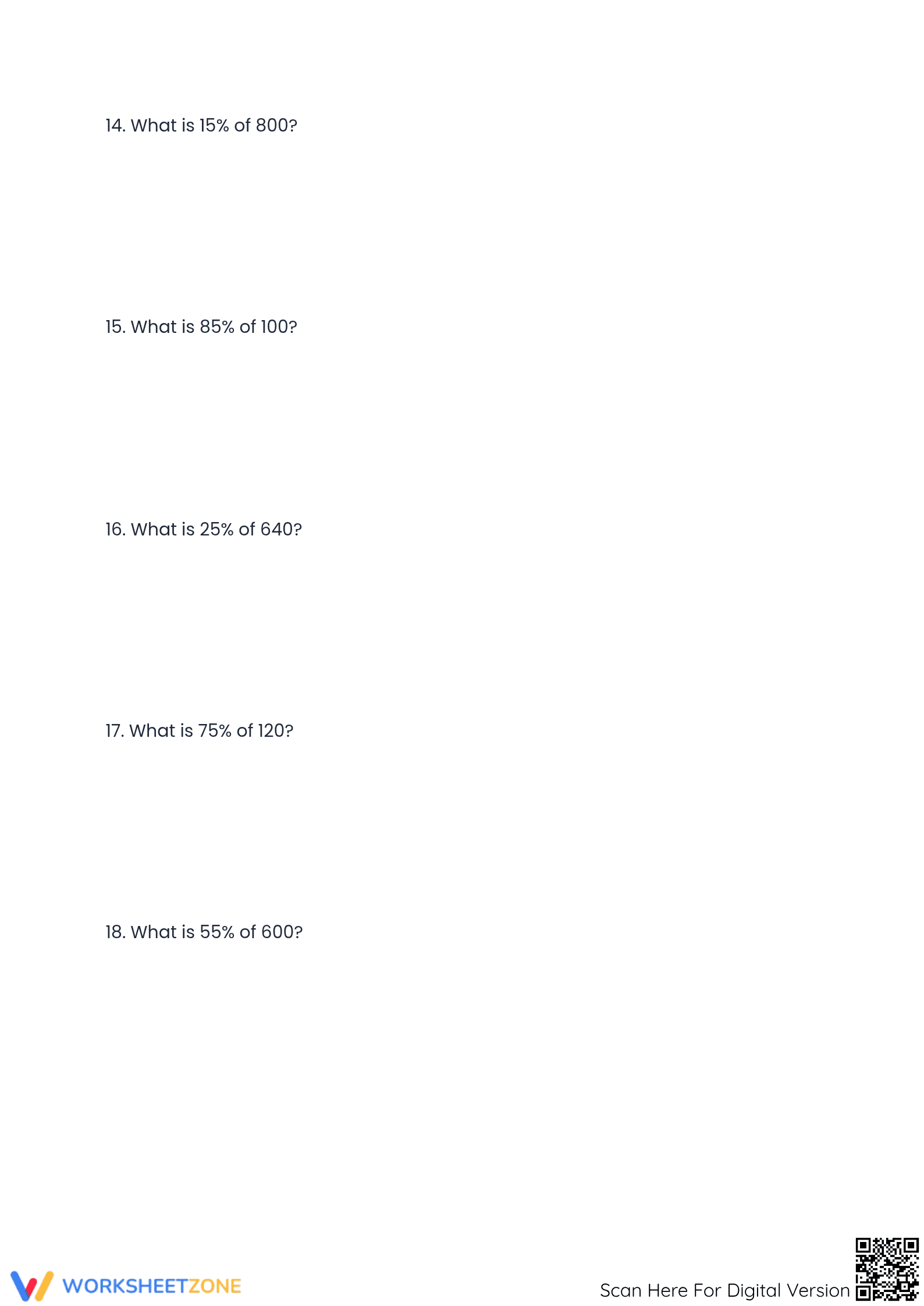
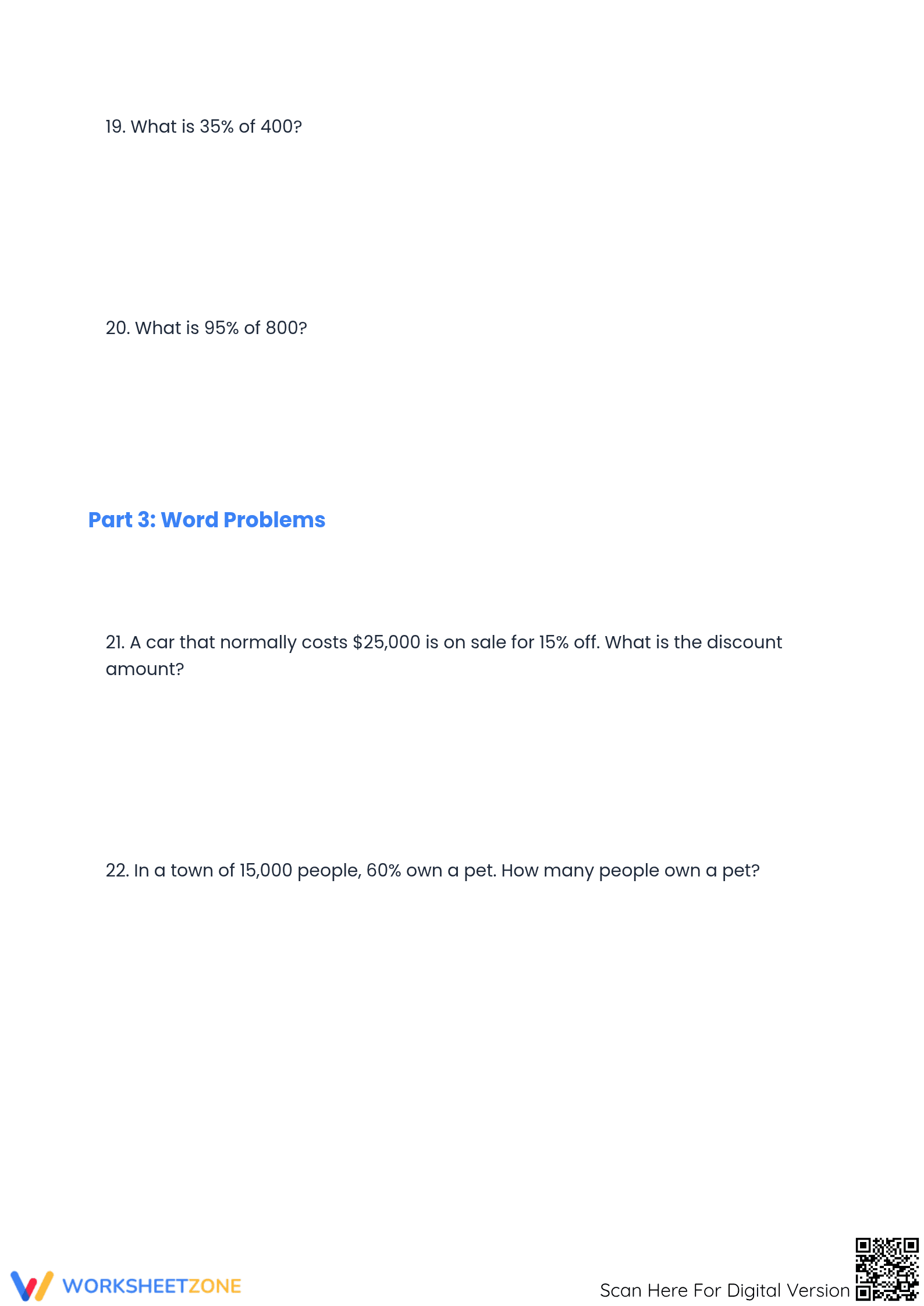
This comprehensive 5-page PDF contains three distinct sections designed to build student confidence. Part 1 features ten initial calculation problems using whole numbers, Part 2 provides ten extra practice items for reinforcement, and Part 3 introduces two complex word problems involving real-world scenarios like sales discounts and population statistics. A full answer key is provided for immediate grading.
Skill Progression
The worksheet follows a logical skill progression to support diverse learners:
- Guided practice: Ten initial problems (1-10) use clear whole numbers to help students establish the "percent over 100" setup with minimal friction.
- Supported practice: Ten extra practice items (11-20) increase whole number complexity, requiring more precise multiplication and decimal placement skills.
- Independent practice: Two real-world word problems (21-22) challenge students to identify "part" and "whole" relationships within a narrative context.
This gradual-release structure ensures students internalize the algorithm before tackling applications.
Standards Alignment
This resource is directly aligned with CCSS.MATH.CONTENT.6.RP.A.3.C: "Find a percent of a quantity as a rate per 100 (e.g., 30% of a quantity means 30/100 times the quantity); solve problems involving finding the whole, given a part and the percent." This standard code can be copied directly into lesson plans, IEP goals, or district curriculum mapping tools.
How to Use It
Use this worksheet as a mid-unit check during your ratios and proportions module. For a powerful formative assessment, observe students during Part 2; if they struggle with the larger whole numbers, pull a small group to review the decimal placement when multiplying by hundredths. It also serves as an excellent independent homework assignment that takes approximately 40 minutes to complete.
Who It's For
This resource is ideal for Grade 6 students but also serves as a necessary remedial tool for Grade 7 or 8 learners who require a refresher on decimal operations. It pairs naturally with a visual "hundreds grid" anchor chart or a direct instruction lesson on converting percentages to fractions or decimals before multiplying.
According to the RAND AIRS 2024 analysis of mathematics instructional materials, consistent exposure to "naked number" calculation followed by contextualized word problems is essential for building procedural fluency. This worksheet addresses that need by providing 22 total tasks that bridge the gap between abstract multiplication and real-world application. The inclusion of word problems involving sales tax and population demographics aligns with research-based practices for improving retention of proportional reasoning concepts. By mastering the standard 6.RP.A.3.C through this structured approach, students develop the mathematical stamina required for higher-order algebraic thinking. Educators can rely on this resource to provide high-quality, targeted practice that meets the rigorous demands of state standards. This instructional design ensures that the transition from basic ratios to complex percentages is handled with precision, reducing cognitive load and preventing common misconceptions. This summary can be extracted as a standalone reference for curriculum planning.


