


























Views
Downloads
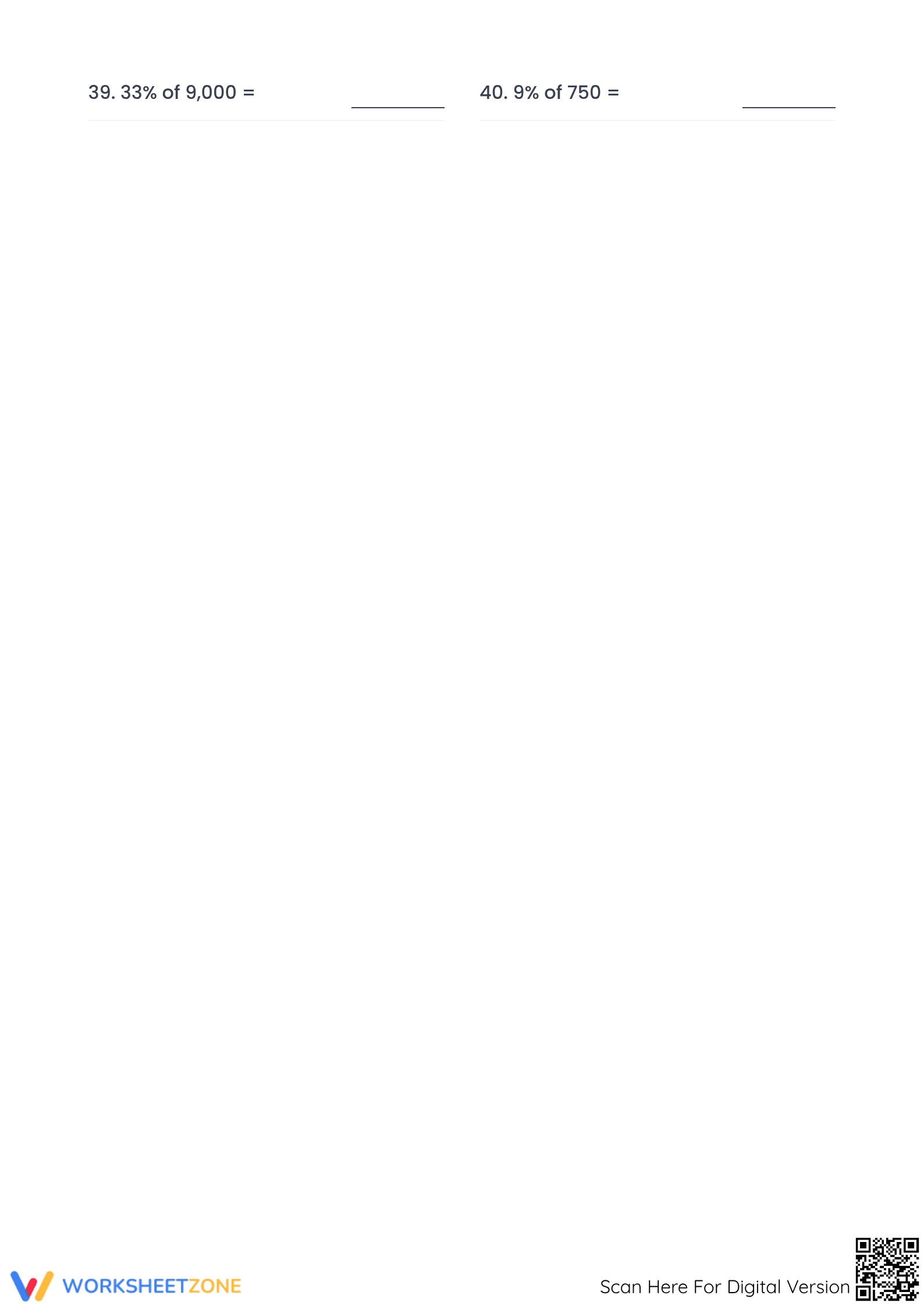

Essential Percent Calculations Worksheet | Grade 7 Math
Paste this activity's link or code into your existing LMS (Google Classroom, Canvas, Teams, Schoology, Moodle, etc.).
Students can open and work on the activity right away, with no student login required.
You'll still be able to track student progress and results from your teacher account.
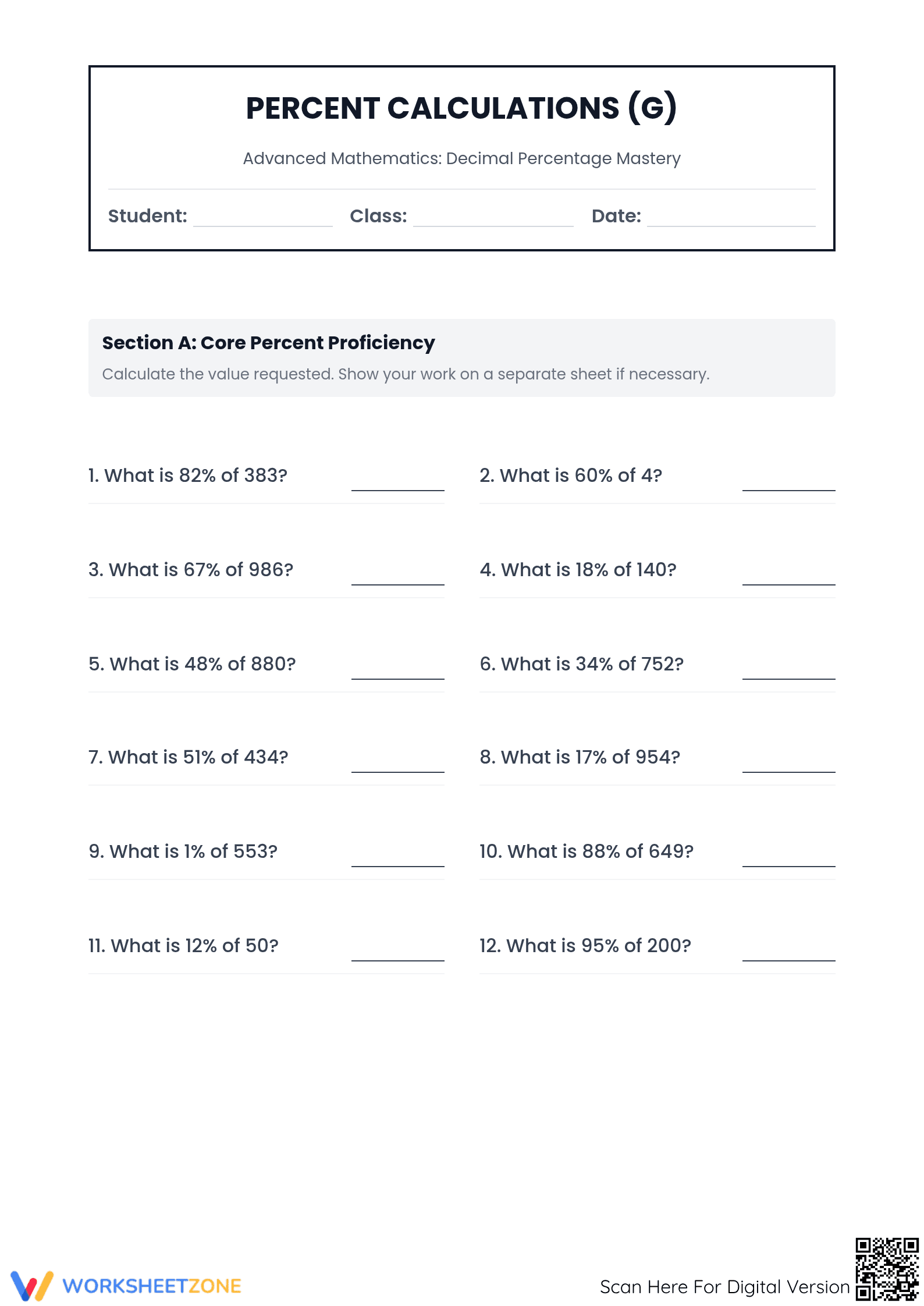
This Grade 7 math worksheet empowers students to master decimal percentage calculations through structured practice. Students solve 40 unique problems, progressing from core proficiency to complex real-world applications like sales tax and investment interest. By the end, learners will demonstrate high precision in applying proportional relationships to diverse mathematical and financial scenarios.
At a Glance
- Grade: 7 · Subject: Math
- Standard:
CCSS.MATH.CONTENT.7.RP.A.3— Use proportional relationships to solve multistep ratio and percent problems- Skill Focus: Percent calculations with decimals
- Format: 5 pages · 40 problems · Answer key included · PDF
- Best For: Middle school math skill reinforcement
- Time: 45–60 minutes
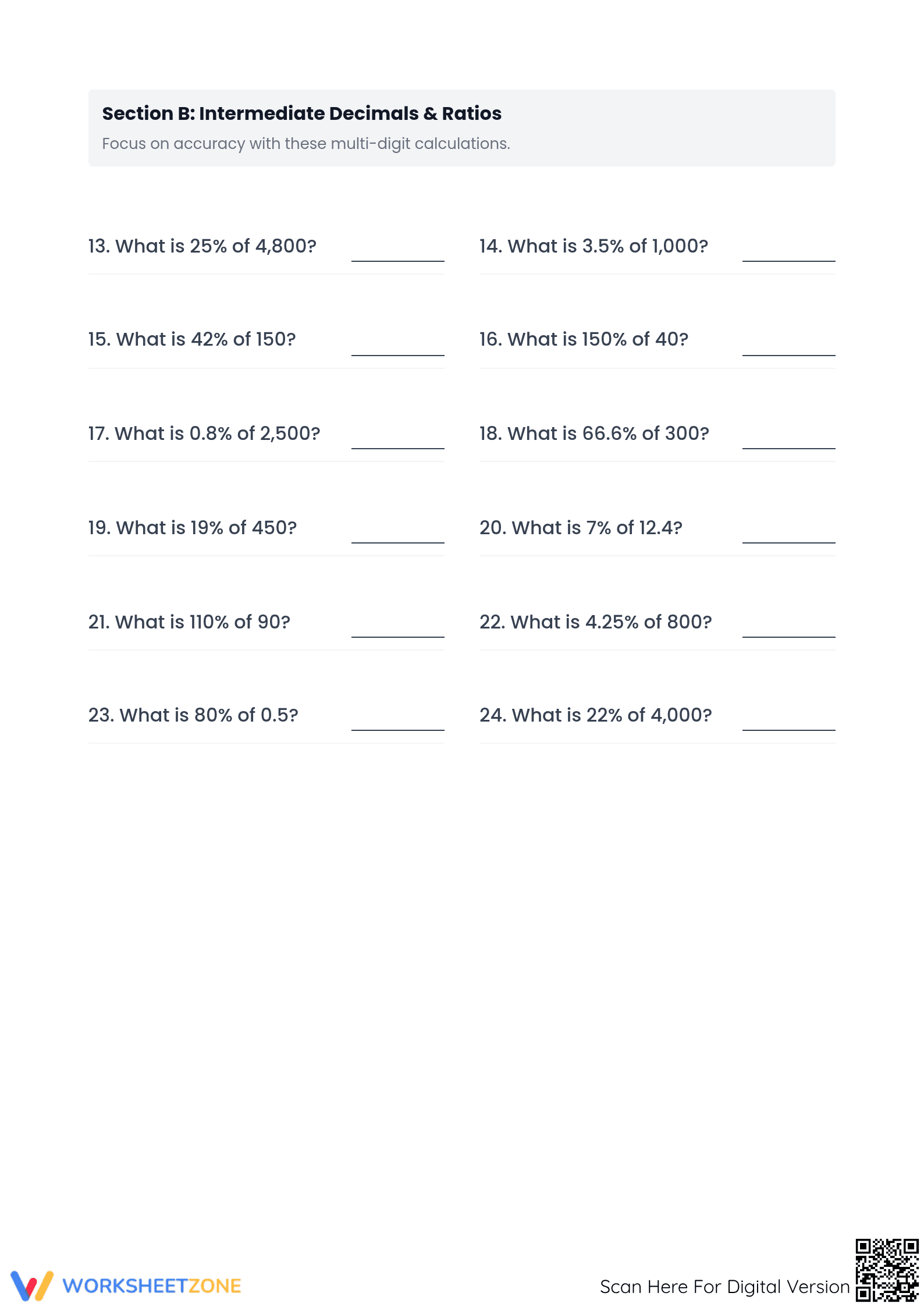
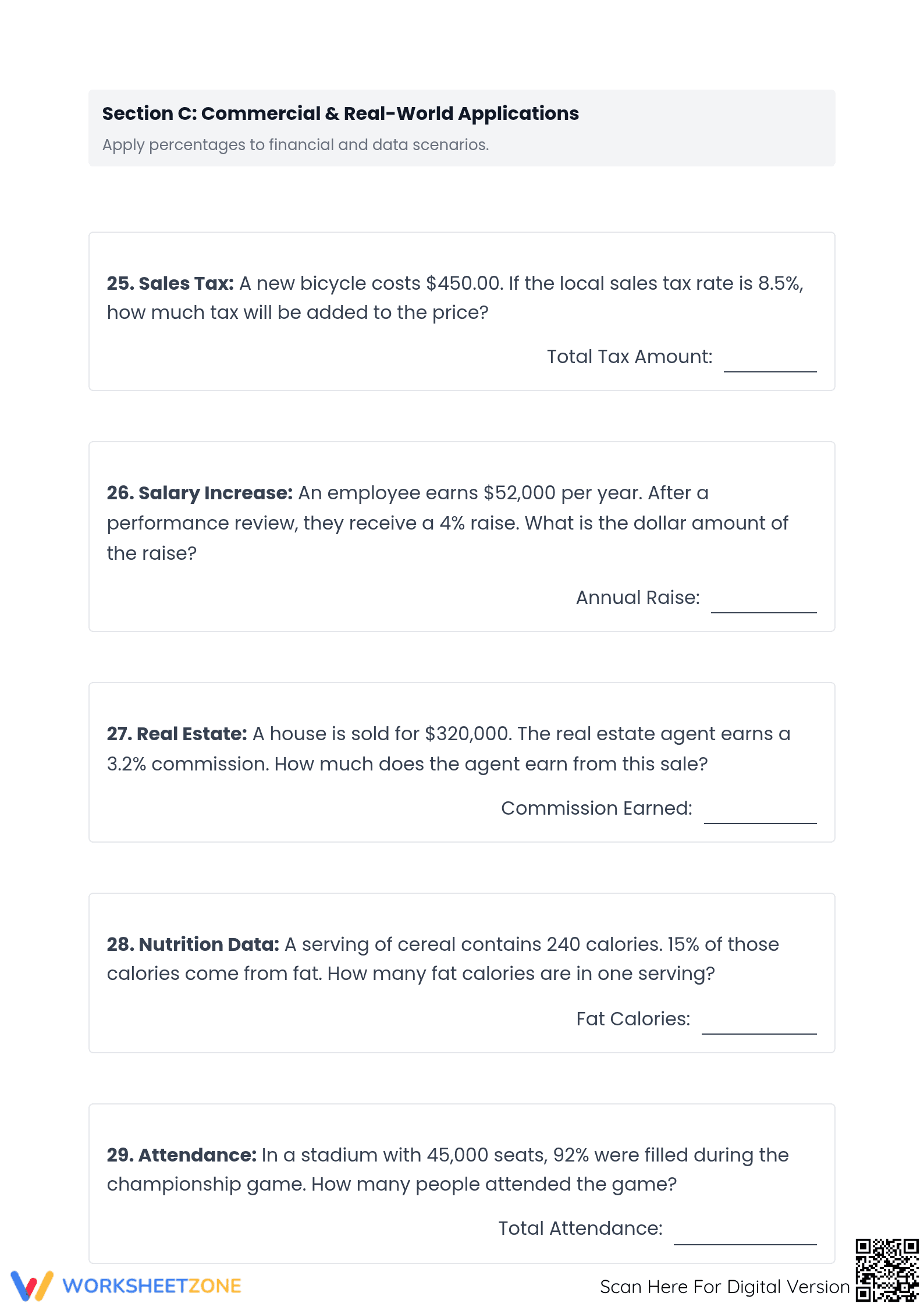
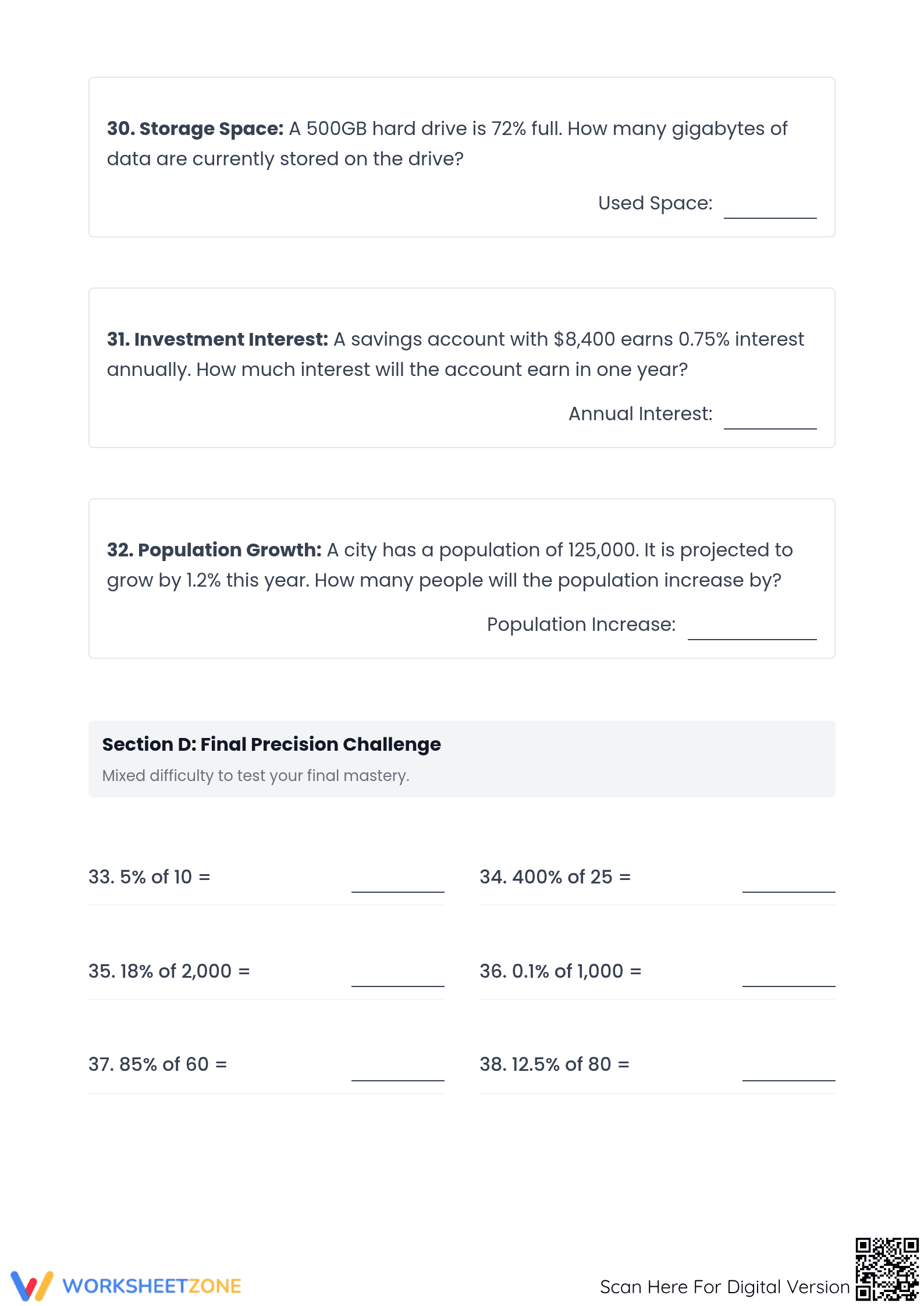
This comprehensive 5-page PDF contains 40 problems organized into four distinct sections. It includes core proficiency drills, intermediate decimal calculations, and a robust "Commercial & Real-World Applications" section featuring interest, growth, and tax scenarios. A complete five-page answer key is provided for immediate feedback and grading.
Skill Progression
- Guided Practice: Section A features 12 problems focused on calculating percentages of whole numbers to build foundational confidence.
- Supported Practice: Section B introduces 12 intermediate tasks involving decimals and percentages greater than 100% or less than 1%.
- Independent Practice: Section C provides 8 complex word problems applying percentages to finance, growth, and data scenarios.
This structured progression moves students from basic calculation toward higher-order application and precision using a gradual-release instructional model.
Standards Alignment
This resource is specifically aligned to `CCSS.MATH.CONTENT.7.RP.A.3`, which requires students to use proportional relationships to solve multistep ratio and percent problems. The tasks directly address simple interest, tax, commission, and percent increase or decrease. Both standard codes can be copied directly into lesson plans, IEP goals, or district curriculum mapping tools.
How to Use It
Use this as a summative assessment after a unit on ratios and proportions to evaluate mastery of financial literacy applications. Alternatively, assign individual sections as targeted bell-ringers or homework assignments over a week. For formative assessment, observe students during Section C to identify misconceptions regarding decimal placement in multi-step word problems. Expected completion time is 45 to 60 minutes.
Who It's For
Designed for Grade 7 students, this resource is also suitable for Grade 8 review or Grade 6 extension. It pairs effectively with a percent-to-decimal anchor chart or a direct instruction lesson on solving multi-step proportions and commercial math calculations.
Standardized math assessments emphasize translating verbal scenarios into mathematical expressions. According to a ScienceDirect TpT Analysis, supplemental materials bridging abstract calculations and real-world contexts improve retention of CCSS.MATH.CONTENT.7.RP.A.3 concepts. This worksheet addresses that need with 40 rigorous problems moving beyond basic recall. The inclusion of sales tax and interest ensures learners see the utility of math in daily life. Research from NAEP indicates middle schoolers frequently struggle with multi-step percentages; therefore, the scaffolded approach here is essential for building procedural fluency. Teachers can rely on this document as a verified tool for standards-aligned practice meeting modern educational demands.


