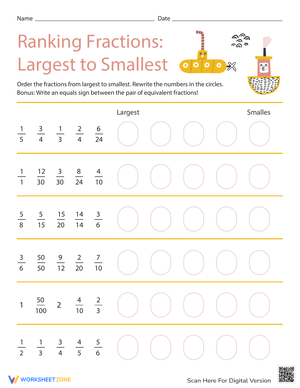
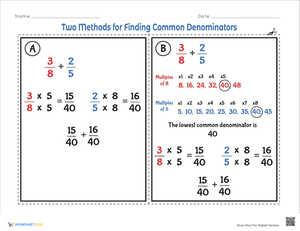
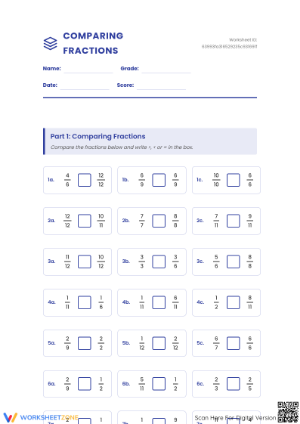
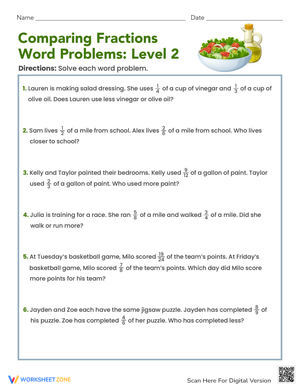
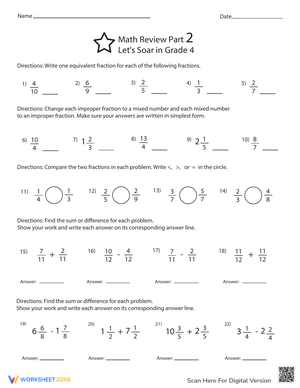
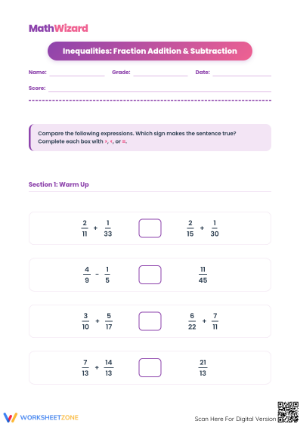
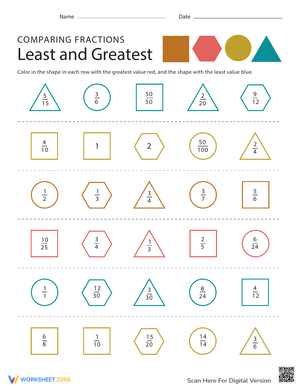
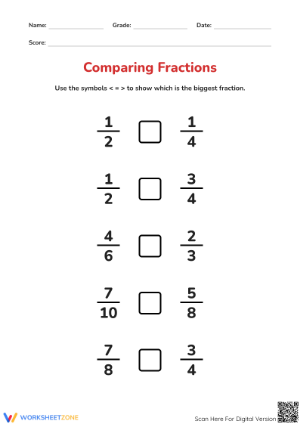
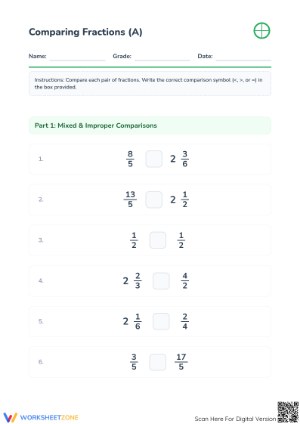
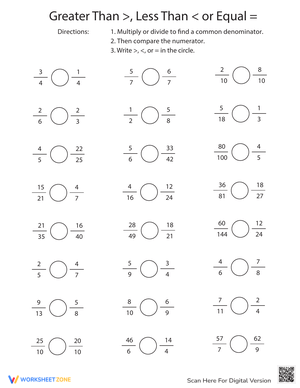
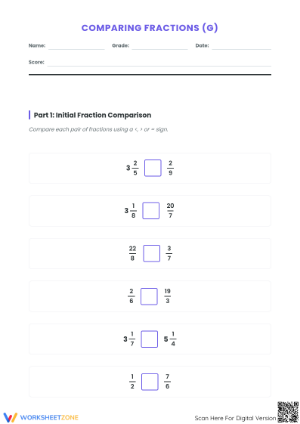
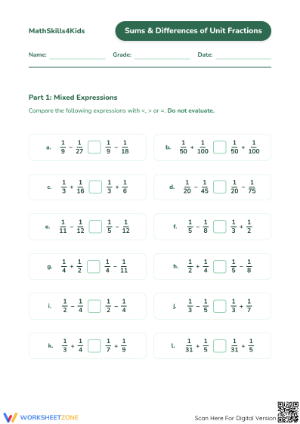
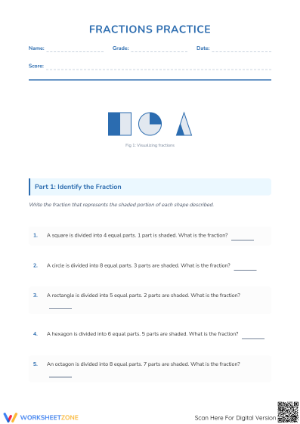
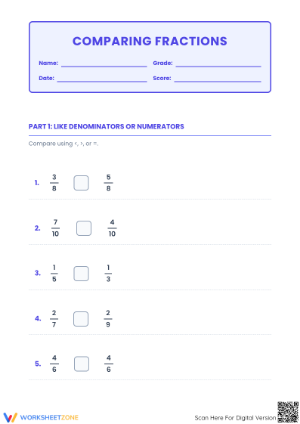
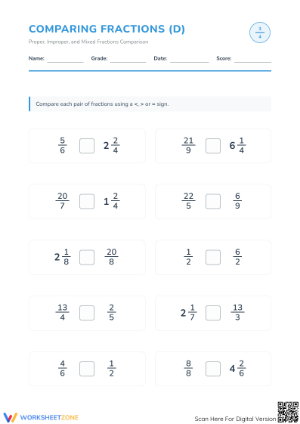
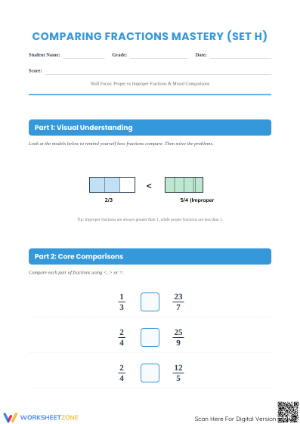
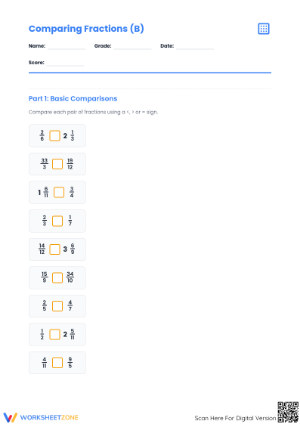
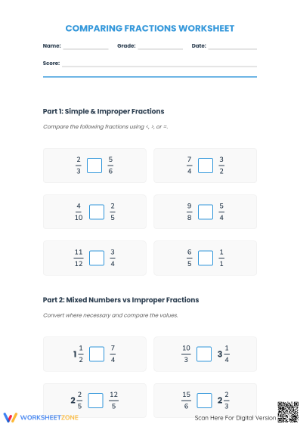
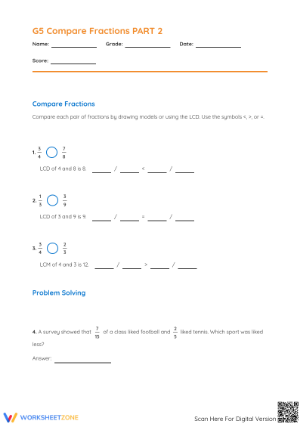
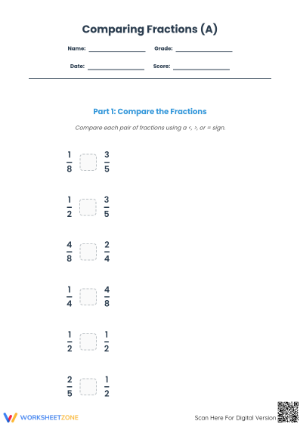
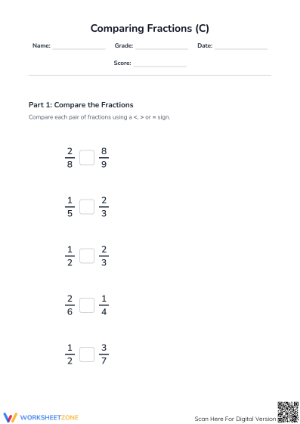
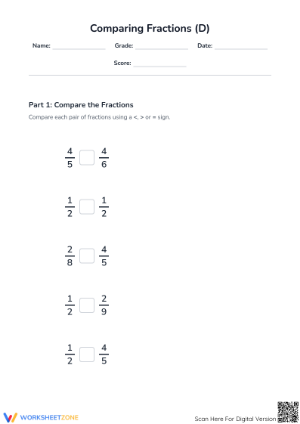
These 5th grade comparing with unlike denominators printable worksheets give teachers a ready set of fraction practice resources that work as warm-ups, formative checks, and small-group tools — no extra prep required. The comparison skill sits at a genuine hinge point in fifth grade: students need confident fraction sense before unlike-denominator addition and subtraction becomes workable, and this set gives teachers a fast way to find out who has that sense and who doesn't.
Where Student Thinking Breaks Down and How These Worksheets Surface It
The most persistent misconception in fraction comparison is treating the denominator as a standalone whole number. A student writes that three-eighths is greater than three-fifths because eight is greater than five — they've lost the relationship between denominator size and part size entirely. This error is stubborn partly because it looks like confidence: the student is doing something, writing a symbol, moving on. A worksheet that deliberately includes pairs built to trigger this confusion — two-thirds vs. two-fifths, four-sevenths vs. four-ninths — exposes the misconception immediately instead of letting it hide behind correct answers on easier items.
A second pattern shows up with benchmark reasoning. Students who've learned to ask whether a fraction is more or less than one-half will correctly identify that five-eighths and three-fourths are both above one-half — then stop there and guess instead of continuing to reason. The benchmark approach started the work but couldn't finish it. These worksheets include pairs where that distinction matters, which trains students to recognize when benchmark analysis is a complete answer and when it's only the first step.
The Specific Skills Targeted Across the Set
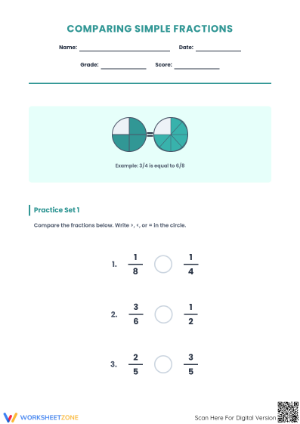
When a set of 5th grade comparing with unlike denominators printable worksheets is well built, students aren't locked into a single comparison method. They rename fractions to common denominators for pairs that require it, use benchmark fractions for pairs where that's faster, and interpret visual models and number lines to understand why a comparison is true — not just which symbol to write. That method flexibility reflects what fifth-grade fraction standards actually ask for.
Each worksheet draws from several task types:
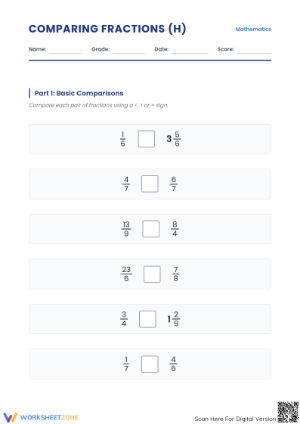
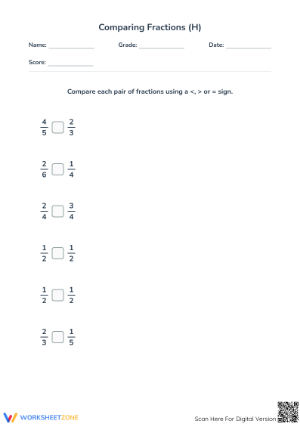
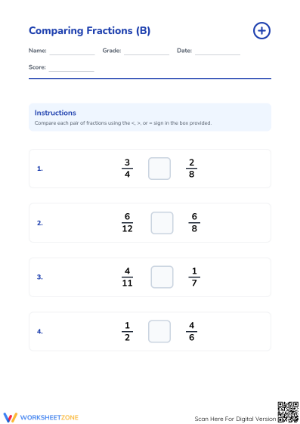
- Symbol comparisons: Students write greater than, less than, or equal to between fraction pairs after working through the comparison.
- Equivalent-fraction renaming: Students find a common denominator and rewrite both fractions before comparing.
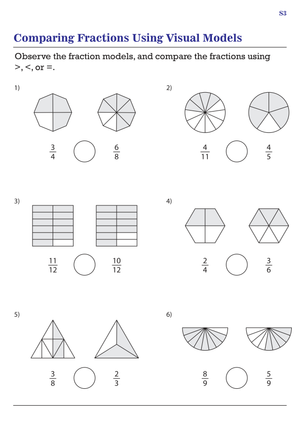
- Shaded area models: Students compare pre-drawn representations to connect quantity to symbol.
- Number-line placement: Students locate or judge fractions by their distance from benchmarks like zero, one-half, and one whole.
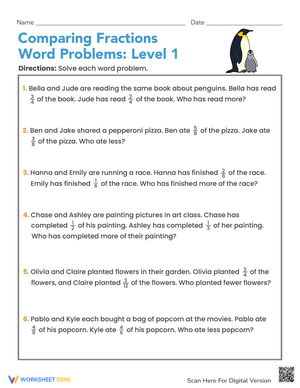
- Short word problems: Students apply comparison in context — deciding which runner finished a greater fraction of a race, for instance.
That range does something a single-format drill cannot. A student who handles symbolic items correctly but struggles when asked to shade a matching area model is giving the teacher specific, usable information: there's a procedure operating without a quantity concept behind it. The mixed format makes each worksheet a more precise diagnostic tool than a column of fill-in-the-symbol problems ever will be.
Putting These Worksheets to Work Across the School Week
The most efficient use of these resources is usually the first 8 to 10 minutes of a math block. Three or four comparison items at the start of class reactivate fraction sense before the lesson's main work begins — this rhythm is especially valuable on Mondays, when a weekend away from math leaves number fluency soft. That same short format also works as an exit check: two mixed-format problems in the final few minutes of class show quickly who can compare independently and who was following along without fully understanding.
For small-group reteach, sequence matters. Start with model-based items — shaded regions or number lines — and shift to purely symbolic comparisons only after students can explain what they see. Moving straight to the symbolic format tends to push students toward a borrowed procedure, cross-multiplying for instance, without giving them the underlying understanding that makes fraction operations sensible later. The model-first order is slower but produces more durable results.
In centers, these worksheets pair naturally with physical fraction strips. Students complete the written comparison, then verify it by lining up the strips. That confirmation step catches errors from students who rush and builds confidence in students who are uncertain about their answer. For substitute plans, any worksheet in the set has self-contained enough directions to run without teacher explanation.
Standard Alignment
Fraction comparison with unlike denominators connects to CCSS 4.NF.A.2, which asks students to compare two fractions with different numerators and different denominators by reasoning about size, using benchmark fractions, or creating common numerators or denominators. In fifth grade, that standard isn't re-taught — it's applied. CCSS 5.NF.A.1 extends students into adding and subtracting fractions with unlike denominators, and CCSS 5.NF.A.2 asks them to assess whether answers make sense using estimation and benchmark reasoning. Both tasks require a student to compare fraction values quickly and reliably. A student who cannot confidently place three-fourths relative to two-thirds has no dependable way to evaluate whether a computed sum is reasonable.
Using 5th grade comparing with unlike denominators printable worksheets for review at the start of a fraction operations unit is not off-grade remediation. It is targeted readiness work that prevents later fraction learning from collapsing into memorized steps with no meaning attached to them.
How to Adjust the Set for a Mixed-Readiness Class
For students who still confuse denominator size with fraction size, limit the first sessions to friendly denominators — halves, thirds, fourths, sixths, eighths — and include visual models on every item. Ask them to mark a benchmark on the number line or shade in both fractions before writing the comparison symbol. That intermediate step interrupts the impulsive response and gives students a built-in self-check before they commit to an answer.
For students who compare reliably with common denominators, the stretch comes from requiring two methods per problem. Ask them to compare seven-twelfths and five-eighths first by finding a common denominator, then by placing both fractions on a number line, and explain which method they'd reach for first on a timed check and why. Fraction pairs where the values are very close — five-ninths vs. four-sevenths — cannot be resolved by benchmark analysis alone and reward careful equivalent-fraction work.
Teachers running a mixed-readiness fifth grade find that 5th grade comparing with unlike denominators printable worksheets work across that full range without needing to be rebuilt for each group. The differentiation is in what each group is asked to show, not in replacing the task. One group writes a symbol; another writes a symbol, explains their method in a sentence, and verifies with a second approach. The same answer key covers both.
Frequently Asked Questions
How do fifth graders decide which comparison method to use?
Students who've practiced multiple strategies develop a quick-scan habit: check whether one fraction is clearly above and the other clearly below a benchmark like one-half or one whole. If that resolves the comparison, done. If both fractions land on the same side of the benchmark, they rename using a common denominator. These worksheets build that decision-making habit because the mixed problem types prevent any single method from working reliably on every item.
Are these worksheets appropriate for students who are still uncertain about equivalent fractions?
Students need a working understanding of equivalent fractions before symbolic comparison makes procedural sense. If that understanding is still uncertain, the model-based and number-line items in the set give those students a visual entry point. Symbolic comparison items follow once students can explain what they observe in the models — not before. Rushing to the symbol format without that foundation is exactly the path that produces the denominator-confusion error described above.
Can these worksheets function as formative assessment rather than just extra practice?
A completed worksheet is a more informative formative tool than it first appears. Scanning for the denominator-confusion error — a student who wrote that two-fifths is greater than two-thirds — takes less than a minute per worksheet and produces directly usable grouping data for the next lesson. The mixed task formats also clarify whether a student's difficulty lives in the renaming step, the comparison symbol, or the underlying concept of fraction size. That distinction changes the reteach plan significantly.














 Interactive Worksheet Maker
 Quiz Maker
 Word Search Maker
 Crossword Puzzle Maker
 Word Scramble Generator
 Sentence Scramble Generator
 Handwriting Worksheet Generator
 Name Tracing Generator
 Fill In The Blank Generator




 BACK TOSCHOOL