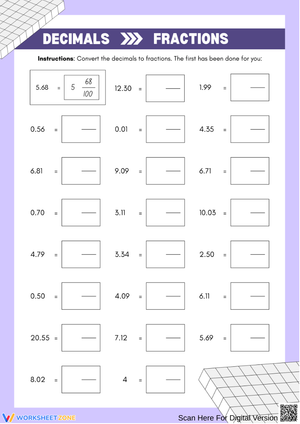
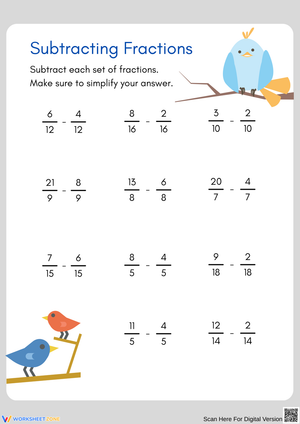
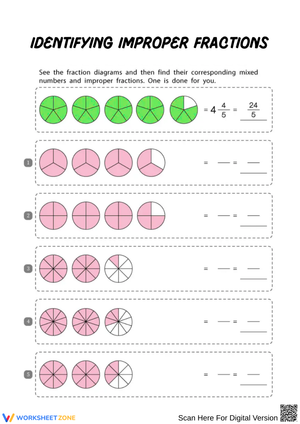
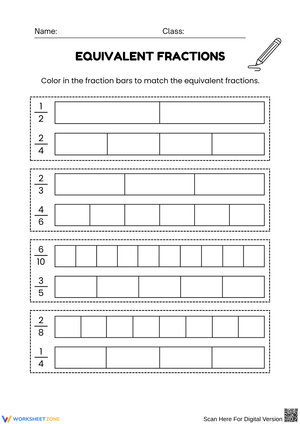
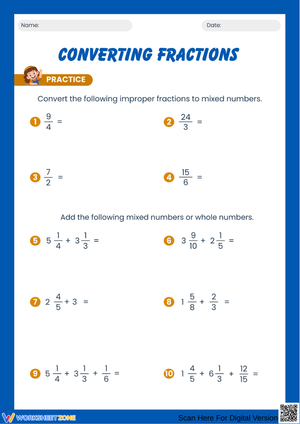
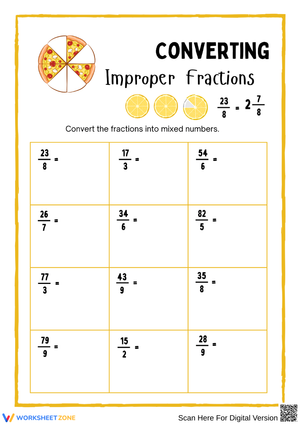
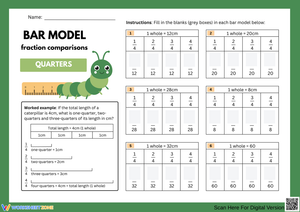
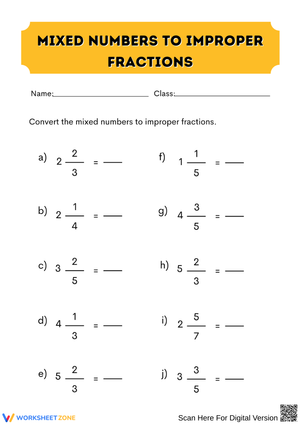
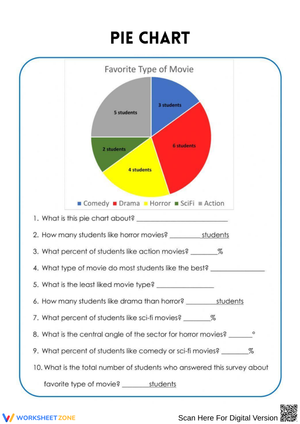
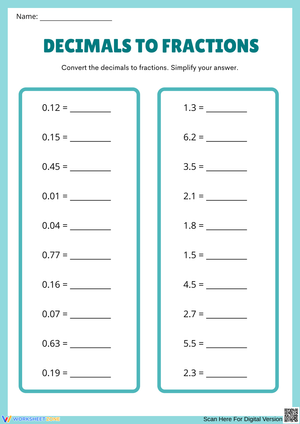
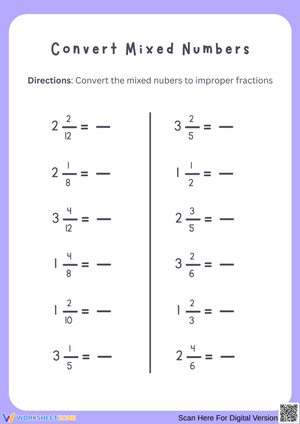
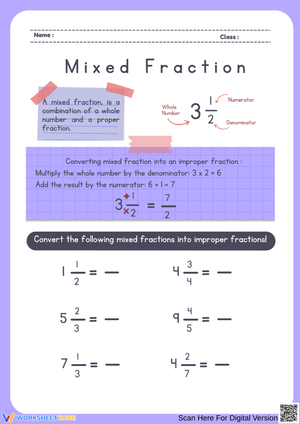
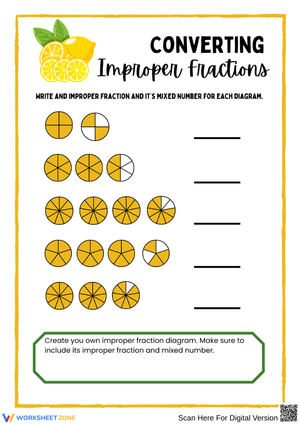
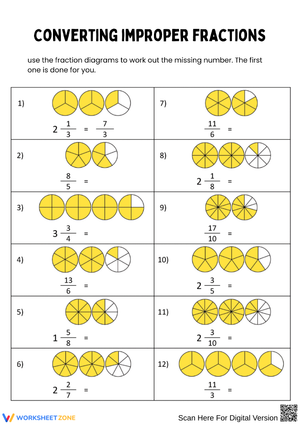
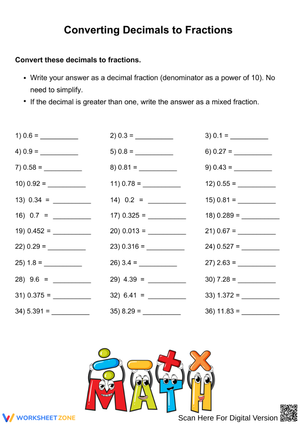
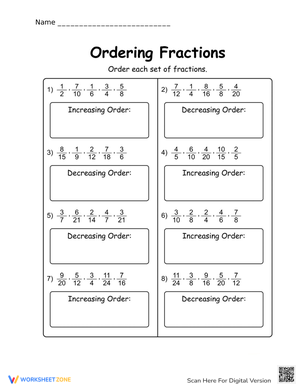
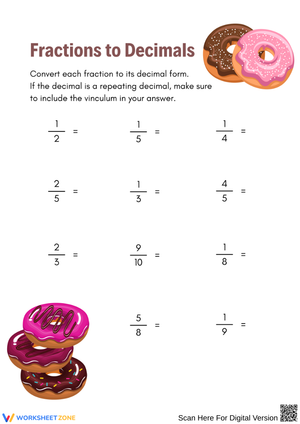
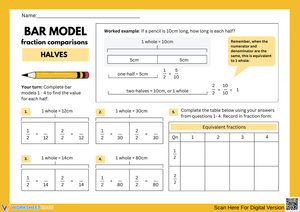
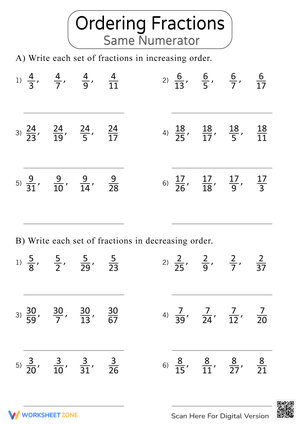
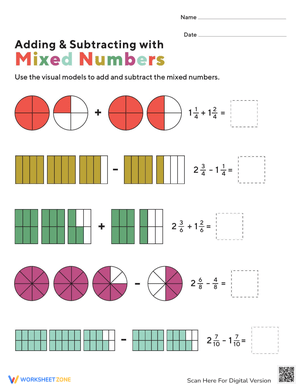
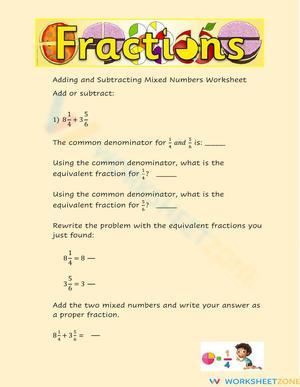
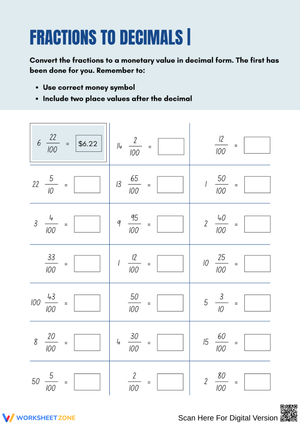
These fraction pdf worksheets for 5th grade stay anchored to the four specific skill clusters in the Grade 5 Number and Operations–Fractions domain, which means teachers aren't sorting through content that belongs in a different grade. Each worksheet addresses one clear objective — unlike-denominator operations, fraction as division, fraction multiplication, or unit-fraction division — so the right practice matches the right lesson without extra preparation.
The Specific Skills Each Worksheet Targets
Grade 5 fraction instruction has a narrower scope than it sometimes appears in commercial workbooks. The four skill clusters below map directly to the standards, and each one is covered in its own set of worksheets so teachers can pull exactly what a lesson calls for rather than working around irrelevant problems.
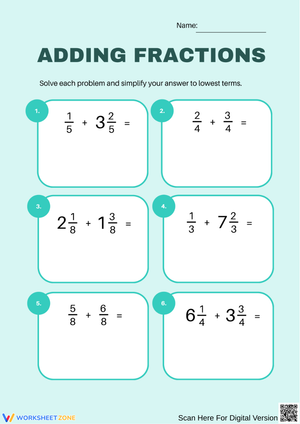
- Unlike-denominator addition and subtraction (5.NF.A.1–2): Students find common denominators, generate equivalent fractions, perform the operation, and check reasonableness. Several worksheets open with an estimation step before the computation begins.
- Fraction as division (5.NF.B.3): Students interpret a fraction as the result of dividing two whole numbers and apply that interpretation to equal-sharing word problems — not just shading and identifying parts of a whole.
- Fraction multiplication (5.NF.B.4–6): The set covers whole-number-times-fraction, fraction-times-fraction, and mixed-number multiplication. Early worksheets use area models; later worksheets work toward the standard algorithm.
- Unit-fraction division (5.NF.B.7): Problems stay inside the grade-level boundary — dividing a unit fraction by a whole number and a whole number by a unit fraction — rather than extending into general fraction-by-fraction division that belongs in a later grade.
Each multiplication worksheet includes at least one problem asking students to interpret the product in context, reflecting the standard's emphasis on connecting the operation to meaning rather than treating it as a pure calculation.
Student Mistakes That Show Up Every Time
The most consistent error with unlike denominators is not random — it follows a predictable path. Students who can reliably find equivalent fractions on their own will still add 1/3 and 1/4 and write 2/7, treating numerator and denominator as independent addition problems. That error surfaces because the "add-across" shortcut works for fraction multiplication, and students carry it into the wrong operation. The estimation prompts on the unlike-denominator worksheets interrupt this before it becomes automatic: a student who has already decided the answer should land close to 3/4 will recognize that 2/7 is wrong in a way that a purely procedural check won't catch.
Unit-fraction division produces a different but equally consistent error. When asked to solve (1/3) ÷ 5, a large portion of students write 5/3. They multiply by 5 rather than by 1/5, because "dividing by 5" and "multiplying by 5" feel like the same action until a number-line model makes the size difference visible. The opening worksheets in that cluster use number-line diagrams specifically so students can see what dividing 1/3 into 5 equal parts actually produces before they work symbolically.
Fraction-as-division problems reveal a third pattern worth tracking. Students correctly identify that 3/4 means 3 divided by 4 when it appears as a standalone question, then lose the connection entirely inside a word problem. They revert to treating the fraction as a shaded region rather than a division result. Asking students to write the corresponding division equation alongside the fraction — not just underline or circle the answer — is the most reliable classroom fix we've seen for this pattern.
Standard Alignment
These worksheets align to the Common Core State Standards for Mathematics Grade 5 Number and Operations–Fractions cluster, covering 5.NF.A.1, 5.NF.A.2, 5.NF.B.3, 5.NF.B.4, 5.NF.B.5, 5.NF.B.6, and 5.NF.B.7. Each worksheet is tagged to a single standard code, which makes reteach decisions faster: when a student misses unlike-denominator subtraction problems, the 5.NF.A.1 worksheets are the ones to pull, not a general fractions review resource that mixes multiple skills.
The 5.NF.B.7 worksheets hold to the explicit scope the standard describes. Grade 5 students divide unit fractions by whole numbers and whole numbers by unit fractions — they do not yet divide any fraction by any fraction. Any printable that includes general fraction-by-fraction division is working outside the grade-level standard and previewing 6th grade content. That boundary matters most during the final weeks before the state assessment, when instructional time is limited and out-of-grade practice pulls attention away from tested objectives.
How to Work These Worksheets Into Your Lesson Sequence
The most practical approach is to organize fraction pdf worksheets for 5th grade by standard rather than by date received or source. A folder for 5.NF.A work and a separate one for 5.NF.B work makes it fast to pull the right resource during a small-group rotation, a reteach block, or an unplanned gap in pacing. Within each folder, keep worksheets that include visual models toward the front and those focused on pure computation toward the back — that order reflects the progression from understanding to fluency without requiring teachers to re-sort every time.
In a typical instructional week, concept worksheets fit the session right after a guided lesson, when students need supported practice before working independently. Fluency worksheets work well during morning warm-ups, the last 8 or 10 minutes before a transition, or as take-home work during an active unit. Mixed-review worksheets belong after students have had at least two or three days with a skill in isolation — using them too early tends to produce anxiety rather than consolidation, because students haven't yet built enough confidence with any single operation to move between them smoothly.
- Use one focused worksheet per center rotation instead of distributing a full packet — shorter tasks keep groups productive and on time.
- During benchmark prep, work through a reduced set of problems from a fluency worksheet aloud with the group, using the discussion to surface strategy choices rather than just correct answers.
- Assign word-problem worksheets after computation is stable, not before — a reading challenge layered on top of an unresolved skill gap makes both problems harder to diagnose.
Using These Worksheets Across Mixed Readiness Levels
Students who are not yet secure with equivalent fractions will hit a ceiling on the unlike-denominator worksheets before the operation itself becomes the focus. For that group, pairing the worksheet with a multiplication chart or a brief equivalent fraction reference card removes enough working memory load to let the operational structure become visible. Once students can reliably find a common denominator on their own, pull the reference card — it is a temporary support, not a permanent feature of their practice.
On the other end of the readiness spectrum, students who move quickly through straight computation can work the word-problem version of a worksheet first, then use the computation worksheet to verify whether their setup was correct. That reversal shifts the cognitive demand: instead of applying a memorized procedure, students are constructing the equation from context. It uses the same fraction pdf worksheets for 5th grade materials without requiring teachers to build separate enrichment resources from scratch.
For students receiving special education services, the area-model and number-line worksheets provide a concrete entry point that does not depend on symbolic fluency. Students can mark, annotate, and reason on the visual before attempting the algorithm, which keeps them working on grade-level content rather than redirected to a completely separate task.
Frequently Asked Questions
What fraction skills should 5th graders be practicing most?
The four clusters that matter most are unlike-denominator addition and subtraction, interpreting fractions as division, multiplying fractions and mixed numbers, and unit-fraction division. Unlike-denominator work takes longer to stabilize than teachers often expect — many students need two to three weeks of distributed practice before the denominator step becomes automatic enough to carry inside a word problem without breaking down the rest of the computation.
How does a teacher know if a fraction worksheet is actually aligned to the grade 5 standard?
The clearest checkpoint is the division content. Grade 5 standard 5.NF.B.7 limits division to unit fractions and whole numbers in both directions. If a worksheet asks students to divide a non-unit fraction by another non-unit fraction, it has moved past the grade 5 standard. These fraction pdf worksheets for 5th grade stay inside that boundary intentionally — teachers preparing students for the grade-level assessment do not need out-of-grade content consuming the final unit weeks.
Do these worksheets include visual models, or are they all symbolic computation?
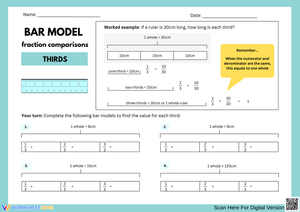
Both appear, and their placement is deliberate. Early worksheets in each skill cluster use number lines or area models to ground the operation in meaning before the symbolic steps are introduced. Later worksheets in the same cluster remove the visual and focus on the algorithm. That progression lets teachers use the same set for concept-building during initial instruction and again for fluency practice several weeks later without the worksheets feeling like the same task twice.
Can these worksheets work for both intervention groups and whole-class instruction?
Yes — the single-skill structure is what makes that practical. In a whole-class setting, all students work the same worksheet following a shared lesson. In an intervention group, the teacher works through two or three problems alongside students before releasing them to finish the rest independently. The content is the same; pacing and teacher proximity are what change. That consistency also makes it easier to compare student work across both settings, which is useful when deciding whether a student is ready to exit the reteach group.














 Interactive Worksheet Maker
 Quiz Maker
 Word Search Maker
 Crossword Puzzle Maker
 Word Scramble Generator
 Sentence Scramble Generator
 Handwriting Worksheet Generator
 Name Tracing Generator
 Fill In The Blank Generator




 BACK TOSCHOOL