


























Views
Downloads



Printable Comparing Fractions Worksheet | Grade 4 Math
Paste this activity's link or code into your existing LMS (Google Classroom, Canvas, Teams, Schoology, Moodle, etc.).
Students can open and work on the activity right away, with no student login required.
You'll still be able to track student progress and results from your teacher account.
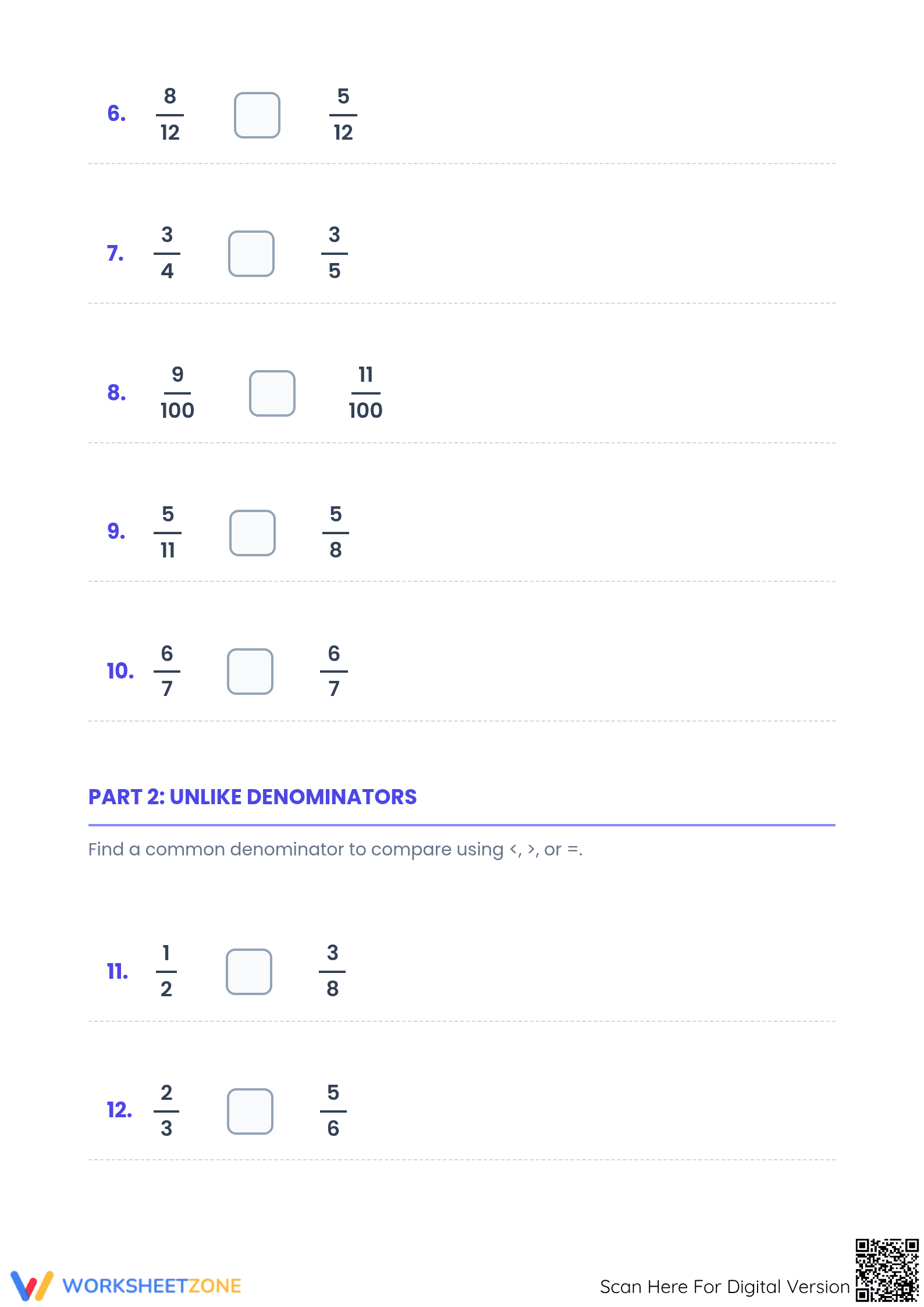
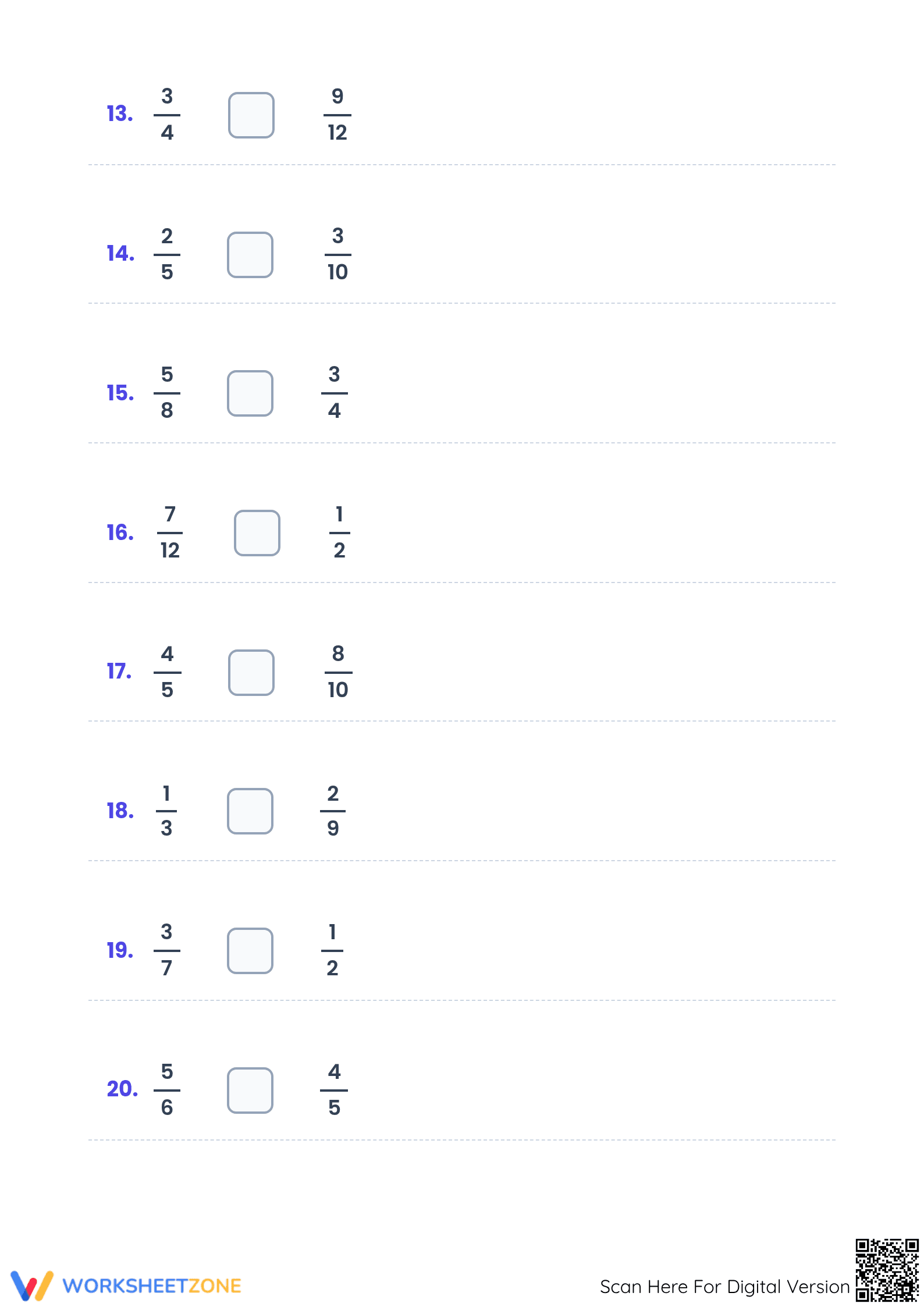
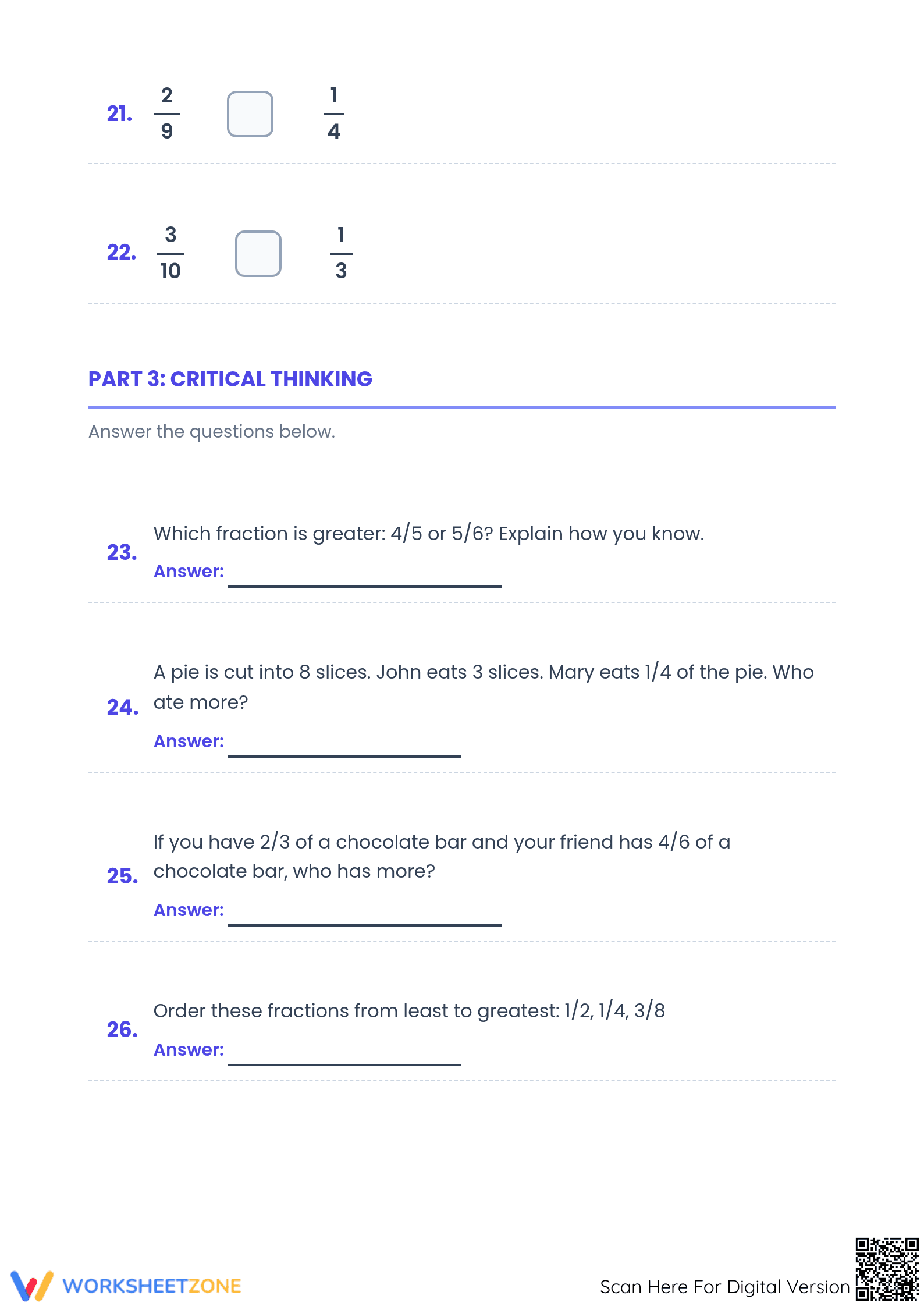
This worksheet provides comprehensive practice for Grade 4 students learning to compare fractions with different numerators and denominators. Through a structured sequence of 53 problems, learners will build fluency in finding common denominators and using visual models, leading to a solid, standards-based understanding of fraction equivalence and magnitude.
At a Glance
- Grade: 4 · Subject: Math
- Standard:
CCSS.MATH.CONTENT.4.NF.A.2— Compare two fractions with different numerators and denominators.- Skill Focus: Comparing Fractions
- Format: 5 pages · 53 problems · Answer key included · PDF
- Best For: Skill reinforcement, homework, or formative assessment.
- Time: 30–45 minutes
This five-page resource has 53 problems on comparing fractions. The first page uses visual bars, while the next four pages focus on numerical problems requiring common denominators. A complete five-page answer key is included for easy grading.
Skill Progression
The worksheet uses a gradual release model.
- Guided Practice: The first page includes visual models (fraction bars), scaffolding the process by showing equivalent fractions.
- Supported Practice: Subsequent problems remove visual aids, encouraging students to find common denominators independently with manageable numbers.
- Independent Practice: The final pages present a higher volume of problems with varied denominators, challenging students to demonstrate speed and accuracy.
This structure ensures students build confidence as scaffolds are removed.
Standards Alignment
This resource is aligned to CCSS.MATH.CONTENT.4.NF.A.2, where students compare fractions with different denominators. The tasks provide focused practice on this core Grade 4 fraction skill. The standard code can be copied directly into lesson plans or curriculum maps.
How to Use It
Use this worksheet for independent practice after a lesson on common denominators. It works well for homework or formative assessment. Observe whether students draw models or move to abstract calculation to check for understanding. Expect completion in 30 to 45 minutes.
Who It's For
Designed for Grade 4, this is also useful for Grade 5 review or advanced Grade 3 students. The progression from visual to abstract problems supports various learners. Pair with a multiples chart to help students who struggle with multiplication facts.
Providing students with targeted practice on discrete skills like comparing fractions is a proven method for building mathematical fluency. According to research on effective instructional practices, such as that summarized in the `RAND AIRS 2024` report, repeated, structured practice is crucial for moving procedural knowledge into long-term memory. This worksheet, aligned with standard `CCSS.MATH.CONTENT.4.NF.A.2`, gives students the necessary repetition to master the process of comparing fractions with unlike denominators. By focusing on the specific procedure of creating common denominators, this resource helps students develop the component skills required for more complex fraction operations they will encounter in later grades. The volume of problems ensures students move beyond initial learning to a state of automaticity, a key goal of standards-based math instruction. This focused approach is critical for ensuring students build a robust and accurate understanding of fractional relationships.


