


























Views
Downloads

Printable Comparing Fractions Worksheet | Essential Grade 4
Paste this activity's link or code into your existing LMS (Google Classroom, Canvas, Teams, Schoology, Moodle, etc.).
Students can open and work on the activity right away, with no student login required.
You'll still be able to track student progress and results from your teacher account.
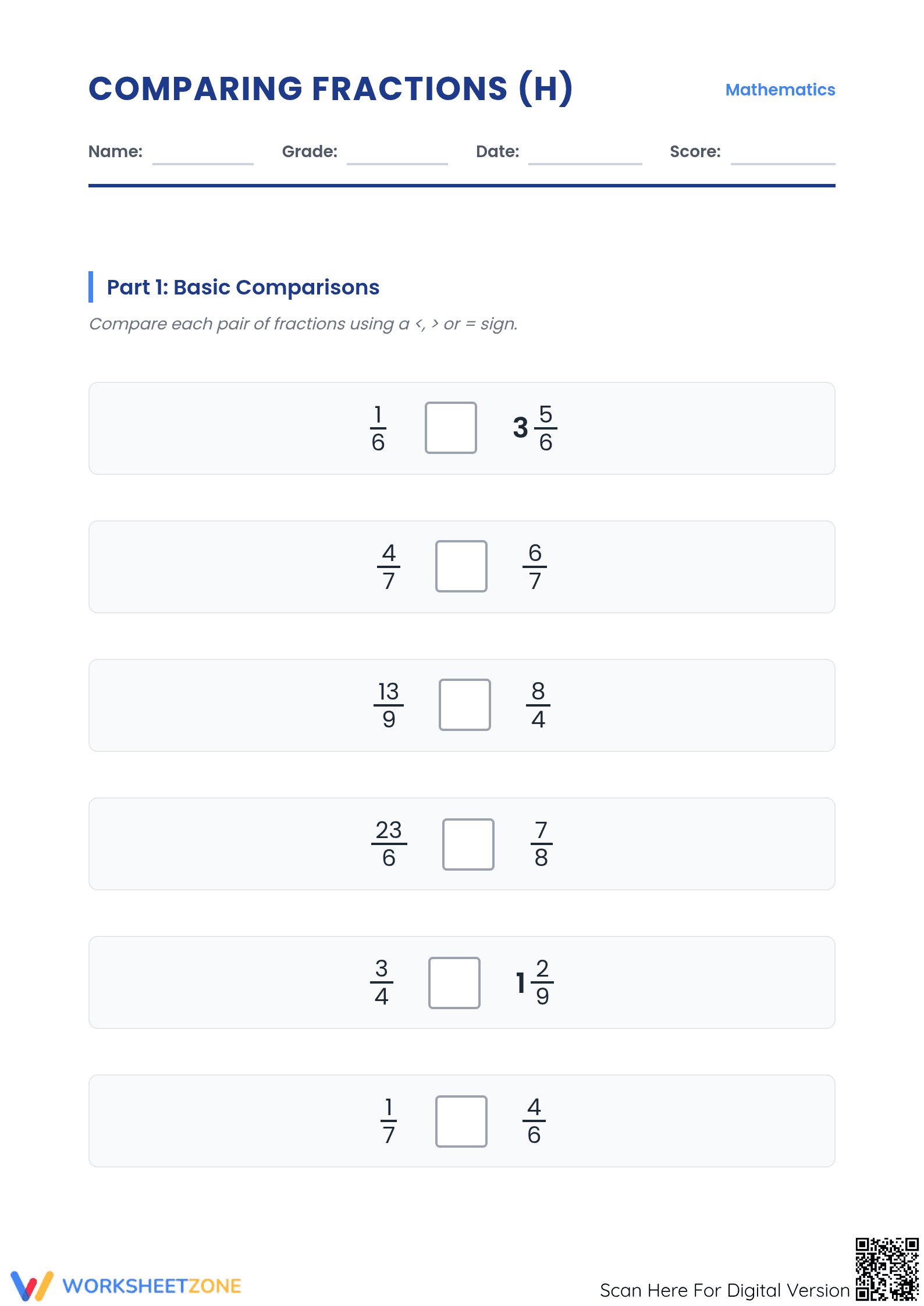
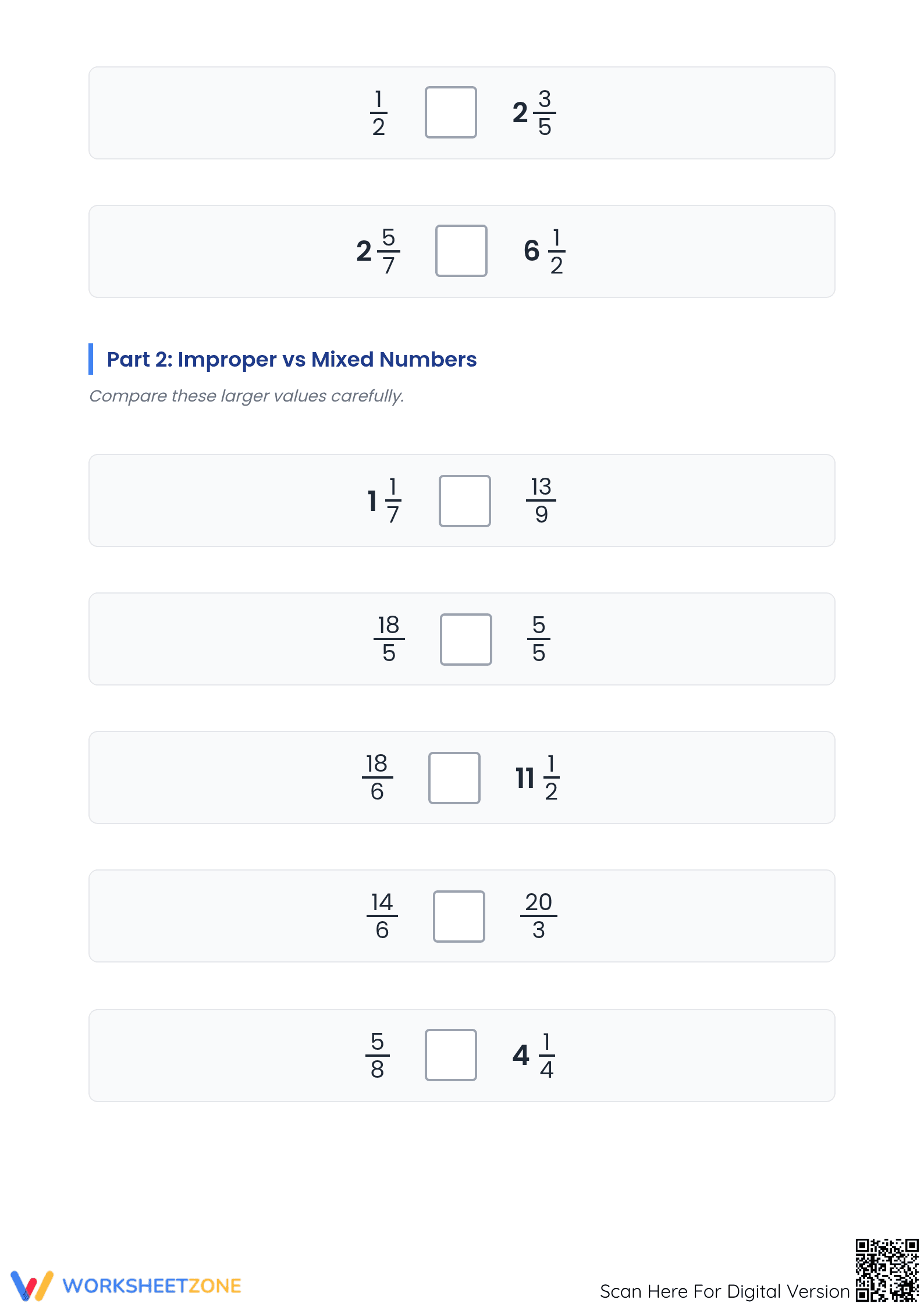
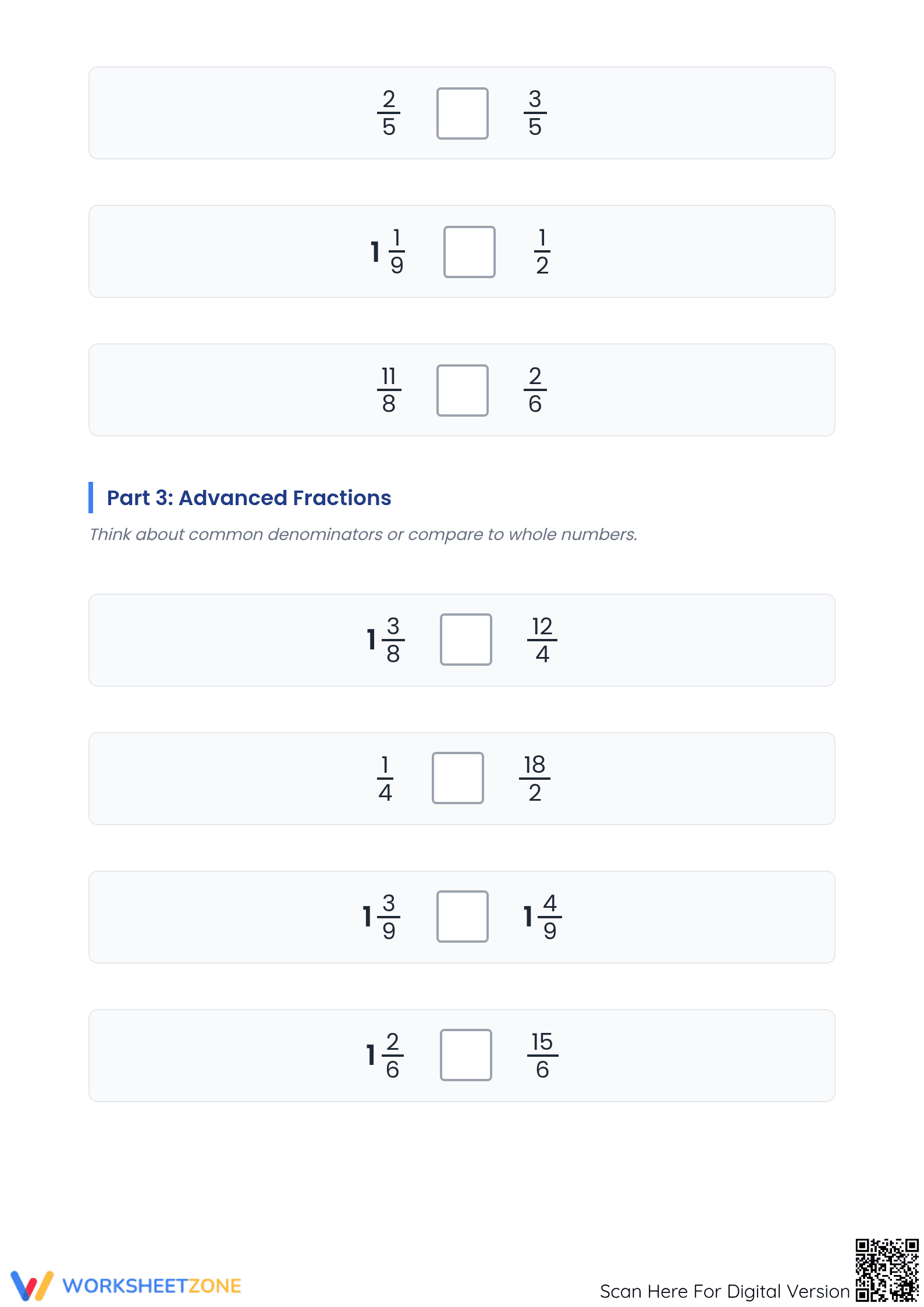
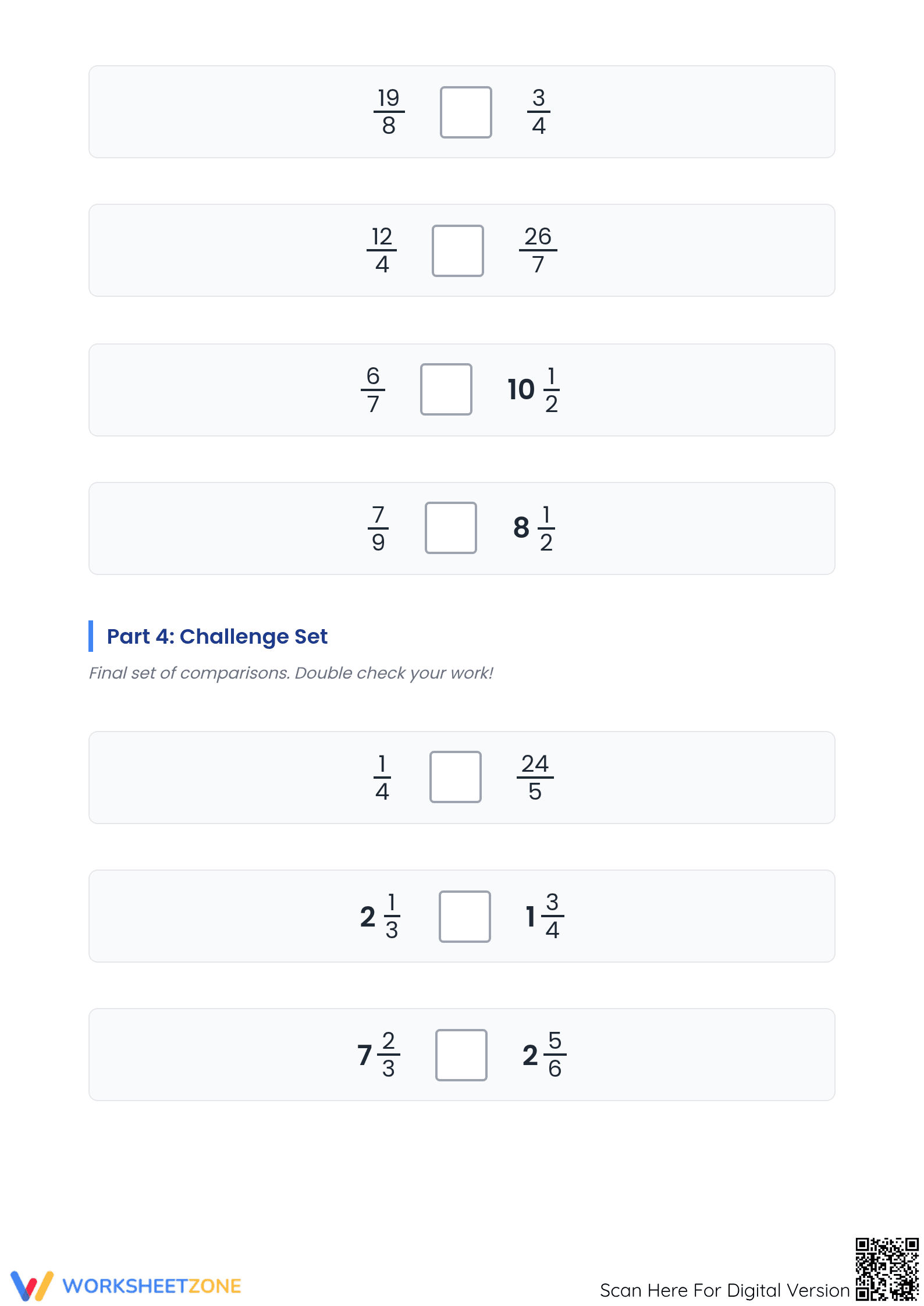
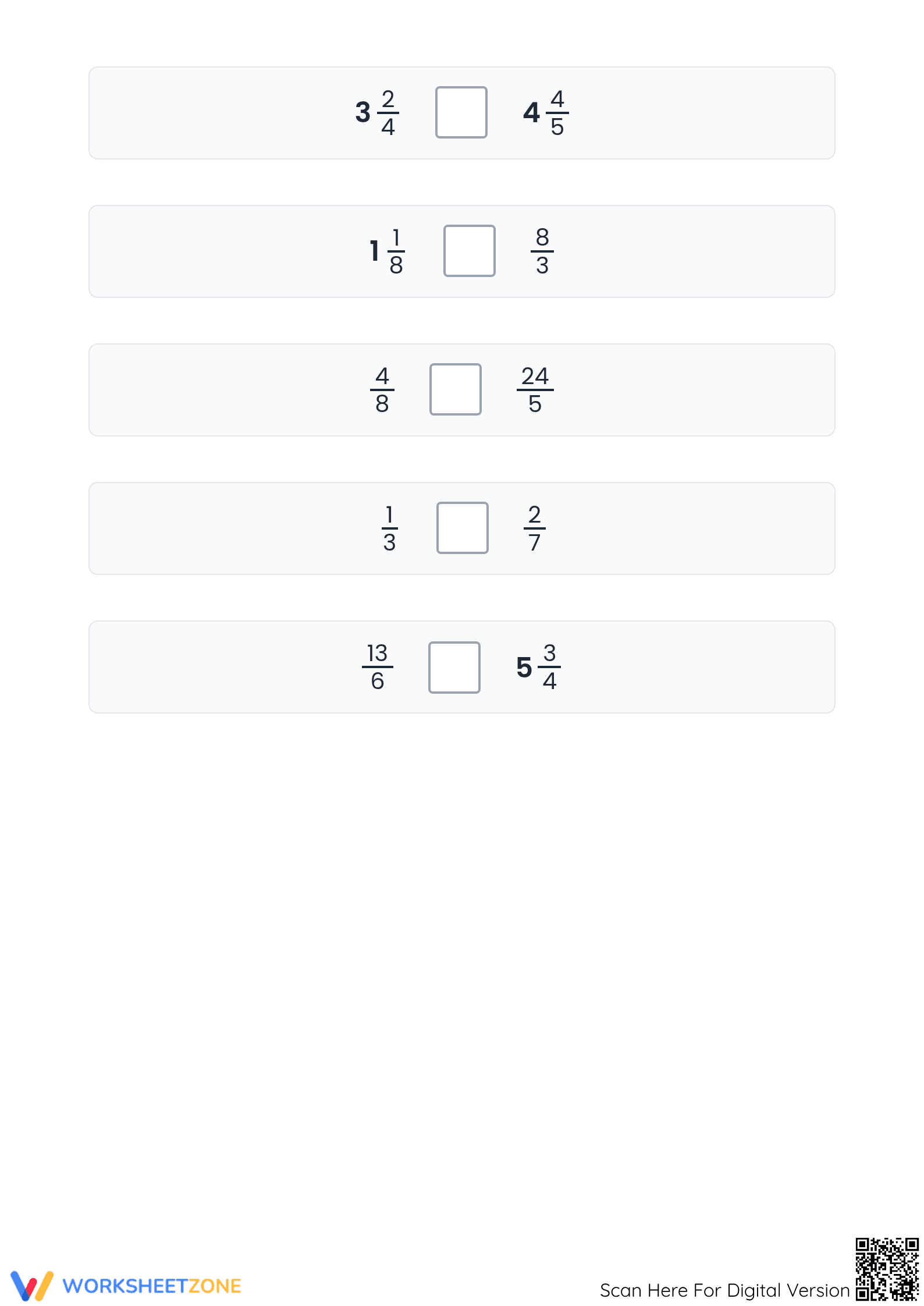
This comprehensive set of worksheets provides students with extensive practice in comparing simple, improper, and mixed fractions. By completing 32 structured problems, learners develop the fluency needed to evaluate fractional values. The progressive difficulty ensures students move from basic comparisons to advanced mixed number analysis with confidence and precision.
At a Glance
- Grade: 4 · Subject: Math
- Standard:
CCSS.MATH.CONTENT.4.NF.A.2— Compare two fractions with different numerators and denominators using symbols- Skill Focus: Comparing simple, improper, and mixed fractions
- Format: 5 pages · 32 problems · Answer key included · PDF
- Best For: Independent practice and skills revision
- Time: 45–60 minutes
What's Inside
Across five detailed pages, this resource presents a variety of comparison tasks. It includes basic fraction pairs, improper fractions versus mixed numbers, and advanced challenges requiring common denominators or whole-number comparisons. Each page is clearly labeled with parts, such as "Basic Comparisons" and "Challenge Set," providing a logical structure for students. A full answer key is provided for immediate feedback.
Skill Progression
- Guided Practice: The first 8 problems focus on basic comparisons with common denominators or simple units to build initial confidence and conceptual foundations.
- Supported Practice: Students transition to 14 problems comparing improper fractions and mixed numbers, requiring more complex mental conversion strategies and cross-multiplication.
- Independent Practice: The final 10-problem challenge set demands mastery as students evaluate complex fractional relationships with diverse denominators and large numerators.
This structured approach follows the gradual-release model, moving from teacher-led "I Do" moments to independent "You Do" application.
Standards Alignment
This resource is specifically aligned to CCSS.MATH.CONTENT.4.NF.A.2, which requires students to compare two fractions with different numerators and different denominators by creating common denominators or numerators, or by comparing to a benchmark fraction. It emphasizes that comparisons are valid only when the fractions refer to the same whole. This standard code can be copied directly into lesson plans, IEP goals, or district curriculum mapping tools.
How to Use It
Use this worksheet as a summative assessment after a unit on fractions or as a targeted intervention for students struggling with mixed number concepts. During instruction, teachers can observe if students are finding common denominators or using benchmark fractions as a strategy. It serves as a strong formative assessment tool, providing a clear picture of student mastery over a 45-minute period.
Who It's For
This packet is designed for Grade 4 students, though it is highly effective for Grade 5 review or Grade 3 enrichment. It is an ideal resource for general education classrooms, small group rotations, or special education settings requiring focused skill practice. This worksheet pairs naturally with visual fraction models or number lines to help students conceptualize the values they are comparing.
Mathematical proficiency in fractions is a critical predictor of later success in algebra. Fisher & Frey (2014) emphasize that a structured progression from guided to independent practice is essential for internalizing concepts like comparing improper and mixed fractions. This worksheet provides that framework with 32 problems, allowing students to demonstrate mastery of the CCSS.MATH.CONTENT.4.NF.A.2 standard. By requiring comparison symbols across various fractional forms, the resource reinforces the conceptual understanding that fractions are numbers with specific values. This systematic approach ensures students can accurately compare fractional values, a fundamental skill identified by NAEP as a key area for elementary development. The inclusion of improper fractions and mixed numbers challenges students to apply multiple strategies, ensuring they are prepared for the rigors of middle school mathematics and complex quantitative reasoning tasks in everyday life.


