


























Views
Downloads



Essential Comparing Proper and Improper Fractions Worksheet
Paste this activity's link or code into your existing LMS (Google Classroom, Canvas, Teams, Schoology, Moodle, etc.).
Students can open and work on the activity right away, with no student login required.
You'll still be able to track student progress and results from your teacher account.
Students often struggle when moving beyond simple proper fractions to compare values greater than one. This comprehensive four-page practice set helps learners master the logic of comparing proper and improper fractions. By progressing from visual models to abstract comparisons and real-world word problems, students build a durable understanding of fraction magnitude and numerical relationships across various mathematical contexts.
At a Glance
- Grade: 4 · Subject: Math
- Standard:
CCSS.MATH.CONTENT.4.NF.A.2— Compare two fractions with different numerators and denominators using symbols- Skill Focus: Proper vs Improper Fraction Comparison
- Format: 4 pages · 23 problems · Answer key included · PDF
- Best For: Guided practice or assessment
- Time: 25–40 minutes
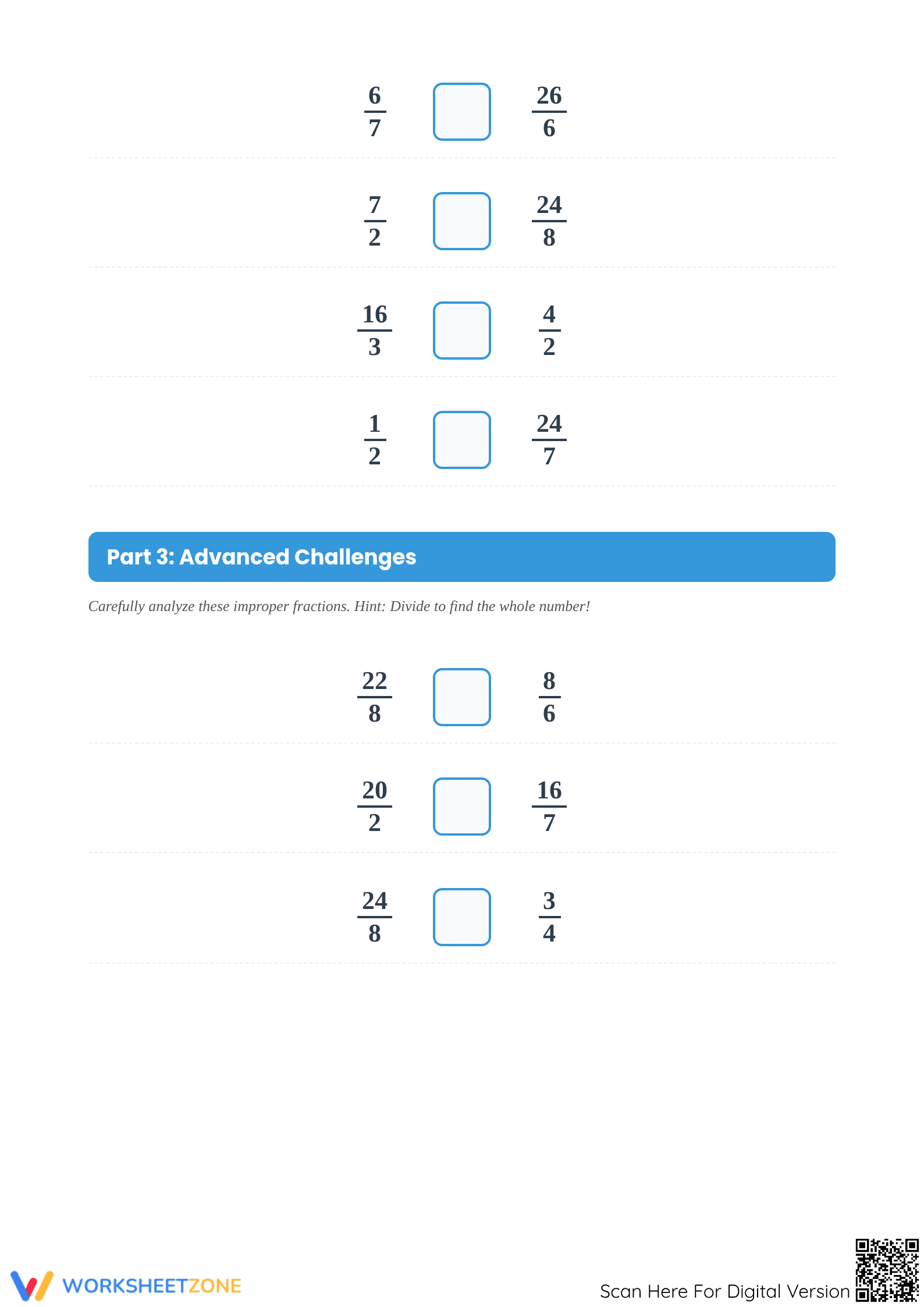
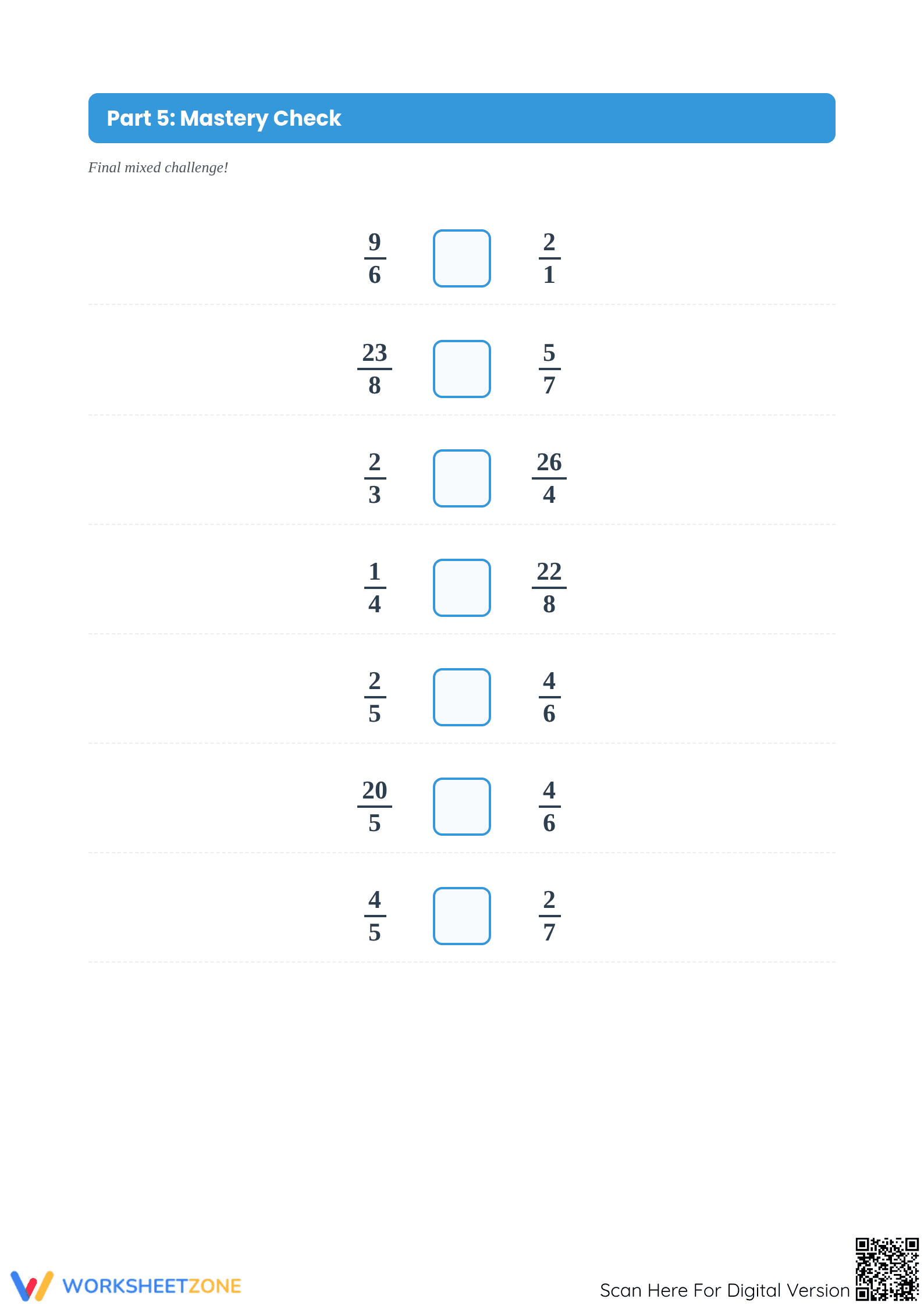
The resource contains five distinct sections spread across four pages. It begins with a visual anchor that illustrates how an improper fraction represents a value greater than one compared to a proper fraction. The bulk of the worksheet consists of 23 numerical comparison tasks, concluding with two scenario-based word problems that require students to apply their knowledge to pizza portions and walking distances.
- Guided Visual Analysis: Students observe shaded area models to recognize that improper fractions naturally exceed the whole, providing a conceptual foundation for abstract work.
- Core Numerical Practice: 14 structured problems ask students to compare pairs with varying denominators using cross-multiplication or common denominator strategies.
- Complex Mastery Tasks: 9 advanced problems and word scenarios remove scaffolds, challenging students to compare mixed sets of improper fractions and justify their reasoning in writing.
This progression follows a gradual-release model to ensure students move from conceptual recognition to procedural fluency without being overwhelmed by technical complexity.
The primary standard addressed is CCSS.MATH.CONTENT.4.NF.A.2: "Compare two fractions with different numerators and different denominators... and record the results of comparisons with symbols >, =, or <." This resource also supports higher-level work with mixed numbers and benchmark fractions. Both standard codes can be copied directly into lesson plans, IEP goals, or district curriculum mapping tools.
Use this worksheet during the "You Do" phase of a lesson on fraction comparisons to evaluate individual student mastery. It is particularly effective after a whole-class demonstration using a number line. For a formative check, observe whether students are relying on visual benchmarks (like "greater than one") or if they have successfully transitioned to finding common denominators for closer comparisons.
This practice set is designed for Grade 4 and Grade 5 students who have already been introduced to the concept of improper fractions. It serves as an excellent differentiation tool for Grade 3 students performing above level or as a remedial review for middle schoolers. Pair this with a fraction tile set or a digital manipulatives tool for maximum instructional impact.
Mastering fraction comparisons is a pivotal milestone in elementary mathematics that directly correlates with success in middle school algebra and proportional reasoning. According to NAEP data, students who develop a strong conceptual grasp of fraction magnitude, particularly when handling improper fractions, demonstrate significantly higher proficiency in complex multi-step problems involving ratios and percentages. This 23-problem worksheet addresses the common misconception that a larger denominator always indicates a smaller value by forcing students to evaluate the relationship between the numerator and the denominator across 4 pages of rigorous practice. By including CCSS.MATH.CONTENT.4.NF.A.2 aligned word problems, the resource ensures that students are not just performing rote calculation but are translating mathematical symbols into meaningful physical quantities. This evidence-based approach to fraction instruction provides the necessary scaffolding for learners to move from concrete visual models to abstract symbolic logic, ultimately securing a foundation for all subsequent rational number operations.


