


























Views
Downloads
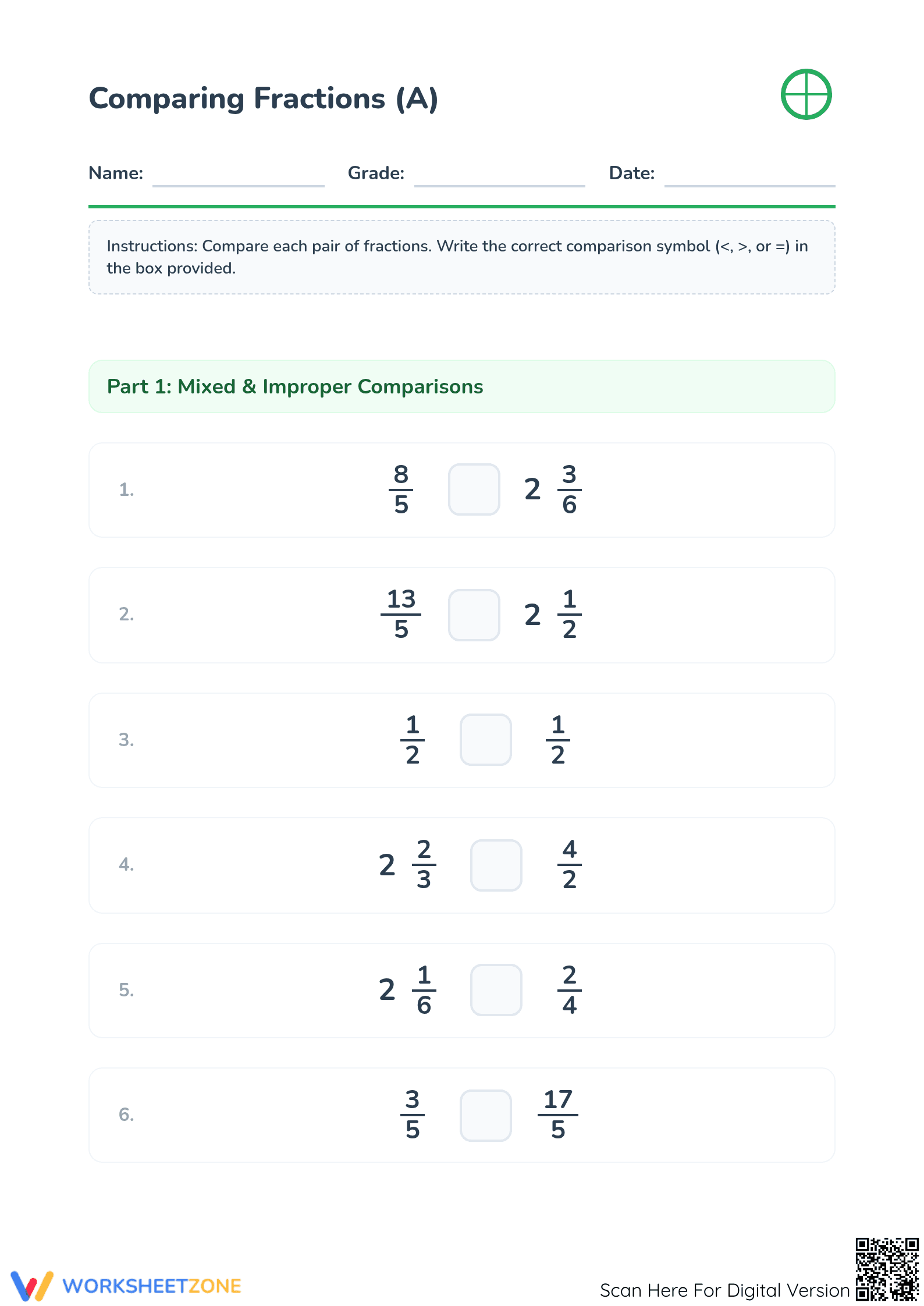



Essential Comparing Fractions Worksheet | Grade 4-5
Paste this activity's link or code into your existing LMS (Google Classroom, Canvas, Teams, Schoology, Moodle, etc.).
Students can open and work on the activity right away, with no student login required.
You'll still be able to track student progress and results from your teacher account.
Mastering fraction comparison is a pivotal milestone in upper elementary mathematics. This essential worksheet provides students with comprehensive practice in evaluating simple, improper, and mixed fractions. By engaging with these structured problems, learners develop the fluency required to navigate complex mathematical relationships and build a solid foundation for future algebraic concepts and operations.
At a Glance
- Grade: 4 · Subject: Math
- Standard:
CCSS.MATH.CONTENT.4.NF.A.2— Compare two fractions with different numerators and denominators using symbols- Skill Focus: Comparing Mixed and Improper Fractions
- Format: 5 pages · 39 problems · Answer key included · PDF
- Best For: Independent Practice and Skills Mastery
- Time: 25–35 minutes
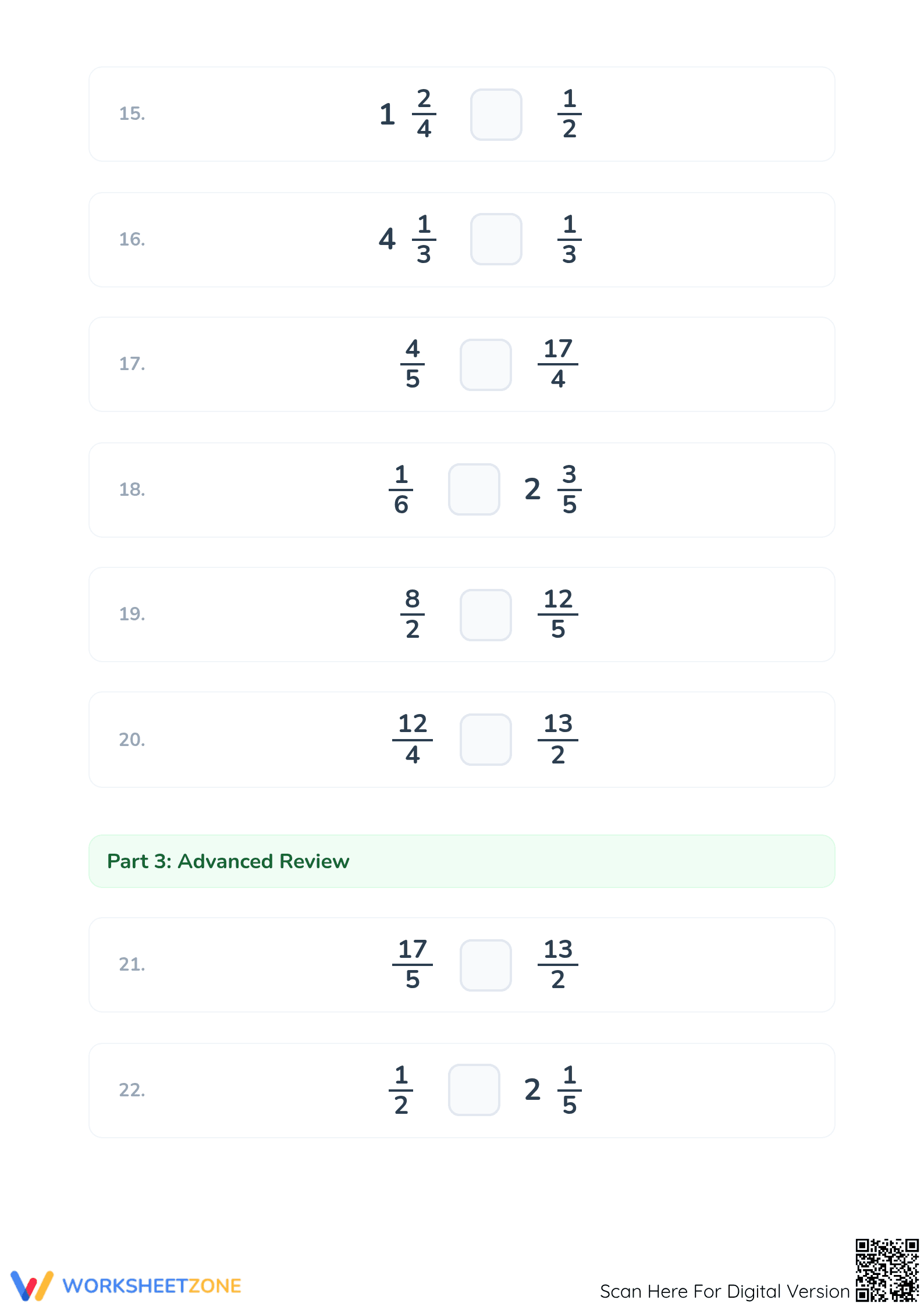
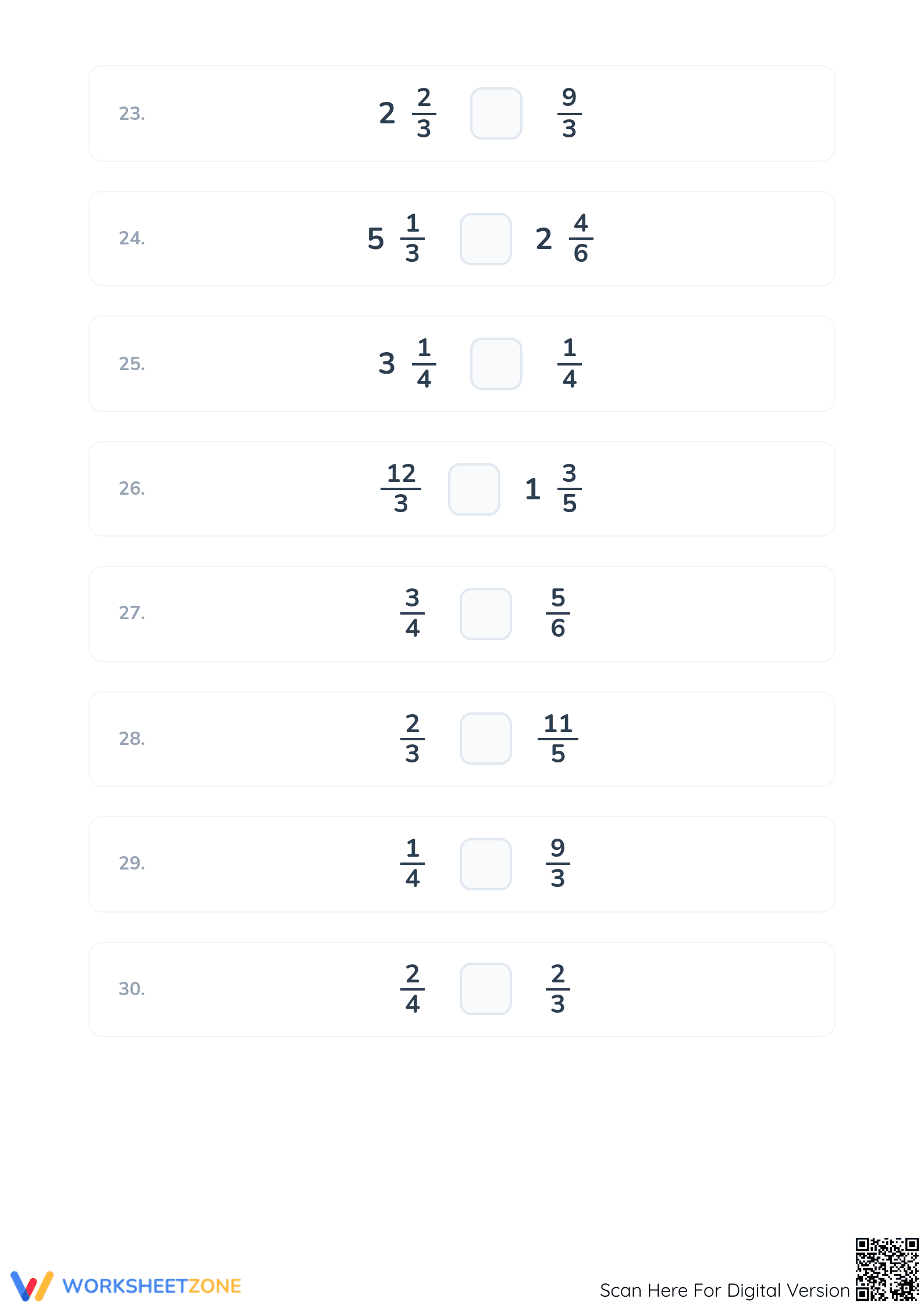
This extensive 5-page resource contains 39 unique comparison tasks distributed across four distinct sections. Students will encounter a mix of simple fractions, improper fractions, and mixed numbers. The clear layout features dedicated boxes for comparison symbols (<, >, or =) and includes a full answer key for immediate self-correction or grading.
Skill Progression
- Guided Practice: Initial sets focus on basic mixed and improper comparisons with small denominators to build student confidence.
- Supported Practice: Mid-level tasks introduce larger values and varied fraction types, requiring more complex common denominator conversion.
- Independent Practice: Final "Mastery Check" sections present challenging mixed-type pairs without prompts, ensuring students can independently apply strategies.
This layout follows a standard gradual-release model, moving students from basic identification to complex mathematical reasoning.
Standards Alignment
This resource is explicitly aligned to CCSS.MATH.CONTENT.4.NF.A.2, which requires students to compare two fractions with different numerators and different denominators. It also supports 5th-grade readiness by reinforcing the equivalent fraction knowledge necessary for addition and subtraction. Both standard codes can be copied directly into lesson plans, IEP goals, or district curriculum mapping tools.
How to Use It
Use this worksheet during the independent practice phase of a lesson following direct instruction on benchmark fractions or common denominators. It serves as an excellent formative assessment tool; observe if students struggle specifically with improper-to-mixed conversion. Expect a completion time of 30 minutes, making it an ideal choice for a substantial seatwork assignment or homework.
Who It's For
This resource is designed for Grade 4 and 5 students who are refining their fractional reasoning. It is particularly effective for learners requiring additional reinforcement in visualizing improper fractions as values greater than one. Pair this worksheet with fraction tiles or number lines to provide visual support for students who need concrete representation.
Effective instruction in fraction comparison requires moving beyond rote cross-multiplication toward deep conceptual understanding. Research from Fisher & Frey (2014) highlights that the gradual release of responsibility model—from initial teacher modeling to independent application—is essential for students to internalize mathematical procedures like finding common denominators. This worksheet embodies that methodology by providing 39 structured opportunities for students to practice comparing simple, improper, and mixed fractions. Aligned with CCSS.MATH.CONTENT.4.NF.A.2, the resource ensures that learners are meeting national benchmarks for fractional literacy. By requiring students to use comparison symbols for various fraction types, it builds the mental flexibility needed for higher-level ratio and proportion work. Studies from NAEP consistently show that students who master fraction concepts in late elementary school are significantly more likely to succeed in algebra, making this focused practice a critical component of a robust mathematics curriculum that prepares students for academic rigor.


