


























Views
Downloads
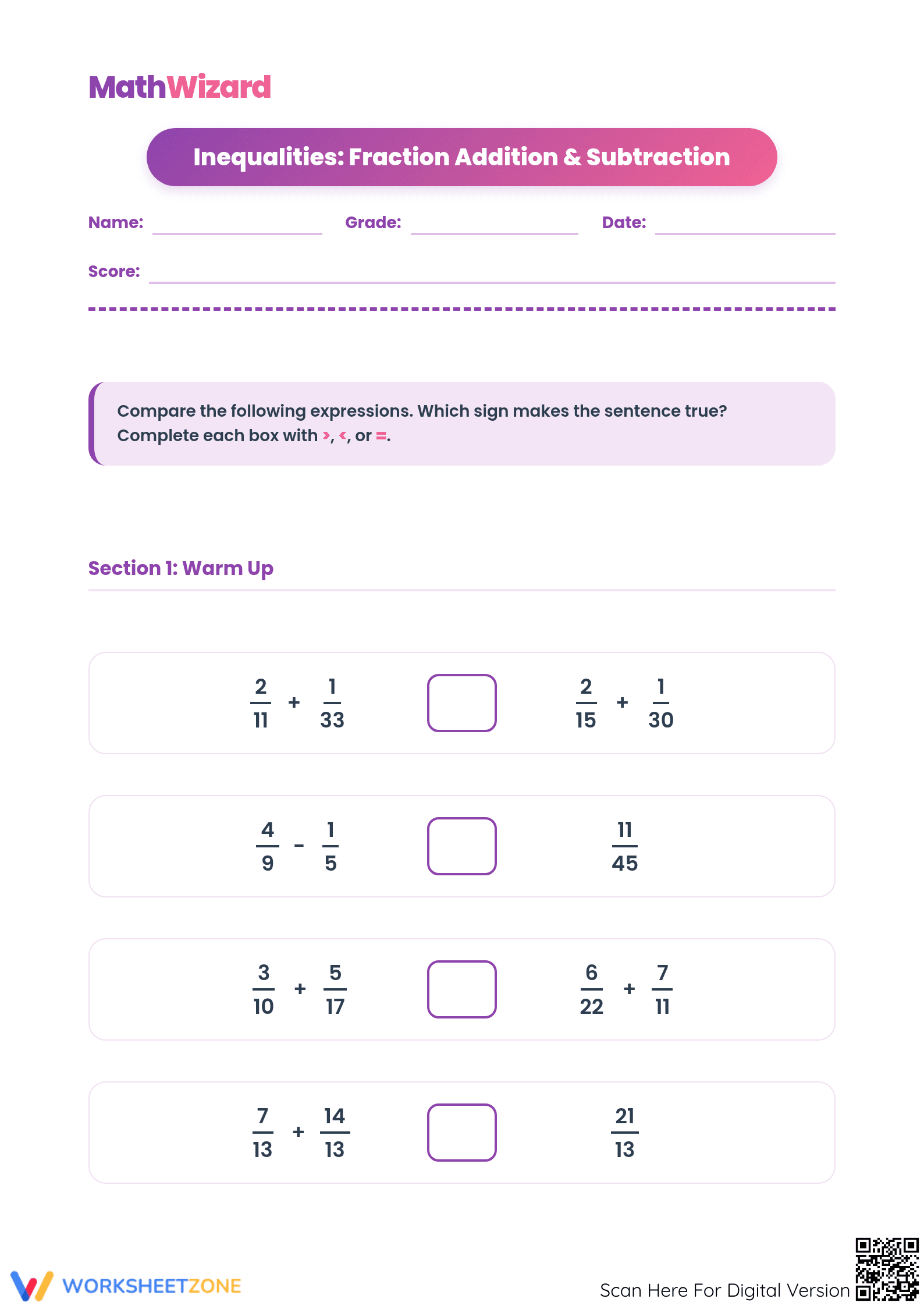



Printable Fractions Inequalities Worksheet | Grade 5 Math
Paste this activity's link or code into your existing LMS (Google Classroom, Canvas, Teams, Schoology, Moodle, etc.).
Students can open and work on the activity right away, with no student login required.
You'll still be able to track student progress and results from your teacher account.
This Grade 5 math worksheet provides comprehensive practice for students mastering inequalities involving the addition and subtraction of both like and unlike fractions. By requiring students to compute and then compare values using greater than, less than, or equal to symbols, it bridges computational fluency with conceptual understanding of fractional magnitude and equivalence. Lead with the skill and the student outcome.
At a Glance
- Grade: 5 · Subject: Math (Fractions)
- Standard:
5.NF.A.1— Add and subtract fractions with unlike denominators to solve inequalities- Skill Focus: Comparing fraction sums and differences
- Format: 4 pages · 48 problems · Answer key included · PDF
- Best For: Independent practice and formative assessment
- Time: 30–45 minutes
The package contains four distinct pages of structured mathematical problems. Each page presents a series of fraction expressions separated by a comparison box. Students must calculate the result of the addition or subtraction on either side of the box before determining the correct inequality symbol. The worksheet covers a range of difficulty levels, from simple common denominators to more complex unlike denominators that require finding least common multiples. A complete answer key is provided to facilitate quick grading or student self-correction.
Zero-Prep Workflow
- Step 1: Print — Select the four-page PDF and print directly from your device in under 30 seconds.
- Step 2: Distribute — Hand out copies to students during independent practice or assign as a standard homework task.
- Step 3: Review — Use the included answer key for rapid grading or project it for immediate student feedback.
Total teacher preparation time is targetted at under 2 minutes, making this an ideal choice for emergency sub plans.
The primary alignment for this resource is 5.NF.A.1, which requires students to add and subtract fractions with unlike denominators, including mixed numbers, by replacing given fractions with equivalent fractions in such a way as to produce a like denominator for the terms. This worksheet extends that requirement by incorporating comparison logic. The standard code can be copied directly into lesson plans, IEP goals, or district curriculum mapping tools.
This worksheet is best used after direct instruction on finding common denominators and performing fraction operations. It serves as an excellent tool for during-lesson guided practice or as a summative homework task. For formative assessment, observe students as they solve problems involving unlike denominators; if a student consistently misses the comparison despite correct calculation, they may need targeted support in understanding fractional size rather than just the mechanics of addition.
The resource is designed for Grade 5 students but is also appropriate for Grade 4 students ready for extension work or Grade 6 students requiring remediation in fraction fluency. It supports diverse learners by providing a consistent visual structure for every problem. Pairing this worksheet with a visual fraction wall or anchor chart detailing common equivalent fractions can provide necessary scaffolding for students who struggle with mental multiplication.
A ScienceDirect TpT Analysis confirms that structured practice materials like this Grade 5 fractions worksheet significantly improve student retention of operational procedures compared to abstract problem-solving alone. This resource focuses on the 5.NF.A.1 standard, which is a critical gateway skill for middle school algebraic thinking. By requiring students to add and subtract fractions with unlike denominators and then apply inequality logic, the worksheet promotes the higher-order thinking skills identified by NAEP as essential for mathematical proficiency. The 48-problem set provides the necessary repetition to move students from hesitant calculation to automaticity. Educators can confidently integrate this tool into their curriculum, knowing it meets the rigorous demands of state frameworks while maintaining a student-friendly layout that reduces cognitive load during complex multi-step operations.


