


























Views
Downloads

Printable Sums and Differences of Unit Fractions Worksheet
Paste this activity's link or code into your existing LMS (Google Classroom, Canvas, Teams, Schoology, Moodle, etc.).
Students can open and work on the activity right away, with no student login required.
You'll still be able to track student progress and results from your teacher account.
This worksheet challenges students to compare complex unit fraction expressions using conceptual reasoning, not rote calculation. By analyzing denominator size and its impact on sums and differences, students build a sophisticated mental model of fraction magnitude and operational relationships.
At a Glance
- Grade: 4 · Subject: Math
- Standard:
CCSS.MATH.CONTENT.4.NF.A.2— Compare fractions with different denominators by reasoning about their size- Skill Focus: Conceptual comparison of fraction operations
- Format: 3 pages · 26 problems · Answer key included · PDF
- Best For: Developing deep conceptual fraction number sense
- Time: 20–30 minutes
What's Inside
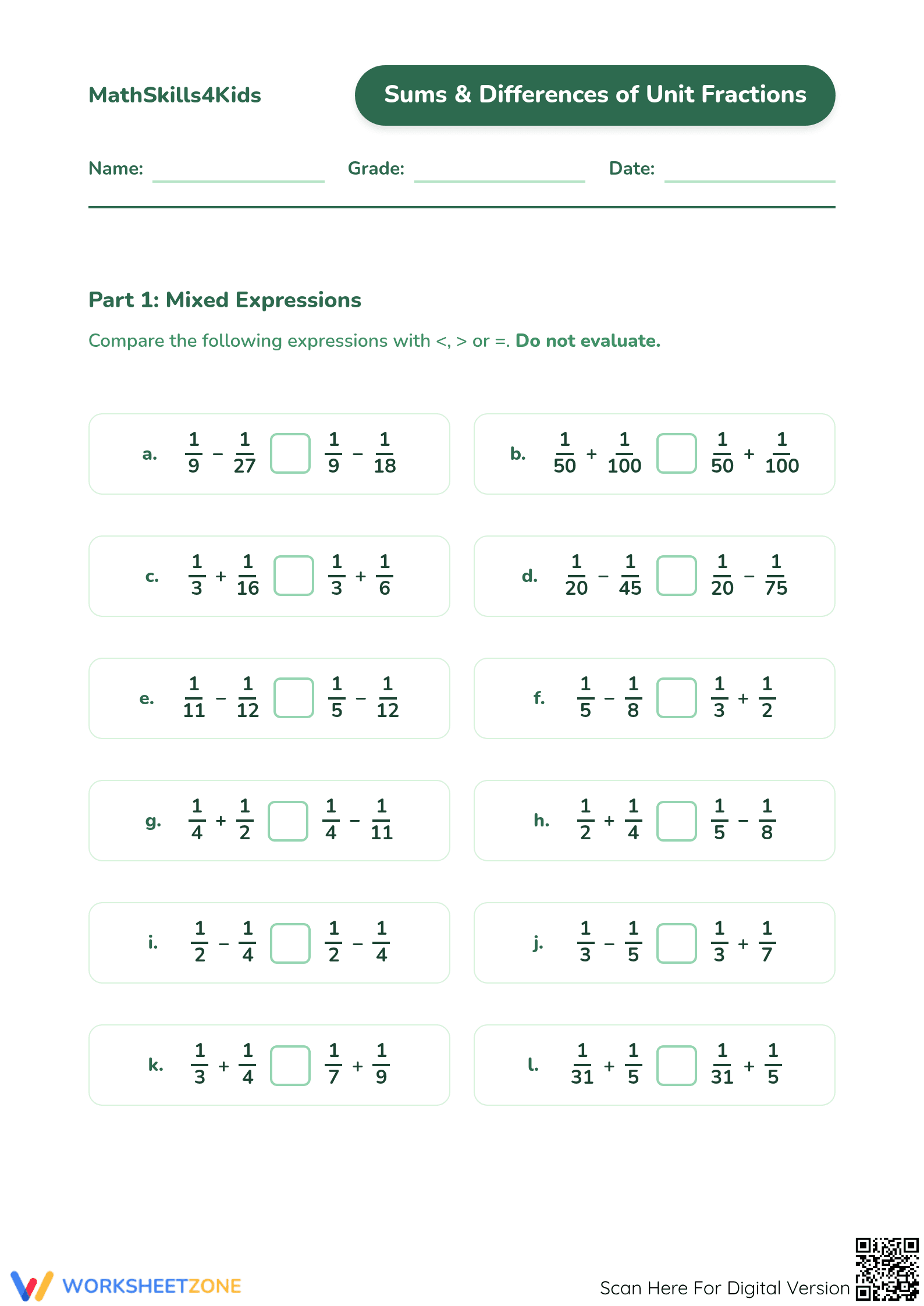
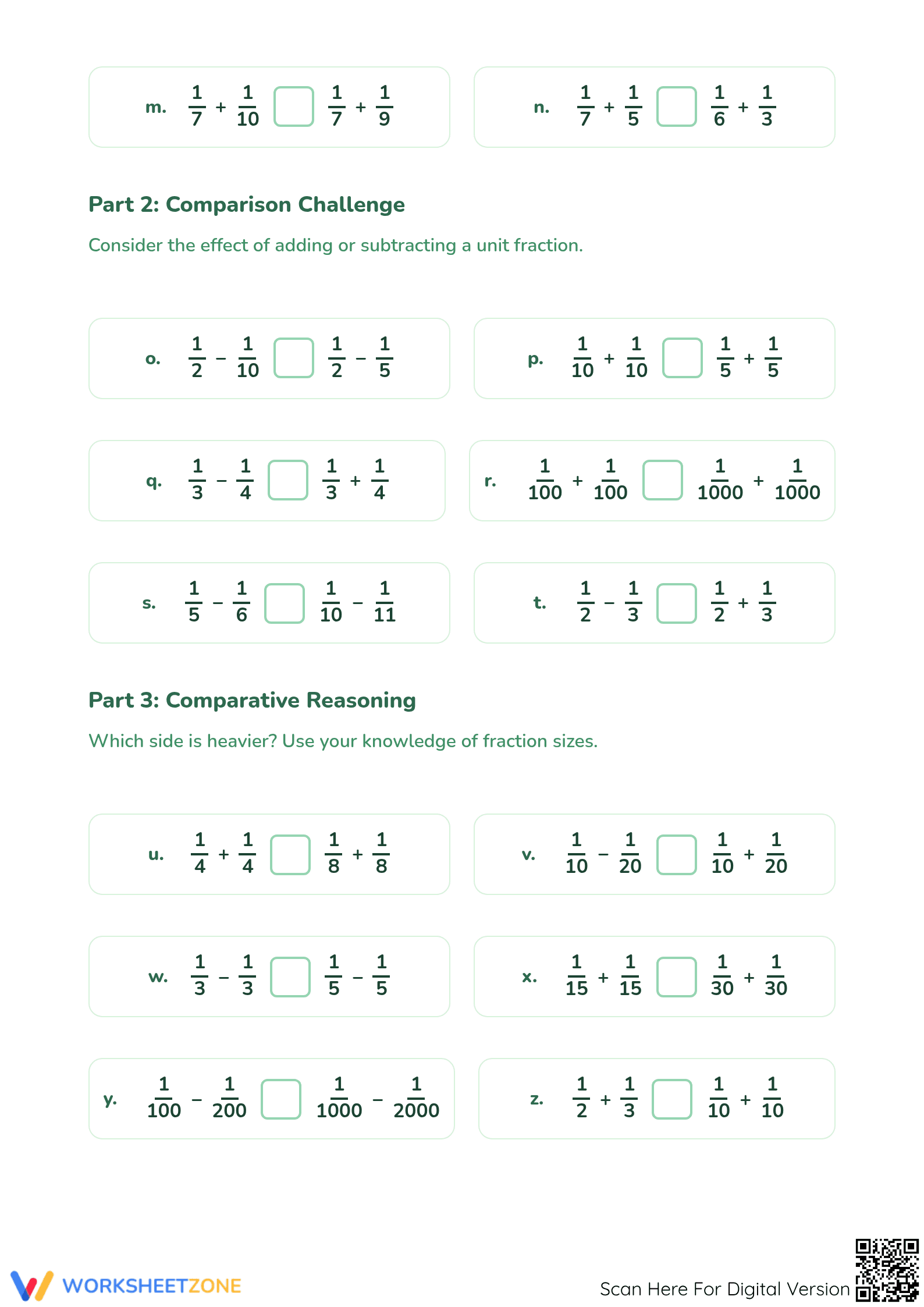
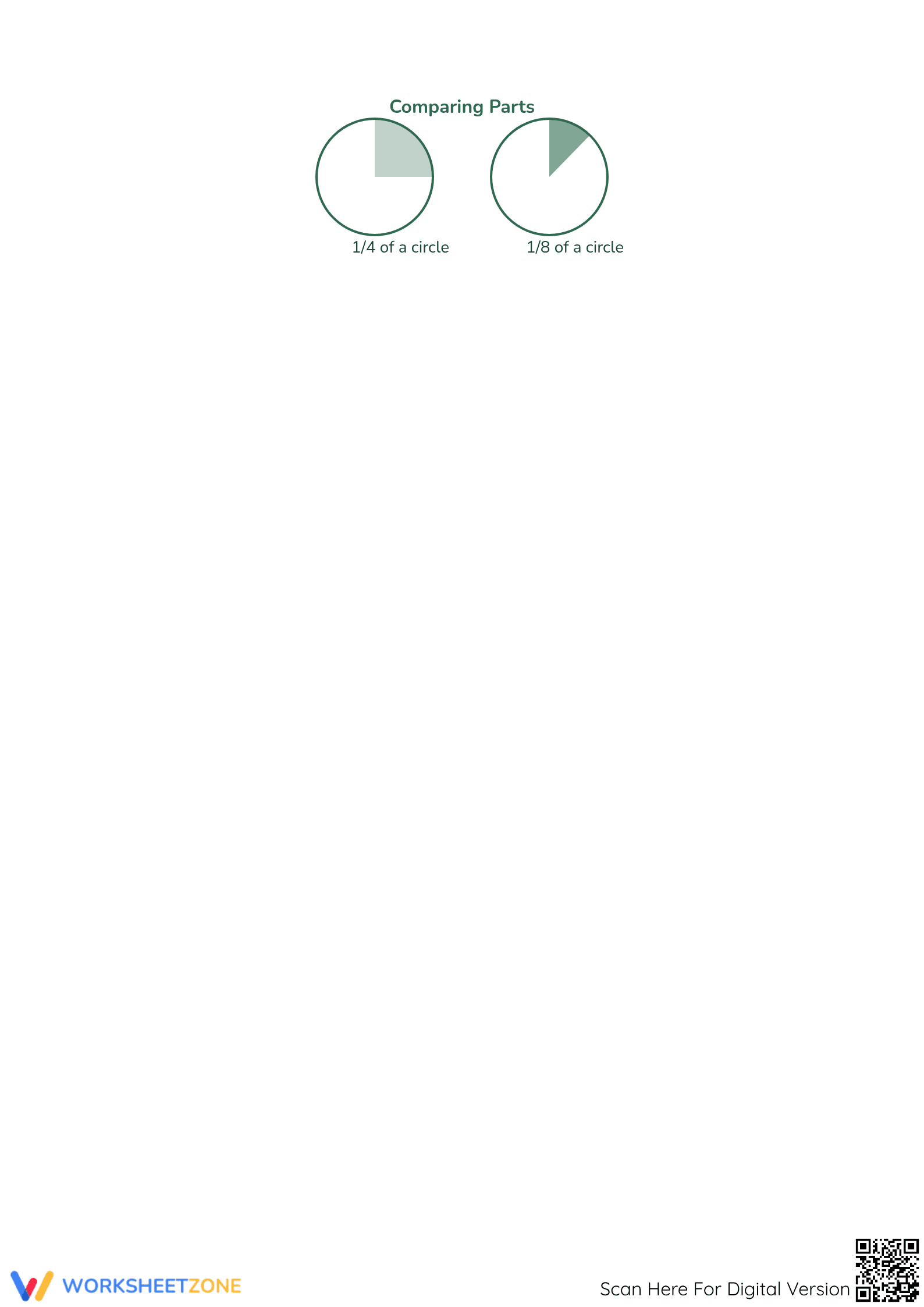
This 3-page PDF features 26 tasks across three sections. Page one covers "Mixed Expressions," comparing subtraction and addition with inequality symbols. Page two offers a "Comparison Challenge" and "Comparative Reasoning," prompting students to analyze the impact of unit fraction operations. Page three integrates visual models (e.g., 1/4 and 1/8 circles) to ground abstract reasoning. A full answer key ensures immediate feedback.
Skill Progression
- Guided Reasoning: The worksheet begins with paired expressions that share common terms, allowing students to isolate the impact of a single differing unit fraction (e.g., comparing 1/9 minus 1/27 versus 1/9 minus 1/18).
- Supported Comparison: Mid-level tasks require students to evaluate how adding different unit fractions to a base value alters the sum, reinforcing the principle that larger denominators represent smaller parts.
- Independent Mastery: The final section presents "Comparative Reasoning" prompts that ask students to identify the "heavier" side of an expression using only their knowledge of fraction sizes, moving away from calculation.
This scaffolded approach follows the gradual release of responsibility model, ensuring students internalize the logic of fraction size before applying it to complex mental math problems.
Standards Alignment
The primary alignment is CCSS.MATH.CONTENT.4.NF.A.2, which requires students to compare two fractions with different numerators and different denominators and recognize that comparisons are valid only when the two fractions refer to the same whole. While these tasks involve operations, the core objective is the comparison of resulting magnitudes. Both standard codes can be copied directly into lesson plans, IEP goals, or district curriculum mapping tools.
How to Use It
Best used during the "Explore" or "Explain" phases of fraction lessons, after basic comparison mastery but before algorithmic methods. Teachers can observe students' conceptual reasoning. Completion takes approximately 25 minutes.
Who It's For
This resource is designed for Grade 4 and Grade 5 students who need to move beyond procedural fluency into deep conceptual understanding. It is particularly effective for small group intervention or as a challenge for students who have mastered standard addition algorithms. Pair this worksheet with a set of fraction tiles or circular fraction manipulatives to help students verify their reasoning visually during the review process.
Drawing on research from Fisher & Frey (2014) and NAEP findings, this resource emphasizes conceptual reasoning with fractions—a critical predictor for success in higher-level mathematics. It addresses common student struggles with fraction magnitude by promoting relational thinking over algorithmic reliance. Aligned to CCSS.MATH.CONTENT.4.NF.A.2, this worksheet builds essential number sense for accurate estimation and error detection in complex fraction problems, supporting the rigorous cognitive demands of modern assessments.


