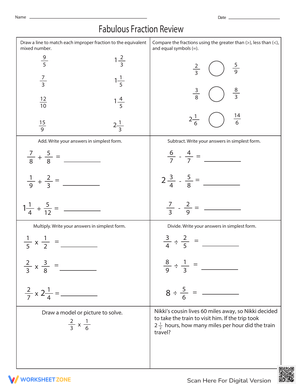
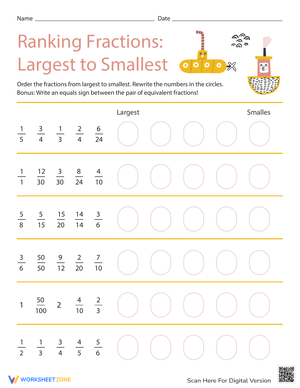
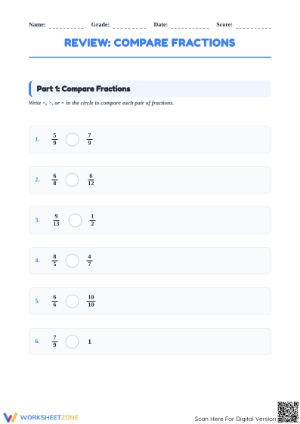
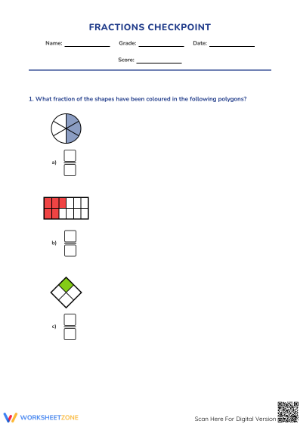
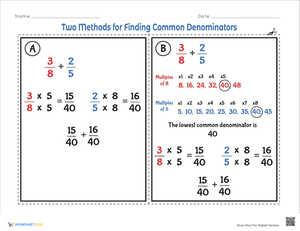
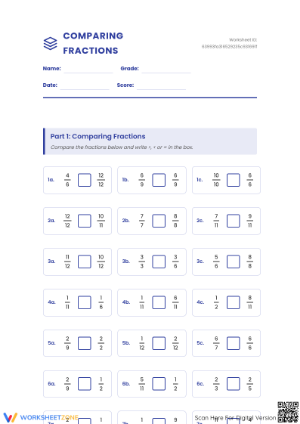
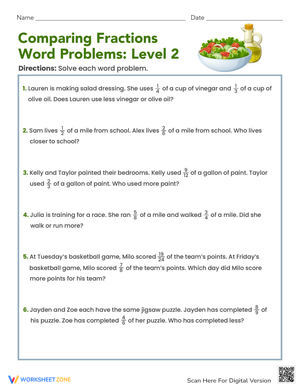
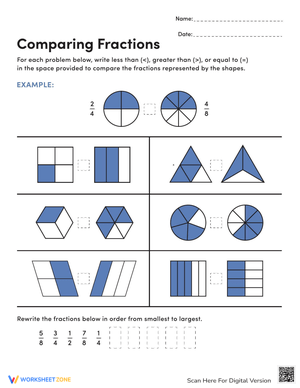
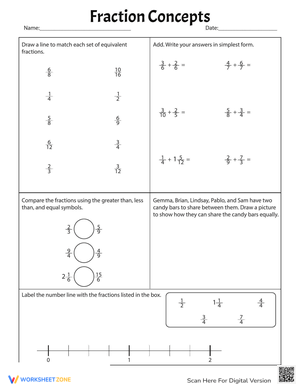
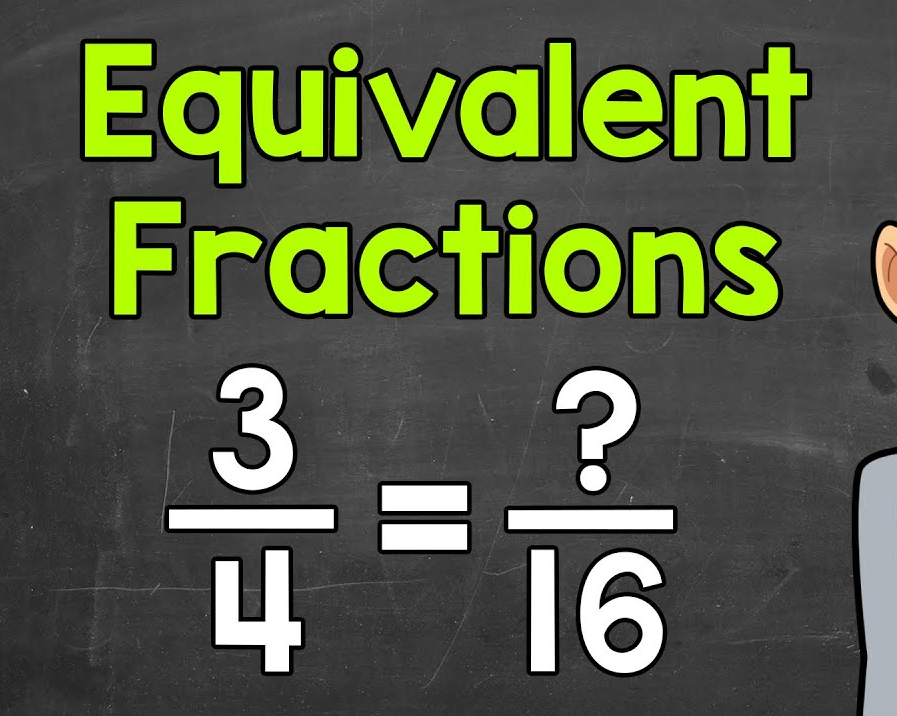
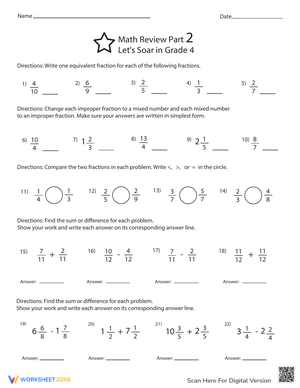
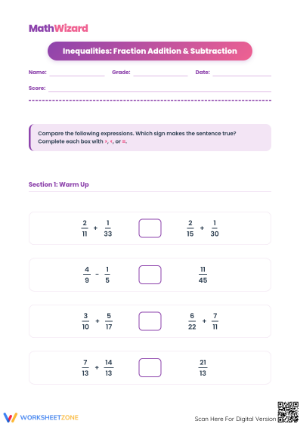
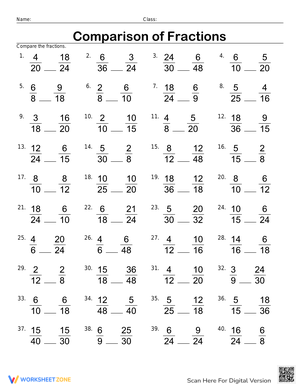
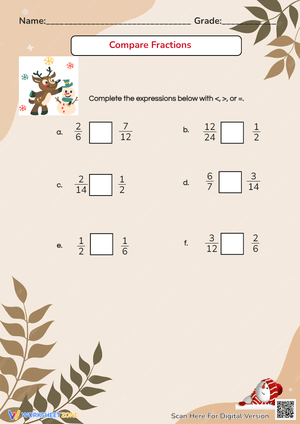
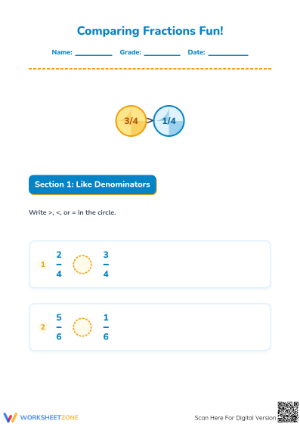
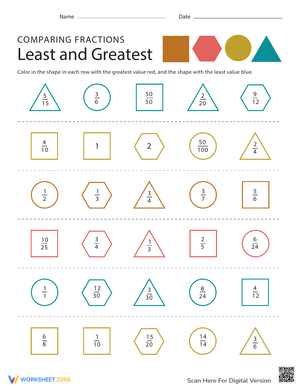
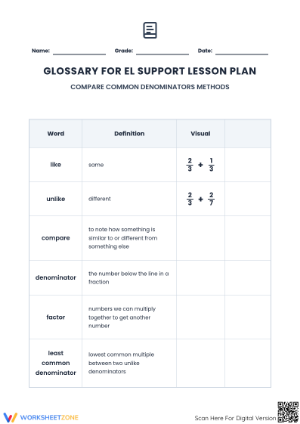
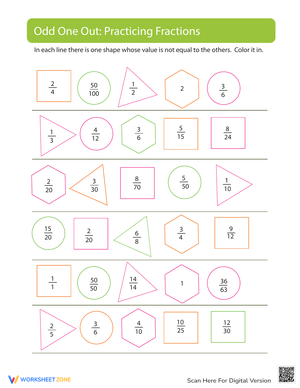
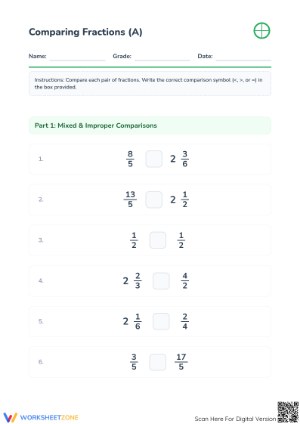
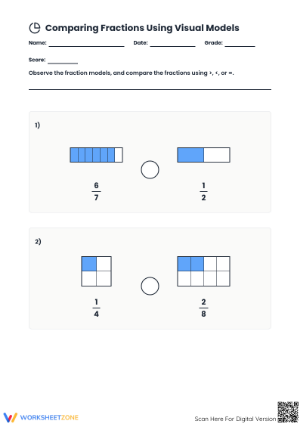
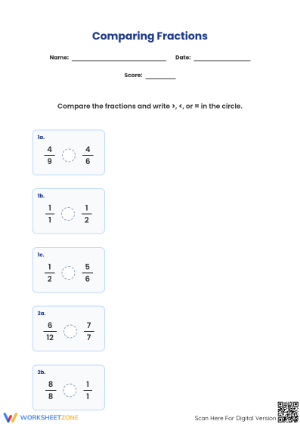
These comparing fractions worksheets for 5th grade give teachers a fast way to see what students actually understand about fraction size — not just whether they can name a fraction, but whether they can decide that 3/4 is greater than 5/8, explain the reasoning behind it, and record the answer with the correct symbol. The set covers the specific work fifth graders are expected to own: comparing values with unlike denominators, using equivalence reasoning to justify a comparison, and developing the magnitude sense that carries into fraction operations later in the unit.
What's Inside the Set
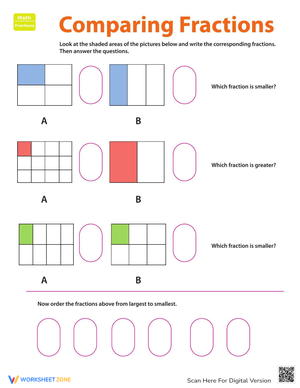
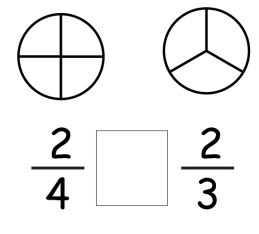
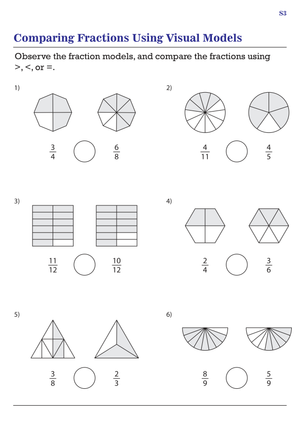
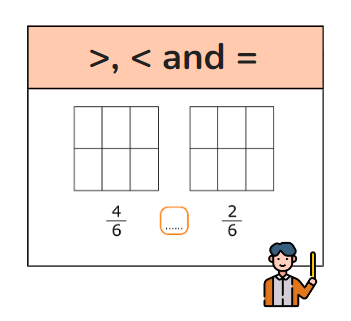
The worksheets use several problem formats because students reveal different misunderstandings depending on how a question is framed. A task with shaded area models shows whether a student understands relative size. A task with unlike denominators shows whether the student can generate equivalent fractions and select a strategy — not just follow a memorized procedure.
- Shaded models and area diagrams for comparing part-whole relationships
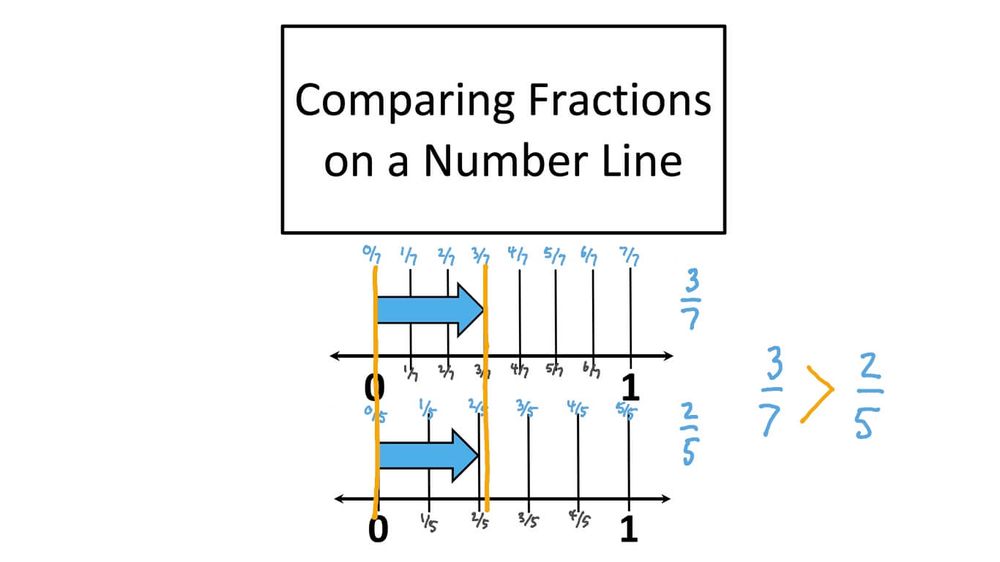
- Number line items that develop magnitude reasoning rather than procedural steps
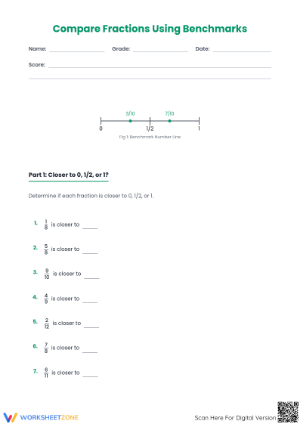
- Benchmark comparisons, particularly to 1/2 and 1
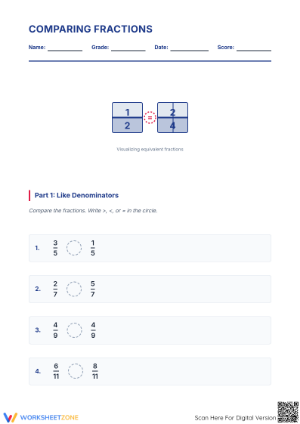
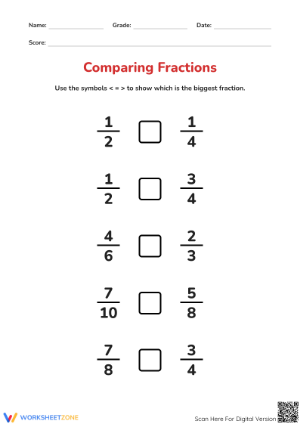
- Symbol practice — recording answers using greater than, less than, and equal to
- Ordering tasks with sets of three or four fractions, both least to greatest and greatest to least
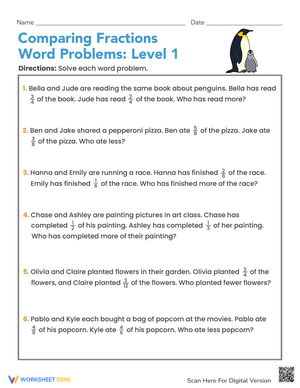
- Short word problems that require applying the comparison in context
That spread matters. A student who completes all symbolic items correctly but struggles to place the same fractions on a number line almost certainly has gaps in magnitude understanding — not just procedural errors. Because these comparing fractions worksheets for 5th grade pair model-based and equivalent-fraction tasks within the same set, teachers get a clearer picture of exactly where a student's thinking breaks down.
Error Patterns That Surface in Fifth-Grade Fraction Comparison
The most persistent mistake we see is using the numerator alone to judge size. A student comparing 3/8 and 5/12 will often mark 5/12 as larger not because of any equivalence reasoning, but simply because 5 is greater than 3. The fraction with the bigger-looking numerator feels bigger. This error is nearly invisible on a test-style item that records only a right or wrong symbol — but it surfaces immediately when students also mark a number line, because the visual evidence directly contradicts their instinct.
A related pattern appears with fractions close to 1. Students who correctly identify that 3/4 is greater than 1/2 sometimes conclude that 7/8 and 5/6 are "about the same" because both seem near 1. They recognize the benchmark but cannot apply it precisely enough to distinguish between two fractions that approach it from different distances. A few benchmark-reasoning items that push past the obvious cases expose this gap early, before it gets embedded further into the unit.
There is also a strategy-transfer problem worth knowing about. Many fifth graders can produce an equivalent fraction when directly prompted. During comparison, though, they do not reach for that strategy on their own — they revert to numerator-comparison or outright guessing. A worksheet sequence that moves from model-based items to equivalent-fraction items reveals whether students select the right strategy independently, without a prompt telling them which one to use.
How to Work These Worksheets Into Your Fraction Unit
The most natural entry point is right after a mini-lesson on a new comparison strategy. Working through a portion of a worksheet alongside students — not assigning it independently — keeps cognitive load manageable while they apply new thinking before it fades. The following day, that same format serves as a warm-up: four or five problems that retrieve yesterday's strategy before the next lesson opens. That two-day loop of new instruction followed by spaced retrieval is where most of the learning actually consolidates.
During centers, a mixed-problem worksheet holds a group's focus without requiring the teacher to be present. Students can cross-check their model-based reasoning against equivalent-fraction work, which gradually builds the self-monitoring habit that replaces guessing. Exit tickets with three or four comparison items give a clean read on readiness within the last five minutes of class. These comparing fractions worksheets for 5th grade are also practical for homework following new instruction — they review one strategy without adding anything new, which keeps the evening task from becoming overwhelming for students or confusing for parents trying to help.
Standard Alignment
Fraction comparison connects directly to CCSS.MATH.CONTENT.4.NF.A.2, which requires students to compare fractions with different numerators and different denominators by generating equivalent fractions or using benchmark reasoning, then record the result with symbols and justify the comparison. Grade 5 builds on that foundation rather than introducing the concept from scratch — which matters for how teachers pace this work. This is consolidation and fluency practice, not first-exposure teaching, so expectations for independent performance and written explanation can be higher than they were in fourth grade. The fluency built here feeds directly into CCSS.MATH.CONTENT.5.NF.A.1, the Grade 5 standard for adding and subtracting fractions with unlike denominators. Students who can reliably compare fractions already understand the size relationships that make those operations meaningful.
Adjusting Each Worksheet for a Range of Readiness Levels
One practical advantage of a printable worksheet set is that it is easy to sort and assign by readiness. The same core skill — comparing two or more fractions — can look very different depending on the number choices, representations, and response demands a teacher selects.
- Support level: visual models, same-numerator and same-denominator pairs, and benchmark comparisons to 1/2 and 1 give students an entry point that does not require generating equivalent fractions first
- On-level: unlike denominators solved through equivalent fractions, number line placement, and mixed symbolic and contextual items reflect the Grade 5 expectation directly
- Extension: ordering four or five fractions, multi-step word problems, and prompts asking students to defend more than one valid strategy push thinking past the standard comparison format
Teachers can also differentiate by trimming a worksheet rather than replacing it entirely. One group might work through only the model and benchmark sections while another completes the full set including written justification. This keeps materials simple and progress monitoring clean — all students are still doing fraction comparison, just at the right level of complexity.
Frequently Asked Questions
What should students already know before comparing fractions with unlike denominators?
Students need a working understanding of what a fraction represents, familiarity with equivalent fractions, and some experience comparing fractions that share either a numerator or a denominator. That prior work prepares them to see why generating a common denominator is necessary — rather than treating it as an arbitrary step to memorize and apply without understanding.
Do visual models still belong in fifth-grade fraction practice?
Yes. A student who marks the correct symbol on a symbolic comparison item can still hold a shaky sense of fraction magnitude. Models and number lines reveal whether errors come from weak conceptual understanding or from procedural mistakes in generating equivalent fractions. Both matter, and they call for different instructional responses — which is why seeing both item types in the same set is worth the extra design effort.
How should teachers use these resources for small-group intervention?
Narrow the focus to one strategy at a time. A group that still defaults to numerator-comparison benefits most from benchmark tasks and visual models first — not equivalent-fraction procedures, which add a step before students understand why that step matters. Once benchmark reasoning is secure, moving to equivalent-fraction items within comparing fractions worksheets for 5th grade gives the group a structured path to practice the strategy they now actually understand.
How does fraction comparison connect to the rest of the Grade 5 math sequence?
Directly and practically. Students who can reliably compare fractions with unlike denominators and explain why one is larger already understand the size relationships that make fraction addition and subtraction meaningful. The student who knows that 3/4 is close to 1 and 5/8 is somewhat greater than 1/2 can estimate whether a sum or difference makes sense — and that estimation habit depends entirely on the magnitude reasoning these worksheets build.














 Interactive Worksheet Maker
 Quiz Maker
 Word Search Maker
 Crossword Puzzle Maker
 Word Scramble Generator
 Sentence Scramble Generator
 Handwriting Worksheet Generator
 Name Tracing Generator
 Fill In The Blank Generator




 BACK TOSCHOOL