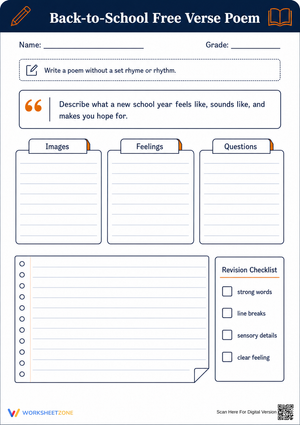
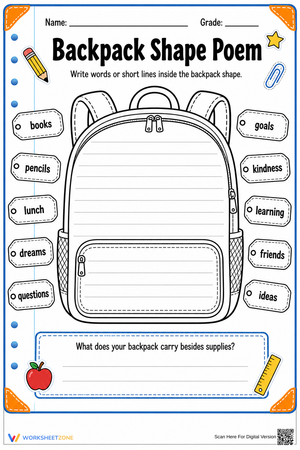
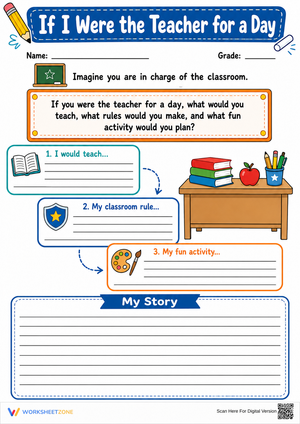
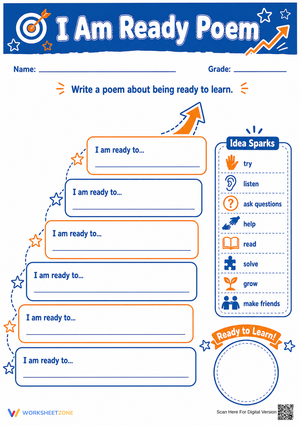
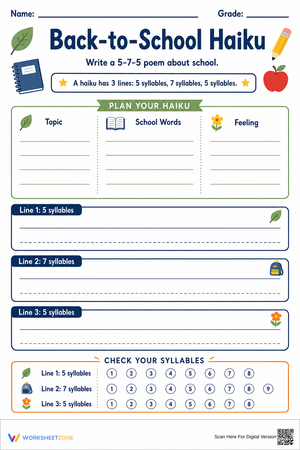
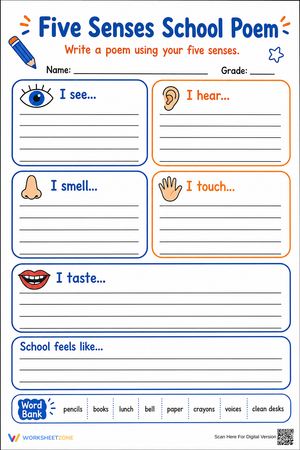
These fiction writing worksheets for 5th grade give teachers a process-wide structure that moves students from raw idea to edited draft — something a single open-ended prompt rarely delivers on its own. Each worksheet handles one part of that work: planning a believable conflict, drafting with forward momentum, adding dialogue that sounds like real speech, or identifying the revision spots that weaken a first draft. For a grade that expects multi-paragraph narrative with craft-level technique, having those pieces available as separate, printable tools makes the writing block genuinely easier to manage.
The Specific Skills Each Worksheet Targets
The set moves through narrative writing the way a well-run unit does — skills first, then application, then refinement. Planning worksheets ask students to define character motivation and conflict before they draft, which matters because fifth graders who skip planning tend to resolve their problems too quickly or lose the thread of cause and effect partway through. Drafting worksheets keep the event sequence visible with light structural reminders so students stay on track without being locked into a formula. Revision and editing worksheets give students a concrete task for improving their own writing rather than just rereading it and changing nothing.
- Character and setting development: trait lists, motivation prompts, and setting-detail organizers that give students something real to write from.
- Conflict planning: structured space for identifying the problem, raising the stakes, and mapping an event sequence with genuine cause and effect.
- Dialogue practice: worksheets that walk through formatting, attribution, and the purpose dialogue serves in moving a plot forward.
- Sensory and descriptive detail: organizers that push students beyond placeholder adjectives like nice or scary toward grounded, specific description.
- Transition and pacing work: targeted practice with temporal and causal language so event sequences do not collapse into a chain of "and then."
- Self-revision and editing: short checklists that help students review their own drafts with a concrete lens rather than just rereading without purpose.
Building These Worksheets Into Your Writing Block
The most practical entry point is pairing each worksheet with the mini-lesson that introduces the same skill. After a 10-minute whole-class demonstration on dialogue formatting — teacher modeling on chart paper, a shared example, two or three student observations — handing out the dialogue worksheet gives students a focused task for the independent writing block that follows. They are not starting from scratch; they are applying what they just watched. That match between lesson and worksheet is what keeps independent work productive instead of stalled.
In small-group instruction, these worksheets let you pull four or five students who are still stuck on planning while the rest of the class drafts independently. A conflict-mapping worksheet at that table gives those students a specific structure to work through rather than a repeat of the whole-class lesson they already heard. That targeted use — handing a particular worksheet to a particular table — is where a set with distinct, separate worksheets has clear value over a generic prompt sheet.
For centers and substitute days, each worksheet works because the directions live on the page and the task fits inside 15 to 20 minutes. A center might ask students to plan a character and central conflict, write one strong opening paragraph, or revise a flat sentence into something with sensory detail. Fiction writing worksheets for 5th grade also work well in an early-finisher folder: keep a few extension worksheets — revision challenges, alternate-ending prompts, "rewrite this weak opening" tasks — so stronger writers continue the same fiction skills rather than shifting to unrelated work.
Student Error Patterns Worth Catching Early
The most common problem in fifth-grade fiction drafts is not bad ideas — it is the gap between a solid story map and a flat draft. Students who plan carefully will sometimes write a story that simply retells the map: "First Marcus found the key. Then he went to the door. Then he opened it and the problem was solved." Each event is technically present, but nothing is rendered as a scene. There is no dialogue, no interior thought, no sensory grounding. Worksheets that push students to draft individual scenes — rather than list events — address this directly by asking them to show the character in the moment, not report on what happened.
Dialogue is another reliable trouble spot. Formatting errors are common — missing quotation marks, inconsistent punctuation before the attribution — but the deeper problem is function. Students write dialogue that exists for its own sake rather than advancing the plot or revealing character. "Hi," said Tom. "Hi," said Maria. "Want to go to the store?" "Sure." This kind of exchange stalls a story rather than moving it. A dialogue-focused worksheet that asks students to name why this conversation belongs in the story helps them make the connection between craft choice and narrative purpose.
Resolution collapse shows up in most grade 5 fiction sets. After two or three solid paragraphs of building conflict, students wrap up with a single sentence: "They worked it out and were friends again." The resolution is reported, not shown. Revision worksheets that ask students to identify where their ending begins — and whether the reader actually sees the solution play out — address this without the teacher marking every draft individually.
Standard Alignment
These worksheets align to CCSS.ELA-LITERACY.W.5.3, which asks fifth graders to write narratives using effective technique, descriptive details, and clear event sequences. The sub-standards break that expectation into the exact moves the worksheets practice: W.5.3a covers narrative techniques including dialogue, description, and pacing; W.5.3b addresses temporal words and transitions; W.5.3c focuses on concrete and sensory detail; W.5.3d requires a conclusion that follows naturally from the events of the story. A teacher planning a fiction unit around W.5.3 can assign worksheets from this set to address each sub-standard in sequence rather than trying to cover all four in the same lesson. That instructional fit — one sub-standard, one focused worksheet — also makes formative data more readable. If a student's dialogue worksheet is strong but their revision checklist shows weak sensory detail, the teacher knows exactly where to focus in the next draft conference.
Supporting Writers at Different Levels With the Same Set
Fiction writing worksheets for 5th grade land very differently depending on the writer. A developing writer handed a full story-drafting worksheet with six connected paragraphs expected may shut down before writing the first sentence. The right starting point for that student is a narrower task: a character-traits and motivation planner, or a conflict-mapping worksheet that asks for just three plot moments before any drafting begins. That narrowed scope is not a watered-down version of the assignment — it is a realistic entry point that produces actual writing.
On-level writers generally handle planning plus multi-paragraph drafting worksheets that expect three or four connected paragraphs with clear transitions and at least one instance of dialogue. The planning worksheet should still be present, but with less structural support — fewer labeled boxes, more open space for the student's own organizational choices.
For enrichment, the revision-focused worksheets are the strongest tools. Instead of assigning more planning, stronger writers benefit from tasks that ask them to rewrite a weak opening (cut "One day there was a girl named Leila" and start in the action), revise a flat ending into a scene that shows rather than tells the resolution, or replace five placeholder adjectives with grounded sensory language. Those tasks push writing quality without simply doubling the volume of work.
Frequently Asked Questions
Do these worksheets work better as part of a fiction unit or as standalone assignments?
Both. The full set of fiction writing worksheets for 5th grade supports a structured fiction unit where each stage — planning, drafting, revision, editing — has a clear, visible deliverable. Used individually, each worksheet targets a specific skill students can practice during a mini-lesson follow-up, a center rotation, or independent work time. Teachers running a four-week writing unit often use the full sequence; teachers who want to address one weak skill without rebuilding their unit pick the relevant worksheet and assign it once.
How many class sessions does a typical worksheet take to complete?
Planning and revision worksheets generally fit inside one independent writing block of 20 to 30 minutes. Drafting worksheets — particularly those asking for multiple connected paragraphs — may take two sessions depending on how much prewriting the student has already done. Building in a clear stopping point works well because students can see exactly where they left off and pick up without losing the thread of their story.
Can these worksheets replace writing conferences?
No, and they are not meant to. A revision checklist helps a student identify problems; it does not teach them how to fix a weak scene the way a two-minute teacher conference can. The worksheets reduce the repetitive procedural instruction that eats conference time — students who already know how to format dialogue before they draft need far less correction later — but a teacher's feedback on individual work remains essential for growth. Think of the worksheets as handling the procedural layer so conferences can stay focused on the writerly decisions.
Are these worksheets appropriate for ELL students or students with IEPs?
The more structured planning worksheets — labeled boxes for character, setting, conflict, and plot events — give ELL students a visual anchor for narrative elements they are learning in a new language. For students with IEPs, the narrow, task-specific format of each worksheet reduces the open-endedness that can be a barrier. A student who struggles with unstructured writing tasks can complete a character-traits planner successfully, which gives them something concrete to draft from. Accommodations like extended time and reduced writing quantity apply to these worksheets the same way they apply to any classroom writing task.












 Interactive Worksheet Maker
 Quiz Maker
 Word Search Maker
 Crossword Puzzle Maker
 Word Scramble Generator
 Sentence Scramble Generator
 Handwriting Worksheet Generator
 Name Tracing Generator
 Fill In The Blank Generator