




























Views
Downloads

Essential Back-to-School Free Verse Poem | Grade 5 ELA

Paste this activity's link or code into your existing LMS (Google Classroom, Canvas, Teams, Schoology, Moodle, etc.).
Students can open and work on the activity right away, with no student login required.
You'll still be able to track student progress and results from your teacher account.
This Grade 5 ELA worksheet facilitates the creation of original free verse poetry, allowing students to express their thoughts on the new school year without the constraints of rhyme or rhythm. By guiding learners through a structured brainstorming process, the activity ensures that final poems are rich with sensory details and authentic emotional resonance.
At a Glance
- Grade: 5 · Subject: ELA
- Standard:
CCSS.ELA-LITERACY.W.5.4— Produce clear and coherent writing appropriate to task, purpose, and audience- Skill Focus: Free verse poetry and pre-writing
- Format: 1 page · 5 tasks · Revision checklist included · PDF
- Best For: Back-to-school icebreaker and creative writing
- Time: 25–40 minutes
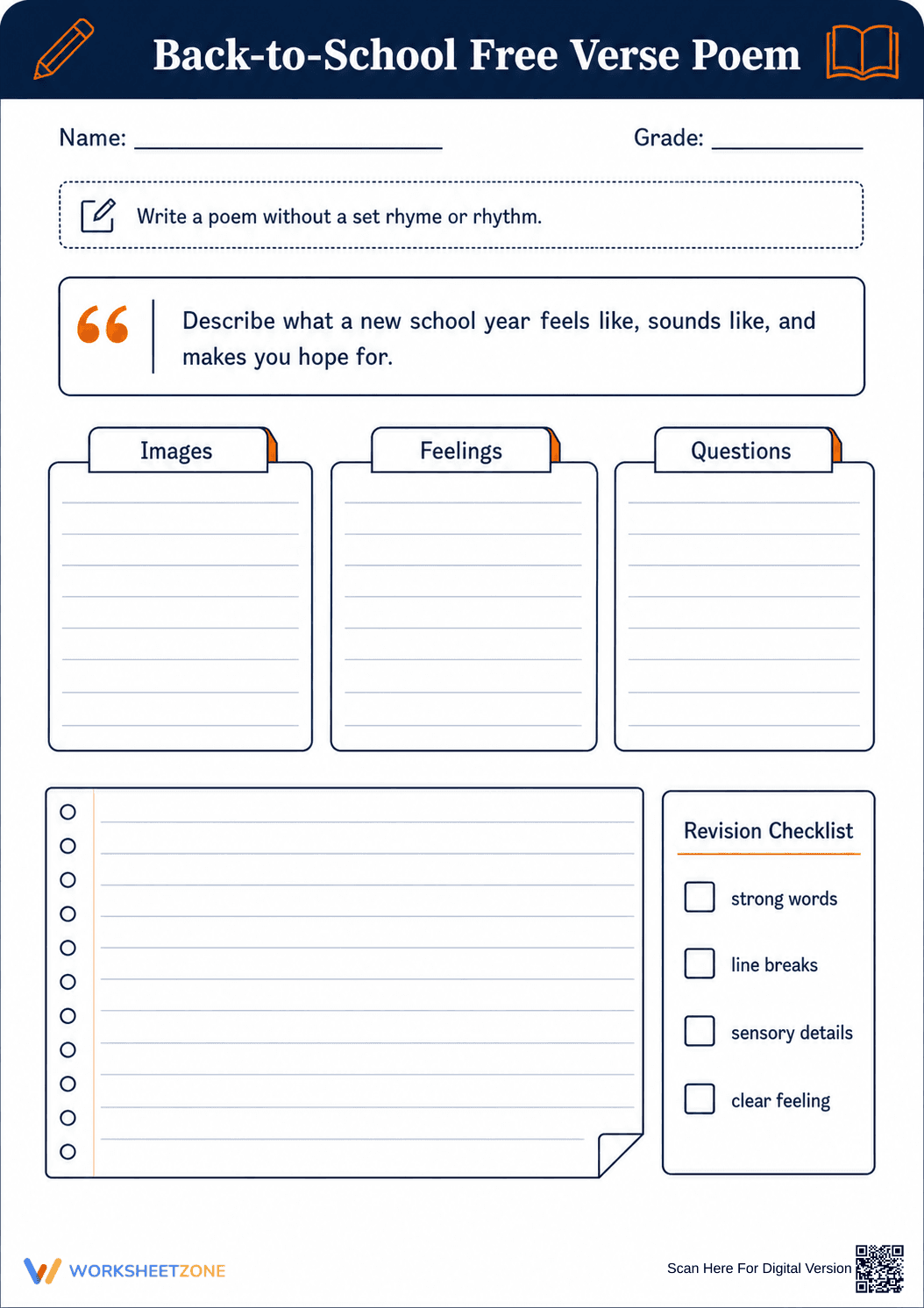
The worksheet features a clean, professional layout designed to minimize distractions. It includes three distinct brainstorming tabs labeled Images, Feelings, and Questions, providing 12 lines of pre-writing space. The lower half of the page offers a dedicated writing area with 10 wide-ruled lines and a built-in revision checklist featuring four critical criteria: strong words, line breaks, sensory details, and clear feeling.
Zero-Prep Workflow
- Print: Generate the single-page PDF for your class (30 seconds).
- Distribute: Hand out sheets and explain that free verse requires no rhyming (2 minutes).
- Review: Students work independently while you circulate for formative assessment (30 minutes).
Total teacher preparation time is under two minutes, making this an ideal resource for sub plans or first-week morning work.
Standards Alignment
This resource is primarily aligned with `CCSS.ELA-LITERACY.W.5.4`, focusing on coherent writing. It also supports CCSS.ELA-LITERACY.W.5.3.D regarding the use of sensory details to convey experiences. Both standard codes can be copied directly into lesson plans, IEP goals, or district curriculum mapping tools.
How to Use It
Use this as a first-week writing diagnostic to observe vocabulary and descriptive skills. It is an excellent poetry unit opener. Observe students during brainstorming to identify those needing support with sensory language. Completion typically takes 30 minutes, providing a quiet, focused activity during busy transition periods.
Who It's For
Designed for Grades 4-8, this is effective for learners who find rhyming rules intimidating. Pair this with a mentor text by Kwame Alexander to provide a model before students begin their own drafts. It is particularly helpful for students needing structured pre-writing support.
According to the RAND AIRS 2024 report on literacy instruction, providing students with structured brainstorming frameworks significantly improves the quality of creative output in middle-grade learners. This worksheet utilizes a multi-sensory approach to poetry, aligning with CCSS.ELA-LITERACY.W.5.4 by requiring students to produce clear and coherent writing appropriate to the task of self-reflection. By categorizing pre-writing into images, feelings, and questions, the resource scaffolds the complex task of free verse composition, which lacks the traditional safety net of rhyme and meter. Research from Fisher & Frey (2014) suggests that such graphic organizers serve as essential cognitive supports during the "You Do" phase of gradual release. This printable tool ensures that students focus on word choice and sensory details rather than just structural mechanics. Educators can use this resource to assess baseline writing skills during the first week of school while fostering a classroom culture of creative expression and emotional literacy.


