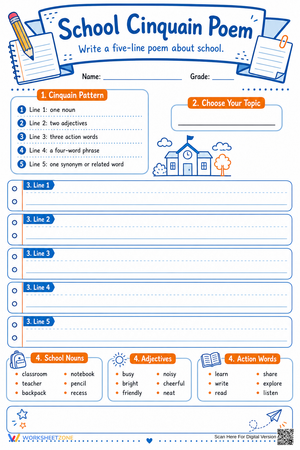
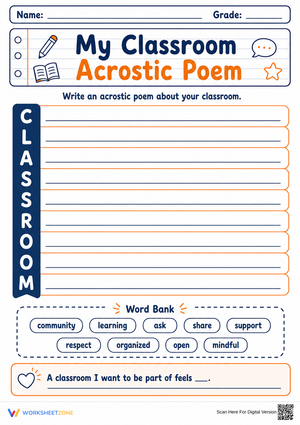
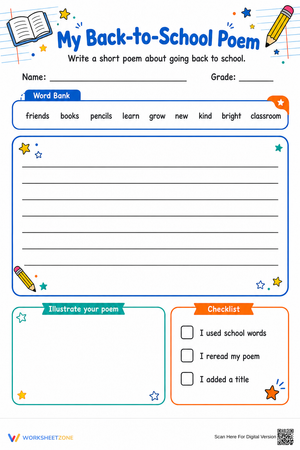
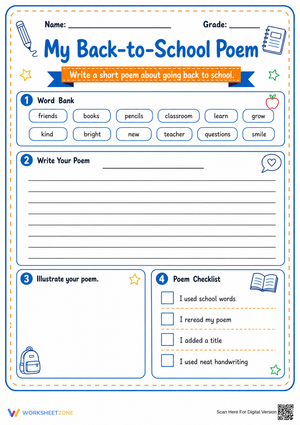
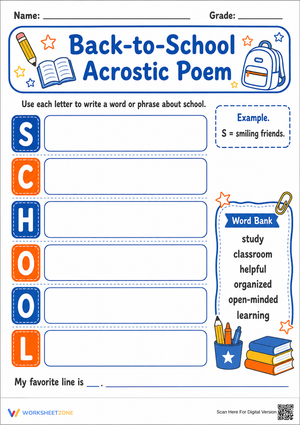
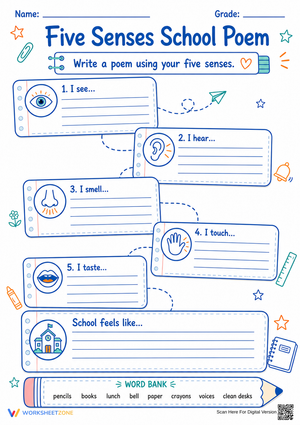
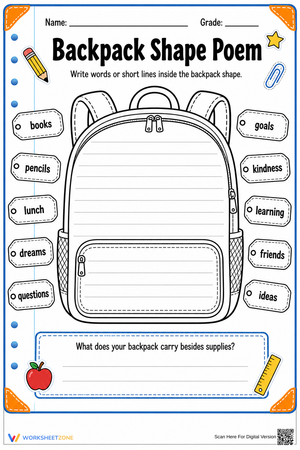
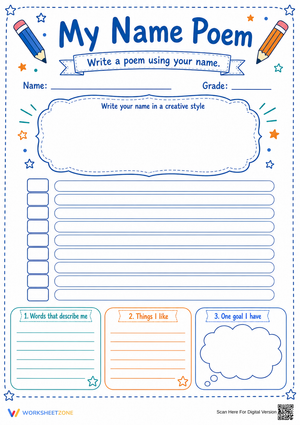
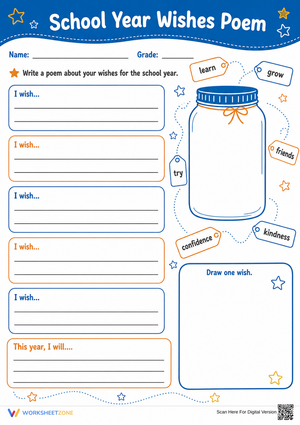
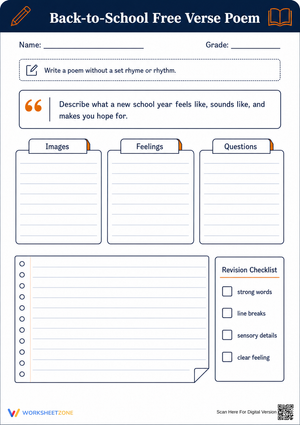
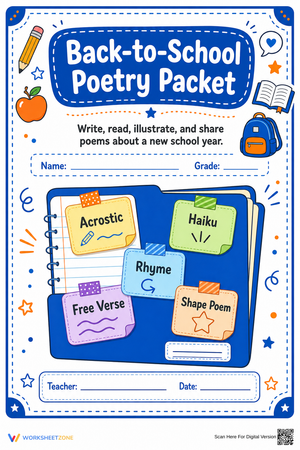
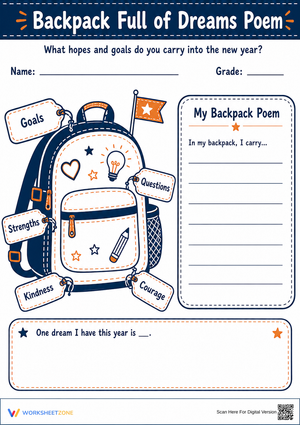
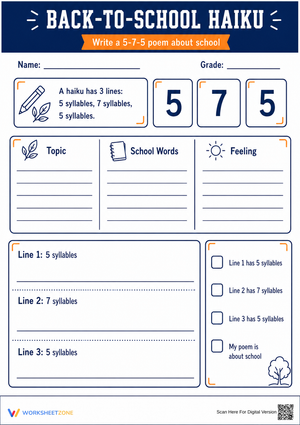
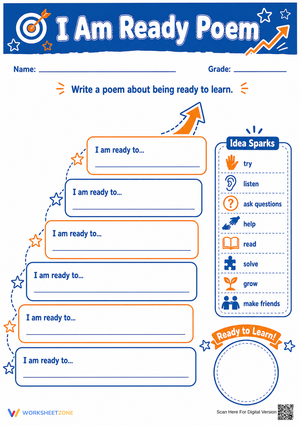
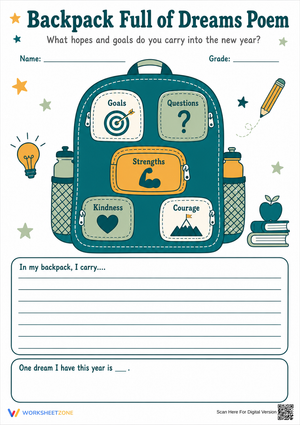
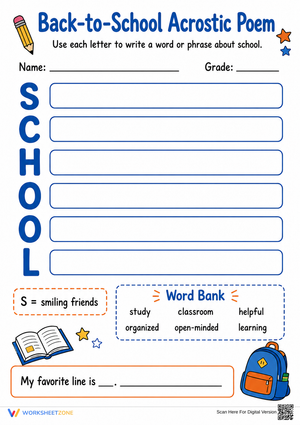
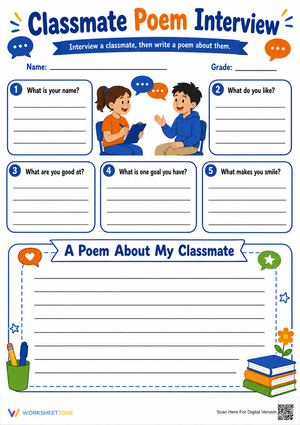
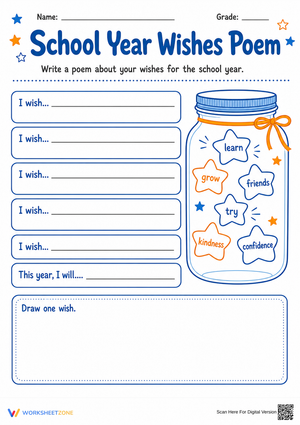
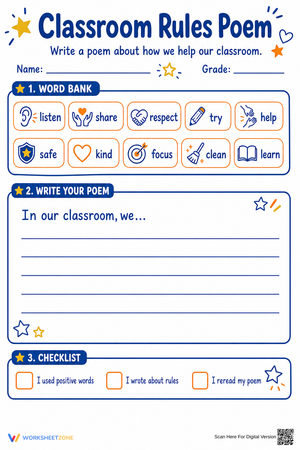
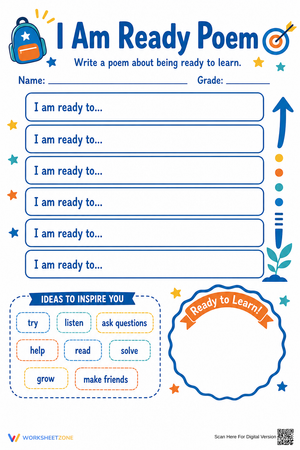
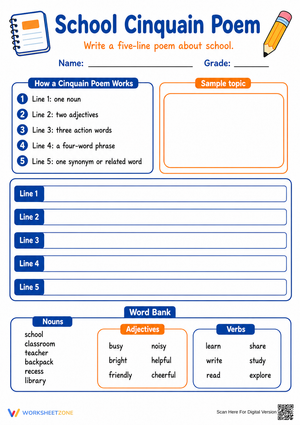
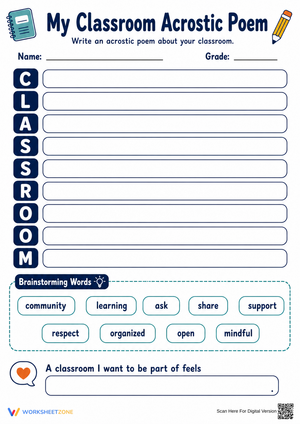
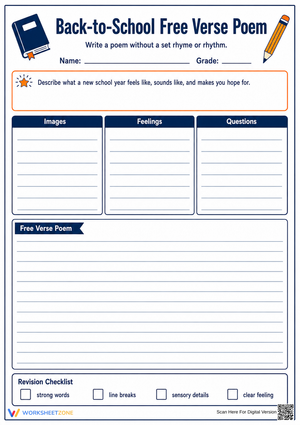
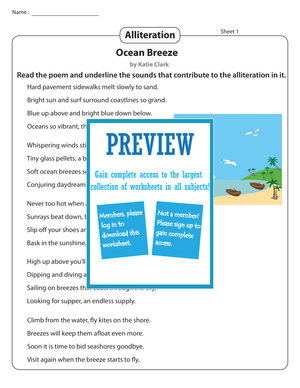
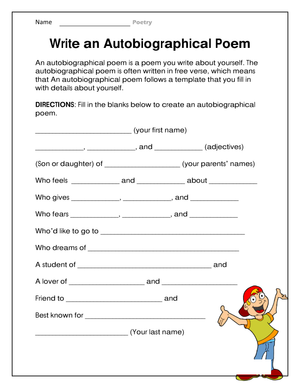
These poetry printable worksheets for 5th grade give teachers a set of close-reading resources built around actual Grade 5 reading literature expectations — not generic comprehension questions that could sit under any genre. Each worksheet pairs a poem with text-dependent prompts that move students from surface-level observation toward explanation of how craft choices shape meaning. The format holds up across whole-group lessons, small groups, and independent center practice without requiring extra prep between those uses.
The Specific Skills Each Worksheet Targets
Fifth grade is when students are expected to shift from noticing figurative language to explaining what it does — why the poet chose a metaphor rather than a direct statement, how a shift in tone between stanzas changes what the poem communicates. These worksheets push students toward that explanatory layer consistently.
- Theme: Students identify the central message and cite specific lines as evidence, not just restate the topic in different words.
- Figurative language: Simile, metaphor, personification, and imagery prompts ask students to explain the effect of each device — what it helps a reader understand — not just locate it in the text.
- Stanza structure: Students examine how line breaks and stanza divisions create emphasis, and why a poet might end a stanza where the central idea is unresolved.
- Speaker and tone: Students distinguish the speaker from the poet and describe the emotional attitude that specific word choices create.
- Sound devices: Rhyme scheme, rhythm, and repetition get treated as intentional craft choices rather than decorative features students simply circle and move past.
One poem can support mini-lessons on theme, figurative language, and structure in a single class period — which is one reason poetry holds more instructional density per text than a comparable prose passage at the same reading level. The prompts in this set are built to take advantage of that.
Student Errors Worth Anticipating Before the Lesson
The errors that appear most often in fifth-grade poetry work cluster around two persistent habits. First, students consistently conflate the speaker with the poet. They write "the author feels lonely" when the poem uses a first-person speaker who may have nothing to do with the author's biography. This is worth a direct, explicit correction before students attempt speaker and tone questions independently — a brief discussion of persona, drawing one example from a familiar poem, usually handles it. The confusion does not resolve on its own if teachers skip past it.
The second habit is treating figurative language identification as the finished product. Students who have spent years being asked "find the simile" will underline it, label it, and wait. When a worksheet prompt asks "what does this comparison help you understand about the subject?", those same students write the comparison back out rather than explaining it. Modeling a worked example — reading a specific line aloud and walking through the move from identification to explanation — closes that gap faster than any written feedback after the fact. The prompt structure in these worksheets anticipates that pattern: questions are sequenced to move from "what is this?" toward "why does it work here?"
A third pattern worth watching: when a poem uses tercets or irregular stanzas, students often treat the line breaks as arbitrary — a formatting decision rather than a meaningful choice. Asking students to mark where the poem's central idea shifts, before they respond to structure questions, helps them read the form as intentional.
How to Work These Worksheets Into Your Lesson Plans
The clearest entry point is the first ten minutes of an ELA block. A poem read aloud, followed by two minutes of independent annotation — underline a vivid image, circle a word that signals tone — gives teachers a fast read on where the class is before instruction begins. That bell-ringer use is low-stakes, but it pays off when the same worksheet continues into a mini-lesson or partner response later in the period.
Within a 45-minute block, one efficient sequence is: read the poem aloud with attention to phrasing, lead a brief whole-group discussion around a single prompt, then release students to complete the remaining questions with a partner or independently. The worksheet carries the structure of that gradual release so the teacher can circulate or pull a small group rather than managing a set of instructions. For poetry printable worksheets for 5th grade to do their most useful work, teachers generally get better results when they run this sequence across two consecutive days — analysis on day one, composition on day two — rather than compressing everything into one period.
These resources also sit reliably in a sub tub or homework folder because the poem and all prompts appear on the same worksheet. A substitute does not need curriculum context to hand them out, and a student at home does not need a second document to complete the task.
Turning Analysis Into Student Composition
After students annotate a poem and answer text-dependent questions, the most productive next move is a short writing task anchored to what they just read. These worksheets include prompts that ask students to do things like rewrite one stanza from a shifted perspective and explain how the change alters the poem's meaning, or imitate the poem's structural pattern — same number of stanzas, same use of repetition — with a different subject entirely.
The distinction between "write a poem" and "write a poem that uses this specific structure" is significant at Grade 5. Open prompts tend to produce rhyme-above-all-else drafts where students sacrifice meaning to close a couplet. A structured imitation prompt keeps students accountable to the craft moves they just analyzed as readers, which produces more interesting writing and keeps the lesson coherent from reading into writing. When students have a mentor poem in front of them with their own annotations visible, academic language like stanza, speaker, and imagery migrates naturally into writing conferences without a separate vocabulary review.
Adjusting the Set for Mixed-Ability Classrooms
Poetry printable worksheets for 5th grade serve a wider range of learners than many teachers expect, partly because short poems do not overwhelm struggling readers with volume before they get to the thinking. A student who reads slowly but carefully can still do real analytical work on a twelve-line poem in a way that is harder to manage with a two-page informational passage.
For students who need additional support, the most effective adjustment is reducing the number of questions per sitting rather than simplifying the questions themselves. A student who answers two interpretation questions with textual evidence is doing more valuable work than one who races through six recall prompts. Pairing the worksheet with an oral read-aloud before independent written response — teacher, partner, or audio recording — removes the decoding barrier without reducing the analytical demand.
Advanced readers benefit from extension work that moves beyond a single poem: comparing how two poets treat the same theme using contrasting imagery, or analyzing what happens to the reader's experience when a structural element like a refrain is removed. English language learners generally do better when three to five content-specific words from the poem are introduced before reading — brief, contextual definitions rather than a vocabulary list — which preserves access to the poem's meaning without replacing the literary analysis with simpler tasks.
Standard Alignment
These worksheets address CCSS.ELA-LITERACY.RL.5.4, which asks students to determine the meaning of words and phrases in a poem, including figurative language and words that convey meaning beyond the literal. They also target RL.5.5, which asks students to explain how a series of stanzas fits together and contributes to the overall structure of a text. In practical classroom terms, RL.5.5 is what separates fourth-grade from fifth-grade poetry expectations: fourth graders describe structure, fifth graders explain what structural choices accomplish. The stanza-based questions and composition prompts in this set are built with that distinction as the target, not as a secondary consideration.
Frequently Asked Questions
Are these worksheets appropriate for both whole-class lessons and independent center work?
Yes. Each worksheet is self-contained — the poem and all prompts appear together — so students do not need supplementary materials to complete the task. That makes the same worksheet usable during direct instruction with full teacher support and later during an independent literacy center with no reformatting or additional explanation required.
How long does one worksheet typically take for fifth graders to complete?
Most students finish in 20 to 30 minutes, depending on the depth of the written response prompt and how much discussion time is built in. Teachers who use these as warm-ups often assign just the annotation and one question, saving the full task for a longer instructional block.
Can teachers use these worksheets as formative assessments rather than just practice?
The written response prompts work well for informal formative assessment because they ask students to explain thinking rather than select an answer. That gives teachers a clear view of whether students are analyzing craft choices or just labeling them. For summative purposes, teachers should review the prompts against their own unit objectives before treating any of these as a formal grade. These poetry printable worksheets for 5th grade are built for regular practice and lesson support — which also means they generate daily evidence that informs instruction more reliably than a single end-of-unit test.
Do these work for students who read below fifth-grade level?
Short poems reduce the volume-related barriers that make grade-level prose harder to access for below-level readers. Students reread a brief text multiple times rather than working through a long passage once, which keeps the cognitive focus on comprehension and analysis rather than stamina. For students significantly below grade level, pairing oral reading of the poem with the written prompts — rather than expecting fully independent silent reading — keeps the task within reach without eliminating the analytical work.












 Interactive Worksheet Maker
 Quiz Maker
 Word Search Maker
 Crossword Puzzle Maker
 Word Scramble Generator
 Sentence Scramble Generator
 Handwriting Worksheet Generator
 Name Tracing Generator
 Fill In The Blank Generator