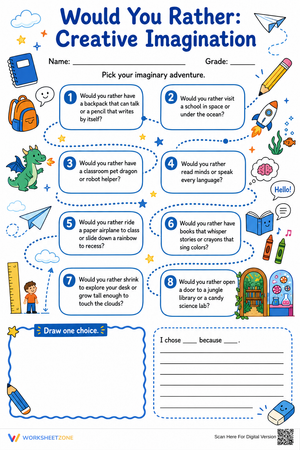
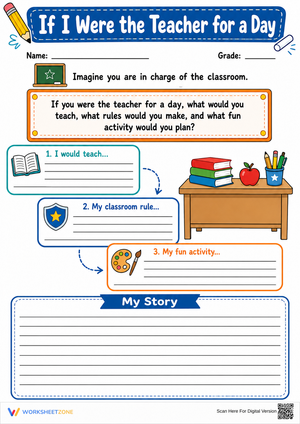
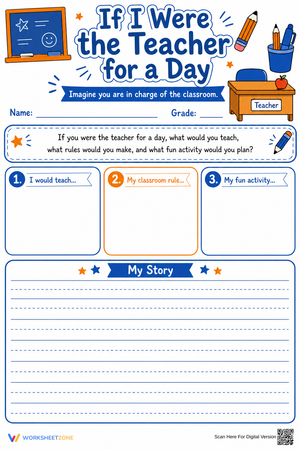
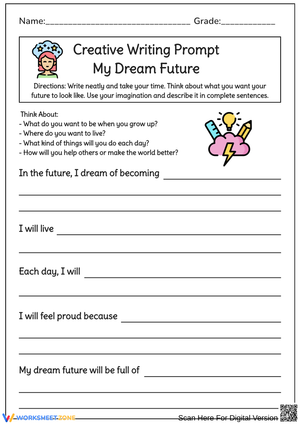
These creative writing pdf worksheets for 5th grade give teachers a set of printable narrative tasks built around the specific moves fifth graders need to master: deliberate sequencing, purposeful pacing, dialogue that reveals rather than summarizes, and endings that actually close the story. Each worksheet pairs a focused prompt with planning support so students can move from idea to complete draft in a single writing block. The format works in whole-class instruction, writing centers, take-home packets, and sub plans without any additional prep.
What's Built Into Each Worksheet
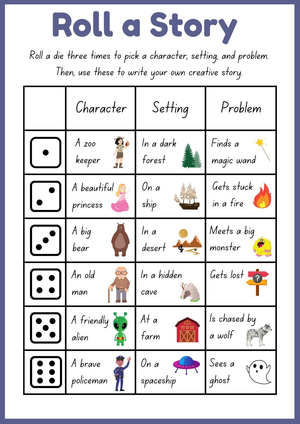
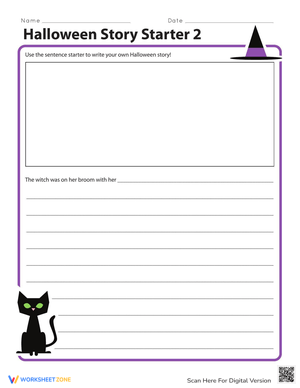
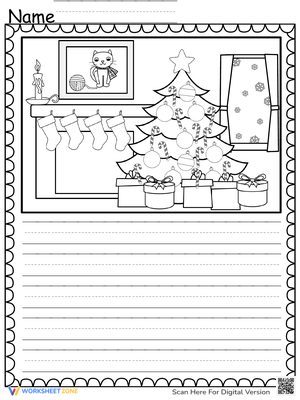
At grade 5, students are developmentally ready to manage a story arc — beginning, middle, turning point, resolution — but most still need a visible structure to hold it together under time pressure. These worksheets provide that structure without deciding the story for the student. A typical worksheet in the set includes a specific prompt, a short planning area for character, setting, and problem, draft space, and at least one craft cue that focuses attention on a single technique.
- Event sequencing: Planning boxes ask students to name the story's problem, turning point, and resolution before drafting — so they arrive at the draft knowing where the story is going.
- Dialogue cues: Several worksheets ask students to include at least one exchange of dialogue — not as decoration, but as the moment where conflict or relationship becomes visible on the draft.
- Sensory and setting detail: Prompts that open with a specific location or time push students past "it was a regular day" openers into writing that grounds the reader immediately.
- Conclusions: A dedicated closing section keeps students from ending mid-scene, which is the most consistent structural gap in fifth-grade narrative drafts.
- Pacing awareness: Some worksheets include a brief reminder to slow down at the story's most important moment — a practical nudge that improves story shape without requiring a separate lesson.
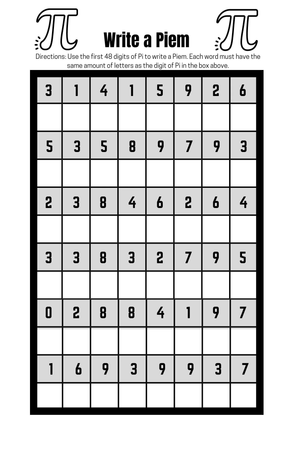
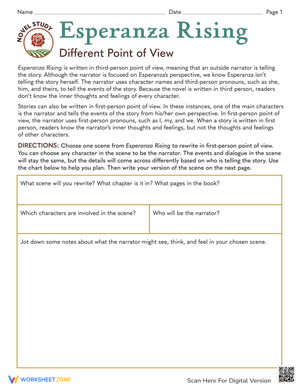
The worksheets vary in layout — some use a linear planning path, others use a box arrangement — so students encounter the same narrative skills in slightly different contexts across the set.
Student Error Patterns Worth Knowing Before You Hand These Out
The most common structural problem in fifth-grade narrative drafts is the "and then" chain: students string events together using "and then" or "next" rather than building toward a turning point. The story keeps moving but never arrives anywhere. These worksheets address that pattern directly by asking students to identify a problem and a turning point during the planning stage — before a single sentence is drafted — which interrupts the chain before it starts.
A subtler error shows up in the pacing. Students who handle the beginning and middle confidently tend to rush through the climax — the exact moment that deserves the most space. A student who has spent two full paragraphs setting up a soccer championship will often resolve it in one sentence: "I kicked the ball and we won." Worksheets that include a pacing reminder help catch this before it becomes a habit, though the pattern still needs explicit reinforcement in your mini-lessons alongside the worksheet practice.
Endings are the other consistent gap. Without a specific closing section, many fifth graders end by announcing the theme rather than finishing the story: "And that's when I learned that friends are important." A worksheet that reserves space for a final image or action — rather than a reflection — produces endings that actually feel finished.
Working These Worksheets Into Your Writing Instruction Week
The most effective use of these worksheets is not as a standalone creative activity but as a quick application block tied to a specific skill you have already taught. After a 10-minute mini-lesson on dialogue punctuation and purpose, hand out a worksheet that includes a dialogue cue. Students have an immediate context to apply what you just modeled, and you have something concrete to examine during the share-out at the end of the block.
For centers, a consistent stack of creative writing pdf worksheets for 5th grade with identical directions means students can rotate in without needing a re-explanation. An index card posted above the stack — read the prompt, complete the planning section, write the full draft — gives students a three-step sequence they manage independently after the first week of practice.
Sub plans are another reliable use. A substitute does not need writing expertise to hand out a well-structured narrative worksheet and keep a class on task — the built-in directions carry the lesson. Teachers who work in teams also find the PDF format practical for sharing across classrooms without any layout surprises in printing.
Standard Alignment
These worksheets connect directly to W.5.3 from the Common Core State Standards for ELA, which expects fifth graders to write real or imagined experiences using effective technique, descriptive details, clear event sequences, and a sense of closure. In practical classroom terms, that standard means students need repeated practice with the full narrative arc — not just brainstorming ideas or drafting openings in isolation. A worksheet that walks a student through planning, drafting, and ending a complete narrative, even a short one, hits the core expectation of W.5.3 more directly than a prompt-only worksheet does.
Teachers building a writing block around a Writers Workshop model can use these creative writing pdf worksheets for 5th grade as structured independent practice during the drafting phase — the part of the workshop where students write on their own after the whole-class lesson. The worksheets do not replace conferencing or revision cycles, but they give students a clear task to work through while you pull small groups.
Adjusting Each Worksheet for a Range of Writers in the Room
Students who freeze at open-ended prompts benefit most from the planning boxes. Directing those students to fill in a character name, setting, and problem before touching the draft space gives them something concrete to write toward. Adding a sentence stem — verbally or on a sticky note alongside the worksheet — provides a starting point without altering the worksheet itself for the rest of the class.
For students ready to move past step-by-step planning, the adjustment is simple: fold back or cover the planning section and hand out just the prompt and draft space. This works especially well for fifth graders who think best by writing rather than outlining in advance — a real and predictable subset of any class. The prompt still anchors the work; the pre-writing structure just steps back.
A third option worth keeping in your toolkit: after a student finishes an initial draft, attach a one-item revision checklist targeting a specific craft skill — varied sentence length, precise word choice, or stronger verb selection. That turns the same worksheet into a quick revision exercise without adding a separate resource to manage.
Frequently Asked Questions
What should a strong 5th grade creative writing worksheet include?
At minimum: a focused prompt, planning structure for story elements, draft space, and at least one craft cue targeting a narrative technique. A conclusion section is worth including on most worksheets because fifth graders who are not prompted to finish a story frequently end by stopping mid-scene. Planning boxes matter more at this grade level than at grades 3–4 because students are managing longer story ideas and can lose the thread partway through without a reference point to return to.
How do these worksheets connect to standards-based writing instruction?
W.5.3 expects students to develop real or imagined experiences with technique, detail, event sequence, and closure — exactly what a well-built narrative worksheet practices. These worksheets are not enrichment fillers. When students complete creative writing pdf worksheets for 5th grade that include all four of those elements, they are rehearsing the same craft moves assessed in longer on-demand writing tasks and scored writing samples.
Can these worksheets work for students at different writing levels in the same class?
Yes, with the minor adjustments described in the differentiation section above. The core worksheet stays the same for every student; the support level shifts based on how much of the planning structure each student uses. Students who need more direction work through the full planning section. Students ready for independence write from the prompt alone. The result is that the whole class works on the same narrative task at the same time, which simplifies your monitoring and whole-class discussion afterward.
Is the PDF format easier to manage than editable document formats?
For most teachers, yes. PDFs print cleanly from any device, hold their layout in the copier queue, and travel intact through email and learning-management systems. Editable documents can drift when shared across different software versions — text boxes shift, fonts substitute, page breaks move. For a resource used across multiple classrooms or sent home regularly, the stability of the PDF format removes a small but steady source of prep friction over the course of a school year.












 Interactive Worksheet Maker
 Quiz Maker
 Word Search Maker
 Crossword Puzzle Maker
 Word Scramble Generator
 Sentence Scramble Generator
 Handwriting Worksheet Generator
 Name Tracing Generator
 Fill In The Blank Generator