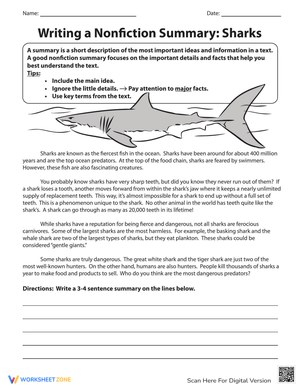
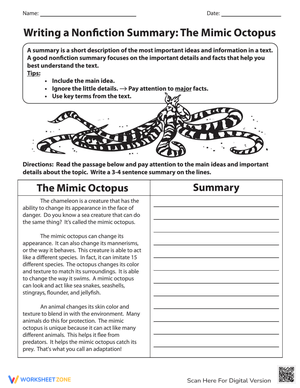
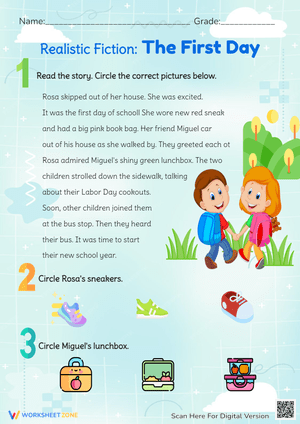
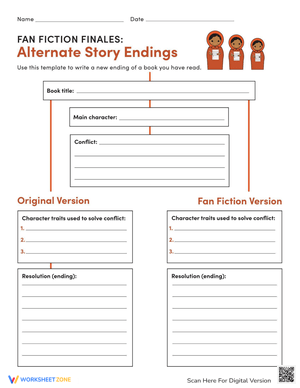
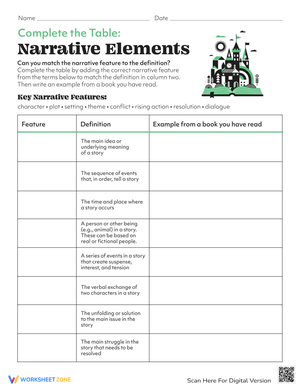
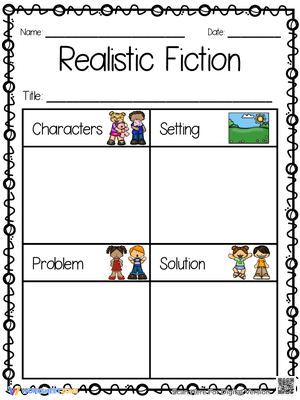
These 5th grade realistic fiction printable worksheets address something writing teachers see all the time: students understand that realistic fiction means a made-up but believable story, yet turning that idea into a coherent narrative — with a grounded character, a logical problem, and a resolution that actually follows from the events — is harder than it first looks. The set covers character development, story planning, event sequencing, dialogue, and revision in standalone worksheets that work across writing workshop, small groups, and intervention blocks.
The Narrative Skills Each Worksheet Targets
At fifth grade, realistic fiction writing involves more than stringing events together. The story elements have to function as a system: a character's traits and motivation drive the problem, the problem shapes which events matter, and the resolution has to feel earned rather than dropped in at the end. Each worksheet isolates one part of that system, which reduces cognitive load during drafting and keeps individual lessons focused enough to assess clearly.
- character traits, internal motivation, and how those traits generate conflict
- setting details that influence what characters do and decide, not just describe a backdrop
- a realistic problem — one that could plausibly happen at school, home, or in a community — and a resolution tied to it
- event sequencing from an inciting moment through rising action to a satisfying ending
- dialogue that reveals character rather than just moves plot forward
- revision moves targeting story openings, scene detail, transitions, and endings
Mistakes Fifth Graders Make That Are Worth Catching Early
The most persistent error in realistic fiction is what might be called fantasy drift — the moment a story that started as a friendship conflict slides into the character discovering a secret tunnel or developing a mysterious ability. Students understand the genre constraint intellectually, but under pressure to keep writing, the imaginative pull toward the extraordinary takes over. An explicit character motivation worksheet, where students commit in writing to what their character wants and why it matters in everyday life, holds writers in the realistic lane more reliably than a verbal reminder alone.
A second pattern worth watching: students who build a strong setup — detailed character, vivid setting, real-feeling problem — and then collapse the resolution into a sentence like "And then they made up and everything was fine." That compression usually means the student didn't plan the resolution before drafting. Story planning worksheets that ask students to write out how the problem gets resolved, and why the character changes as a result, give that ending more weight before a word of the actual story gets written.
Dialogue is another consistent weak spot. Fifth graders writing realistic fiction often produce exchanges that read like stage directions with quotation marks: "Let's go to the park," said Maria. "Okay," said Dani. A targeted dialogue worksheet that asks students to revise a flat exchange by adding an action beat, an internal thought, or an emotional subtext pushes them toward something that actually sounds like conversation.
How to Work These Worksheets Into Your Writing Unit
These worksheets work best when sequenced to match the arc of a writing unit rather than handed out whenever there's a gap. A natural flow: use the character and setting worksheets during prewriting, the story map during planning, the dialogue and description worksheets during the drafting phase, and the revision checklist near the end. That sequence makes each resource feel like part of the instruction, not a supplement distributed when time allows.
The 5th grade realistic fiction printable worksheets also fit in the gaps where teachers routinely scramble for usable independent work — the ten minutes before the class switches to math, a literacy center that needs a focused task, or a sub plan that has to keep a writing unit moving without teacher-led explanation. Because each worksheet targets one skill, students can work through the task independently once the concept has been introduced in a mini-lesson.
Small-group use is especially productive. If writing conferences reveal that several students consistently rush their resolutions, one targeted worksheet becomes the whole lesson for that group. There's no need to pull the whole class back when the need is specific and shared among just a handful of writers. One visible advantage of this set is that when students keep their planning, drafting-support, and revision worksheets together, teachers can trace exactly where a weak final story broke down — limited prewriting, thin event sequencing, or a rushed ending — which makes conferences faster and reteaching more direct.
Standard Alignment
These worksheets align to Common Core State Standards Writing Standard W.5.3, which asks fifth graders to write narratives using narrative techniques, descriptive details, and clear event sequences to develop real or imagined experiences. In classroom terms, that standard breaks into specific sub-skills this set addresses directly: W.5.3a (establishing a situation and narrator) maps to the character and story setup worksheets; W.5.3b (narrative techniques like dialogue and description) maps to the dialogue and sensory detail worksheets; W.5.3c (transitions) and W.5.3e (a conclusion that follows from narrated events) map to the sequencing and revision worksheets. Teachers working in CCSS-aligned districts can assign individual worksheets by sub-standard rather than treating the set as a single block of instruction.
Differentiating the Set Across a Range of Learners
For students who struggle to generate ideas before writing, the character and setting worksheets work well paired with a brief verbal prewriting step — a two-minute partner conversation before anything goes on the worksheet. Some writers freeze when shown an open planning grid; talking through what their character cares about before writing reduces that initial block considerably and gives hesitant students something concrete to record rather than something to invent from nothing.
For students who need more challenge, the same worksheets extend without requiring entirely different materials. Require that the resolution directly contradicts a character trait the student recorded during the planning worksheet. Ask a stronger writer to revise a dialogue exchange so that the setting details from an earlier worksheet appear organically in the conversation. Those constraints push more capable writers toward thinking carefully about how story elements connect. The 5th grade realistic fiction printable worksheets are structured loosely enough that the tasks stretch or compress depending on what a particular writer needs at that moment in the unit.
Frequently Asked Questions
What distinguishes realistic fiction from other narrative genres at the fifth-grade level?
Realistic fiction operates by the same rules as everyday life — no magic, no alternate history, no invented creatures. For fifth graders, that typically means characters who are roughly their age, settings like school, home, or a neighborhood, and problems tied to relationships, responsibility, fairness, or belonging. The genre deserves specific attention at this grade because students are moving toward longer, more complex narratives, and the believability constraint forces them to develop characters and plots with more internal logic than they might apply to fantasy or adventure writing.
How do these worksheets fit inside a writing workshop structure?
Each worksheet functions as a mini-lesson follow-up, a guided practice task, or an independent center activity depending on where students are in the unit. The planning worksheets work early as structured prewriting. The drafting-support worksheets — dialogue, description, transitions — belong in the middle of the unit when students are actively composing. Revision worksheets close the unit before final publication or assessment. That sequence gives writing workshop a clear arc and natural checkpoints without requiring teachers to develop additional materials.
Can students use these worksheets if they have never written realistic fiction before?
Students who have written personal narratives but not realistic fiction benefit especially from the planning worksheets, which make the shift from "things that happened to me" to "things that could happen to a character I invented" concrete and manageable. The 5th grade realistic fiction printable worksheets in this set assume some prior narrative writing experience but do not assume students have worked in this specific genre before.
Do these worksheets address revision, or only planning and drafting?
Revision is often the most underdeveloped phase in a realistic fiction unit. Students tend to treat it as proofreading, so having worksheets specifically focused on narrative revision — strengthening the opening hook, adding scene detail, checking whether the resolution connects back to the problem — gives that phase real instructional weight. A revision worksheet that asks students to locate the moment their character makes a key decision and then check whether that moment has enough scene detail around it produces more substantive edits than a general "fix it up" prompt ever does.












 Interactive Worksheet Maker
 Quiz Maker
 Word Search Maker
 Crossword Puzzle Maker
 Word Scramble Generator
 Sentence Scramble Generator
 Handwriting Worksheet Generator
 Name Tracing Generator
 Fill In The Blank Generator