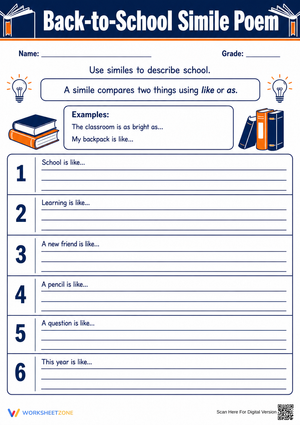
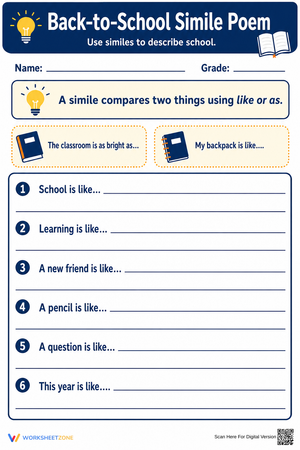
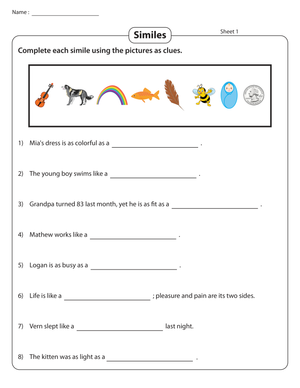
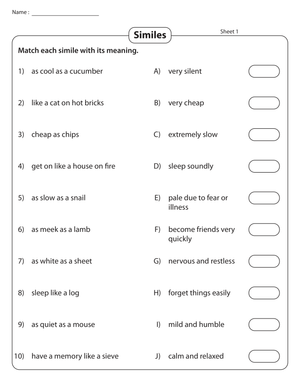
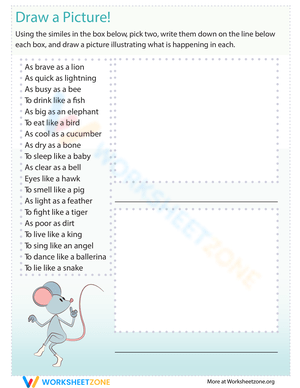
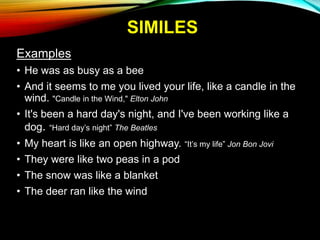
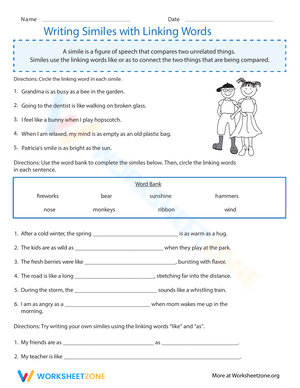
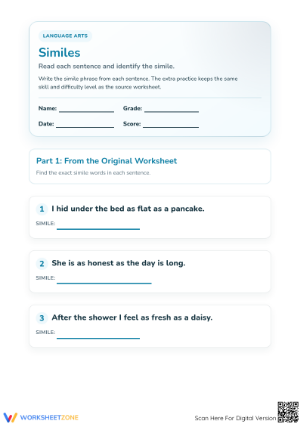
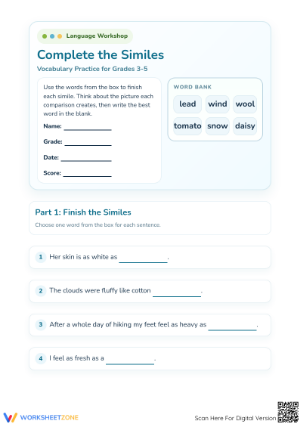
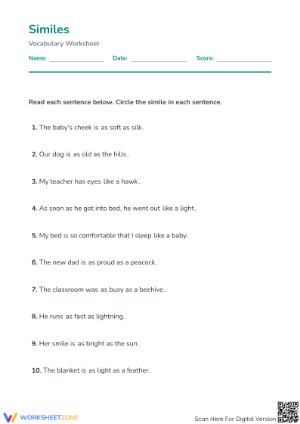
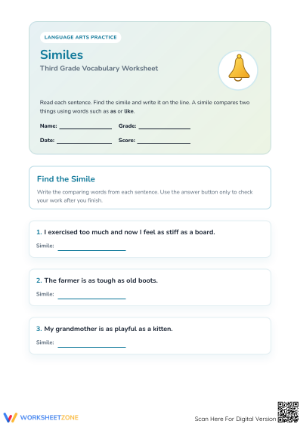
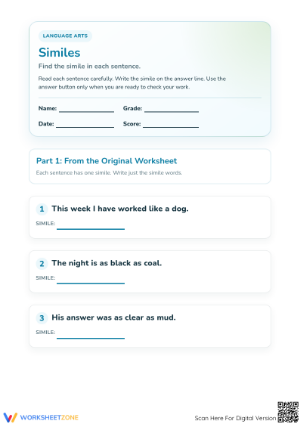
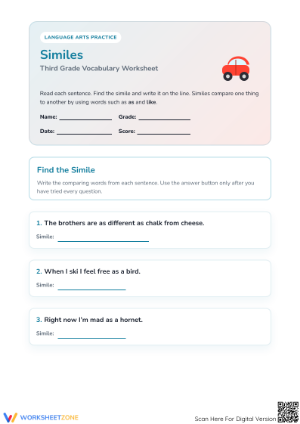
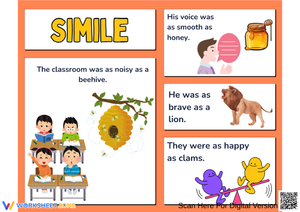
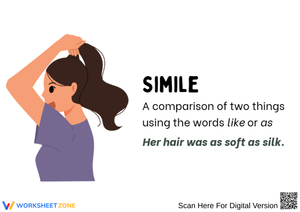
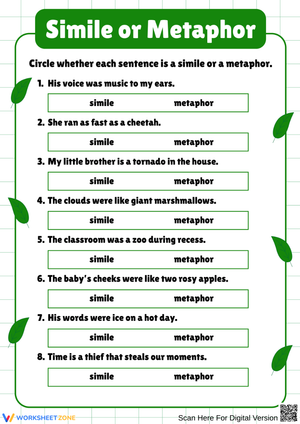
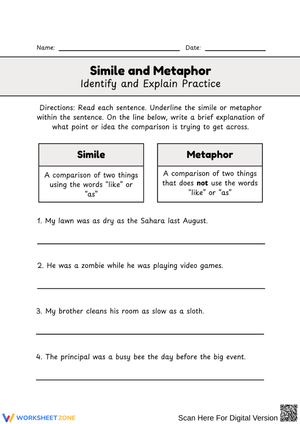
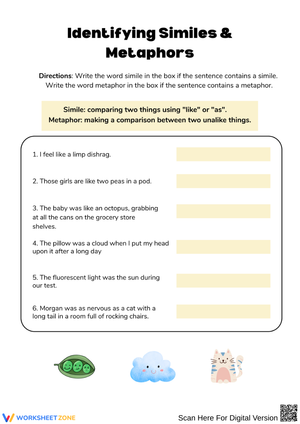
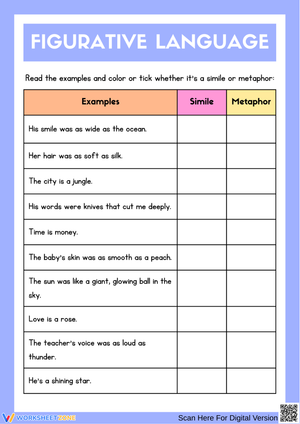
These similes worksheets for 5th grade give teachers something more useful than basic underline-the-comparison drills — each worksheet moves students past recognition and into interpretation, asking them to explain what a figurative comparison contributes to a sentence, poem, or short passage. The set targets identification, meaning-making in context, and the simile-versus-metaphor distinction, which is where Grade 5 figurative language instruction needs to arrive. Because these are printable PDFs, they fit the lesson slots that don't accommodate device-dependent tasks: warm-ups, literacy centers, intervention folders, and Friday review blocks.
What Students Are Asked to Do Across the Set
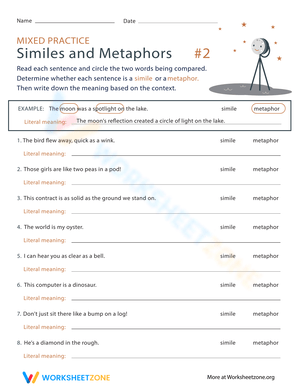
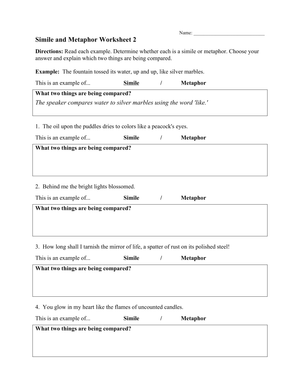
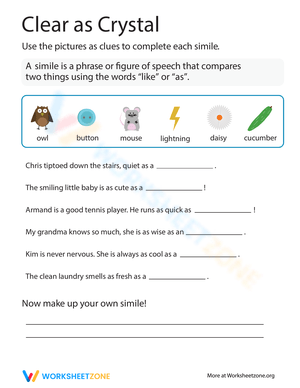
The tasks build from naming to explaining. Students identify the simile and name both things being compared, then restate the comparison in plain, literal language — not just "she was quiet" but something closer to "the comparison means she went completely unnoticed, like background noise everyone has stopped hearing." That restatement step is the most instructionally valuable task on any figurative language worksheet because it forces the shift from visual scanning to actual interpretation.
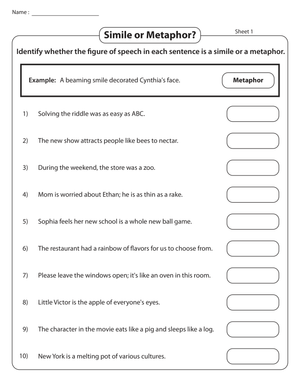
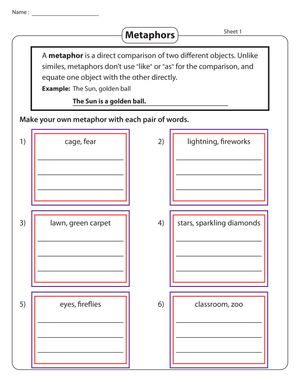
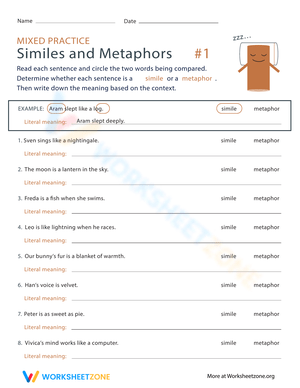
Beyond restatement, items across the worksheets ask students to select the best meaning from two close options, infer what a simile suggests about mood or character in a short passage, and sort examples by form when similes and metaphors appear together. That last task carries real weight because students who can define both forms during direct instruction will still label "the room was a furnace" as a simile during independent work — especially when the surrounding items all use like or as. Any similes worksheets for 5th grade set that mixes both forms without flagging which is which surfaces that confusion before it shows up on a test.
Mistakes Students Make That These Worksheets Help You Catch
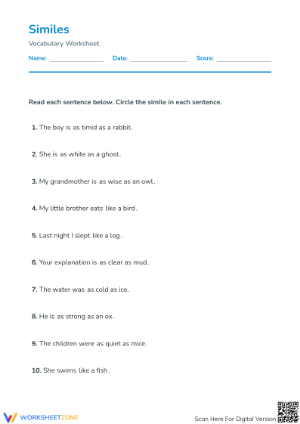
The predictable error at this grade level is not failing to notice a simile — most fifth graders can circle the comparison words within a few minutes of direct instruction. The gap appears at interpretation. A student reads "her voice was like gravel on a dirt road" and writes that it means "she sounded rough." That answer shows word-level awareness without real interpretive work: the student hasn't used surrounding context to decide what that roughness implies — harshness, fatigue, age, authority — based on what the rest of the sentence or passage is doing. These worksheets slow that step down by requiring a second sentence of explanation, not just a paraphrase of the comparison phrase.
A second pattern that shows up consistently is overconfident labeling late in a worksheet. When several simile items run in sequence, some students stop reading for structure and start defaulting to pattern-matching — the fifth item resembles the fourth, so it must be a simile too. Inserting a metaphor mid-sequence disrupts that shortcut and gives teachers real diagnostic information. Students who catch it are reading for structural meaning. Students who miss it are scanning for familiar surface features.
How to Build These Worksheets Into Instruction Without Treating Them as Filler
The most effective sequence runs across several days rather than one concentrated block. On Monday, unpack two or three simile examples aloud with visible think-aloud commentary before students touch a worksheet — that teacher talk does the interpretive setup. Tuesday, students work through a sentence-level worksheet independently. By Thursday, after reading a poem or short passage together, a context-heavy worksheet functions as both application practice and a quick formative check. That spacing reflects what spaced retrieval research consistently shows: students retain figurative language concepts better when practice is distributed across the week rather than packed into a single afternoon.
The format also handles several specific slots that don't always accommodate longer activities:
- Pre-reading warm-ups: the 8–10 minutes before reading workshop begins is one of the most underused windows in a Grade 5 day; one focused worksheet fills it without eating into lesson time.
- Literacy centers: each worksheet is self-directing and completable in about 15 minutes without teacher support.
- Intervention folders: keep two or three targeted worksheets ready for students who consistently collapse the simile-metaphor distinction during independent reading.
- Sub plans: each worksheet is self-contained and doesn't depend on device access or a specific lesson's prior context.
Standard Alignment
These worksheets align to CCSS.ELA-LITERACY.L.5.5a, which requires fifth graders to interpret figurative language including similes and metaphors. In classroom terms, that standard rarely stands alone: it connects directly to RL.5.4, which asks students to determine the meaning of words and phrases in literary text, including figurative language. Teachers building toward RL.5.4 in a reading unit will find these worksheets useful as formative checkpoints distributed across instruction rather than only as a review tool at the end. The standard is explicit that interpretation — not just identification — is the Grade 5 expectation, which is why every worksheet in the set includes at least one item that asks students to explain what a simile reveals, not merely name what it is.
Tiering the Set for Students at Different Points in Figurative Language Understanding
Sorting by cognitive demand is more instructionally useful here than sorting by a generic difficulty label. One group works with sentence-level items, familiar comparison vocabulary, and an optional word bank for restating meaning. A second group works without the word bank and must explain meaning in their own words. A third group receives short passage context where the simile's meaning depends on surrounding details — the inference load is higher, and the answer can't be pulled from the comparison phrase alone.
For students who need more support, the right adjustment is fewer items with the interpretation task preserved — not a switch to identification-only work. Dropping interpretation removes the most diagnostically useful data point: teachers need to see whether a student's gap is in recognition or in meaning-making, and circling exercises don't reveal that distinction. For extension, the most productive task is asking students to write an original simile that matches the tone of a passage they've just read, then explain why their comparison fits. The resulting sentences reveal vocabulary range, tone awareness, and figurative reasoning all at once. A well-chosen similes worksheets for 5th grade set that flexes across those three levels reduces the separate material teachers have to locate or build from scratch.
Frequently Asked Questions
What should fifth graders be able to do with a simile beyond identifying one?
They should be able to name the two things being compared, restate the comparison in literal language, and explain what the simile implies in context — whether that's a character's emotional state, the feel of a setting, or the tone of a specific moment. They should also be able to distinguish a simile from a metaphor when both appear in close proximity in the same text.
How do these worksheets fit alongside a broader figurative language unit?
Each worksheet works best after direct instruction rather than instead of it. Introduce the concept, model several examples aloud with visible thinking, then assign a worksheet to see whether students can transfer the same reasoning to new text. Earlier worksheets in the set suit initial practice right after first instruction; context-heavy worksheets suit review and formative assessment as the unit develops over two or three weeks.
Do these worksheets address the distinction between similes and metaphors?
Several worksheets include both forms in the same exercise, which is where the distinction becomes genuinely meaningful. Students who have only seen similes in isolation often develop a surface scan strategy — looking for like or as — rather than reading for structural meaning. Mixing both forms on the same worksheet interrupts that shortcut and gives teachers a clearer picture of actual conceptual understanding versus pattern recognition.
What should I look for in a simile set built for test preparation?
State assessments typically ask students to determine the meaning of figurative language inside a reading passage — not just identify its form. The printables in a strong similes worksheets for 5th grade collection address that specific demand by requiring students to interpret what a simile reveals in context rather than simply label it. The most effective test-prep use pairs one worksheet with brief class discussion of student answers so errors are corrected before the assessment rather than after.












 Interactive Worksheet Maker
 Quiz Maker
 Word Search Maker
 Crossword Puzzle Maker
 Word Scramble Generator
 Sentence Scramble Generator
 Handwriting Worksheet Generator
 Name Tracing Generator
 Fill In The Blank Generator