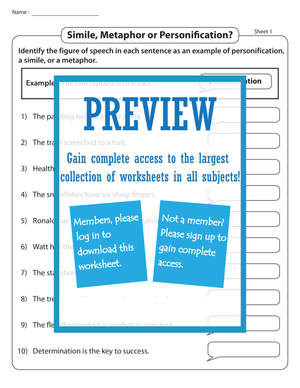
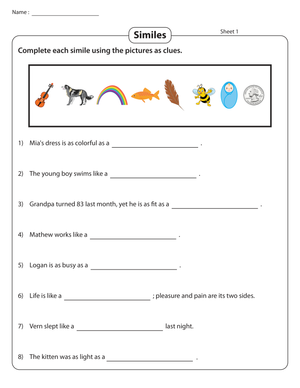
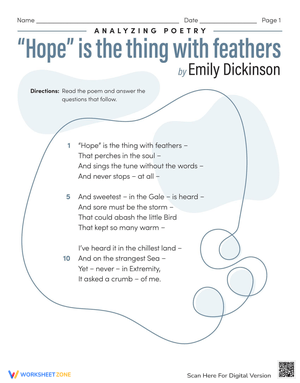
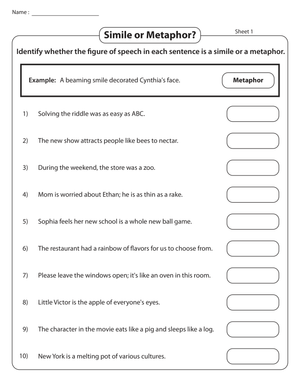
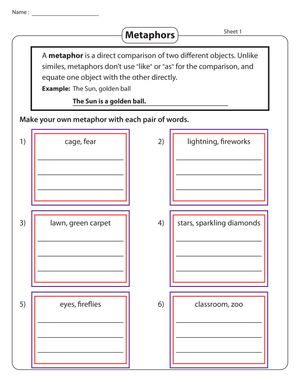
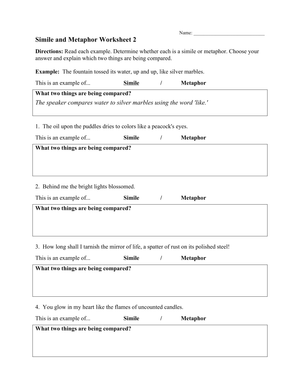
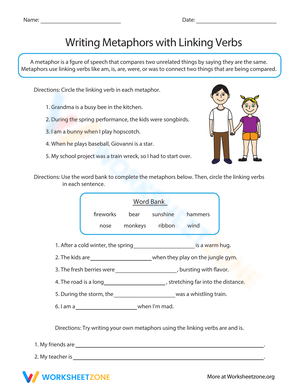
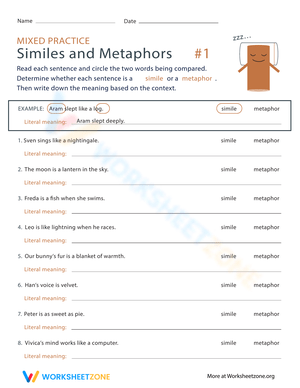
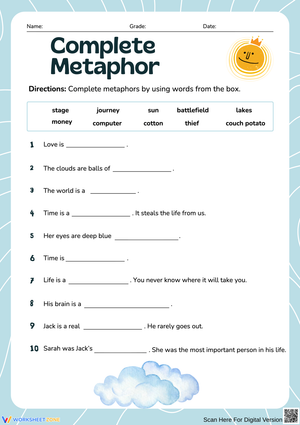
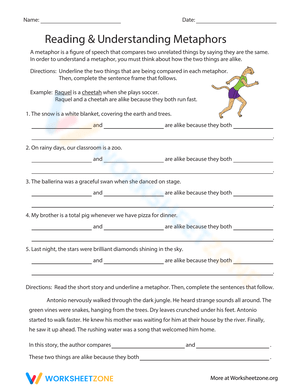
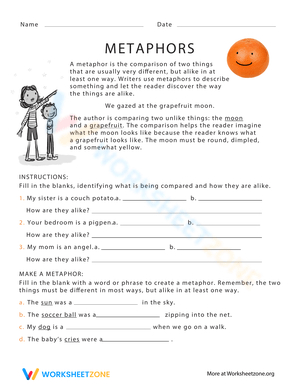
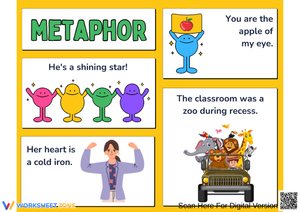
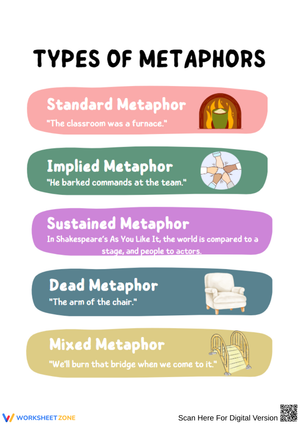
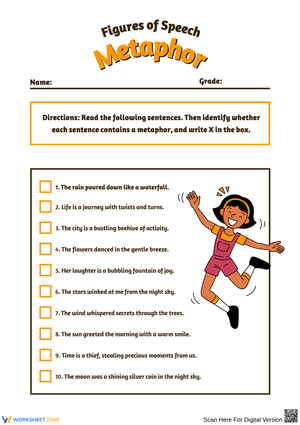
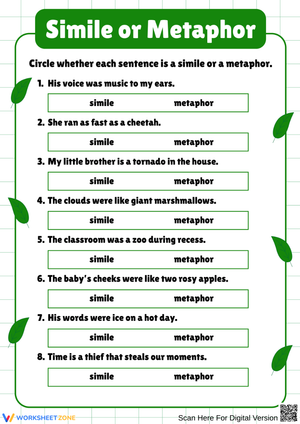
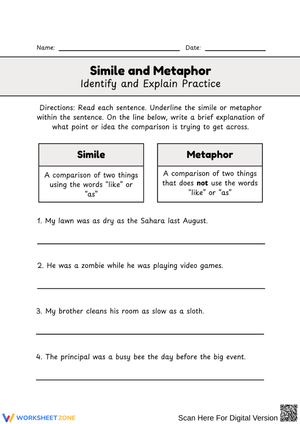
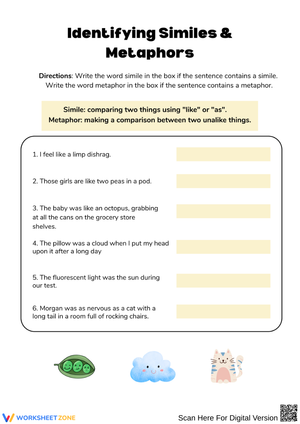
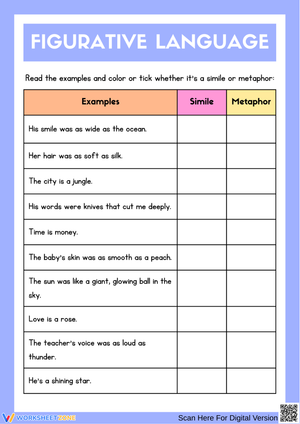
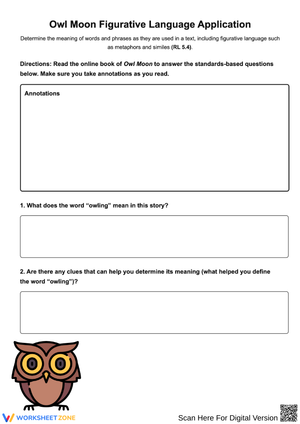
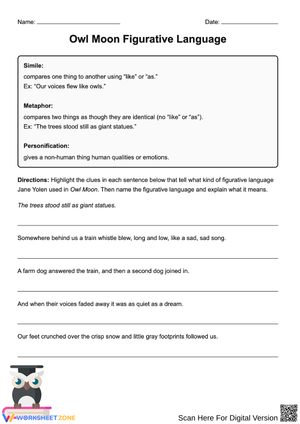
These metaphors printable worksheets for 5th grade give teachers ready-to-print practice that moves students past underlining figures of speech and into the harder work of interpreting them. Each worksheet asks students to name the two unlike things being compared, identify the shared trait, and read the nonliteral meaning back into the sentence or passage. That three-part structure — locate, name, explain — is what separates knowing what a metaphor is from understanding what a specific metaphor does.
The Specific Skills Each Worksheet Targets
Fifth grade is the right moment to press on figurative language interpretation. Students are reading enough — in novels, informational passages, and mentor texts — to encounter metaphors regularly, but they still need explicit practice unpacking how comparisons work. The skills the set builds fall into five categories:
- Locate the metaphor: Students identify the figurative comparison in a sentence or short paragraph, not just circle any vivid phrase.
- Name the comparison: Students write out the two unlike things the writer is equating.
- Explain the shared quality: Students describe the single trait that makes the comparison work — the "so what" behind the figure of speech.
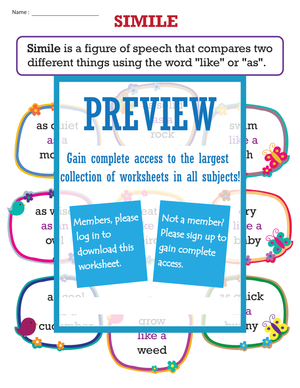
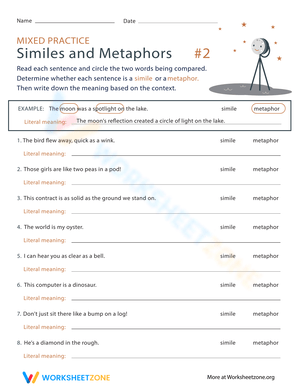
- Sort simile vs. metaphor: Students use the absence of like or as as a structural check, then confirm the comparison is direct.
- Write original metaphors: Students generate their own comparisons in complete sentences, applying the concept rather than only recognizing it.
That last task is where gaps surface most clearly. A student may read and explain three teacher-written metaphors without trouble, then write "The dog was fast like a cheetah" when asked to produce one. The simile habit runs deep at this grade. Worksheets that require original metaphor writing — not just identification — reveal that confusion quickly.
Student Mistakes Teachers Should Watch For and Address
The most telling error in fifth grade metaphor work shows up during explanation tasks, not identification. A student marks "Her voice was honey" correctly, then writes: "She had a sweet voice." That restates the idea without naming the shared quality. A more diagnostic version of the same mistake appears with unfamiliar metaphors: given "The city was a machine," a student who relies on familiar associations will explain the comparison fluently, while a student working from a fragile definition will write "the city was mechanical" — circular, not an explanation of a shared trait.
A second pattern worth watching: students treat any vivid sentence as a metaphor. "The fog rolled in slowly" gets marked because it creates an image. Returning to the structural definition — a direct comparison that states one thing is another — helps students apply a consistent test rather than make a judgment call about language they find interesting. Mixed item sets that include similes and non-examples alongside actual metaphors make that distinction visible without any additional teacher explanation.
Working These Worksheets Into Your Lesson Planning
The most efficient classroom routine for this skill is: model two examples aloud, think through the shared trait in front of students, then hand off the worksheet for guided or independent practice. Review answers together before asking students to apply the same reasoning in one original sentence connected to a character, setting, or topic from current reading. That sequence keeps each worksheet tied to instruction rather than floating as an isolated skill check.
Specific entry points that work reliably: the first eight minutes of class as a focused warm-up using four to six items, a literacy center rotation where students work for ten to twelve minutes without support, homework following an initial in-class introduction, and small-group reteach where teacher and students work through each item together before students attempt the remaining ones independently. These metaphors printable worksheets for 5th grade stay practical across all of those slots because task directions are self-contained and each worksheet requires nothing beyond a pencil.
Standard Alignment
These worksheets address CCSS.ELA-LITERACY.L.5.5a, which requires students to interpret figurative language — including similes and metaphors — in context. In classroom terms, that standard sits at the intersection of language study and reading comprehension. Students who can explain a metaphor are also better prepared to discuss an author's word choice in literature conferences and address it in short written responses. Pairing a worksheet with an excerpt from a novel currently in the read-aloud cycle keeps the standard connected to real text rather than treating it as a stand-alone grammar unit.
Adjusting the Set for a Range of Learners
The most practical differentiation lever is the explanation demand. For students still building identification skills, the immediate goal is reliably locating the comparison before worrying about the shared trait. A word bank listing possible shared qualities — warmth, strength, chaos, speed — gives those students the vocabulary to complete explanation items without getting stuck on word retrieval, which is a separate problem from understanding the figure of speech.
On-level practice works best with a mixed worksheet: two or three identification items, one or two written explanations, and a simile-versus-metaphor sort. For extension, ask students to revise a flat, literal sentence by inserting a metaphor and then annotate their revision — explaining why the comparison fits and what it adds to the meaning. That task requires generating, evaluating, and justifying a figure of speech, which is genuinely harder than recognizing one. Using metaphors printable worksheets for 5th grade that include open-ended writing prompts supports this kind of tiered use without requiring separate handouts for each level.
One efficient way to score metaphor work across levels is to check for three things separately: identification, interpretation, and transfer. A student who locates the metaphor but cannot explain the shared trait needs reteaching focused on meaning, not on the definition. A student who explains modeled examples correctly but cannot write one needs sentence modeling and revision practice. That three-part check turns any worksheet into a fast planning tool for small-group decisions.
Frequently Asked Questions
What is the difference between a simile and a metaphor, and how should I explain it to fifth graders?
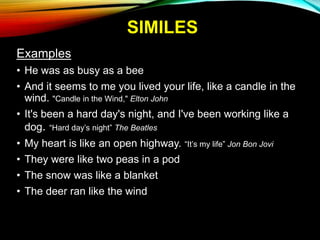
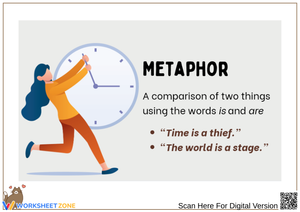
A simile uses like or as to signal the comparison; a metaphor makes it directly, stating that one thing is another. The most useful teaching move is to write the same comparison both ways — "Her laugh was music" and "Her laugh was like music" — and read them aloud. Students hear the difference before they can reliably sort examples on paper, so the side-by-side demonstration usually lands faster than a definition alone.
How many items should a fifth grade metaphor worksheet include?
Six to ten items is a practical range for independent practice. Fewer than six rarely gives enough variety to reveal patterns in student thinking. More than ten items, especially when each requires a written explanation, creates a fatigue problem — the last few responses tend to be rushed and less informative than the first few. For a formative exit ticket, three to four items with an explain-the-meaning prompt is enough to show whether the concept is landing or needs another round.
Can these worksheets replace direct instruction on figurative language?
No — and using them that way is where teachers run into trouble. These metaphors printable worksheets for 5th grade work as practice after the concept has been introduced, as review between reading and writing blocks, and as a formative check to inform small-group planning. They don't replace the teacher-led discussion where students have to articulate why a comparison makes sense. Worksheets extend and confirm understanding; they don't build it from the ground up.
How do I know if a student truly understands metaphors or is just pattern-matching?
Give them an unfamiliar metaphor drawn from a different genre or subject area and ask them to explain it in writing without support. A student with solid understanding works through a new example by applying the definition. A student who has been pattern-matching on familiar phrases will stall or produce a literal reading. The written explanation task on any well-constructed worksheet is the diagnostic lever — identification alone does not separate the two groups.












 Interactive Worksheet Maker
 Quiz Maker
 Word Search Maker
 Crossword Puzzle Maker
 Word Scramble Generator
 Sentence Scramble Generator
 Handwriting Worksheet Generator
 Name Tracing Generator
 Fill In The Blank Generator