


























0
Views
0
Downloads

0.0
0
Save
0 Likes
Share
Create Your Own Metaphors: Creative Writing Worksheet
0 Views
0 Downloads
Paste this activity's link or code into your existing LMS (Google Classroom, Canvas, Teams, Schoology, Moodle, etc.).
Students can open and work on the activity right away, with no student login required.
You'll still be able to track student progress and results from your teacher account.
Information
Description
What It Is:
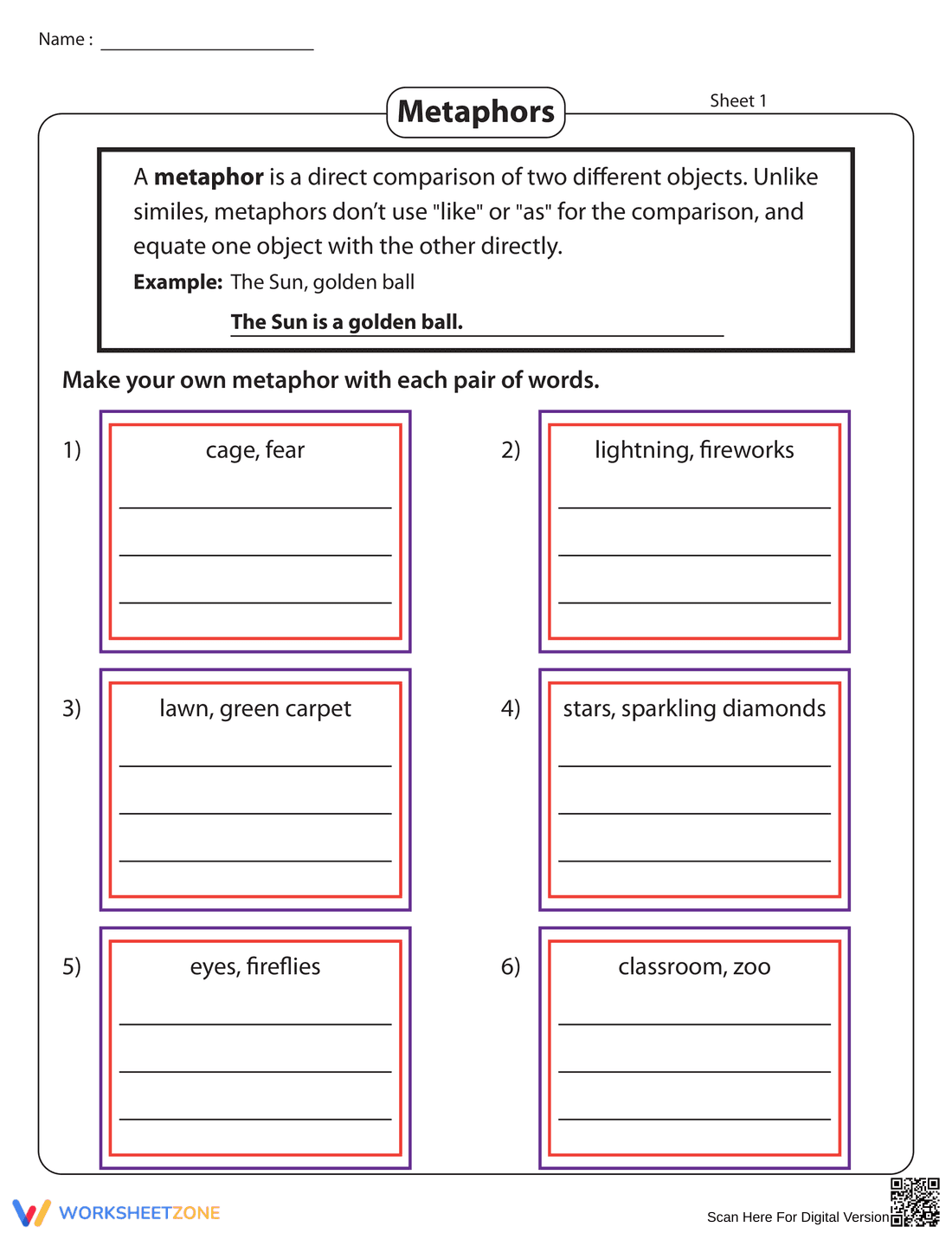
This is a worksheet designed to teach and reinforce the concept of metaphors. It provides a definition of a metaphor, contrasting it with similes, and offers an example. The main activity requires students to create their own metaphors using provided pairs of words like 'tears, raindrops,' 'lightning, fireworks,' 'lawn, green carpet,' 'stars, sparkling diamonds,' 'eyes, fireflies,' and 'classroom, zoo.' There are lines provided for students to write their metaphors.
Grade Level Suitability:
This worksheet is suitable for grades 4-6. The concept of metaphors is typically introduced in the upper elementary grades, and the vocabulary used is appropriate for this age group. The activity requires creative thinking and language skills that are developed at this level.
Why Use It:
This worksheet helps students understand and apply the concept of metaphors, enhancing their creative writing and reading comprehension skills. It encourages them to make connections between seemingly unrelated objects and express those connections in a figurative way. It also reinforces the difference between metaphors and similes.
How to Use It:
First, review the definition and example of a metaphor provided at the top of the worksheet. Then, for each pair of words, students should write a sentence or phrase that uses one word as a metaphor for the other. For example, for 'tears, raindrops,' a student might write 'Tears are raindrops of sadness.' Students should aim to create vivid and imaginative comparisons.
Target Users:
This worksheet is designed for elementary and middle school students who are learning about figurative language, specifically metaphors. It is also useful for teachers looking for creative writing exercises to improve students' vocabulary and expressive abilities.
This is a worksheet designed to teach and reinforce the concept of metaphors. It provides a definition of a metaphor, contrasting it with similes, and offers an example. The main activity requires students to create their own metaphors using provided pairs of words like 'tears, raindrops,' 'lightning, fireworks,' 'lawn, green carpet,' 'stars, sparkling diamonds,' 'eyes, fireflies,' and 'classroom, zoo.' There are lines provided for students to write their metaphors.
Grade Level Suitability:
This worksheet is suitable for grades 4-6. The concept of metaphors is typically introduced in the upper elementary grades, and the vocabulary used is appropriate for this age group. The activity requires creative thinking and language skills that are developed at this level.
Why Use It:
This worksheet helps students understand and apply the concept of metaphors, enhancing their creative writing and reading comprehension skills. It encourages them to make connections between seemingly unrelated objects and express those connections in a figurative way. It also reinforces the difference between metaphors and similes.
How to Use It:
First, review the definition and example of a metaphor provided at the top of the worksheet. Then, for each pair of words, students should write a sentence or phrase that uses one word as a metaphor for the other. For example, for 'tears, raindrops,' a student might write 'Tears are raindrops of sadness.' Students should aim to create vivid and imaginative comparisons.
Target Users:
This worksheet is designed for elementary and middle school students who are learning about figurative language, specifically metaphors. It is also useful for teachers looking for creative writing exercises to improve students' vocabulary and expressive abilities.


