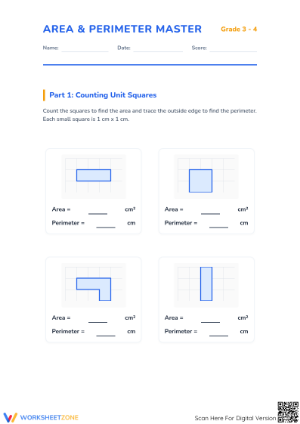
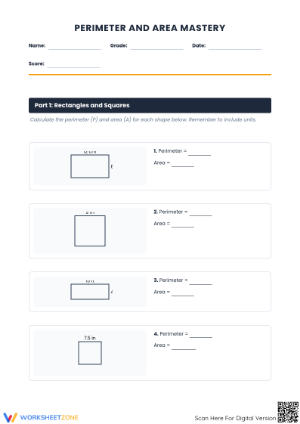
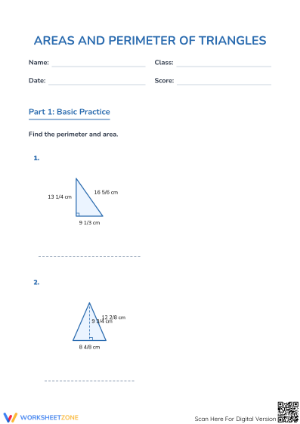
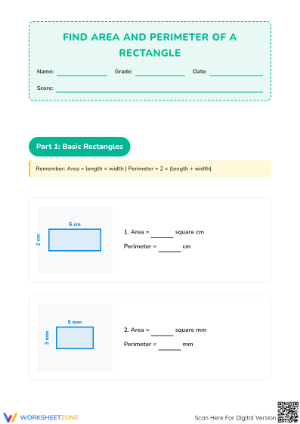
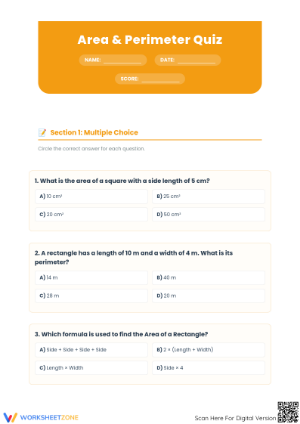
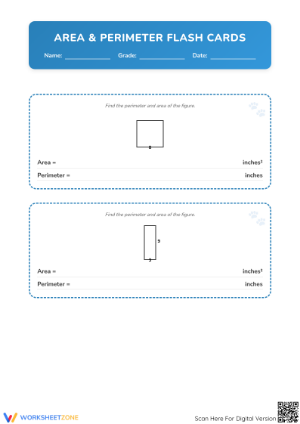
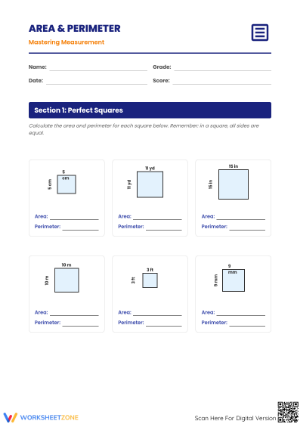
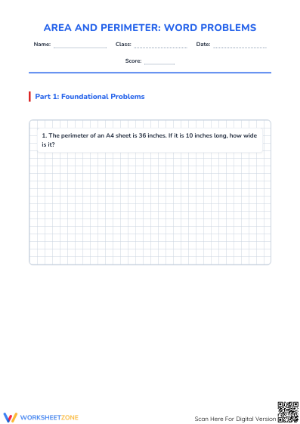
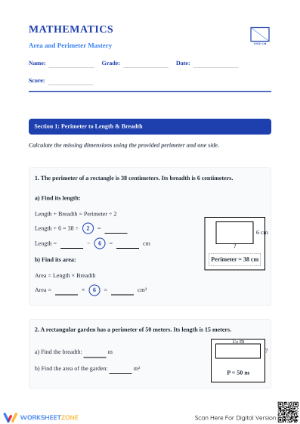
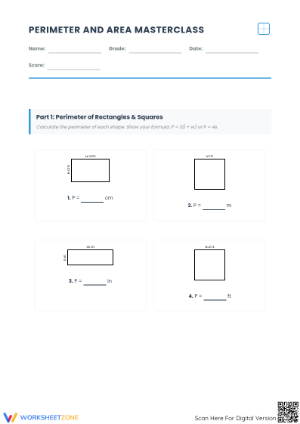
These 4th grade area and perimeter printable worksheets give students structured, repeatable practice with two concepts that look similar on the surface but measure completely different things — and that distinction is exactly where most fourth graders get stuck. The set moves from basic rectangle problems through word problems and rectilinear figures, giving teachers a range of entry points depending on where a class is in the unit.
The Specific Skills Each Worksheet Builds
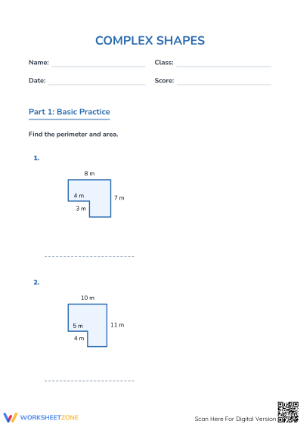
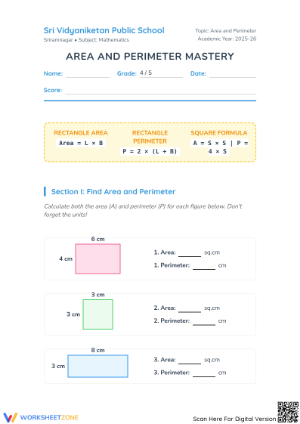
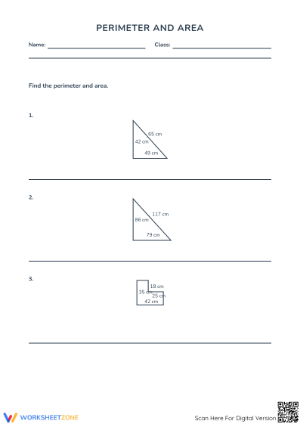
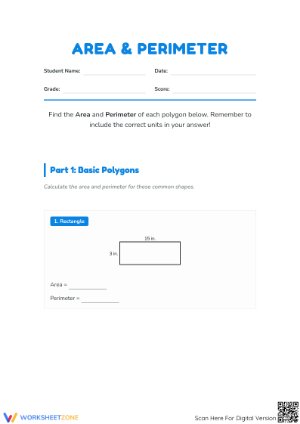
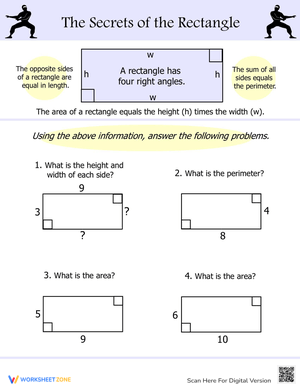
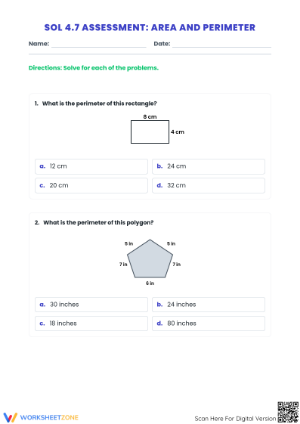
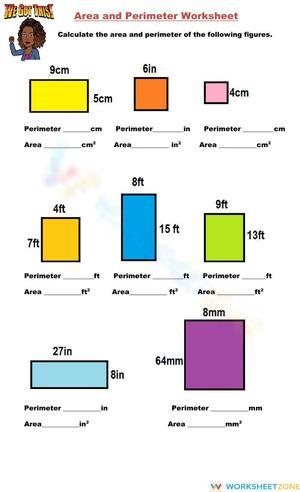
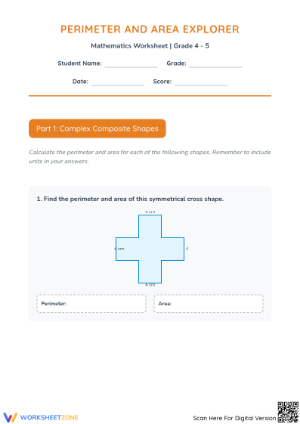
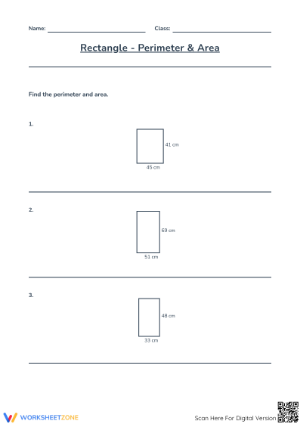
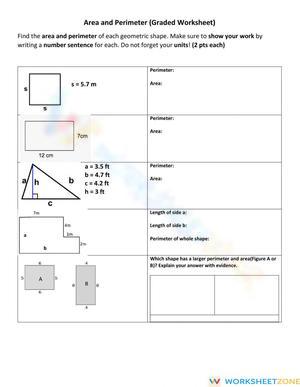
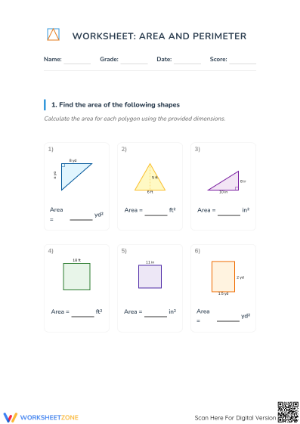
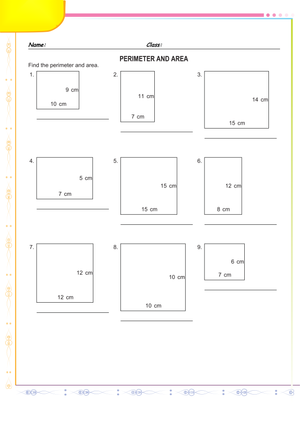
The set addresses the full arc of what 4.MD.A.3 asks students to do. Early worksheets focus on applying formulas directly: students are given labeled rectangles and asked to find area, perimeter, or both. From there, problems remove the diagram and require students to work from dimension pairs alone. Later worksheets introduce rectilinear shapes — L-shaped rooms, T-shaped gardens — where students must mark and compute missing side lengths before breaking the figure into smaller rectangles and summing the results.
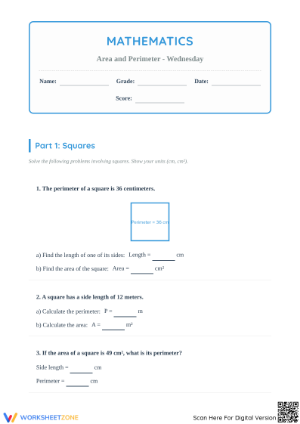
Word problems run throughout. Some give both dimensions and ask for a computed value; others give area and one dimension and require division to find the missing side. Students also practice unit labeling on every worksheet — a requirement that sounds minor but consistently separates students who understand what they are computing from those who are simply executing steps.
Student Errors Worth Anticipating Before You Teach
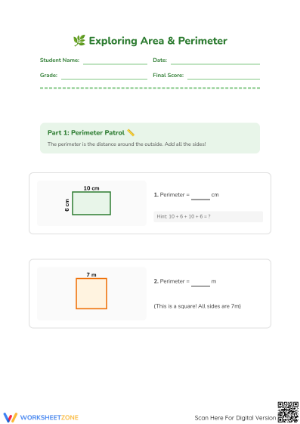
The most persistent error is formula reversal. Students who can recite both formulas will still multiply length and width when asked for perimeter — especially when the numbers look plausible. A rectangle with sides 4 cm and 6 cm gives a perimeter of 20 cm and an area of 24 sq cm — close enough that a student moving quickly won't catch the swap. Worksheets that ask students to compute both measurements for the same shape in the same problem force the comparison and reduce this substitution pattern.
Unit labeling produces its own consistent mistakes. Students know they should write "cm" or "ft" but frequently omit the "square" qualifier for area — writing 18 cm instead of 18 sq cm. What looks like carelessness is usually conceptual: those students haven't fully made sense of why area requires a two-dimensional unit. Having students write a brief sentence alongside each answer — "the area is 18 square centimeters because we're measuring how many 1-centimeter squares fit inside" — adds two minutes to a problem and substantially reduces this error over time.
A third error surfaces specifically with rectilinear figures. When a shape has an unlabeled side, students often assign a dimension from a visible parallel side without checking whether the figure's total dimensions actually support that choice. Walking through one example on the board — annotating each side before writing any formula — reduces this error more reliably than telling students to "be careful."
Standard Alignment
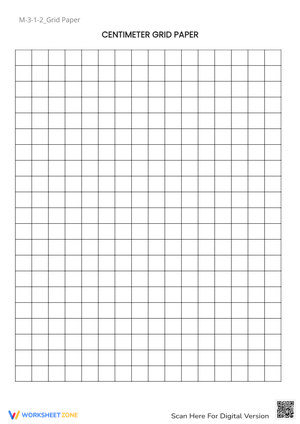
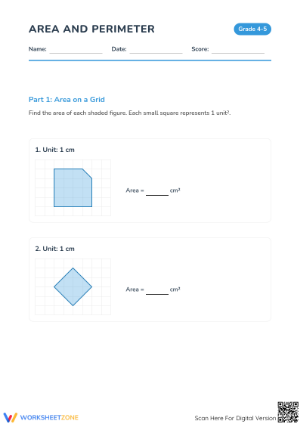
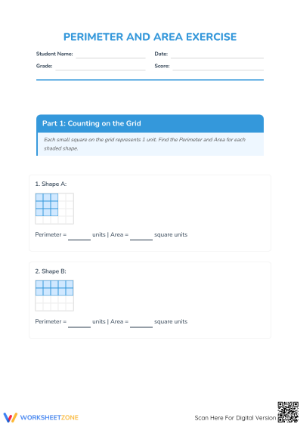
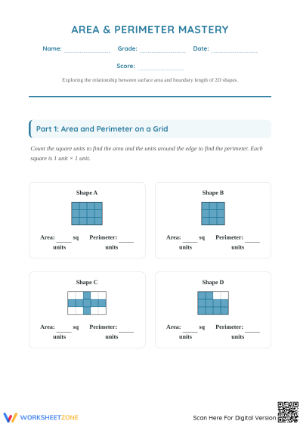
CCSS.MATH.CONTENT.4.MD.A.3 requires students to apply the area and perimeter formulas for rectangles in real-world and mathematical problems. In classroom terms, this standard appears midway through the geometry unit, after students have spent time in 3rd grade building area through unit-square counting and tiling. The 4th grade expectation is that students stop counting and start computing — using A = l × w and P = 2 × (l + w) fluently rather than deriving the answer visually. These worksheets are calibrated to that transition: the earliest problems include light grid lines students can still use as a check, and later problems remove them entirely so students commit to the formula rather than falling back on counting.
How to Build These Worksheets Into Your Lesson Plans
The most reliable use pattern is to open the unit with grid-based problems and let students count squares to verify their formula answers for the first two or three days. Once the class consistently matches, pull the grid versions and move to unlabeled dimension pairs. That moment of pulling the grid is a clean formative checkpoint: students who stall need more time with the concrete model; students who proceed confidently are ready for word problems and missing-dimension problems.
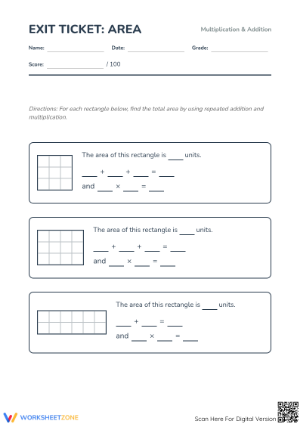
Exit tickets are where these 4th grade area and perimeter printable worksheets resources earn their keep most reliably. A single problem at the end of a lesson — asking for area, perimeter, or a missing side given the total area — takes fewer than five minutes and tells you exactly who is ready to move forward. The worksheets lend themselves to being cut apart and used that way: one problem handed out at the door is more useful as a quick check than a full worksheet completed for homework that you won't see until the following morning.
For whole-class instruction, project the worksheet and work through the first problem with the class before releasing students to work independently. Annotating dimensions with two different colored markers on a projected problem — one color for length, one for width — makes the component parts of each formula visually distinct during guided practice without requiring any extra materials.
Making These Worksheets Work Across Ability Levels
Students who need more support do well starting with problems that have both dimensions labeled on a diagram, with grid lines still visible. The visual confirmation of counting squares alongside the formula answer builds the connection between the two representations. For these students, keeping a reference card with both formulas and a worked example on their desk reduces the working memory demand enough that they can focus on procedure rather than formula retrieval.
Students working above grade level benefit most from the missing-dimension word problems and rectilinear figures. A strong extension: give them the perimeter of a rectangle and ask them to find all possible whole-number dimension pairs, then calculate the area for each. A perimeter of 24 cm produces rectangles with areas ranging from 11 sq cm (1 × 11) to 36 sq cm (6 × 6). That investigation surfaces the relationship between perimeter and area in a way that straight formula practice doesn't reach — and 4th grade area and perimeter printable worksheets problems built around open-ended constraints set that kind of thinking up naturally.
Frequently Asked Questions
Do these worksheets cover rectilinear figures, or only basic rectangles?
The set includes both. Earlier worksheets work with single rectangles. Later worksheets introduce L-shaped and T-shaped rectilinear figures where students must identify and compute missing side lengths before calculating area. These composite-shape problems reflect the full scope of what 4.MD.A.3 expects by the end of the unit.
How do I use these worksheets if my students are still in the counting-squares stage?
Start with the grid-based versions and use them as a bridge. Have students count squares first, then verify their count using the formula. Once the two answers consistently match, students build enough confidence in the formula to use it without the grid. Removing the grid too early — before students have made that connection themselves — tends to produce formula application without understanding, and the errors that follow are harder to untangle later.
What's the most practical way to handle unit labeling errors without losing class time?
A classroom anchor chart with two columns works well as a standing reference: "Perimeter — measure of length — label with cm, ft, in" and "Area — measure of surface — label with sq cm, sq ft, sq in." Having students check their unit labels against the chart before turning in each worksheet catches most omissions without requiring teacher intervention every time. These 4th grade area and perimeter printable worksheets resources fit naturally alongside that routine — the habit of checking units becomes part of how students finish a problem, not an afterthought.













 Interactive Worksheet Maker
 Quiz Maker
 Word Search Maker
 Crossword Puzzle Maker
 Word Scramble Generator
 Sentence Scramble Generator
 Handwriting Worksheet Generator
 Name Tracing Generator
 Fill In The Blank Generator