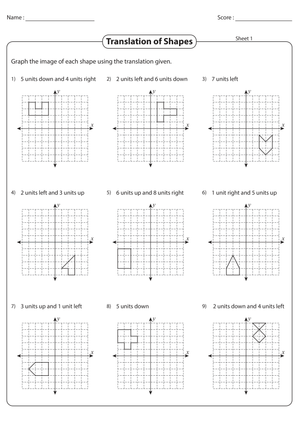
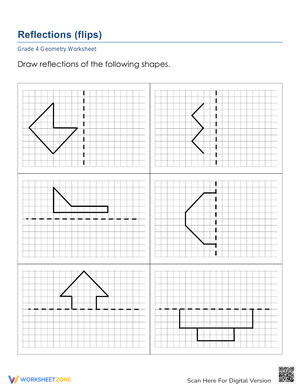
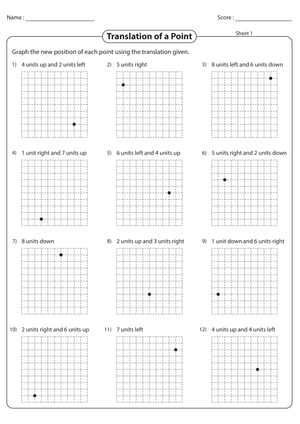
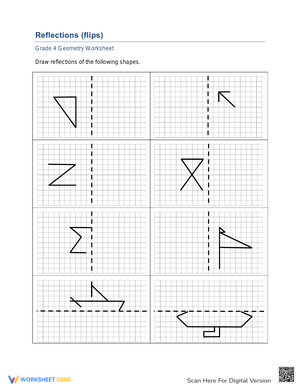
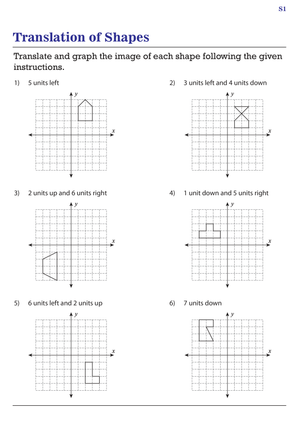
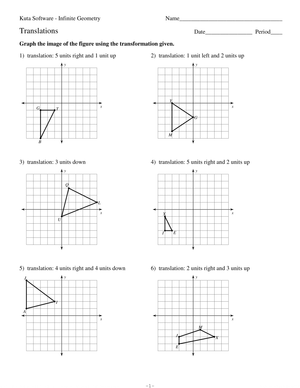
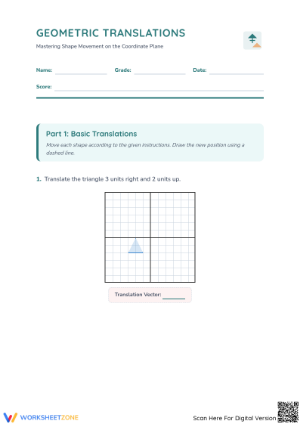
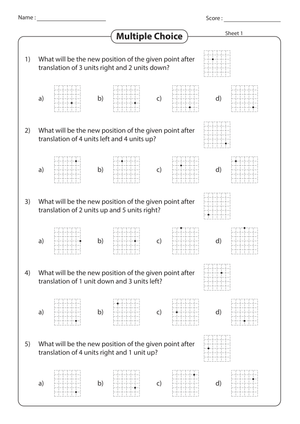
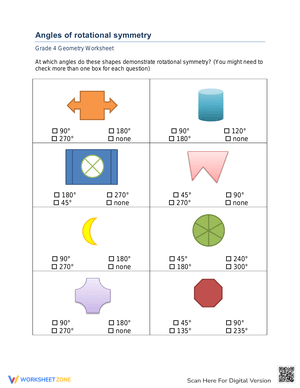
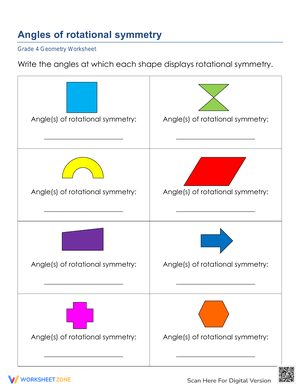
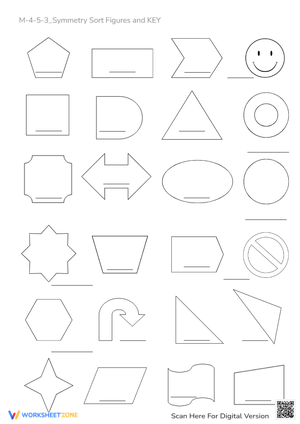
These transformations pdf worksheets for 4th grade give teachers a ready-made set of targeted practice resources for slides, flips, and turns — the three geometric movements that anchor the 4th-grade geometry unit. Each worksheet isolates a specific operation on a coordinate grid or dot paper, so students build one skill at a time before applying all three together. The set treats congruence as a running thread: every task reinforces that moving a shape does not change its size or angles.
What Each Worksheet in the Set Targets
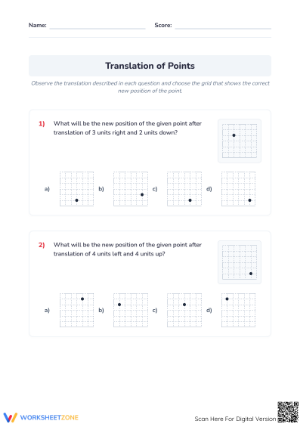
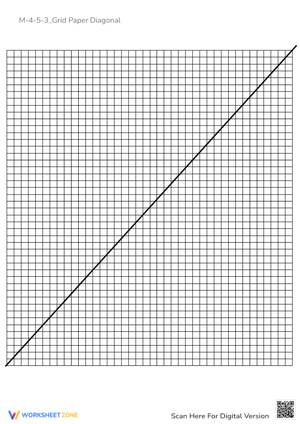
Translation worksheets ask students to shift a figure a set number of units — left, right, up, or down — and plot every vertex of the resulting image. Exercises start with simple rectangles on labeled grids and progress to irregular polygons where students must track five or six vertices separately. The essential understanding being built is that every point in the figure shifts by the same amount in the same direction: if vertex A moves four units right, so does every other point.
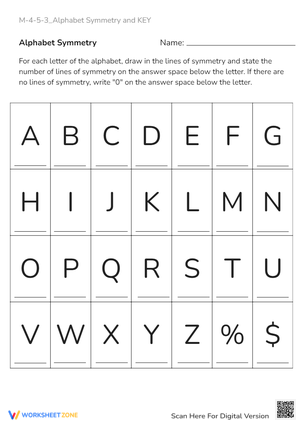
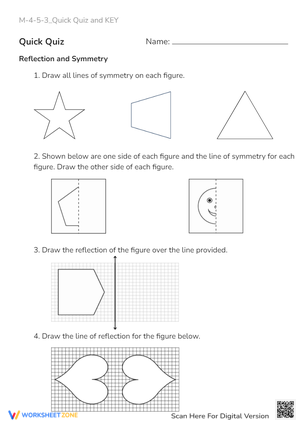
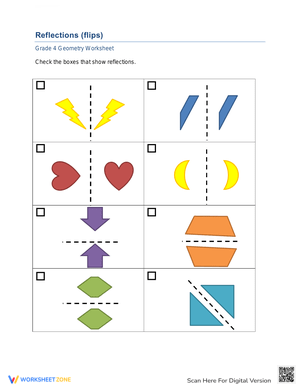
Reflection worksheets focus on horizontal and vertical lines of reflection. Students count the perpendicular distance from each vertex to the line, then plot the mirror point on the opposite side. A subset of the reflection worksheets asks students to identify the line of reflection when given both the pre-image and image already drawn — a reversal task that distinguishes students who understand the concept from those who have only learned a drawing procedure.
Rotation worksheets use 90-degree and 180-degree increments around a labeled center point. Students predict the final orientation before drawing, then verify by checking vertex positions. Several worksheets pair clockwise and counterclockwise problems on the same grid, requiring students to track direction deliberately rather than defaulting to whichever rotation feels easier to visualize.
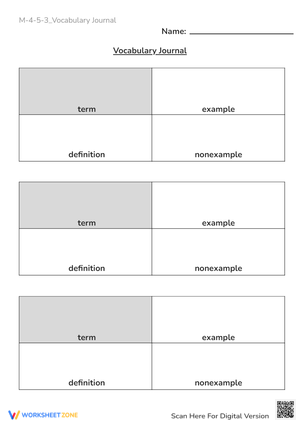
Vocabulary terms — pre-image, image, congruent, line of reflection, center of rotation, vertex — appear inside problem prompts rather than only in glossaries or word banks. Students encounter and use the language within actual tasks, which builds working familiarity more reliably than isolated definition review.
Mistakes Students Make That These Worksheets Surface
The most persistent error across all three transformation types is off-by-one counting on the grid. Students count the starting square as "one" instead of the first space moved, placing the entire image one unit off from where it belongs. This shows up most often in translation work and is easy to miss if a teacher checks only the final drawing. Having students mark each counted space with a small tick — as part of the procedure, not as an afterthought — catches this before it becomes a practiced habit.
Reflections produce a specific directional confusion. Students who handle vertical lines of reflection correctly will often reverse the logic when the line is horizontal — they flip the shape left-to-right instead of up-and-down, producing an image that looks plausible at a glance but fails any distance check from the line. The fix is procedural: students mark the perpendicular distance from each vertex before drawing the image, not after. Checking distances after the fact allows the error to stand; building the check into the drawing process stops it.
Rotations generate the most confusion about direction. A 90-degree clockwise turn and a 90-degree counterclockwise turn look identical to many students until both results are placed side by side on the same grid. Drawing a small clock face lightly in pencil at the center of rotation gives students a directional reference before the formal vocabulary fully settles in. Once a student can explain the direction in plain language — "it spins the same way the hour hand moves" — the pencil clock is no longer needed.
How to Work These Worksheets Into Your Geometry Unit
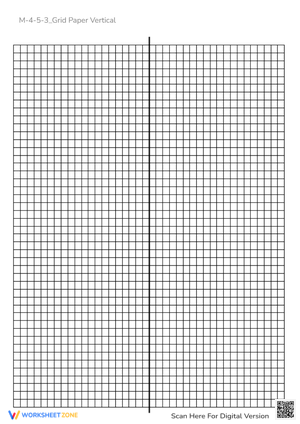
Most teachers introduce each transformation type whole-class with a document camera, modeling the counting method step by step on grid paper. The corresponding worksheet then moves into independent practice or a small-group rotation the same day. The tighter the gap between the model and the practice, the more students retain — waiting a day to assign the practice consistently increases the rate of directional errors in student work.
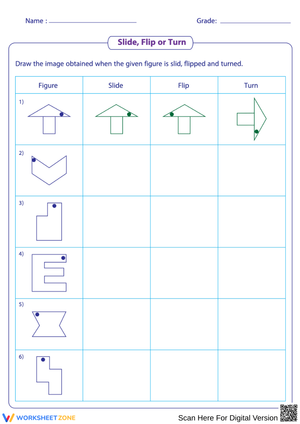
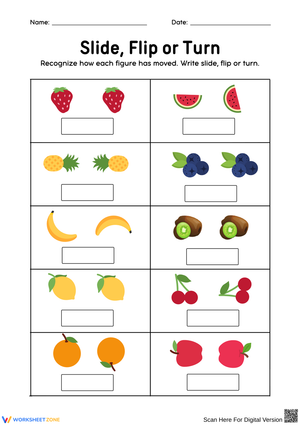
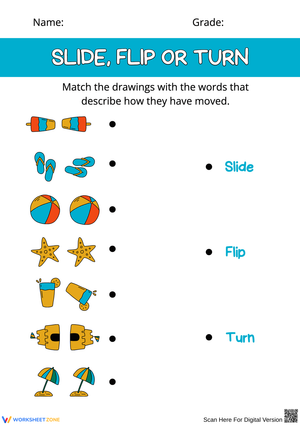
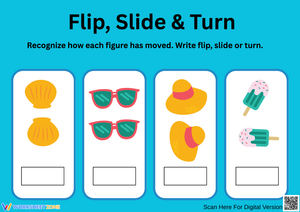
Exit tickets work especially well with this material. A quick transformation-identification task — slide, flip, or turn — takes under four minutes and tells you which students are still conflating reflection and rotation before the confusion has time to harden. For teachers structuring a rotation-based math block, the transformations pdf worksheets for 4th grade fit cleanly into a center activity alongside the teacher-led station, giving students immediate practice on the day's concept without requiring additional prep.
For hands-on support during the first week of the unit, the patty-paper technique is worth building into the routine. Students trace the pre-image onto thin translucent paper, then physically slide, flip, or turn the tracing to see where the image should land on the grid. This does not replace grid work, but it gives students a concrete way to verify their drawn answers and interrupt directional errors before those errors calcify. Keep a small stack at the small-group table for at least the first two weeks of the unit.
Standard Alignment
Within the Common Core State Standards, CCSS.MATH.CONTENT.4.G.A.3 asks students to recognize and draw lines of symmetry for two-dimensional figures, which maps directly onto the reflection tasks in this set. The formal transformation standards — covering translations, reflections, and rotations with coordinates — appear at grade 8 (8.G.A.1–8.G.A.4), but the spatial vocabulary built here is the same foundation those standards draw on. Several state frameworks, including Texas TEKS 4.7.A–C, explicitly place all three transformation types in the 4th-grade geometry strand, so the full scope of this set aligns more directly in those contexts.
In terms of instructional placement, this material fits after students have classified 2D shapes by their attributes (4.G.A.1–4.G.A.2) and before any coordinate-system work. The grid-based tasks here introduce how a plane tracks position — a concept students return to in every subsequent geometry and algebra unit through middle school.
Adjusting the Set for a Range of Learners
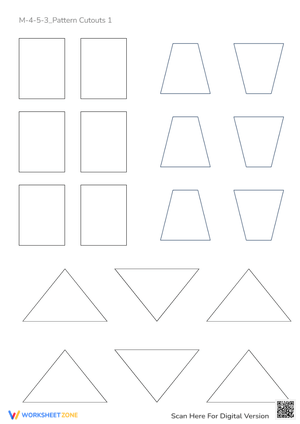
Students who need more support on translations and reflections do better starting on dot paper rather than a numbered coordinate grid. Dot paper removes axis-label clutter and lets students focus purely on counting spaces and plotting points. Pairing those worksheets with physical cut-out polygon shapes — so students move the shape by hand before recording the image in pencil — adds a concrete step before the abstract grid work. This sequence from physical to drawn shortens the time most students spend at the guessing stage.
Students who move quickly through standard problems can take on the double-transformation extensions included in several worksheets: apply a reflection, then rotate the resulting image 90 degrees clockwise. Tracking a shape through two sequential moves requires students to treat each intermediate image as a new pre-image — a conceptual shift that previews composition of transformations, a topic they will meet formally in middle school. The transformations pdf worksheets for 4th grade include these extension problems as optional additions within the same worksheet, so advanced students stay within the unit's content rather than moving to unrelated enrichment material.
Frequently Asked Questions
Do these worksheets include answer keys?
Yes. Each worksheet comes with an answer key showing the correctly plotted image on the grid. Students can see exactly which vertex landed in the wrong position — not just that the overall answer was marked incorrect — which makes self-correction productive rather than frustrating.
How do students work through rotations before learning to use a protractor?
At the 4th-grade level, rotations stay at 90-degree and 180-degree increments, which students verify using the right-angle corners of the grid squares rather than a measuring tool. A reliable classroom habit: before drawing, students write the direction and degree amount at the top of the problem. That small annotation catches the most common error — choosing the wrong direction — before the drawing begins.
Can these be used for homework?
These transformations pdf worksheets for 4th grade work well as homework once the concept has been taught in class. Translation and reflection tasks are generally manageable independently after a solid whole-class lesson. Rotation homework is better held until students can explain the movement correctly out loud — students still in the early concrete stage tend to practice errors at home rather than correct procedure, which creates more re-teaching work than the homework saves.
What is the difference between congruence and symmetry in these tasks?
Congruence means two figures are identical in size and shape, wherever they appear on the grid. Symmetry describes a relationship within a single figure — a shape is symmetric when one half mirrors the other across a line. Reflections always produce congruent figures; when the line of reflection passes through the figure itself, it also marks a line of symmetry. The worksheets treat these as related but distinct concepts, which heads off the common student habit of using the terms interchangeably.













 Interactive Worksheet Maker
 Quiz Maker
 Word Search Maker
 Crossword Puzzle Maker
 Word Scramble Generator
 Sentence Scramble Generator
 Handwriting Worksheet Generator
 Name Tracing Generator
 Fill In The Blank Generator