


























Views
Downloads


Area and Perimeter Essential Practice | Grade 3-4 Worksheet
Paste this activity's link or code into your existing LMS (Google Classroom, Canvas, Teams, Schoology, Moodle, etc.).
Students can open and work on the activity right away, with no student login required.
You'll still be able to track student progress and results from your teacher account.
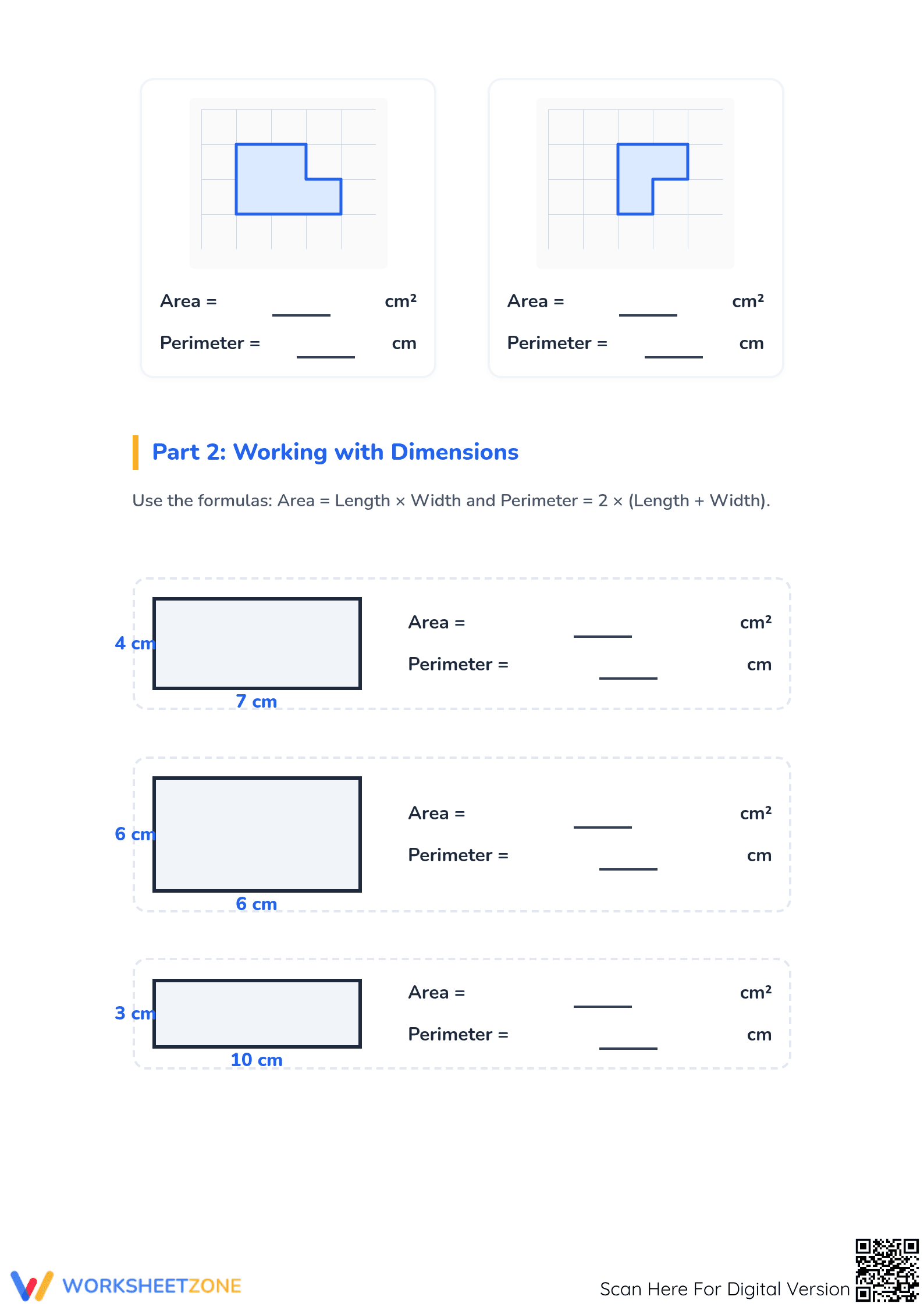
This Area and Perimeter Master worksheet provides Grade 3 and 4 students with a structured progression for spatial measurement mastery. By transitioning from concrete counting to formula application, learners build a conceptual understanding of boundaries and interiors. Students successfully calculate dimensions for regular rectangles and composite figures using provided grids and mathematical formulas.
At a Glance
- Grade: 3 – 4 · Subject: Math
- Standard:
CCSS.MATH.CONTENT.3.MD.C.7— Measure area by counting unit squares and relating tiling to multiplication- Skill Focus: Area and Perimeter Mastery
- Format: 4 pages · 14 problems · Answer key included · PDF
- Best For: Comprehensive unit practice or assessment
- Time: 45–60 minutes
What's Inside
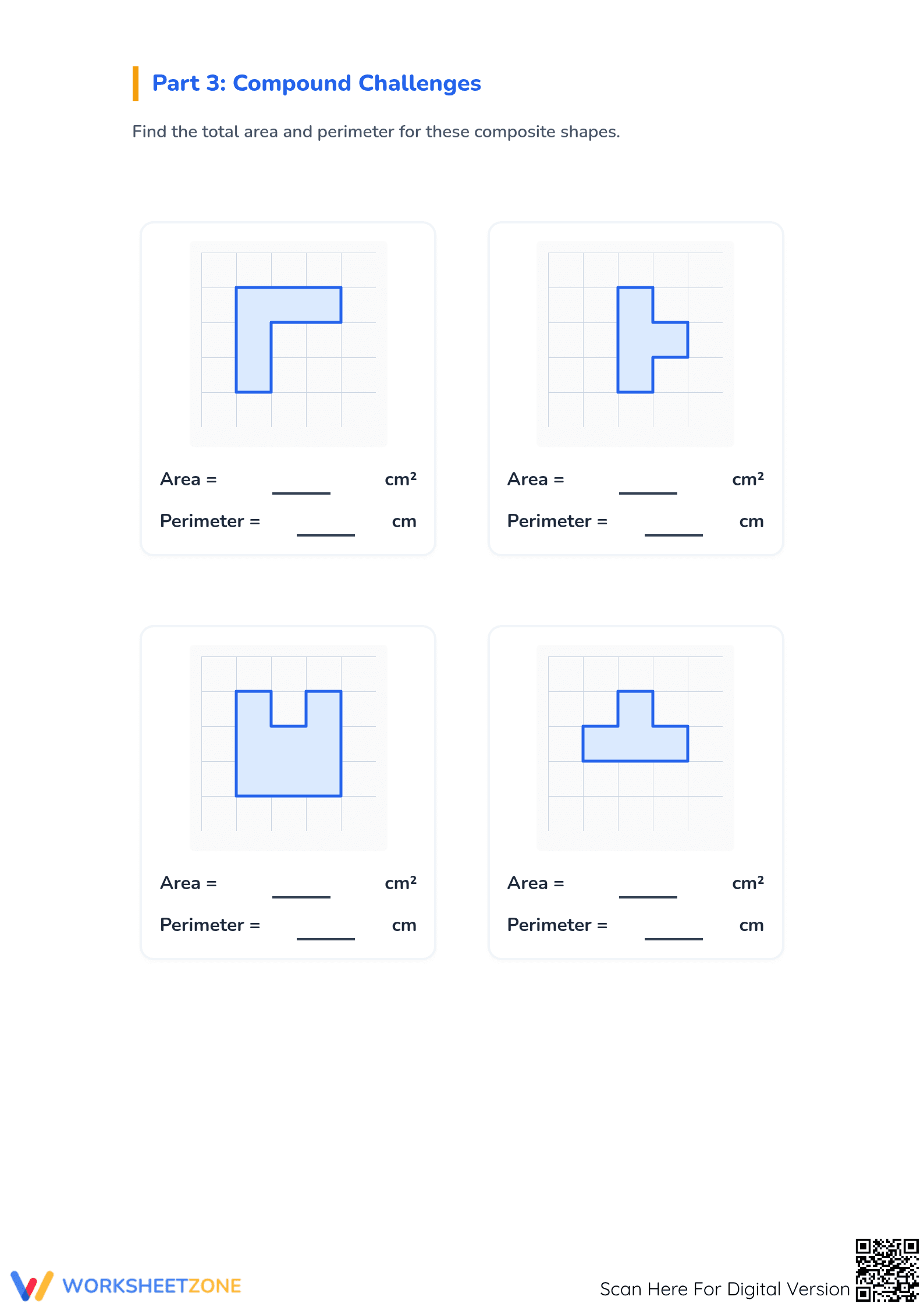
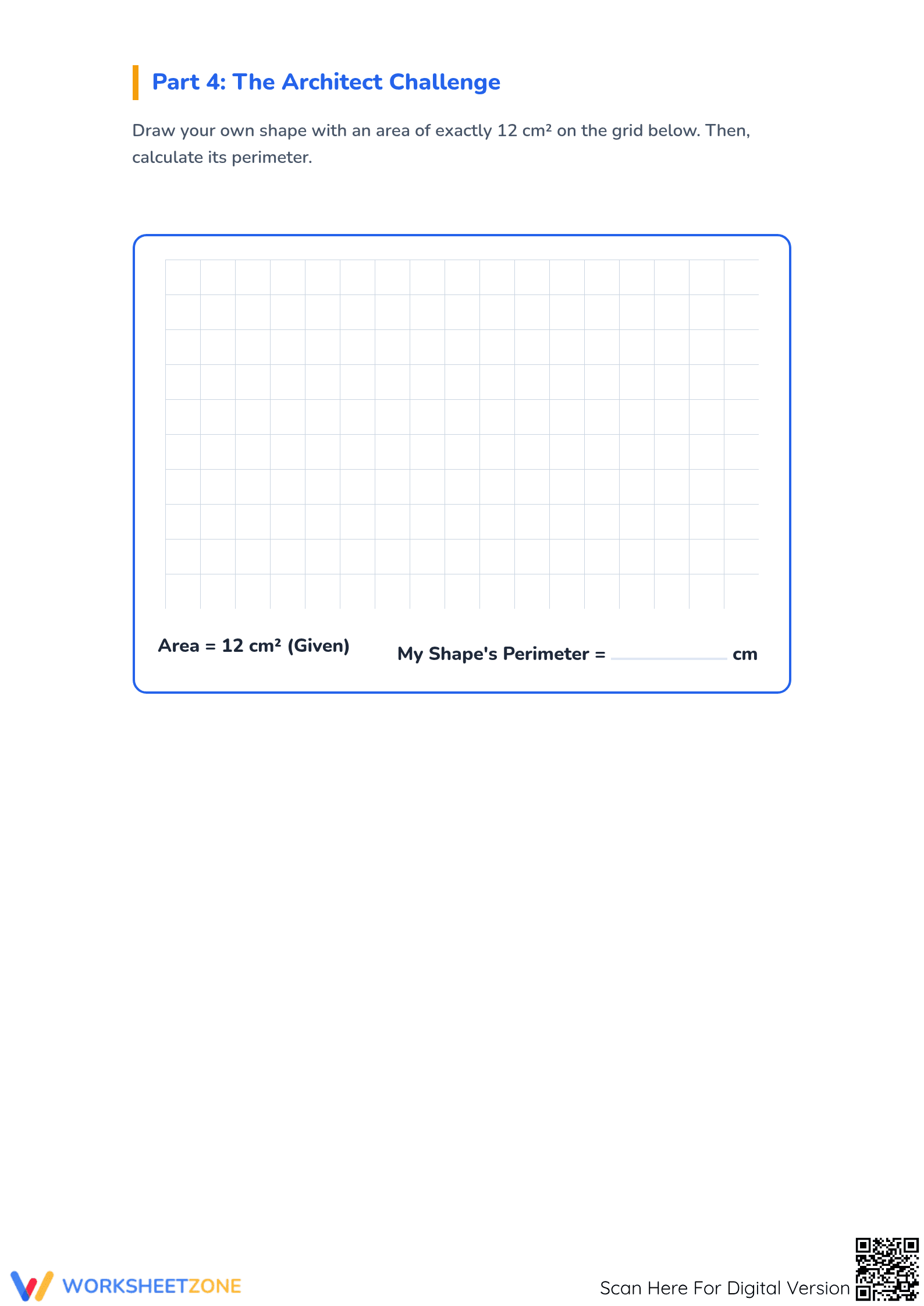
This four-page packet includes fourteen diverse tasks organized into four distinct parts. Students begin with six grid-based counting exercises to establish a visual baseline for area and perimeter. The second section introduces three formula-driven rectangle problems, followed by four composite shape challenges on grids. The final page features a creative "Architect Challenge" where students design their own 12 cm² shape on a provided grid.
Zero-Prep Workflow
- Print: Generate the four-page PDF document in approximately 30 seconds.
- Distribute: Hand out the structured packets for immediate student engagement (1 minute).
- Review: Use the provided answer key for efficient grading or peer-assessment (5 minutes).
This streamlined process requires less than two minutes of total teacher preparation, making it an ideal choice for emergency sub plans or last-minute lesson extensions.
Standards Alignment
The primary focus is `CCSS.MATH.CONTENT.3.MD.C.7`, which relates area to multiplication. The worksheet also aligns with `CCSS.MATH.CONTENT.3.MD.D.8` for perimeter and `CCSS.MATH.CONTENT.4.MD.A.3` for area formulas. These standard codes can be copied directly into lesson plans, IEP goals, or curriculum mapping tools to ensure rigorous alignment with state and national frameworks.
How to Use It
Use this worksheet as a summative assessment at the end of a geometry unit or as a scaffolded practice set during direct instruction. Teachers should observe students during Part 3 to ensure they are correctly identifying shared edges in composite shapes. The packet is designed for a single 60-minute instructional block but can be split across multiple days for students requiring intervention.
Who It's For
This resource is tailored for Grade 3 and 4 students developing foundational geometry skills. It provides necessary scaffolds, such as grid lines for visual learners, while challenging advanced students with the open-ended design task. It pairs naturally with an anchor chart depicting area formulas or a physical manipulative lesson using base-ten blocks to reinforce the relationship between tiling and calculations.
The instructional design of the Area and Perimeter Master worksheet, specifically aligned to CCSS.MATH.CONTENT.3.MD.C.7, reflects the gradual release of responsibility model advocated by Fisher & Frey (2014). By starting with concrete tiling and counting (Part 1), the resource aligns with cognitive development theories that suggest students must visualize spatial boundaries before applying abstract algebraic formulas like Area = L x W. The inclusion of composite shapes in Part 3 directly addresses common misconceptions regarding additive area, a critical hurdle identified in the RAND AIRS 2024 report on elementary mathematics achievement. This 14-task progression ensures that Grade 3 and 4 students move beyond rote memorization toward a functional understanding of geometric measurement. The creative "Architect Challenge" serves as a high-yield formative assessment tool, allowing educators to verify that students can synthesize their knowledge to create shapes with specific constraints, a skill frequently assessed on standardized state examinations and national NAEP benchmarks.


