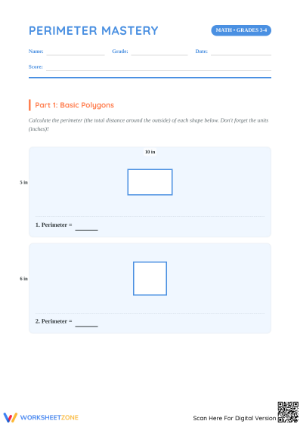
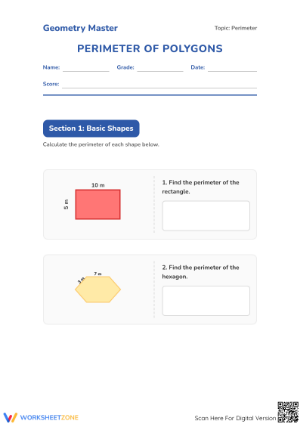
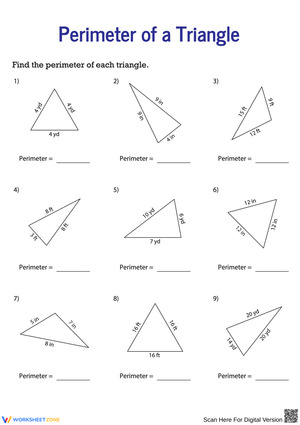
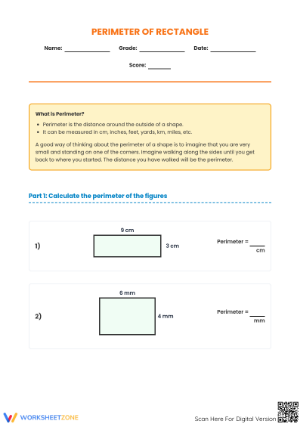
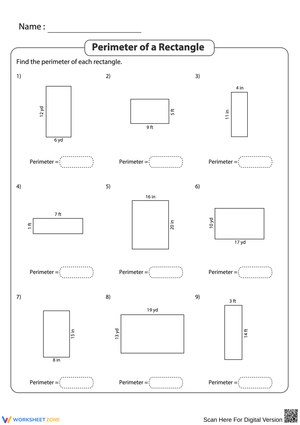
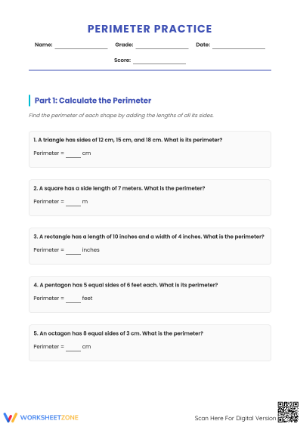
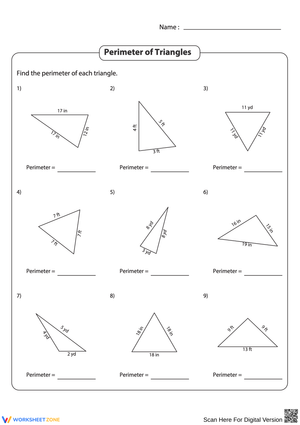
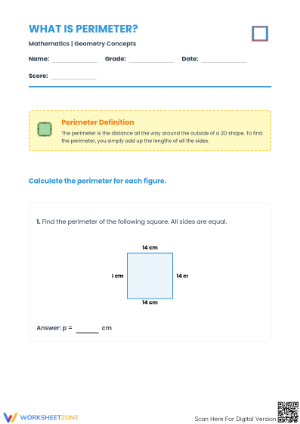
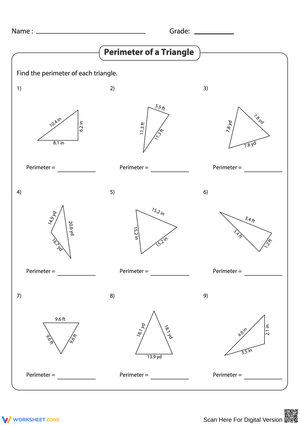
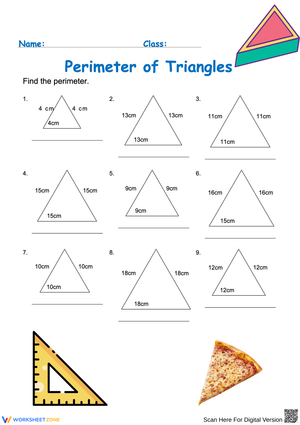
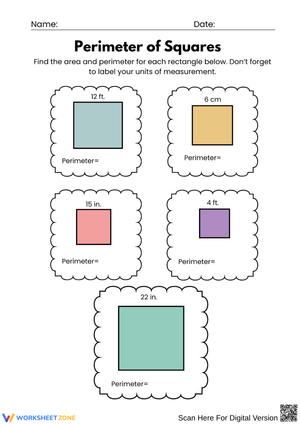
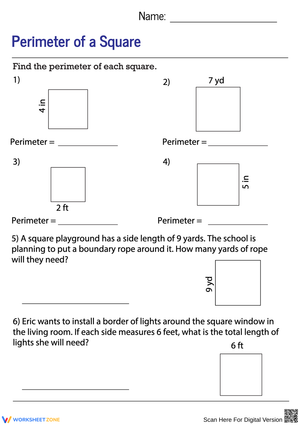
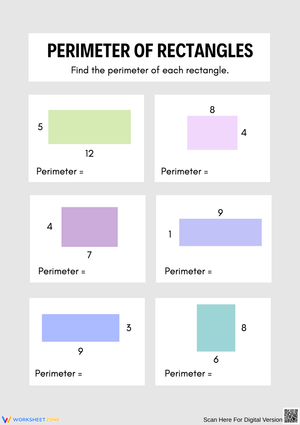
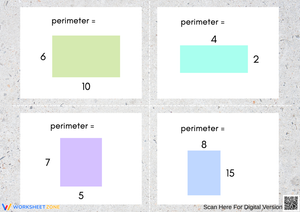
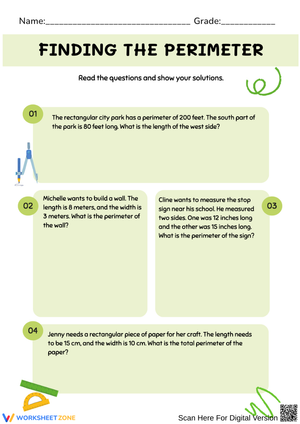
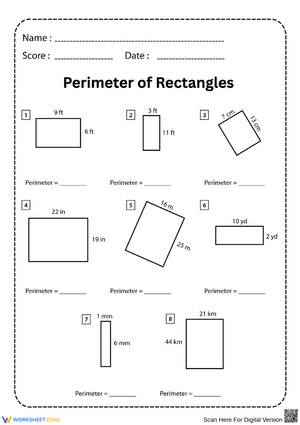
These 4th grade perimeter printable worksheets give teachers targeted practice for the two distinct skill jumps in Grade 4 geometry: moving from repeated addition to formula-based calculation, and working backward from a known perimeter to find a missing side length. Each worksheet isolates a specific problem type, so you can assign the right one at the right moment in the unit rather than handing students a mixed exercise before they've encountered all the skills.
The Specific Skills Each Worksheet Targets
The 4th grade perimeter printable worksheets work through a deliberate progression. Earlier worksheets have students add all four sides of a rectangle explicitly — length + length + width + width — before introducing the more efficient formula P = 2l + 2w. That transition matters because students who jump straight to the formula without understanding why it works tend to fall apart when the numbers get messier or the shape changes.
Later worksheets move into:
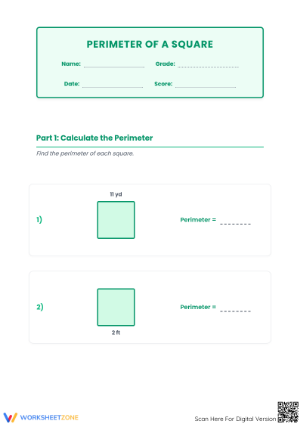
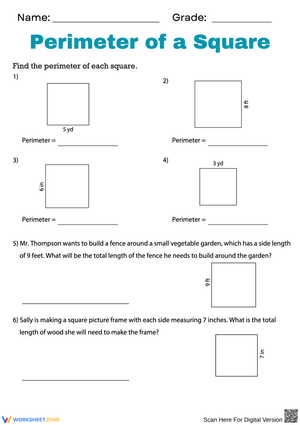
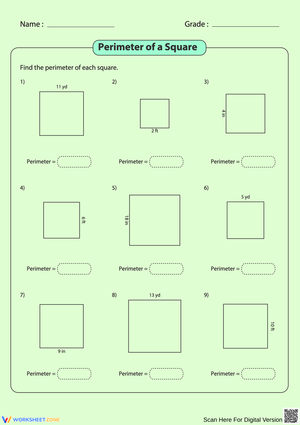
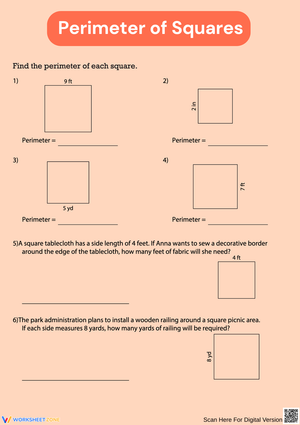
- Applying P = 4s to squares, with attention to why that formula is a special case of the rectangle formula rather than a separate rule to memorize
- Solving for a missing side length when the perimeter and one dimension are given
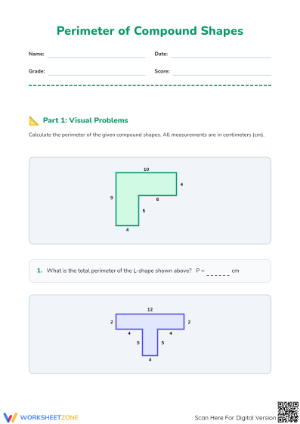
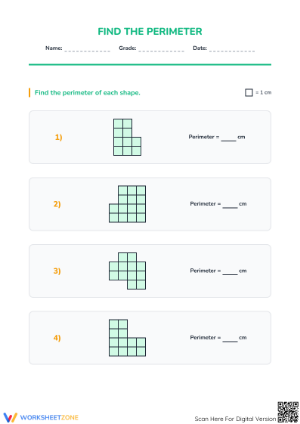
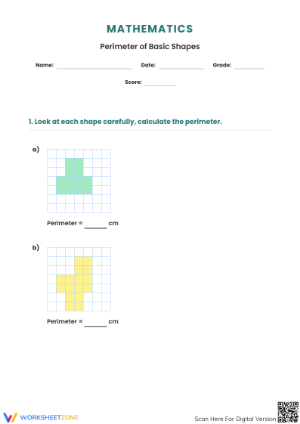
- Finding the perimeter of composite rectilinear shapes — L-shapes and T-shapes where students must derive unlabeled side lengths before they can total the outer boundary
- Word problems using real contexts: fencing a yard, framing a photograph, bordering a classroom bulletin board
The Missing-Dimension Problem — Where Students Actually Struggle
The hardest single skill in this unit, based on what shows up consistently in student work, is working backward from a known perimeter to find a missing side. Here is what the error looks like: a rectangle has a perimeter of 28 cm and a length of 9 cm. A significant number of students write 28 − 9 = 19, then stop — as if one subtraction produces the width. They have not internalized that a rectangle has two lengths and two widths, which means they need to first account for both copies of the known side (9 + 9 = 18), subtract from the total (28 − 18 = 10), and then divide by two to get the width of 5. The step most commonly dropped is that final division.
Each worksheet in this section of the set includes a worked example showing the full multi-step process. Students who can talk through each step aloud — rather than just computing — make far fewer of these errors in later practice.
Errors Worth Anticipating Before You Hand These Out
Beyond the missing-dimension issue, two other patterns appear regularly in fourth grade work on this topic. First, when students encounter an L-shaped figure, they frequently count the interior step lines as part of the perimeter — adding edges that fall inside the boundary, often because the figure looks like two separate rectangles joined together. A quick pre-teaching move is asking students to trace only the outer path with their pencil before they write down any numbers. That one habit catches the error before it becomes a calculation.
Second, students who can correctly apply P = 2l + 2w to rectangles will sometimes use the same formula on a square, plugging in two different numbers when both dimensions are actually equal. It is formula-following without genuine understanding, and it shows up most often when the square is drawn slightly off-proportion on the worksheet. Naming this explicitly before composite-shape work begins — "a square is just a rectangle where l and w happen to be the same number" — prevents a lot of confusion downstream.
Building These Into Your Lesson Rotation
The straightforward formula worksheets work well as Monday warm-ups once you've introduced P = 2l + 2w in whole-group instruction. Three or four problems is enough — students who have the concept check their work quickly, and students who don't reveal the gap before the rest of the week's lesson compounds it.
The missing-side and composite-shape worksheets are better placed after a guided practice session, not before one. Assign them as independent work while you pull a small group to the back table. The word-problem worksheets fit naturally into the 10 minutes before the end of math block — short enough to complete, long enough to surface who is reading carefully and who is lifting numbers without reading the context.
One honest limitation worth naming: the composite-shape worksheets frustrate students who haven't yet done any work decomposing rectilinear figures into smaller rectangles. If that background is missing, those worksheets need a whole-group model session first. A worked example at the top of the worksheet is not sufficient on its own when the underlying spatial skill isn't there yet.
Adjusting the Work for a Range of Learners
For students who are still shaky on multi-digit addition, the early worksheets — which require adding only two numbers at a time — keep the cognitive focus on the geometry rather than the arithmetic. Pairing those students with a number line or hundred chart does not change what those worksheets are measuring.
Students who move quickly through standard formula problems benefit most from the composite-shape section and from a verbal extension prompt: given a fixed perimeter of 24 units, how many different rectangles with whole-number dimensions can they draw? That question surfaces fast for early finishers and prevents the plateau that happens when strong students run out of printed problems. The set does not include this as a separate worksheet — it works as a spoken extension — but it pairs naturally with these 4th grade perimeter printable worksheets and costs nothing to assign.
For English language learners, the word problems assume some real-world familiarity with fencing, framing, and borders. A two-minute vocabulary preview before independent work — pointing to a diagram and explaining why you would measure around the outside of a yard — makes the problem stems more accessible without reducing the mathematical demand of the task.
Standard Alignment
CCSS.MATH.CONTENT.4.MD.A.3 asks students to apply area and perimeter formulas for rectangles in real-world and mathematical problems. In classroom terms, this standard sits in the measurement and data strand but carries informal algebraic reasoning — students solving for a missing dimension are doing equation work before they ever see a variable presented formally. The 4th grade perimeter printable worksheets in this set cover the full scope of 4.MD.A.3, addressing both direct formula application and the reverse-reasoning problems where students work from a known total toward an unknown dimension.
Frequently Asked Questions
Do these worksheets cover area as well, or only perimeter?
The set focuses on perimeter only. Area is addressed in a separate set. Keeping them apart reflects how most teachers sequence the unit — perimeter first, then area, then comparing the two — and avoids the formula confusion that reliably appears when students practice both in the same sitting.
At what point in the unit should the composite-shape worksheets appear?
After students are solid on the formula for simple rectangles and have had at least one lesson on identifying all outer edges of an irregular figure. Assigning composite-shape work too early, before students have a reliable process for labeling unlabeled sides, produces frustration rather than useful practice.
Are the word problems accessible to students who read below grade level?
Most word problems use short sentences and include a labeled diagram. Students reading significantly below grade level can use the diagram to set up the calculation even when the problem stem is difficult to parse. The fencing and framing contexts do assume some real-world familiarity, so a brief class discussion before those particular worksheets helps considerably.
How many problems are on each worksheet?
It varies by problem type. Formula-application worksheets include 8 to 12 problems. Missing-dimension and composite-shape worksheets typically include 5 to 8 problems, since each item requires more steps and students need time to work carefully rather than rushing through a longer set.













 Interactive Worksheet Maker
 Quiz Maker
 Word Search Maker
 Crossword Puzzle Maker
 Word Scramble Generator
 Sentence Scramble Generator
 Handwriting Worksheet Generator
 Name Tracing Generator
 Fill In The Blank Generator