


























Views
Downloads



Essential Area and Perimeter Worksheet | Grade 6 Math
Paste this activity's link or code into your existing LMS (Google Classroom, Canvas, Teams, Schoology, Moodle, etc.).
Students can open and work on the activity right away, with no student login required.
You'll still be able to track student progress and results from your teacher account.
This comprehensive Grade 6 math worksheet provides a structured approach to mastering area and perimeter calculations. Students transition from basic geometric shapes to complex real-world applications, ensuring formula accuracy in multiple contexts. By the end of these exercises, learners will demonstrate proficiency in solving multi-step geometry problems with confidence and precision.
At a Glance
- Grade: Grade 6 · Subject: Math
- Standard:
6.G.A.1— Find the area of triangles, quadrilaterals, and polygons in mathematical problems- Skill Focus: Area and Perimeter Calculations
- Format: 4 pages · 12 problems · Answer key included · PDF
- Best For: Independent practice and skills reinforcement
- Time: 30–45 minutes
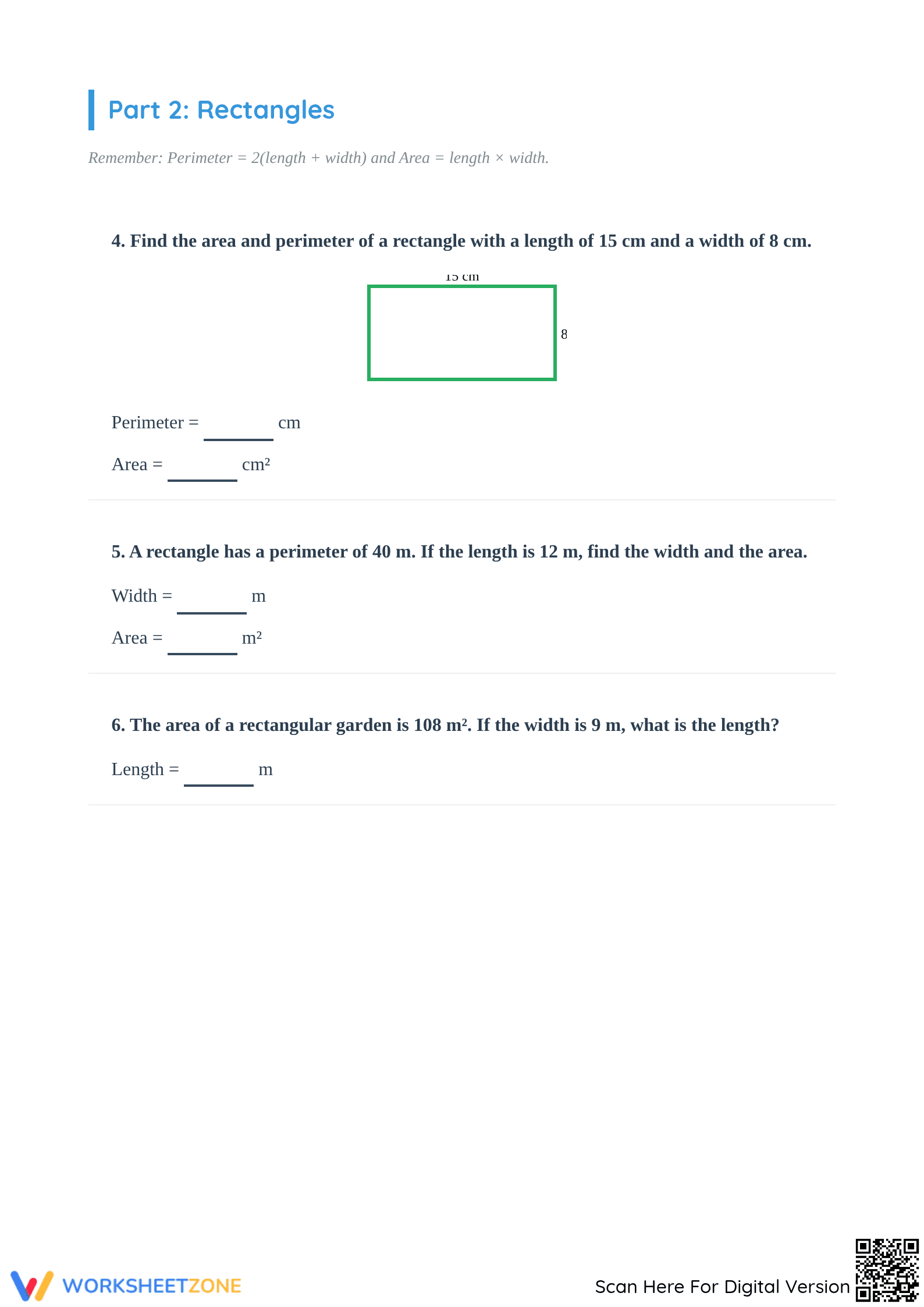
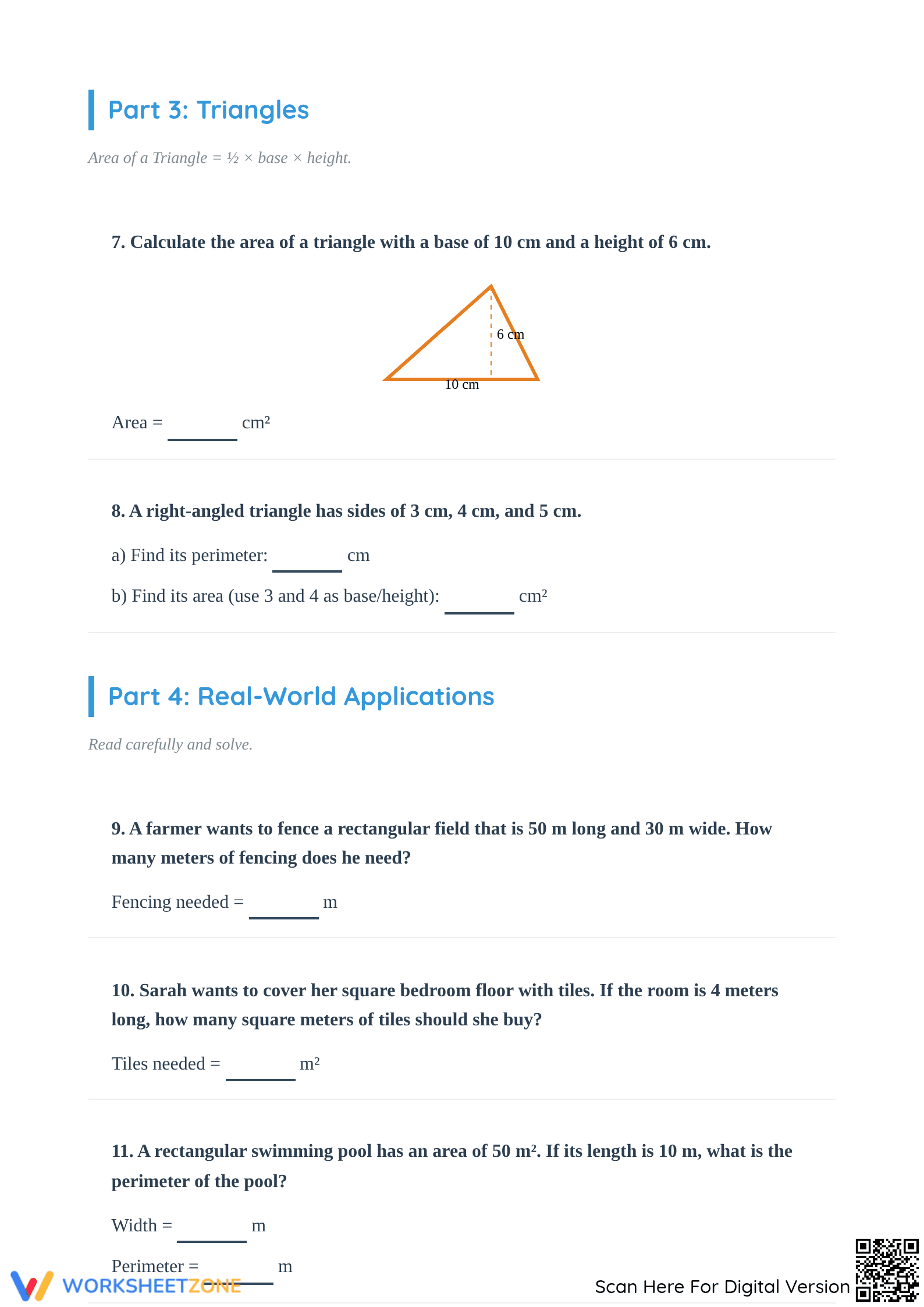
Inside this four-page PDF resource, you will find twelve problems divided into four distinct parts. The worksheet covers squares, rectangles, and triangles, plus a variety of real-world application scenarios. Each section includes clear headings, helpful formulas, and dedicated workspace for student calculations. A full answer key is provided for quick grading and immediate student feedback.
The practice sequence follows a strategic progression. It begins with guided practice in Part 1, where students find side lengths and areas of squares using provided perimeter values. Part 2 offers supported practice focusing on rectangles, requiring students to manipulate formulas for area and width. Finally, Part 3 and 4 move to independent practice, challenging students with triangle geometry and 5 multi-step word problems. This model ensures students build necessary scaffolding before tackling complex, unassisted tasks.
This resource is aligned to `6.G.A.1`, which requires students to find the area of triangles and polygons by composing into rectangles or decomposing into triangles and other shapes. The tasks specifically address applying these techniques in the context of solving real-world and mathematical problems. Both standard codes can be copied directly into lesson plans, IEP goals, or district curriculum mapping tools.
Use this worksheet as a mid-unit check during your geometry instruction or as a comprehensive review before a summative assessment. During the lesson, observe how students handle the 'Part 4' word problems to identify those who may struggle with translating text into geometric operations. Completion usually takes 30 to 45 minutes, making it ideal for a full-period activity or a substantial homework assignment.
Designed for Grade 6, this practice is highly effective for advanced Grade 5 learners or Grade 7 students needing remedial support. The clear formatting and formula reminders make it accessible for diverse learners, including those with IEP accommodations. For best results, pair this worksheet with a coordinate plane activity or a digital geometry exploration tool to provide a multi-modal learning experience.
The RAND AIRS 2024 report indicates that high-quality instructional materials blending procedural fluency with conceptual application significantly improve middle school geometry outcomes. This worksheet addresses that need by requiring students to move beyond simple rote memorization of the A=L*W formula. By integrating 12 diverse tasks including abstract shapes and real-world scenarios like fencing and floor tiling, the resource forces students to visualize spatial relationships and units of measurement such as cm² and m². This alignment with research-based pedagogical strategies ensures that learners develop a deep understanding of the `6.G.A.1` standard. The inclusion of a challenge problem encourages higher-order thinking, a key component of mathematical mastery identified in recent NAEP frameworks. Educators can utilize this structured practice to bridge the gap between basic identification and complex problem-solving in their everyday math curriculum.


