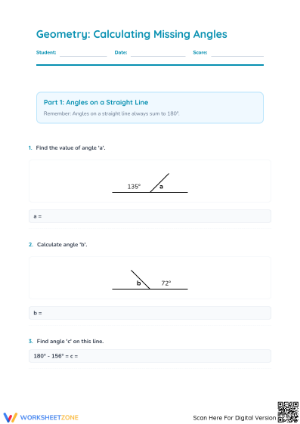
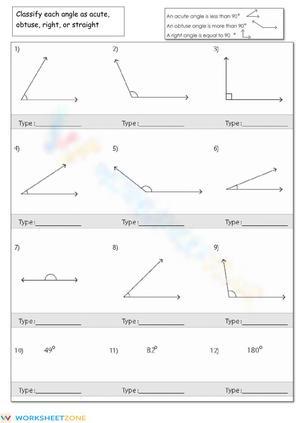
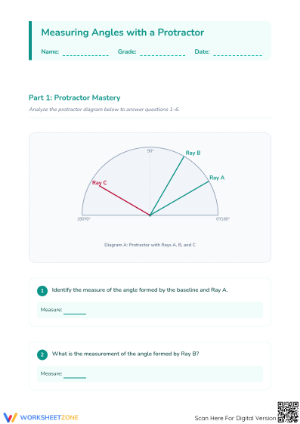
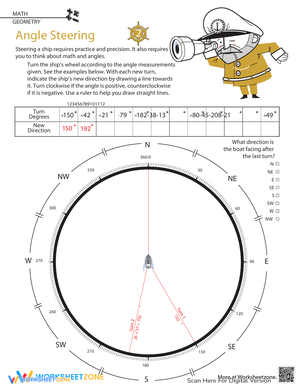
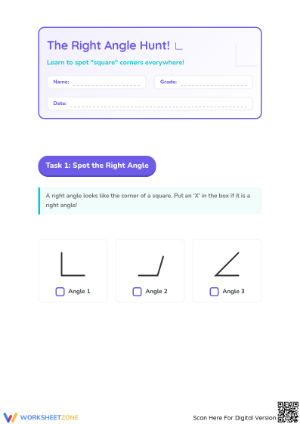
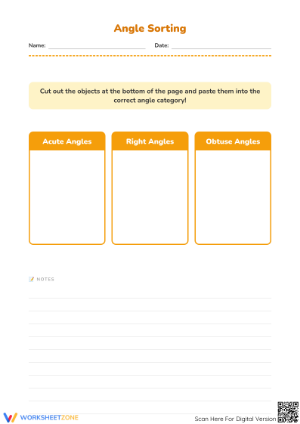
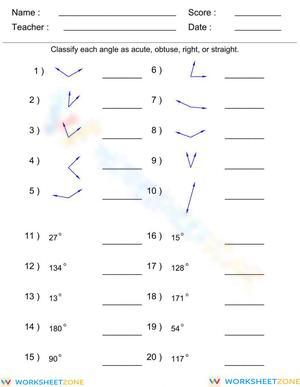
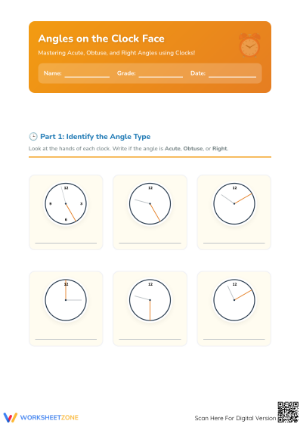
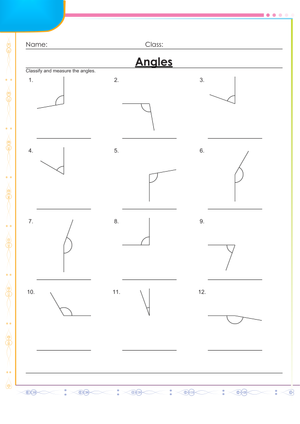
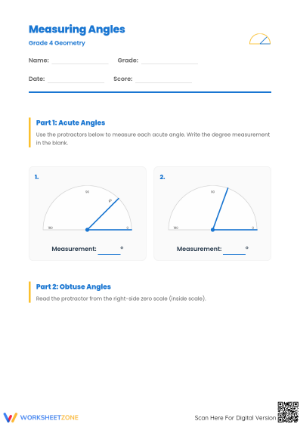
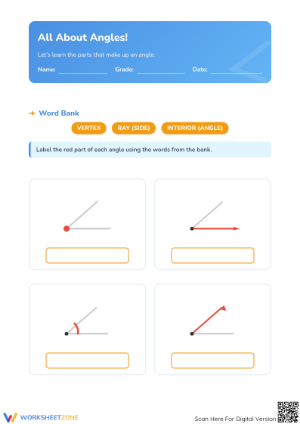
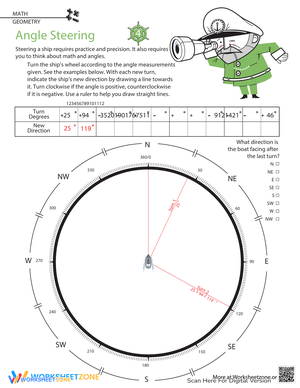
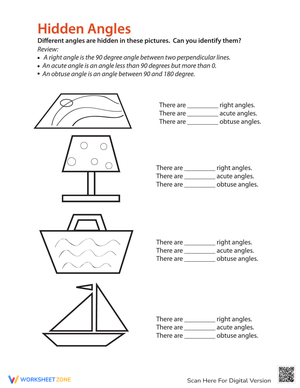
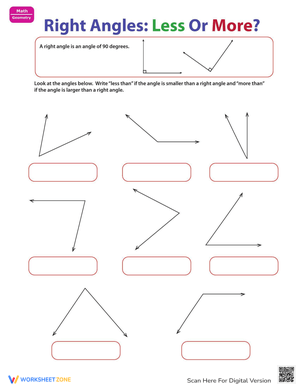
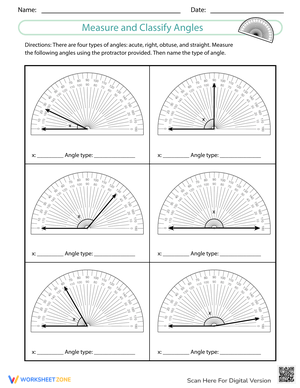
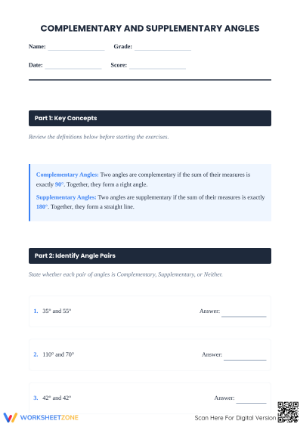
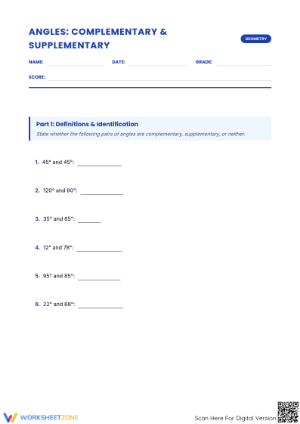
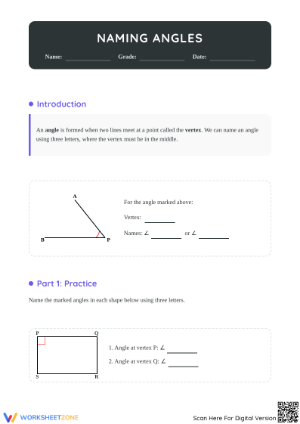
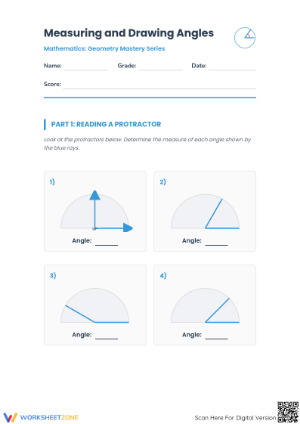
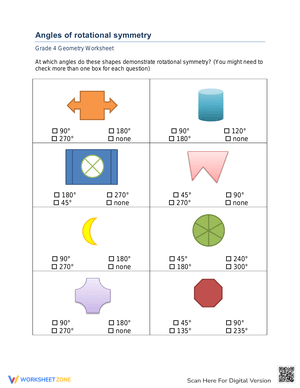
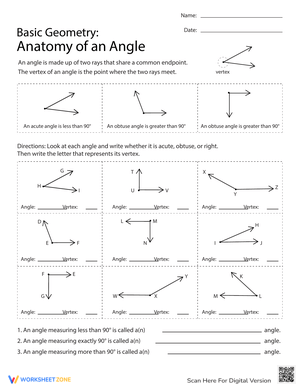
These 4th grade angles printable worksheets resources cover the full arc of what most Grade 4 geometry units require — from spotting acute and obtuse angles at a glance to lining up a protractor correctly and reading the right scale without confusing the inner and outer number rows. Each worksheet targets a specific angle skill so students build understanding before the tasks increase in difficulty. The set works across multiple settings: mini-lesson follow-up, math center rotations, small-group practice, and quick informal checks.
The Specific Skills Each Worksheet Builds
Angle work in fourth grade moves faster than many teachers expect. Students need solid footing at each step before the next one makes sense, and the worksheets reflect that progression directly.
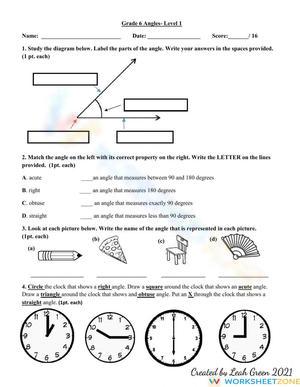
- Vertex and ray identification: Students mark the vertex and label both rays using standard geometric notation.
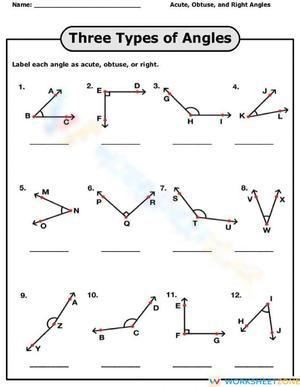
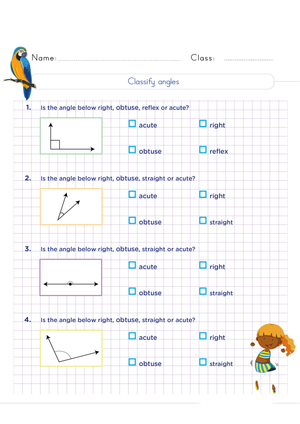
- Classification: Students sort angles as acute, right, or obtuse — first with clear examples, then with less obvious cases designed to catch the most common guessing strategies.
- Visual comparison: Students rank two or three angles by size before picking up a protractor, building the estimation habit that makes measurement errors easier to catch later.
- Drawing from description: Students sketch an angle that matches a written type — acute, right, or obtuse — without a template to copy from.
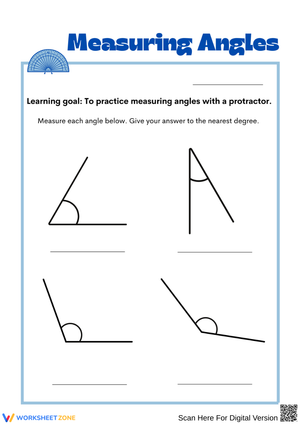
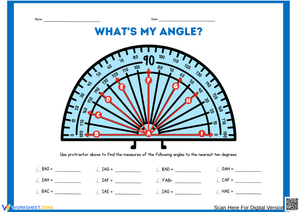
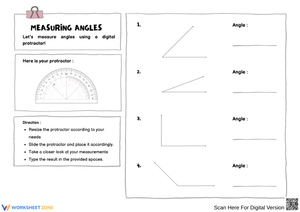
- Protractor measurement: Students measure angles on printed diagrams with enough white space to position the tool properly and record measurements without crowding.
- Angles within polygons: Students identify angle types in squares, triangles, and trapezoids, applying vocabulary to shapes they already recognize.
The drawing tasks in this 4th grade angles printable worksheets set deserve particular attention. Asking a student to draw an obtuse angle without providing a template — and without letting them copy a neighbor's paper — gives far more diagnostic information than another classify-and-circle worksheet does. Students who truly grasp the concept draw a range of obtuse angles; students who are pattern-matching tend to draw the same shape every time.
Mistakes Students Make That These Worksheets Help You Catch
The ray-length misconception is the most consistent error in Grade 4 angle work. Students assume that longer rays mean a larger angle. Present a diagram where a 40° angle has long rays extending nearly to the edge of the paper, then place a 110° angle beside it with short rays — a significant portion of the class will call the first one bigger. Several worksheets are built around that exact problem, placing smaller angles in larger visual frames so students are forced to focus on the opening between the rays rather than the length of the lines themselves.
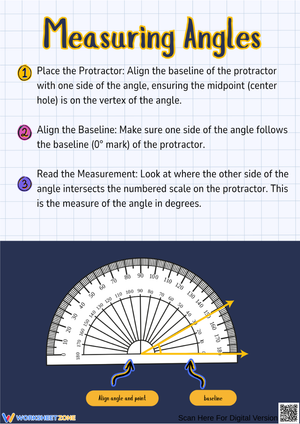
Protractor errors follow a different pattern. The most frequent mistake is reading the wrong scale — every standard student protractor has two number rows, and students routinely record 130° when the answer is 50°, or 70° when the angle is actually 110°. The fix that holds up in real classrooms is having students estimate the angle type before measuring: if the angle looks obtuse, the reading should be greater than 90°. When a student records 50° for an angle that clearly opens past a right angle, they catch the contradiction themselves rather than waiting for teacher feedback. The measurement worksheets are structured to prompt that estimation step before asking students to write any degree measurement.
Fitting These Worksheets Into the Week Without Overhauling Your Plans
The cleanest entry point is pairing an identification or classification worksheet with the same day you introduce the vocabulary — acute, right, obtuse, vertex, rays — giving students about 10 to 12 minutes of independent practice while the language is still fresh. Protractor worksheets hold better for later in the week after students have had two or three exposures to recognizing and naming angles without any measuring tool in hand.
For math centers, the sorting and drawing worksheets function independently. The directions stay consistent across the set, the diagrams are uncluttered, and students can move through them without raising their hands for clarification. The measurement worksheets run better in small-group settings where a teacher can watch how each student positions the protractor and redirect before inaccurate technique becomes automatic. One sequence that holds up well across most fourth-grade classrooms: classification on Monday and Tuesday, drawing on Wednesday, guided protractor work Thursday in a small group, and a mixed-review worksheet on Friday as a quick formative check on what stuck.
Standard Alignment
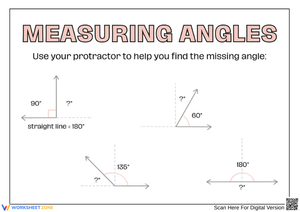
These worksheets address CCSS 4.MD.C.5, 4.MD.C.6, and 4.MD.C.7. Teachers who are used to filing angle work under a geometry header sometimes find it surprising that the Common Core places these standards in the Measurement and Data domain at Grade 4 — but the placement reflects the unit's actual emphasis: measuring angles precisely is the goal, and visual classification is the entry point that prepares students to use a protractor meaningfully. Standard 4.MD.C.5 covers understanding what angles are and how their size is determined by the rotation between two rays, not by the rays' length. Standard 4.MD.C.6 addresses measuring angles in whole-number degrees with a protractor and sketching angles of a specified measure. Standard 4.MD.C.7 introduces angle decomposition — recognizing that a 90° angle can be split into a 35° portion and a 55° portion, or that two adjacent angles can be added to find the total — which the mixed-review worksheets begin to address through combination and missing-angle problems.
Adjusting the Set for Students at Different Readiness Levels
Students who need more time before measurement tasks are better served starting with classification and visual comparison worksheets only. Printing those diagrams at 115% gives students more room to mark the vertex, trace both rays, and see the angle opening clearly — particularly helpful for students whose fine motor control makes protractor work frustrating before the concept itself is secure. A reference card showing one labeled example each of acute, right, and obtuse stays more useful on the desk than re-explaining the same vocabulary three times during independent work.
On-level students move through identification, classification, and drawing before the protractor worksheets. Students who are ready for more challenge benefit from tasks that require written explanation — not just circling an answer, but writing which protractor scale they used and why the other scale would produce a wrong reading. The 4th grade angles printable worksheets mixed-review options push at exactly that level, combining classification, drawing, and measurement in tasks that resist guessing. For the protractor worksheets specifically, pairing students works well: one student positions the tool while the other reads the scale and records the measure, then they switch for the next angle. That arrangement builds in a natural accuracy check without changing anything about the worksheet itself.
Frequently Asked Questions
Do students need a protractor for every worksheet in the set?
No. Several worksheets focus on identification, classification, and drawing — none of which require a measuring tool. Protractor use appears later in the set, after students have worked with angles visually across multiple tasks and built a reliable sense of what each angle type looks like.
How should teachers handle students who consistently read the wrong protractor scale?
The most effective correction is building an estimation step before every measurement: students name the angle type first, then measure, then check whether the number they recorded matches. An obtuse angle should read greater than 90°; an acute angle should read less than 90°. That two-step routine catches most scale-reading errors without requiring a separate re-teaching session, and students internalize the check faster than they internalize a rule about "always starting from zero."
Are these worksheets appropriate for students who have never used a protractor before?
Yes. The sequence within the 4th grade angles printable worksheets collection builds toward protractor use rather than opening with it. Teachers who introduce the tool through a brief live demonstration — showing specifically how to align the center point, not just the baseline — before assigning the measurement worksheets see far fewer scale-reading errors in student work, and those students are faster to self-correct when their recorded measurement doesn't match their visual estimate.
Can these worksheets serve as informal assessments?
Several work well for that purpose. The classification worksheets show quickly whether students are distinguishing angle types reliably or guessing. The mixed-review worksheets reveal whether accuracy holds when angle position changes — students who have only practiced horizontal angles often struggle when the same angle is rotated, and that gap is worth catching before a unit test. Trimming any worksheet down to its four or five most diagnostic problems tends to give cleaner data in less time than assigning the full set.













 Interactive Worksheet Maker
 Quiz Maker
 Word Search Maker
 Crossword Puzzle Maker
 Word Scramble Generator
 Sentence Scramble Generator
 Handwriting Worksheet Generator
 Name Tracing Generator
 Fill In The Blank Generator