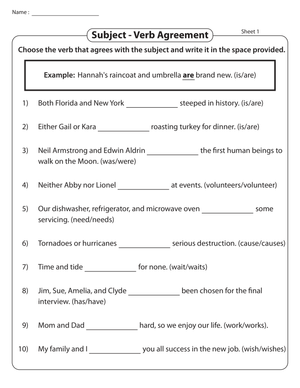
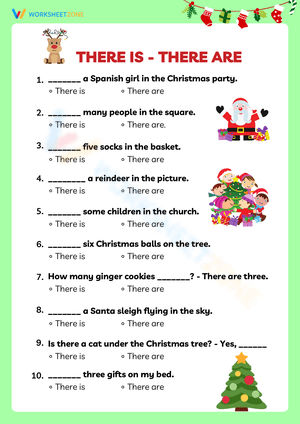
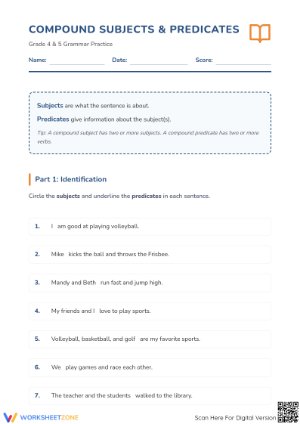
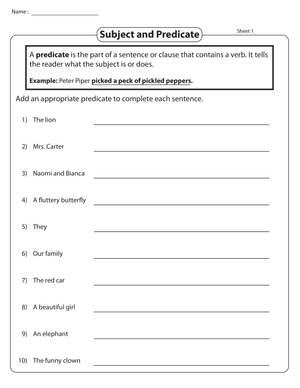
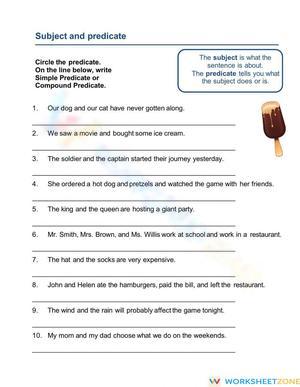
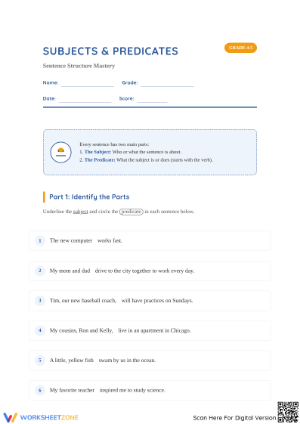
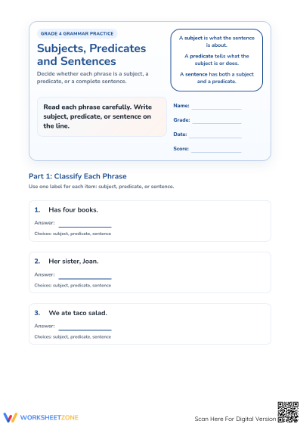
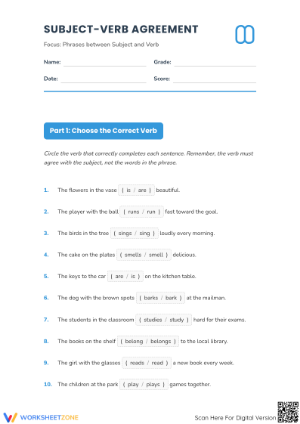
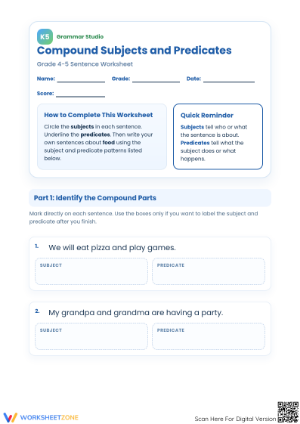
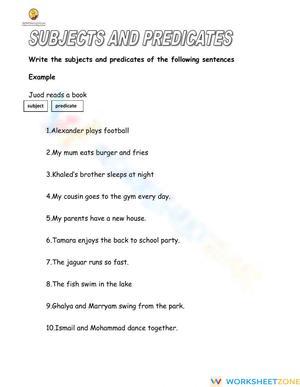
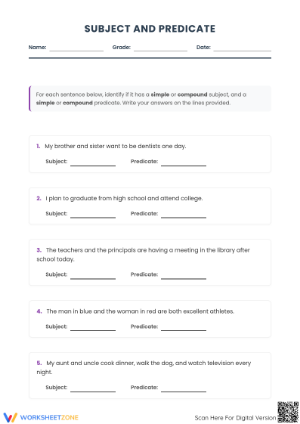
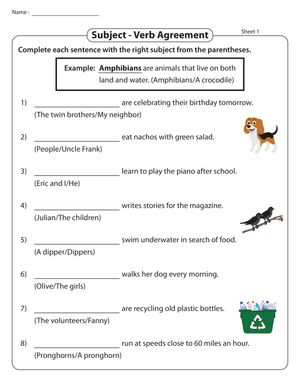
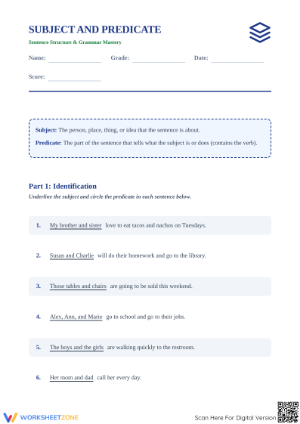
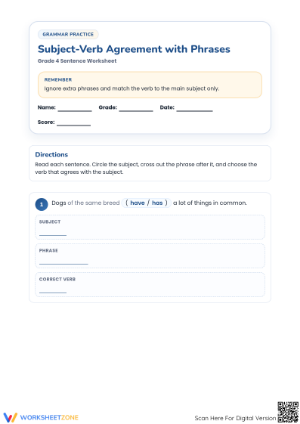
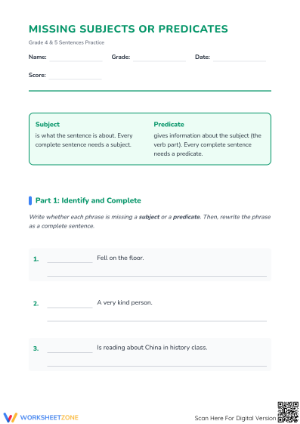
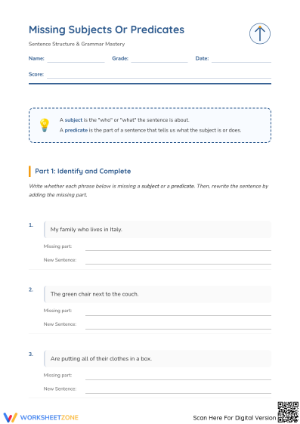
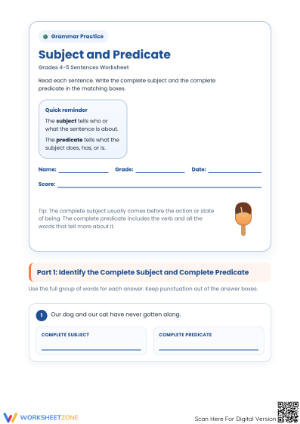
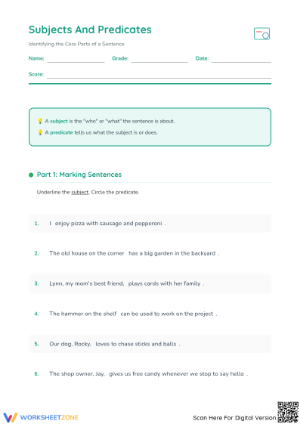
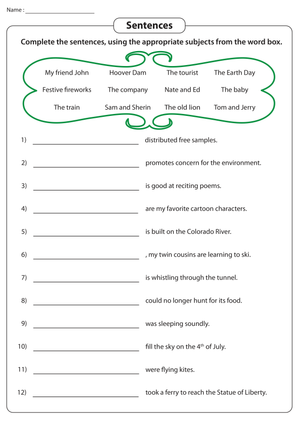
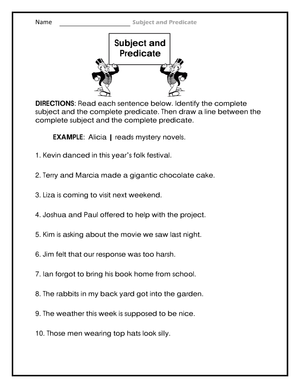
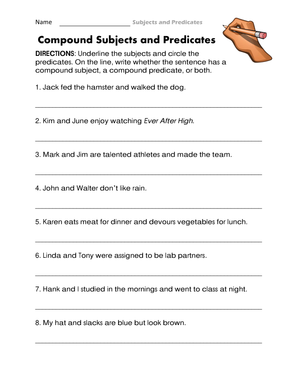
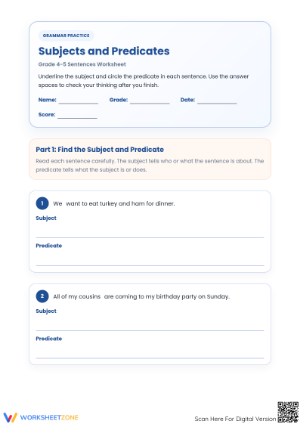
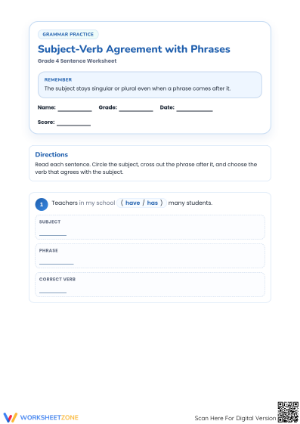
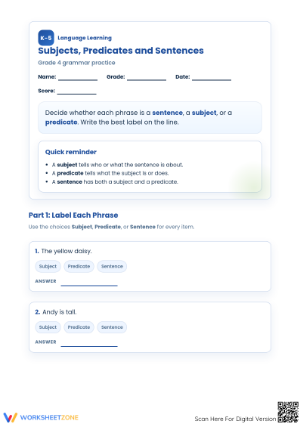
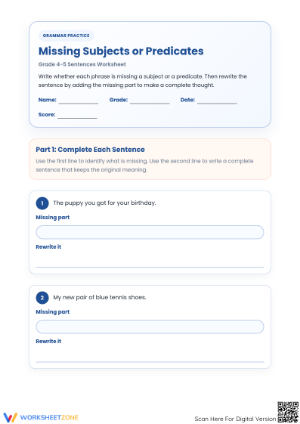
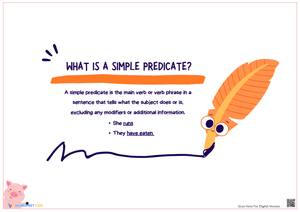
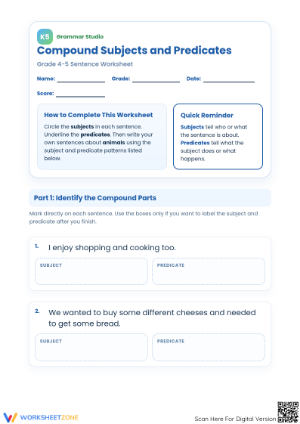
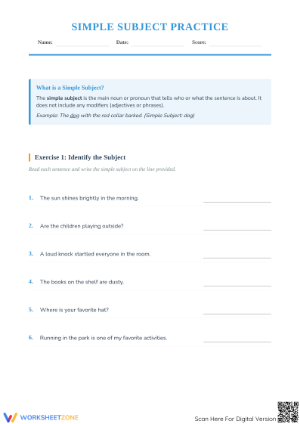
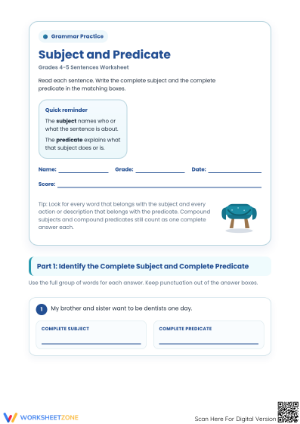
These 4th grade subject verb agreement pdf worksheets give teachers a printable set targeting the agreement constructions that fourth graders consistently struggle with — not just basic singular and plural in short sentences, but the harder cases: subjects separated from their verbs by prepositional phrases, compound subjects joined by or and nor, indefinite pronouns like everyone and each, and collective nouns that behave as singular despite implying a group. Each worksheet isolates a specific agreement pattern so teachers can address one trouble spot at a time rather than asking students to hold multiple rules in mind at once.
Agreement Patterns Covered Across the Set
The worksheets move through agreement rules in a deliberate order, starting with patterns students have some prior exposure to and building toward constructions that require more careful sentence analysis. Activity formats vary across the set: some worksheets ask students to circle the correct verb from two options, others ask them to identify and rewrite a sentence with an embedded error, and fill-in-the-blank items require students to determine the subject before committing to a verb form. Two worksheets in the set include open-response prompts where students compose original sentences using a given subject — practicing agreement through production rather than pattern recognition alone.
Sorting tasks round out the set. Students categorize subject-verb pairs as singular or plural agreements, which forces them to articulate the rule rather than just apply it by feel. This format works especially well as a Monday warm-up when returning to the skill after a weekend away from the material.
Student Error Patterns Worth Anticipating
The most reliable error fourth graders make is proximity matching — selecting the noun sitting closest to the verb rather than identifying the actual subject. In a sentence like The crate of old library books was returned, students who latch onto books write were without hesitation. This error appears even in students who handle short, direct sentences cleanly. The prepositional phrase worksheets address it by having students cross out the intervening phrase first, which makes the true subject easier to isolate before verb selection happens.
Compound subjects with or and nor produce a separate pattern. Students who have internalized the and rule apply it reflexively to all compound subjects. A student writing about a school production will produce Neither the director nor the cast members was present — inverting the agreement because they sense something about proximity but haven't sorted out how it interacts with nor specifically. Worksheets in this section place matched examples side by side so the contrast is visible without requiring a lengthy explanation from the teacher.
Indefinite pronouns generate a third category of errors. Everyone, each, and nobody strongly imply a group, and students reach for plural verbs to match that felt meaning. The error feels correct to them — which is exactly what makes it harder to dislodge than mistakes students already sense are wrong.
Fitting These Worksheets Into Your ELA Block
The strongest entry point for this set is a brief direct-instruction mini-lesson on a single pattern, followed immediately by guided practice on the matching worksheet. Trying to address prepositional phrase distractors, compound subjects, and indefinite pronouns in a single session almost guarantees students will conflate the rules. Keeping each day's worksheet focused on one pattern manages cognitive load and gives teachers a clear target for circulating feedback during practice.
Mid-week independent practice works well when the worksheet matches the pattern introduced at the start of the week. If more than a third of the class misses the same item type on an independent worksheet, that's a reliable signal to pull a small group the next morning rather than pressing forward. The mixed-review worksheet in the set — which combines all covered patterns — makes a strong Friday exit ticket, and completed worksheets filed in student writing folders document growth across the unit in ways a single end-of-unit test cannot.
One classroom move that consistently improves transfer: after students complete an error-correction worksheet, direct them to open a current draft of their own writing, mark every verb, and check each one against the subject. That ten-minute revision step anchors the skill more durably than running through a second worksheet on the same pattern.
Standard Alignment
These resources address CCSS.ELA-LITERACY.L.4.1, which requires fourth graders to demonstrate command of standard English grammar and usage in writing and speaking. Subject-verb agreement is a central component of that standard at this grade level. In third grade, students practice basic agreement in simple, direct sentences; fourth grade pushes them toward accurate application in complex constructions — compound subjects, prepositional phrase distractors, and the irregular behavior of indefinite pronouns — within their independent writing. That developmental progression explains why the skill gets explicit instructional attention at Grade 4 specifically: students need enough sentence-writing experience to encounter the harder constructions naturally before targeted practice on them has much effect. Teachers using 4th grade subject verb agreement pdf worksheets alongside authentic writing tasks — rather than treating the set as a standalone grammar unit — will see the standard's intent carried out more fully.
Tailoring the Set for Mixed-Ability Classrooms
Students still inconsistent with basic singular and plural in short sentences need to start there before encountering prepositional phrase distractors. For those students, set the intervening phrase worksheets aside temporarily and use the simpler fill-in-the-blank items — ones where subject and verb sit directly next to each other — until accuracy on basic forms is steady. A visual reference card pairing "singular subject" with "add -s to the verb" and "plural subject" with "no -s" reduces the working memory demand enough that students can focus on identifying the subject rather than retrieving the rule at the same time.
Students who move through core worksheets quickly benefit from the open-response writing prompts and from items featuring multiple prepositional phrases or less common indefinite pronouns like several and few. Asking those students to write their own "tricky" sentences — ones deliberately constructed to mislead a classmate — and then checking whether the classmate applies the agreement rule correctly extends the practice without requiring additional worksheets beyond the set.
Frequently Asked Questions
Are these worksheets appropriate for students still working on basic singular and plural agreement?
Yes, with some adjustment. Earlier worksheets in the set use short, direct sentences where the subject and verb sit close together. Those work well for students still consolidating the basic rule. Hold off on prepositional phrase and compound subject worksheets until a student handles the simpler patterns with consistency — introducing the harder constructions too early adds confusion rather than productive challenge.
How many worksheets specifically address intervening prepositional phrases?
Several worksheets in the set focus on this pattern because it produces the highest error rates in fourth-grade student writing. The approach moves from identification — students cross out the phrase to expose the true subject — to verb selection, to full sentence rewriting, with each step requiring a bit more independent application than the previous one.
Can these worksheets double as formative assessment tools?
Easily. Collecting a completed worksheet and scanning for errors by item type — rather than simply marking a total score — gives specific enough data to guide next-day instruction. If six students all miss items featuring collective nouns, that's a reteaching signal, not a grading problem. 4th grade subject verb agreement pdf worksheets serve this formative role well because the items are organized by pattern, which makes grouping student errors straightforward and actionable.
What is the best approach for introducing indefinite pronouns without overwhelming students?
Anchor initial teaching to a short, memorable list — everyone, nobody, each, someone — before expanding to the full category. Students need a reliable core group they can recall under pressure before the broader rule makes sense as a category. The relevant worksheets present these pronouns in context sentences rather than as isolated vocabulary items, which helps students attach the rule to real usage instead of a definition they memorize once and forget. Using 4th grade subject verb agreement pdf worksheets that show these pronouns in varied sentence positions — not always at the start of the sentence — also helps students generalize the agreement rule more reliably than practice built around a single sentence template.












 Interactive Worksheet Maker
 Quiz Maker
 Word Search Maker
 Crossword Puzzle Maker
 Word Scramble Generator
 Sentence Scramble Generator
 Handwriting Worksheet Generator
 Name Tracing Generator
 Fill In The Blank Generator