




























Views
Downloads
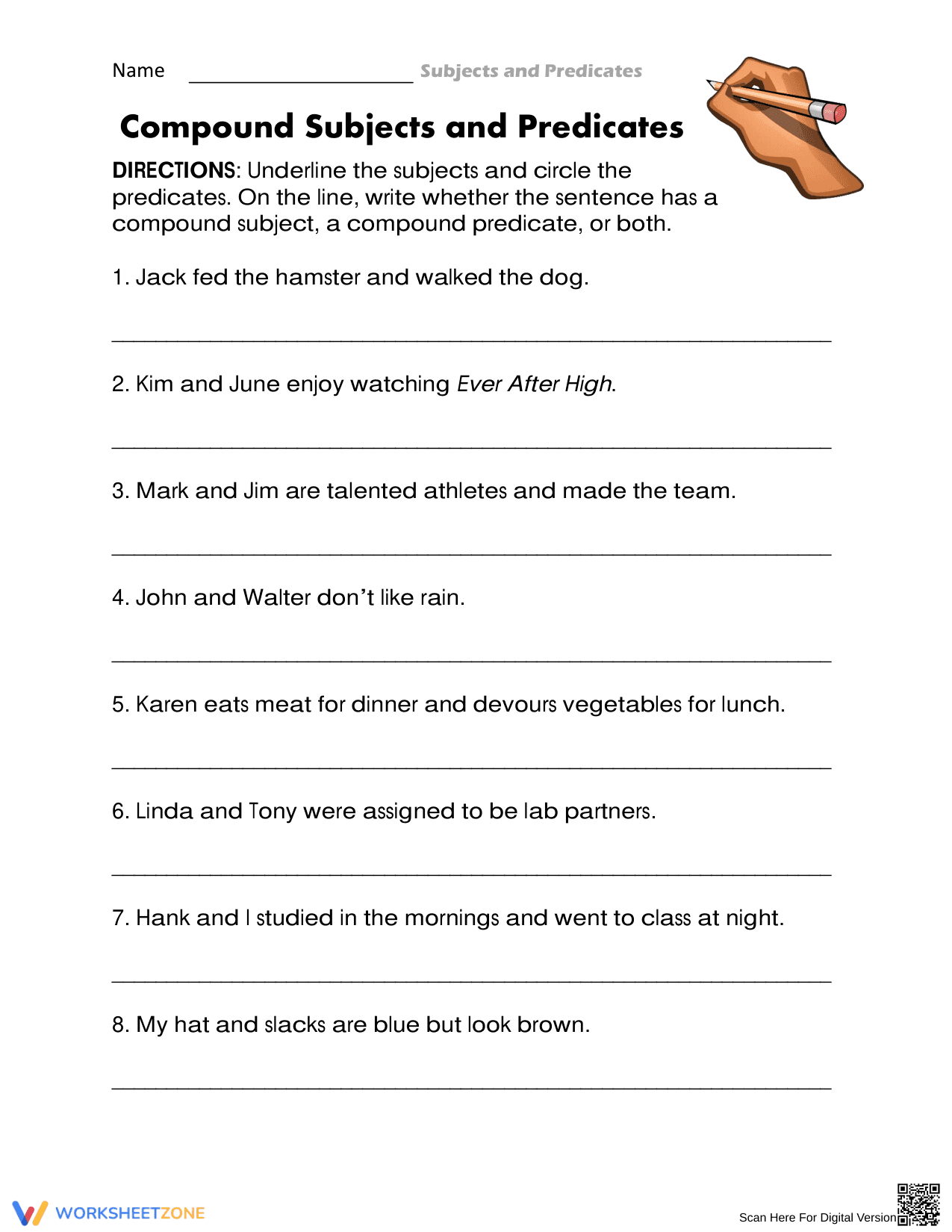

Compound Subjects & Predicates Worksheet | Essential Grade 4

Paste this activity's link or code into your existing LMS (Google Classroom, Canvas, Teams, Schoology, Moodle, etc.).
Students can open and work on the activity right away, with no student login required.
You'll still be able to track student progress and results from your teacher account.
This comprehensive Grade 3-5 grammar worksheet helps students master compound subjects and predicates through targeted sentence analysis. By identifying multiple actors or actions within a single sentence, learners build the foundational syntax skills necessary for complex writing. Students will underline subjects, circle predicates, and categorize sentence structures to demonstrate mastery of standard English conventions.
At a Glance
- Grade: 4 · Subject: ELA
- Standard:
CCSS.ELA-LITERACY.L.3.1.I— Produce simple, compound, and complex sentences through identifying multiple subjects and predicates- Skill Focus: Compound subjects and predicates
- Format: 1 page · 8 problems · Answer key included · PDF
- Best For: Grammar centers and independent practice
- Time: 15–20 minutes
This single-page PDF features eight carefully crafted sentences that challenge students to look beyond simple actors and actions. Each task requires two distinct steps: a mechanical identification phase where students underline and circle sentence parts, and a cognitive classification phase where they label the sentence type. The layout provides ample writing space on dedicated lines, and a complete answer key is provided for immediate feedback or teacher grading.
This resource is designed for a three-step workflow that takes under two minutes of prep time. First, print the single-sheet PDF (30 seconds). Second, distribute to students; the clear directions minimize verbal setup (30 seconds). Finally, review answers using the included key (1 minute). This efficiency makes it ideal for emergency sub plans or quick bell-ringer activities. Teachers can rely on its self-explanatory nature for consistent student output.
The primary alignment for this resource is CCSS.ELA-LITERACY.L.3.1.I, which requires students to produce simple, compound, and complex sentences. By deconstructing sentences into their compound components, students learn the structural logic required to eventually build their own sophisticated prose. This worksheet also supports 4th grade standards by reinforcing complete sentence boundaries. Both standard codes can be copied directly into lesson plans, IEP goals, or district curriculum mapping tools.
For best results, assign this worksheet during the independent practice portion of a grammar lesson after introducing the concepts of multiple subjects and verbs. It serves as an excellent formative assessment tool; teachers should observe if students are missing the second half of compound structures, which often indicates a need for further scaffolding. The expected completion time is 15 to 20 minutes, making it a perfect fit for a dedicated literacy rotation.
This activity is tailored for elementary students who are transitioning from simple to more varied sentence structures. It provides enough support for struggling writers through its repetitive structure while offering a meaningful challenge for on-grade learners. This worksheet pairs naturally with a mentor text passage or an anchor chart that visualizes the conjunction as a bridge between subjects or predicates. It is suitable for both whole-class instruction and small-group remediation.
Research from Fisher & Frey (2014) emphasizes that structural sentence analysis is a critical precursor to writing fluency. This worksheet applies these principles by requiring students to isolate compound subjects and predicates, a skill directly mapped to CCSS.ELA-LITERACY.L.3.1.I. By engaging with eight distinct task sets, students move from rote identification to a conceptual understanding of how sentences carry more information. According to NAEP data, students who master internal sentence logic early show significantly higher proficiency in narrative writing tasks in later years. This resource provides the high-repetition environment necessary for that mastery. Teachers can use the data from these eight problems to identify syntax gaps, ensuring that grammar instruction remains data-driven and responsive to individual student needs. This systematic approach ensures that students are not just memorizing rules but are actively constructing a mental map of English syntax, which is essential for future academic success.


