




























Views
Downloads

Printable Subject and Predicate Worksheet | Grades 4-5

Paste this activity's link or code into your existing LMS (Google Classroom, Canvas, Teams, Schoology, Moodle, etc.).
Students can open and work on the activity right away, with no student login required.
You'll still be able to track student progress and results from your teacher account.
Strong writing begins with a firm grasp of sentence architecture. This worksheet provides a focused environment for students to master the division between subjects and predicates, ensuring they can identify the actor and the action in both simple and complex sentences. By isolating these components, learners improve their ability to produce complete thoughts and avoid the common pitfalls of fragments or run-on sentences in their own compositions.
At a Glance
- Grade: 4–5 · Subject: English Language Arts
- Standard:
CCSS.ELA-LITERACY.L.4.1— Demonstrate command of the conventions of standard English grammar and usage when writing- Skill Focus: Complete and Compound Subjects and Predicates
- Format: 3 pages · 10 problems · Answer key included · PDF
- Best For: Grammar reinforcement and formative assessment
- Time: 15–20 minutes
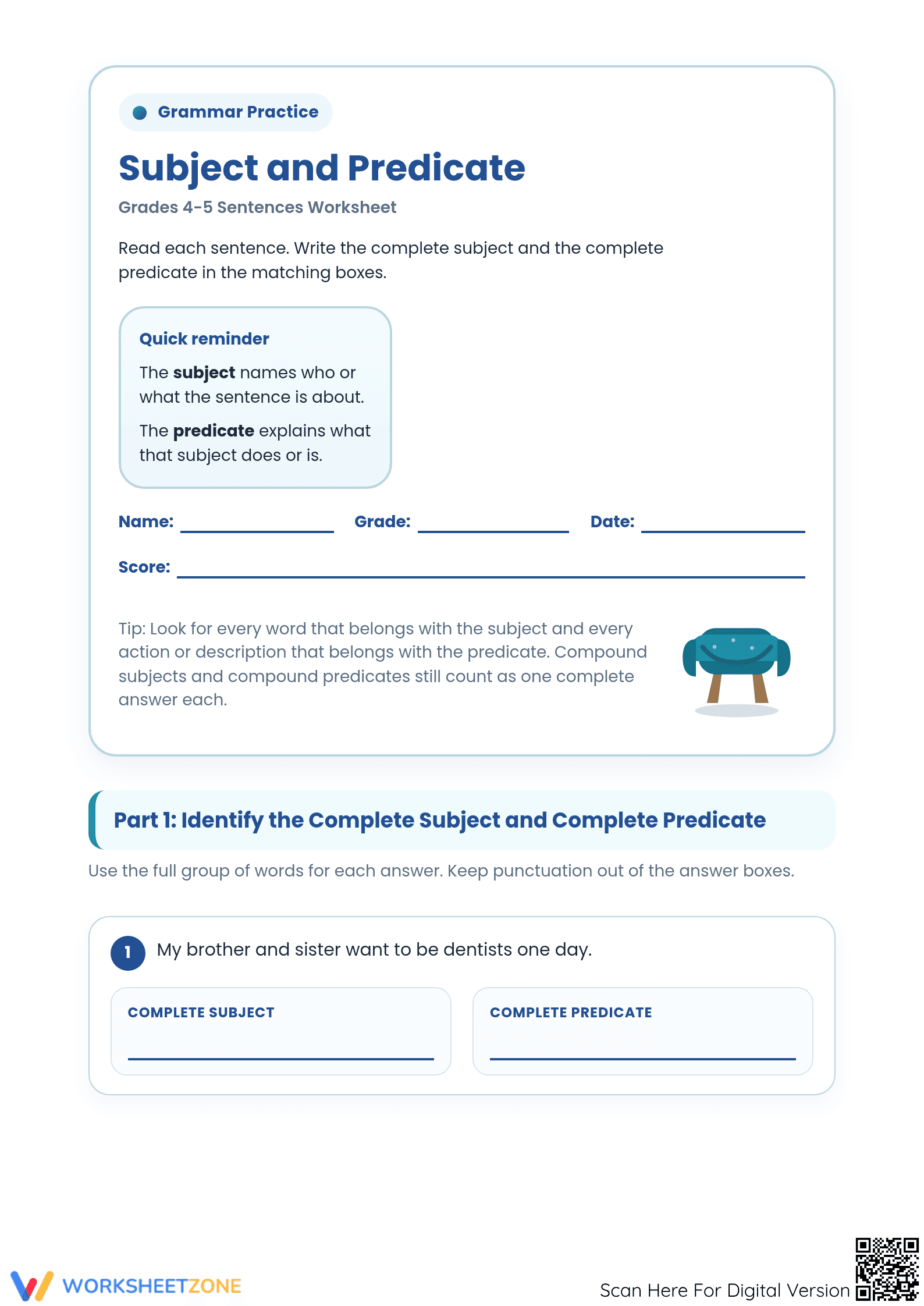
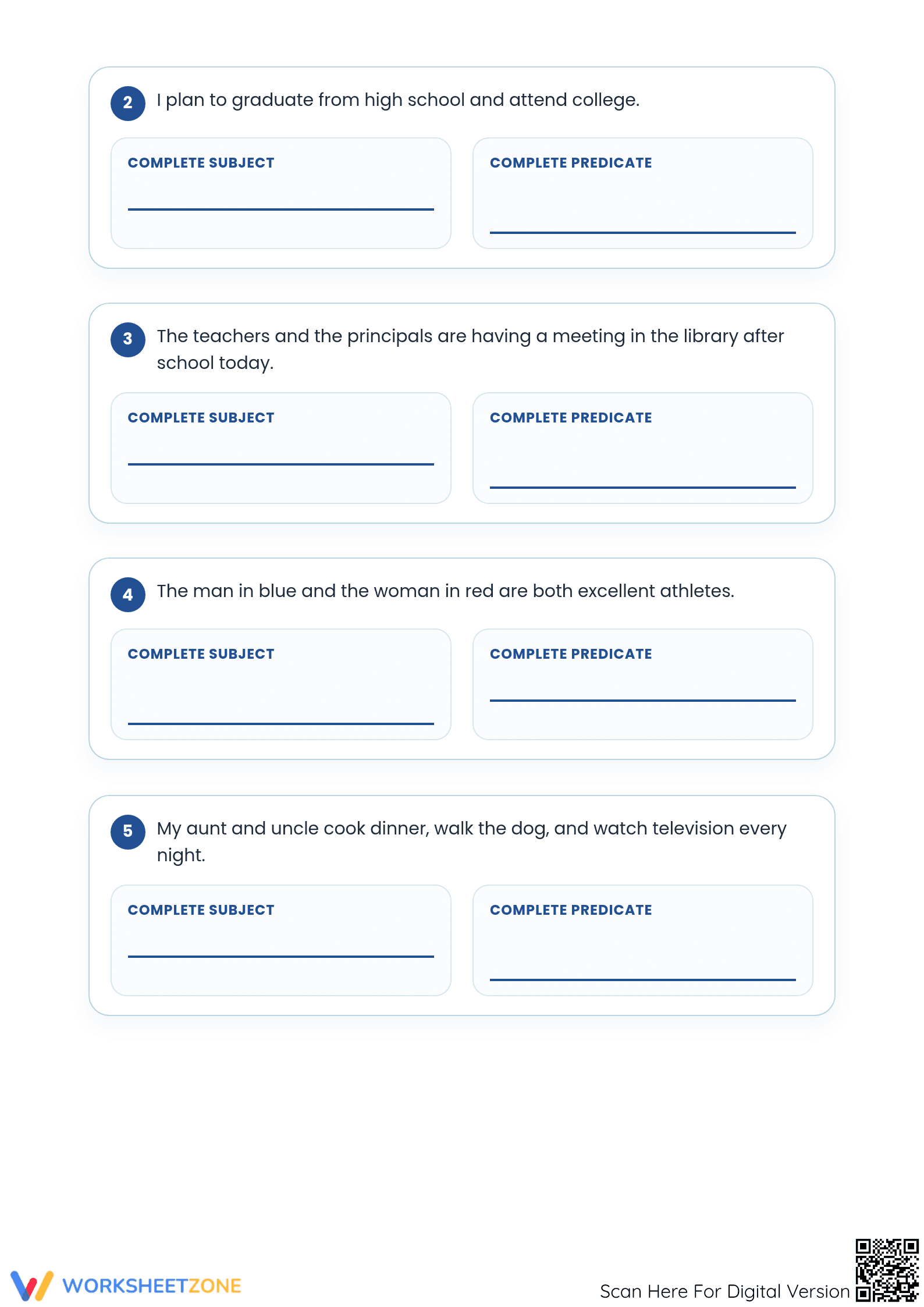
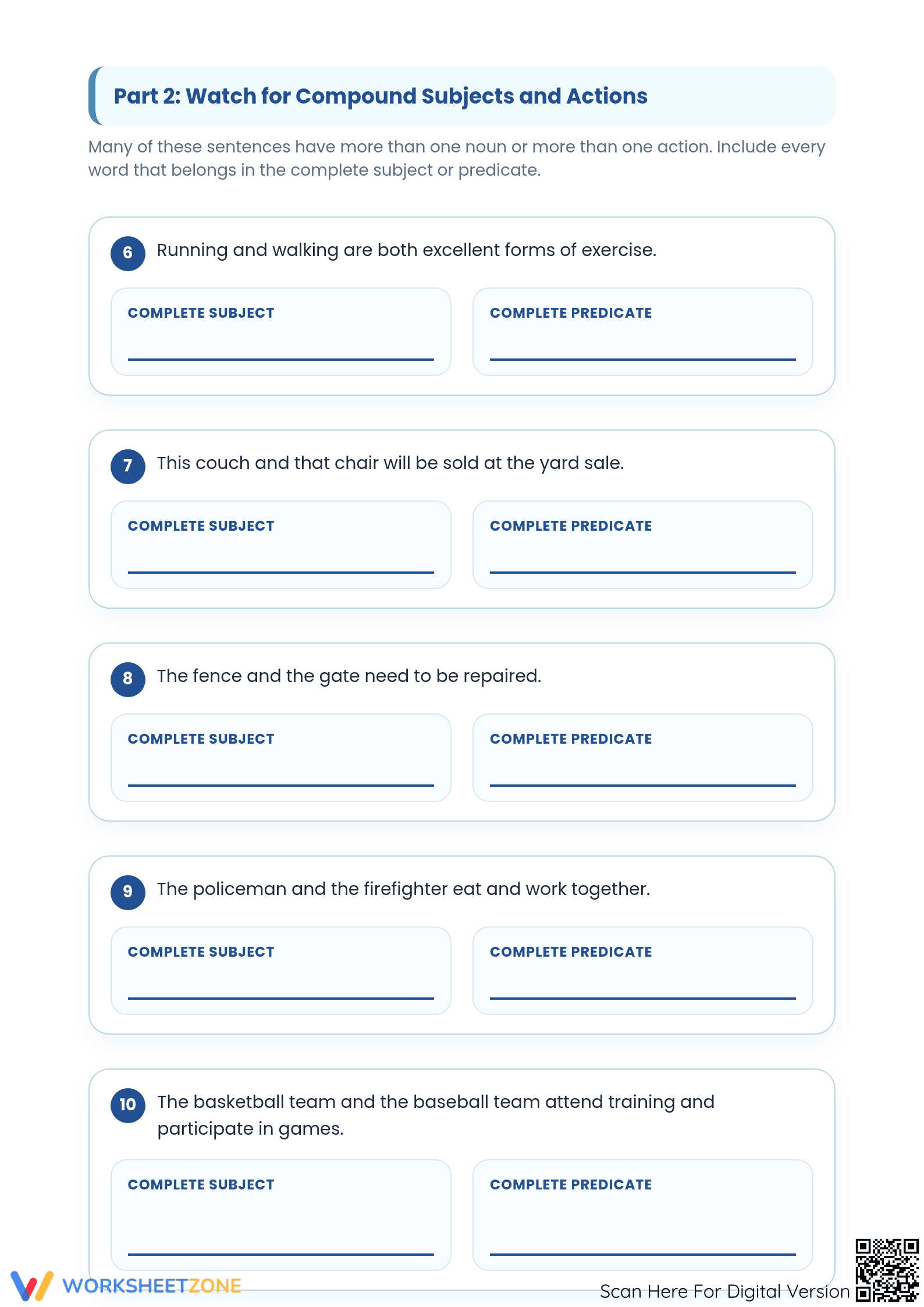
This three-page instructional resource is designed for clarity and ease of use. It contains ten structured tasks where students must read a sentence and transcribe the complete subject and complete predicate into designated response boxes. The worksheet includes a "Quick Reminder" box on the first page to define key terms and a specialized tip regarding compound structures, ensuring students remain supported as the complexity of the sentences increases across the three pages.
Zero-Prep Workflow
This resource is optimized for the busy educator who needs high-quality materials without the burden of preparation. The zero-prep workflow is straightforward: Print the three pages for your class (30 seconds), Distribute the worksheets for independent or guided practice (1 minute), and Review using the provided full-page answer keys (2 minutes). The self-contained "Quick Reminder" box means students can work through the tasks with minimal teacher intervention, making this an ideal selection for emergency sub plans or independent literacy centers.
Standards Alignment
This worksheet is aligned to `CCSS.ELA-LITERACY.L.4.1` and `CCSS.ELA-LITERACY.L.5.1`, focusing on the student's ability to demonstrate command of the conventions of standard English grammar. Specifically, it targets the foundational understanding of sentence parts required to produce complete, grammatically correct sentences. This standard code can be copied directly into lesson plans, IEP goals, or district curriculum mapping tools to document rigorous alignment with national literacy expectations.
How to Use It
Deploy this worksheet as a bell-ringer activity to start a grammar-focused lesson or as a formative assessment after direct instruction on sentence parts. Teachers can observe students as they work on Part 2, which introduces compound subjects and actions, to identify who might be struggling with more complex sentence frames. Students typically complete the 10-item set in 15 to 20 minutes, making it a perfect fit for a structured literacy block or a quick homework assignment.
Who It's For
The content is tailored for 4th and 5th-grade students who are transitioning from simple sentence identification to more nuanced grammar analysis. It is highly effective for general education classrooms, English Language Learners (ELL) who need clear visual boundaries for sentence parts, and special education students who benefit from the scaffolded boxes and explicit reminders. Pair this resource with a mentor text passage where students can underline subjects and predicates in real-world writing.
According to a ScienceDirect TpT Analysis, structured grammar worksheets like this one are vital for bridging the gap between isolated skill acquisition and functional writing application. By requiring students to physically write the subject and predicate into separate boxes, the resource reinforces the conceptual boundary between the "who" and the "do." This mechanical practice is supported by Fisher & Frey (2014) as a necessary step in the gradual release of responsibility, providing the "guided practice" phase before students are expected to self-edit their own essays. The inclusion of compound subjects ensures the worksheet maintains a level of rigor suitable for Grade 5 standards while remaining accessible to Grade 4 learners. This dual-grade alignment makes it a versatile tool for differentiated instruction and multi-grade classroom environments. The `CCSS.ELA-LITERACY.L.4.1` standard is fully addressed through this systematic approach to sentence deconstruction, providing teachers with verifiable evidence of student mastery in fundamental English conventions.


