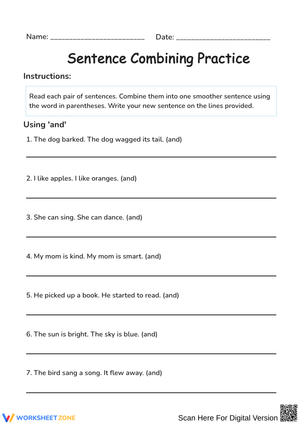
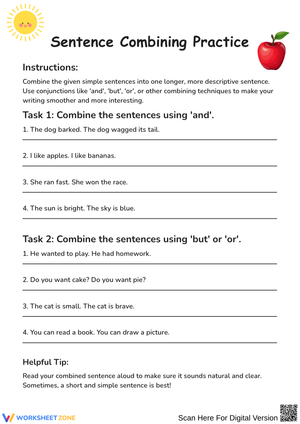
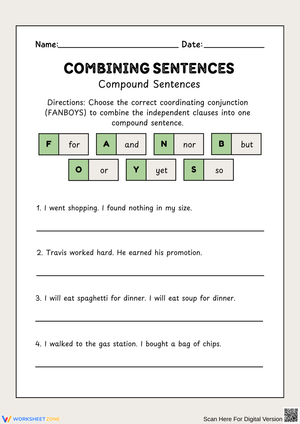
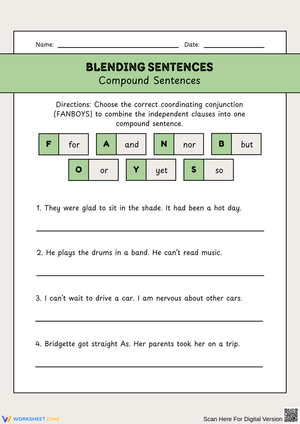
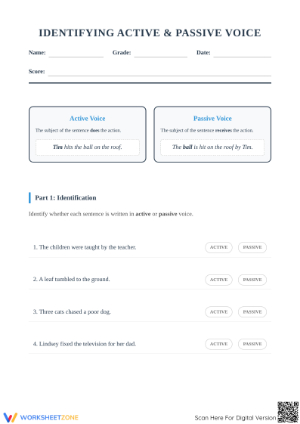
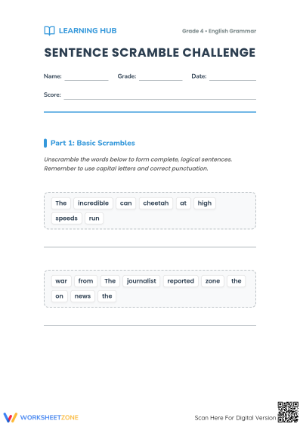
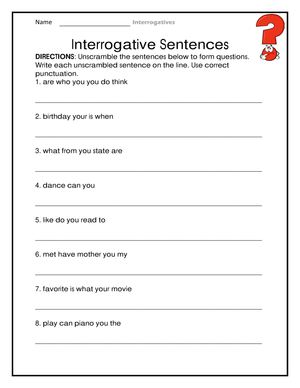
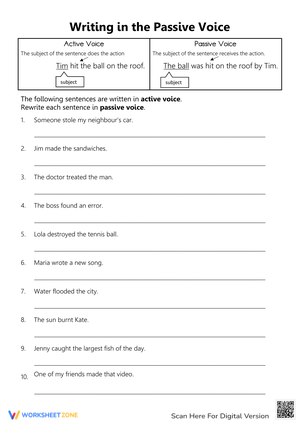
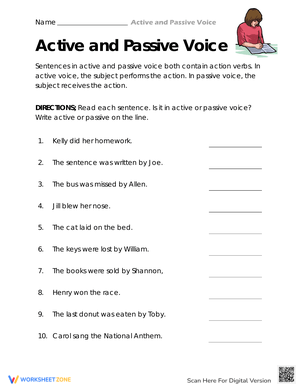
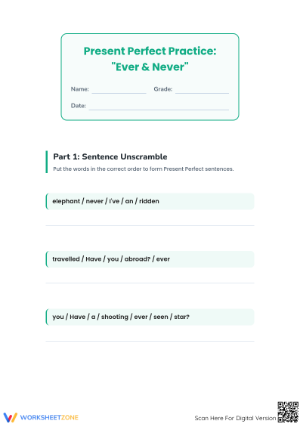
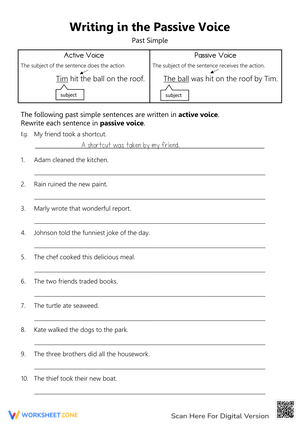
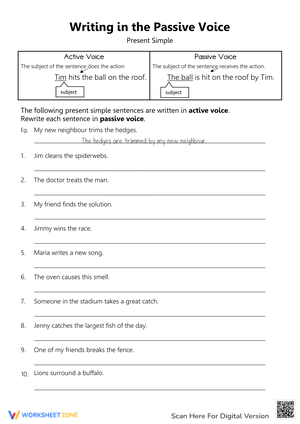
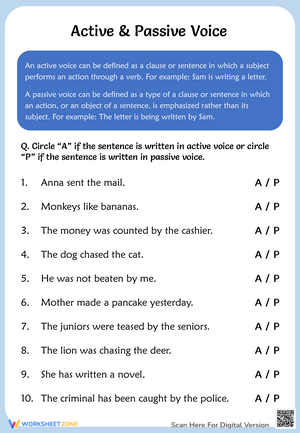
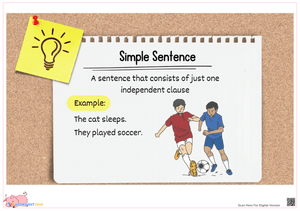
These 4th grade sentence structure pdf worksheets give teachers a targeted way to address the grammatical moves fourth graders are expected to control by mid-year — telling a fragment from a complete sentence, untangling run-ons, and building compound and complex sentences with intentional punctuation. The set covers the specific skills named in CCSS.ELA-LITERACY.L.4.1.F without the clutter of mixed-topic grammar packets that diffuse student attention.
The Specific Skills Each Worksheet Targets
Fourth grade is the grade where sentence variety stops being optional. Students who spent second and third grade writing simple, workable sentences now need to stretch — connecting clauses, subordinating ideas, and controlling the punctuation that holds those structures together. Each worksheet in the set isolates one of these moves rather than stacking all of them into a single activity.
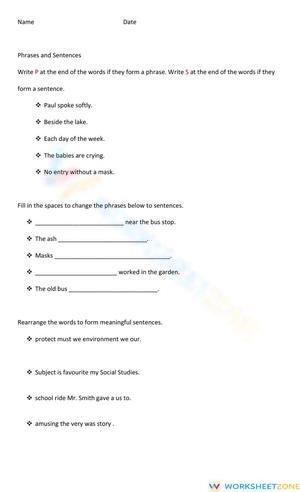
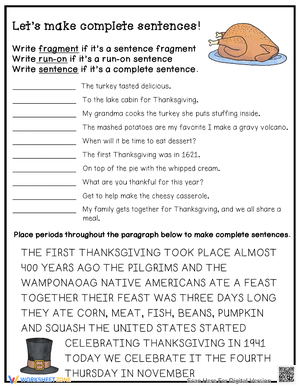
- Identifying and fixing fragments: Students read groups of words, mark whether a subject, a predicate, or both are missing, then rewrite each fragment as a complete sentence.
- Correcting run-ons: Each worksheet presents fused sentences and comma splices for students to fix using three approaches — a period break, a coordinating conjunction with a comma, or a subordinating conjunction that converts one clause to a dependent one.
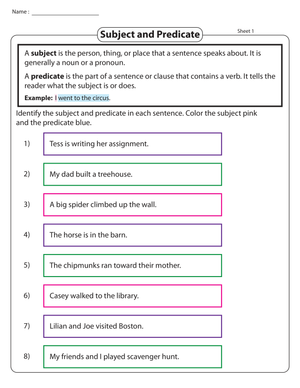
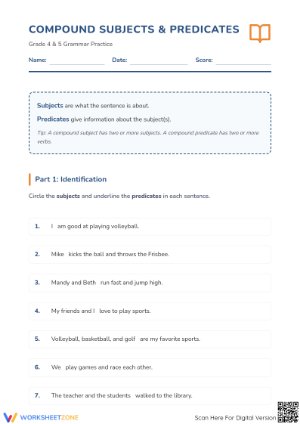
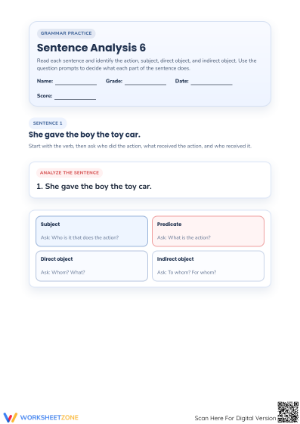
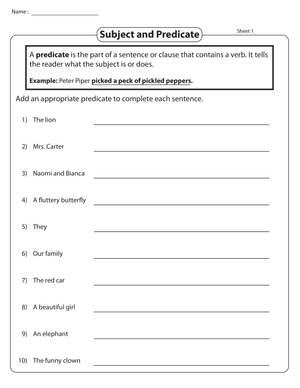
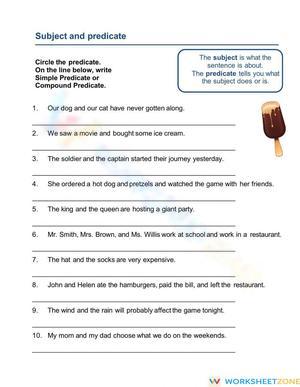
- Locating subjects and predicates: Students underline the complete subject once and the complete predicate twice, then label compound subjects and compound predicates where they appear.
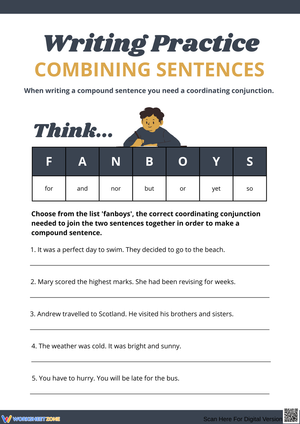
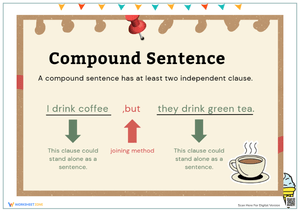
- Sentence combining: Short, choppy pairs of sentences are provided, and students merge them using FANBOYS conjunctions or subordinators like although, because, and since — choosing the connector that best reflects the logical relationship between ideas.
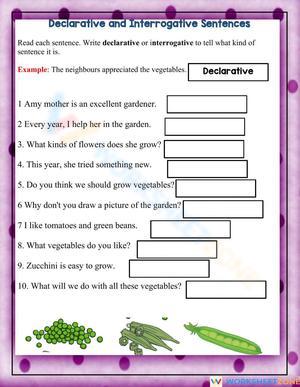
- Compound and complex sentences: Students sort and annotate sentences by type, identifying independent and dependent clauses and applying correct comma placement for each structure.
Frequent Errors Students Make — and What to Watch For
The most persistent mistake at this level is not the obvious fragment — students generally catch "Running down the hall." as incomplete. The trouble is the long fragment that sounds finished. A sentence like "Because the storm knocked out the power all night long and no one could finish their homework." reads fluent enough that many fourth graders submit it without a second look. The subordinating conjunction because signals a clause that cannot stand alone, but the sheer length of the phrase gives it convincing weight. These worksheets surface that error repeatedly so students learn to test for completeness by finding the independent clause, not just scanning for a capital letter and a period.
Run-ons create a different problem. Students often know they have written two ideas but believe a comma alone is sufficient to separate them — the classic comma splice. "We finished the project early, our teacher gave us free reading time." feels punctuated to a fourth grader who can see the pause marked. Part of the work here is getting students to name what is actually happening: two independent clauses require either a period, a semicolon, or a coordinating conjunction paired with a comma. Students who can state that rule aloud fix the error more consistently than students who have only seen it corrected on a paper without explanation.
Building These Worksheets Into Your Lesson Plans Effectively
These worksheets fit cleanly into the grammar mini-lesson block that precedes independent writing — the ten to twelve minutes before students move into drafting or revision. Used that way, each worksheet becomes a bridge between direct instruction and student writing rather than a standalone drill. Walk through the first two items together as a class, then release students to complete the rest independently while you circulate. That approach takes about fifteen minutes total and leaves students with a skill fresh in working memory right as they open their writing notebooks.
The two-color highlighter approach works particularly well with the fragment and run-on worksheets. Ask students to mark every complete subject in one color before touching anything else, then mark every predicate in a second color. If a group of words carries only one color, it is a fragment. If two complete subjects and two complete predicates exist without a conjunction or period between them, it is a run-on. Making this a physical, visual step before any rewriting slows down the automatic "it sounds right" response that causes most errors in the first place. These 4th grade sentence structure pdf worksheets are print-ready, so the two-color strategy costs nothing beyond what students already have in their pencil cases.
The sentence-combining worksheets also work well as partner activities on Fridays when students have already practiced the skill independently. Pairs tend to debate conjunction choice — whether but or although better reflects the relationship between two ideas — and those debates are more instructive than any individual correction exercise. That kind of low-stakes discussion surfaces reasoning that a completed worksheet alone does not reveal.
Standard Alignment
The core standard these worksheets address is CCSS.ELA-LITERACY.L.4.1.F, which requires fourth graders to produce complete sentences, recognizing and correcting inappropriate fragments and run-ons. In classroom terms, this standard typically surfaces during the Language block in the first and second quarters, when teachers are establishing the grammatical expectations that will govern student writing throughout the year. It reappears during the revision phase of any major writing unit — narrative, opinion, or informational — because sentence structure is assessed within writing rubrics even when it is not the writing unit's primary focus. Having a targeted set of worksheets on hand means you can pull fragment-and-run-on practice for the student who still needs it in November without derailing the larger unit arc for the rest of the class.
Adjusting the Set for a Range of Learners
For students who struggle with the abstract distinction between a clause and a phrase, provide a sentence-testing frame before they begin the worksheet: a strip that reads "Who or what? ___. Did what? ___." Students fill in both blanks using words from the given group. If one blank stays empty, the group of words is a fragment. This step-by-step format reduces the cognitive load of holding the definition in mind while simultaneously trying to analyze unfamiliar text — and it gives students a repeatable procedure rather than a rule they have to recall under pressure.
Students who move through the worksheets quickly benefit from an extension that requires production rather than correction. Instead of fixing a given run-on, they write their own compound and complex sentences about a current science or social studies topic, then swap with a partner who identifies the clause types and checks comma placement. This pushes the skill from recognition to controlled use, which is where real transfer happens for students who are ready to move past error correction.
Frequently Asked Questions
Can these worksheets serve as a formative assessment?
Yes. Because each worksheet targets a single skill, teachers can collect and review student work quickly to see which errors are individual and which are class-wide. A worksheet where most students correctly fix run-ons but leave comma splices untouched tells you exactly what the next mini-lesson needs to cover. That kind of focused data is harder to extract from a multi-skill grammar test where results blend together.
How do I help a student who keeps writing "because" fragments even after direct instruction?
The most effective fix is having the student read the clause aloud and then finish the thought spontaneously: "Because the power went out — and then what happened?" Students who have to answer a follow-up question begin to feel the incompleteness they cannot yet see on the page. After a few rounds of that oral practice, the 4th grade sentence structure pdf worksheets provide enough written repetition to help students internalize the pattern so it transfers to their own drafting.
Are these worksheets appropriate for third or fifth graders?
The fragment and run-on worksheets work well as review for fifth graders who are still making these errors in their writing — the skill expectation carries forward even as the writing tasks grow more demanding. For third graders, the subjects-and-predicates worksheets are appropriate, but the compound and complex sentence activities introduce vocabulary and punctuation rules that most third graders have not yet encountered formally. Use those selectively and with more front-loaded explanation before releasing students to work independently.
What is the best sequence for introducing sentence combining?
Start with the coordinating conjunctions before moving to subordinating ones. FANBOYS conjunctions — for, and, nor, but, or, yet, so — produce compound sentences where both clauses carry equal weight, and students find that structure more intuitive than the dependent-clause relationship required by subordinators. Once students can reliably combine two independent clauses with a comma and a coordinating conjunction, introducing because and although feels like a natural next step rather than an entirely new concept. These 4th grade sentence structure pdf worksheets are organized so teachers can follow that progression or pull individual worksheets in whatever order the class needs.












 Interactive Worksheet Maker
 Quiz Maker
 Word Search Maker
 Crossword Puzzle Maker
 Word Scramble Generator
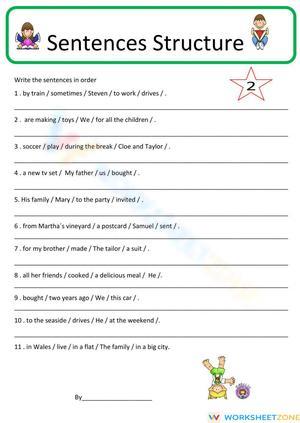
 Sentence Scramble Generator
 Handwriting Worksheet Generator
 Name Tracing Generator
 Fill In The Blank Generator