




























Views
Downloads
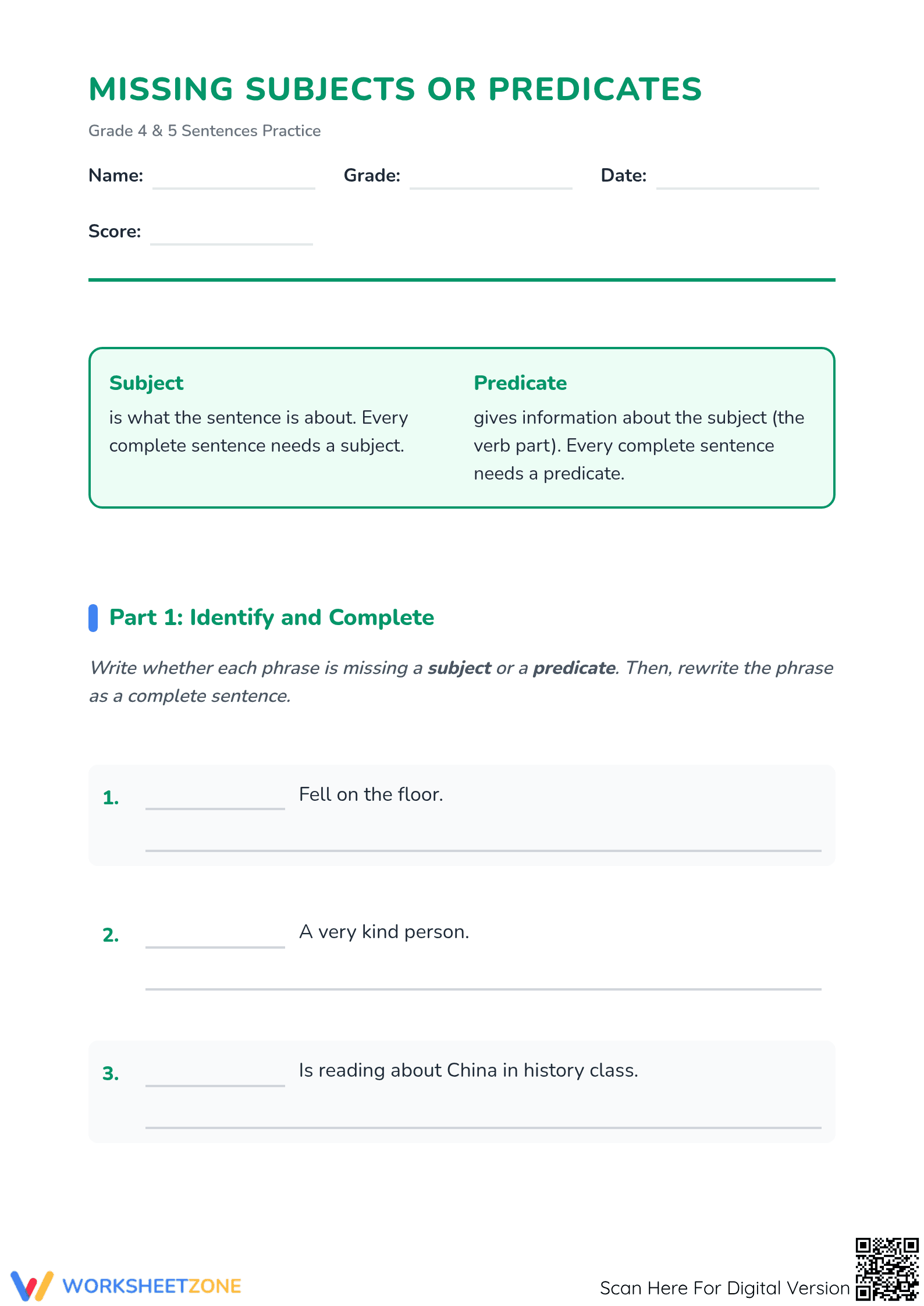


Printable Missing Subjects and Predicates Worksheet for Grades 4-5

Paste this activity's link or code into your existing LMS (Google Classroom, Canvas, Teams, Schoology, Moodle, etc.).
Students can open and work on the activity right away, with no student login required.
You'll still be able to track student progress and results from your teacher account.
Mastering the mechanics of sentence construction is a foundational literacy skill. This comprehensive worksheet helps Grade 4 and 5 students identify and complete subjects and predicates across three distinct practice phases. By isolating these core components, learners develop the structural awareness necessary to eliminate fragments and produce sophisticated, complete sentences in their own academic writing.
At a Glance
- Grade: 4-5 · Subject: English Language Arts
- Standard:
CCSS.ELA-LITERACY.L.4.1.F— Produce complete sentences and recognize fragments or run-ons in writing- Skill Focus: Subject and Predicate Identification
- Format: 4 pages · 18 problems · Answer key included · PDF
- Best For: Grammar reinforcement and sentence structure mastery
- Time: 25–35 minutes
This four-page resource provides a clear definition of sentence components before moving into structured practice. It includes 10 "Identify and Complete" tasks, a 5-item matching section to build logical connections, and 3 "Fix the Fragments" exercises. The clear layout and scaffolded approach ensure students understand how the naming part and the action part work together to convey complete thoughts.
The instructional design follows a clear skill progression to ensure student success.
- Guided practice: Students begin by classifying 10 provided phrases as missing a subject or predicate, then rewriting them with added support to form complete sentences.
- Supported practice: A matching section requires students to connect 5 specific subjects to appropriate predicates, reinforcing the logical agreement required for coherent communication.
- Independent practice: Three final tasks challenge students to fix broken fragments from scratch, applying their learning to produce original, grammatically correct sentences.
This worksheet is primarily aligned to CCSS.ELA-LITERACY.L.4.1.F, which focuses on producing complete sentences and recognizing or correcting inappropriate fragments. Additionally, it supports CCSS.ELA-LITERACY.L.5.1 by strengthening the command of the conventions of standard English grammar. Both standard codes can be copied directly into lesson plans, IEP goals, or district curriculum mapping tools.
Teachers can utilize this worksheet as a mid-unit check for understanding after introducing sentence parts. It works effectively as an independent practice activity during a literacy rotation or as a targeted intervention for students struggling with sentence fragments. During the matching phase, observe if students can explain why a specific subject logically pairs with its predicate to gauge their syntactic comprehension.
Designed for Grade 4 and 5 students, this resource is ideal for whole-class instruction or small-group remediation. The structured format particularly benefits English Language Learners and students with IEPs who require explicit scaffolding in grammar. Pair this worksheet with a mentor text passage to have students highlight subjects and predicates in professional writing for deeper application.
Research by Fisher & Frey (2014) emphasizes the importance of the gradual release of responsibility in grammar instruction, moving from explicit modeling to independent application. This worksheet applies that framework by providing clear definitions followed by increasingly complex tasks that isolate subjects and predicates. By mastering these components, students build the syntactic maturity required for Grade 5 and middle school writing standards. According to NAEP data, students who demonstrate a strong grasp of sentence mechanics in elementary school show significantly higher proficiency in narrative and expository writing tasks later in their academic careers. This resource directly addresses the common obstacle of sentence fragments by forcing students to physically write the missing components. The inclusion of an answer key allows for immediate feedback, which RAND AIRS 2024 studies identify as a critical factor in long-term skill retention for foundational ELA concepts.


