


























Views
Downloads
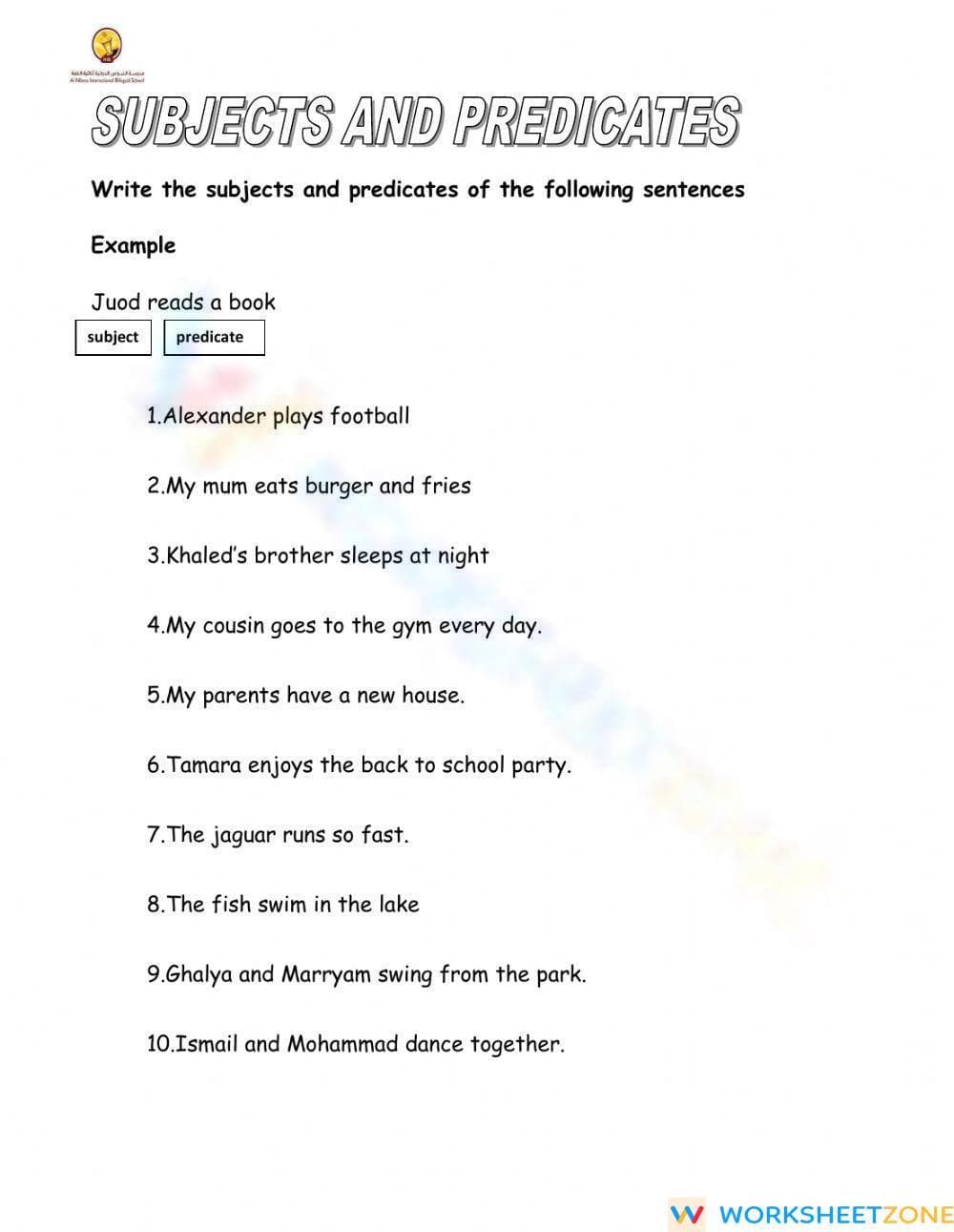

Printable Subjects and Predicates Worksheet | Grade 3 ELA
Paste this activity's link or code into your existing LMS (Google Classroom, Canvas, Teams, Schoology, Moodle, etc.).
Students can open and work on the activity right away, with no student login required.
You'll still be able to track student progress and results from your teacher account.
Sentence construction requires a clear understanding of subjects and predicates. This Grade 3 ELA worksheet provides targeted practice in identifying the "who" or "what" of a sentence and the action. By isolating these components, learners develop the foundational skills necessary for writing complete, grammatically correct sentences.
At a Glance
- Grade: 3 · Subject: ELA
- Standard:
CCSS.ELA-LITERACY.L.3.1— Demonstrate command of standard English grammar and usage when writing or speaking- Skill Focus: Identifying subjects and predicates
- Format: 1 page · 10 problems · Answer key included · PDF
- Best For: Independent grammar practice and review
- Time: 15–20 minutes
This single-page PDF features an instructional example to guide student understanding. Students are presented with 10 sentences of varying complexity, including compound subjects. The layout provides ample white space for writing out subjects and predicates, ensuring the task remains focused on the grammatical concept without overwhelming the learner.
The zero-prep design allows teachers to integrate this resource into their lesson plans in under two minutes. Simply print the worksheet, distribute it to the class, and allow students to work through the problems independently or in pairs. The clear instructions and included example mean no additional teacher setup or lecturing is required, making it an ideal choice for morning work, homework, or emergency sub plans.
Aligned primary to CCSS.ELA-LITERACY.L.3.1, this worksheet ensures students demonstrate command of English grammar. Identifying subjects and predicates helps students master simple and compound sentences. This standard code can be copied directly into lesson plans, IEP goals, or district curriculum mapping tools to document instructional alignment and student progress.
Use this worksheet as a formative assessment during a unit on sentence structure. After a mini-lesson on the parts of a sentence, assign the worksheet to observe which students can successfully isolate the complete subject from the complete predicate. A completion time of 15 to 20 minutes makes it a perfect "exit ticket" activity to gauge student readiness for more complex writing tasks.
This resource is designed for Grade 3 students, though it is highly applicable for Grade 2 enrichment or Grade 4 remediation. It supports diverse learners through its clear structure and can be paired with an anchor chart displaying common subject-predicate patterns. For students needing more support, teachers might highlight the nouns and verbs first to help them visualize the sentence components.
According to the RAND AIRS 2024 report on elementary literacy, explicit instruction in sentence-level mechanics is a critical predictor of long-term writing proficiency. This worksheet targets the fundamental breakdown of subjects and predicates, directly supporting the CCSS.ELA-LITERACY.L.3.1 requirement for grammatical mastery. By providing 10 structured opportunities for students to analyze sentence parts, this resource reinforces the syntactic awareness needed to transition from simple phrases to complex academic writing. Research from EdReports 2024 emphasizes that consistent, focused practice on word classes and functions allows students to internalize the logic of English grammar, reducing cognitive load during the drafting phase of the writing process. This printable tool offers a low-stakes environment for students to apply their knowledge, ensuring they can accurately identify the essential actors and actions within any given text before they begin composing their own original narratives.


