




























Views
Downloads
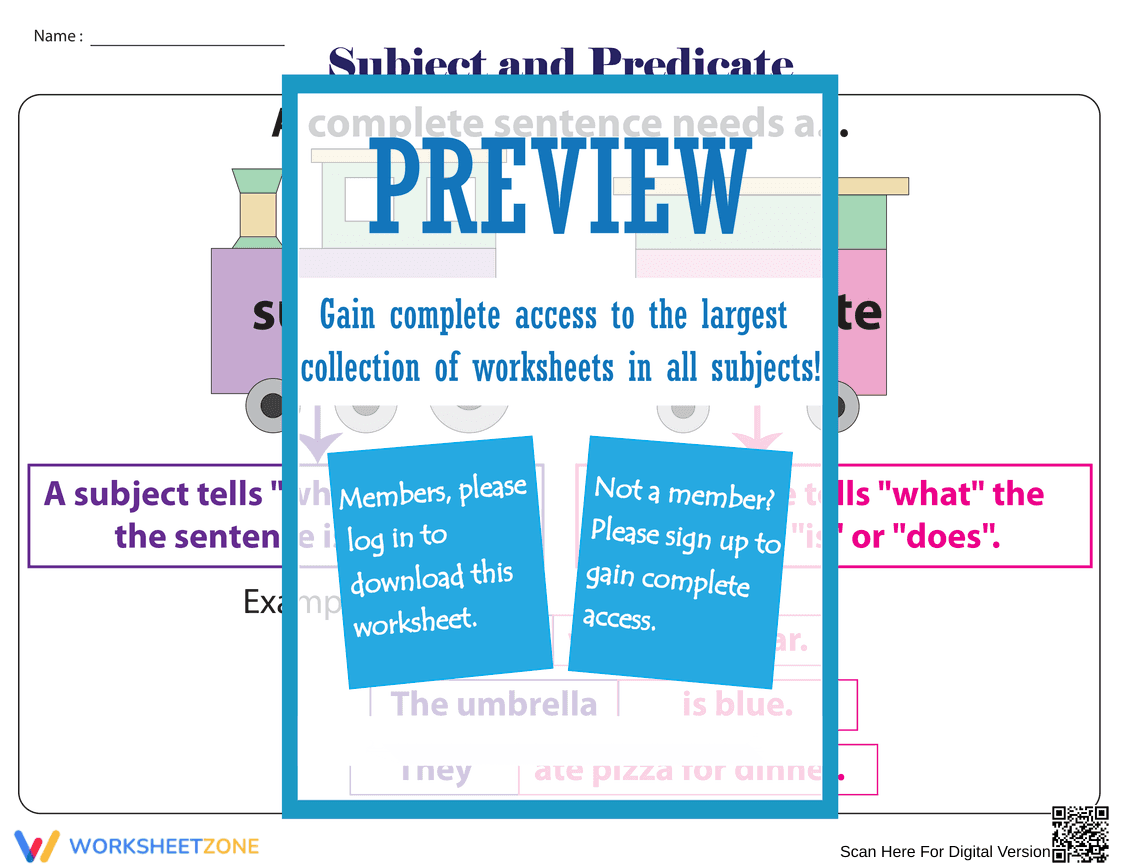

Essential Subject and Predicate Chart | Grade 3 ELA

Paste this activity's link or code into your existing LMS (Google Classroom, Canvas, Teams, Schoology, Moodle, etc.).
Students can open and work on the activity right away, with no student login required.
You'll still be able to track student progress and results from your teacher account.
Subject and predicate mastery starts with clear visual aids. This Grade 3 anchor chart provides a foundation for sentence structure by breaking down the "who" and the "do" of every complete thought. Students will quickly grasp how subjects and predicates connect to form coherent sentences, improving their writing and grammar skills immediately.
At a Glance
- Grade: 3 · Subject: ELA
- Standard:
CCSS.ELA-LITERACY.L.3.1.I— Produce simple, compound, and complex sentences using proper structure- Skill Focus: Sentence Components: Subject and Predicate
- Format: 1 page · 3 examples · Reference Chart · PDF
- Best For: Writing centers and student notebook inserts
- Time: 5–10 minutes
This single-page reference tool features a clear train metaphor to illustrate sentence construction. It defines the subject as the "who" or "what" and the predicate as what the subject "is" or "does." The layout includes three color-coded examples that visually separate sentence parts, making it an ideal companion for introductory grammar lessons.
Teachers can implement this tool in under two minutes. Step 1: Print the color PDF. Step 2: Distribute to students for their grammar folders or project it onto the whiteboard. Step 3: Review the three provided examples as a class to model sentence identification. This no-prep resource is also perfect for substitute teacher folders.
This resource is aligned with CCSS.ELA-LITERACY.L.3.1.I, which requires students to produce simple, compound, and complex sentences. By identifying the subject and predicate, students build the structural awareness necessary for sentence variety. This standard code can be copied directly into lesson plans, IEP goals, or district curriculum mapping tools.
Use this chart as an anchor during direct instruction to introduce sentence parts. After the lesson, provide students with a copy to keep in their writing journals as a permanent reference. For a quick formative assessment, ask students to write one original sentence on the back and circle the subject while underlining the predicate.
Designed for third-grade students, this chart also serves as a helpful review for Grade 4 or a scaffolded introduction for Grade 2. It is particularly effective for English Language Learners (ELLs) who benefit from the visual train metaphor. This resource pairs naturally with sentence-building blocks or grammar workbooks.
The CCSS.ELA-LITERACY.L.3.1.I standard emphasizes the production of grammatically correct sentences, a skill rooted in the fundamental understanding of subjects and predicates. According to Fisher & Frey (2014), visual scaffolds like anchor charts provide the necessary "clues" for students to internalize complex linguistic structures during the gradual release of responsibility. By providing a clear definition of the "who" and the "do" in a sentence, this chart reduces the cognitive load during the writing process. Research from EdReports 2024 highlights that consistent access to reference tools in ELA classrooms significantly improves student independence in grammar application. This chart serves as a concise, extractable summary of sentence mechanics that can be integrated into diverse educational frameworks to ensure students meet core literacy benchmarks through evidence-based instructional design.


