




























Views
Downloads


Essential Compound Subjects and Predicates | Grade 4-5 ELA

Paste this activity's link or code into your existing LMS (Google Classroom, Canvas, Teams, Schoology, Moodle, etc.).
Students can open and work on the activity right away, with no student login required.
You'll still be able to track student progress and results from your teacher account.
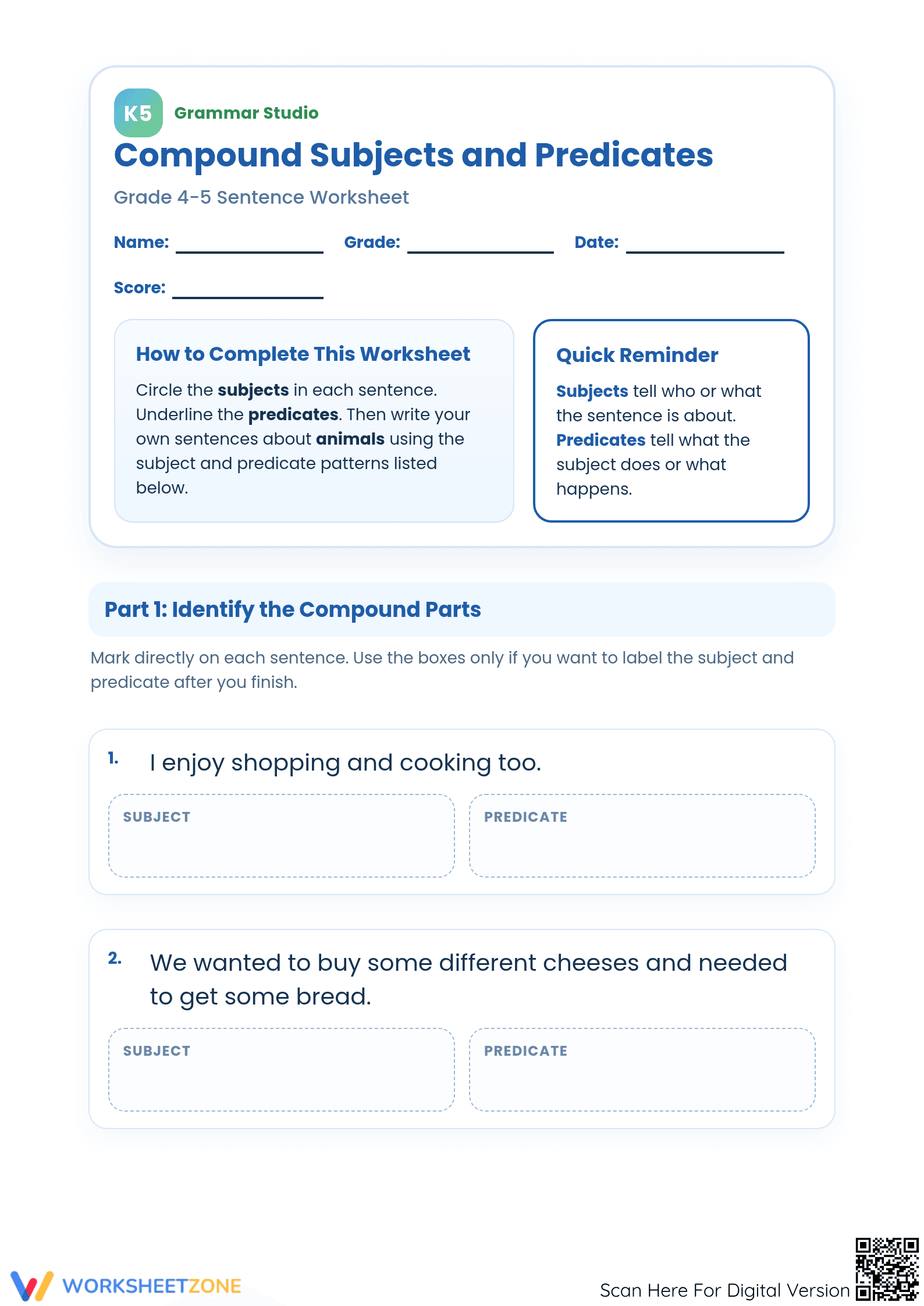
This Grade 4-5 grammar worksheet provides focused practice on compound subjects and predicates to improve sentence structure and writing complexity. Students identify compound components in provided sentences before applying their knowledge to original writing tasks. This resource ensures learners can distinguish between simple and compound parts while maintaining subject-verb agreement throughout their compositions.
At a Glance
- Grade: 4–5 · Subject: ELA
- Standard:
CCSS.ELA-LITERACY.L.4.1— Use relative pronouns and relative adverbs to form complete sentences- Skill Focus: Compound Subjects and Predicates
- Format: 3 pages · 10 problems · Answer key included · PDF
- Best For: Small group grammar reinforcement and review
- Time: 15–25 minutes
What's Inside: This 3-page printable PDF features a structured layout designed for clarity and ease of use. Part 1 contains 6 identification tasks where students circle subjects and underline predicates in sentences about shopping and cooking. Part 2 presents 4 creative writing prompts requiring students to generate their own sentences about animals using specific patterns. A full answer key is provided to facilitate quick grading or student self-correction.
Skill Progression
- Guided Identification: 6 initial sentences provide a clear framework for students to isolate compound subjects and predicates, with dedicated boxes for labeling each part after marking the text.
- Supported Sentence Construction: Tasks transition to writing original sentences with one subject and two predicates, or two subjects and one predicate, reinforcing specific syntactic patterns.
- Independent Mastery: The final challenge requires students to combine two subjects and two predicates into a cohesive sentence about animals, demonstrating a high level of grammatical control.
This sequence follows a gradual-release model, moving from passive recognition to active production of complex sentence structures.
Standards Alignment
This worksheet is primarily aligned to `CCSS.ELA-LITERACY.L.4.1`, which requires students to demonstrate command of the conventions of standard English grammar when writing or speaking. Specifically, it targets the ability to produce complete sentences while avoiding fragments. Both standard codes can be copied directly into lesson plans, IEP goals, or district curriculum mapping tools.
How to Use It
Use this worksheet as a formative assessment during a unit on sentence parts or as a targeted intervention for students struggling with run-on sentences. It is particularly effective as a mid-lesson check for understanding after direct instruction on compound structures. Educators should observe students during Part 2 to ensure they are using coordinating conjunctions correctly; expect completion within 20 minutes.
Who It's For
This resource is designed for upper elementary students in grades 4 and 5 who are refining their writing mechanics. It serves as an excellent bridge for English Language Learners (ELLs) who need explicit practice with sentence boundaries. Pair this worksheet with a mentor text passage to have students identify compound parts in professional writing.
According to the RAND AIRS 2024 analysis of primary literacy frameworks, explicit instruction in sentence logic—specifically the distinction between compound subjects and predicates—is a critical precursor to mastering complex syntax in middle school. This worksheet addresses that developmental bridge by requiring students to move beyond simple identification into high-order sentence construction. By isolating the functional components of a sentence, learners develop a clearer understanding of how ideas are combined, which directly impacts their ability to revise for clarity and variety. The inclusion of ten structured tasks ensures sufficient repetition for cognitive retention, while the answer key allows for immediate corrective feedback. This alignment with CCSS.ELA-LITERACY.L.4.1 provides a robust foundation for conventions of standard English grammar. Educators can utilize these findings to justify the integration of grammar-focused drills within broader writing workshops, ensuring that mechanical proficiency supports overall expressive fluency in student-led compositions.


