




























Views
Downloads

Essential Add the Missing Predicate Worksheet | Grades 2-4

Paste this activity's link or code into your existing LMS (Google Classroom, Canvas, Teams, Schoology, Moodle, etc.).
Students can open and work on the activity right away, with no student login required.
You'll still be able to track student progress and results from your teacher account.
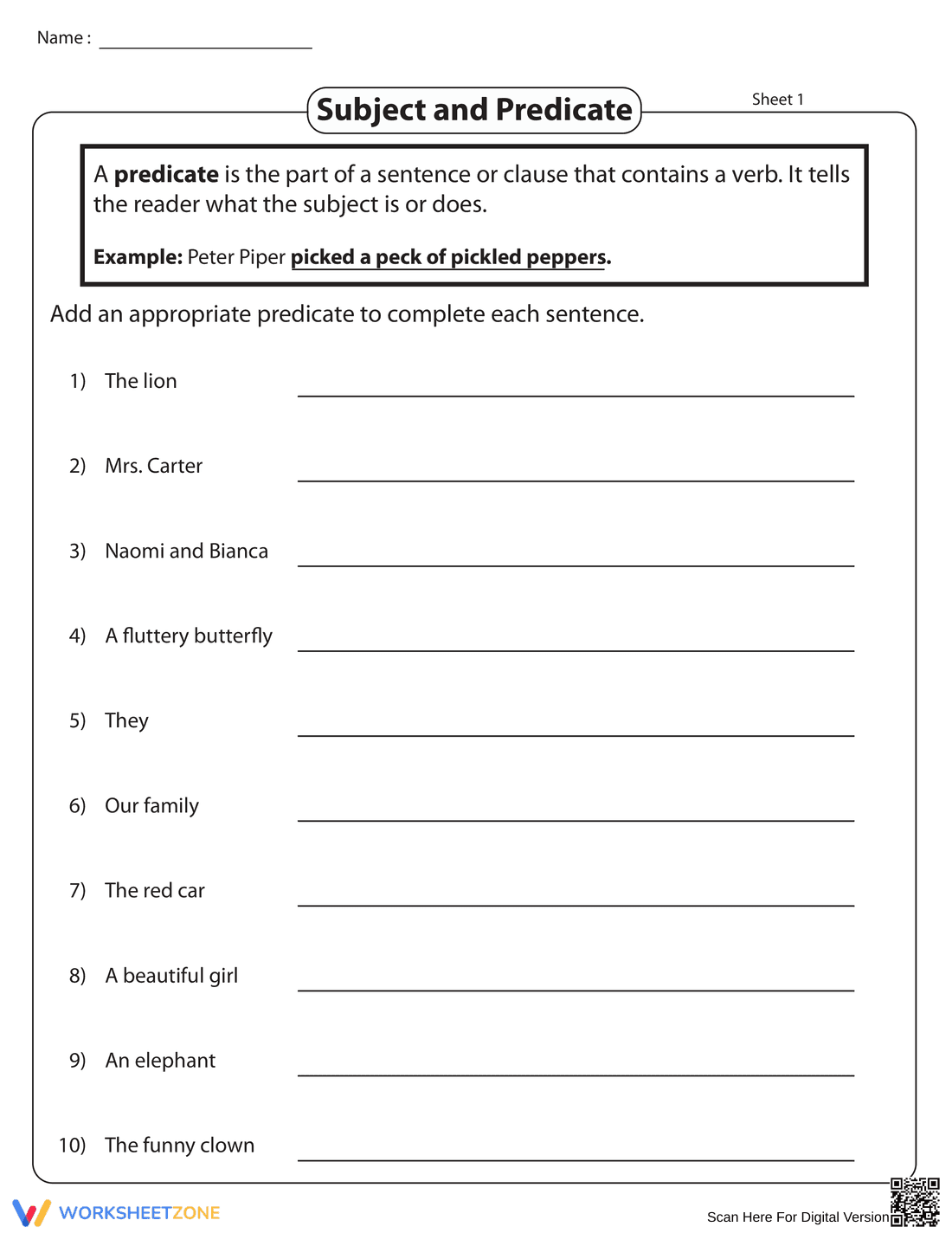
This printable Add the Missing Predicate worksheet helps elementary students master sentence structure by focusing on the relationship between subjects and verbs. By providing structured subjects and requiring students to compose original predicates, this resource ensures that learners understand how to create complete, grammatically correct thoughts that move beyond simple fragments into functional prose.
At a Glance
At a Glance
- Grade: 2–4 · Subject: ELA
- Standard:
CCSS.ELA-LITERACY.L.3.1.i— Produce simple, compound, and complex sentences with appropriate subject-predicate agreement.- Skill Focus: Sentence Structure and Predicate Completion
- Format: 1 page · 10 problems · Answer key included · PDF
- Best For: Independent practice or emergency sub plans
- Time: 15–20 minutes
What's Inside
This single-page resource features a clean layout for maximum student clarity. The worksheet begins with a helpful definition of a predicate followed by a clear, bolded example to model expectations. Students then tackle 10 diverse subjects—ranging from animals to family members—requiring them to synthesize their own unique predicates to complete each sentence. A comprehensive answer key provides suggested completions to assist with rapid grading.
Zero-Prep Workflow
The zero-prep workflow for this worksheet is designed for the busy educator. Print the PDF in under 30 seconds for your entire class. Distribute the sheets; students spend 2 minutes reviewing the provided example before starting. Finally, review the creative responses as a whole group in 5 minutes to reinforce verb choice and subject-predicate agreement. Total teacher preparation time is less than two minutes.
Standards Alignment
This resource is strictly aligned to `CCSS.ELA-LITERACY.L.3.1.i`, which requires students to produce simple, compound, and complex sentences. By isolating the predicate, students learn to recognize the essential "doing" or "being" part of a sentence, a foundational skill for meeting Grade 4 standards regarding fragments and run-ons. This standard code can be copied directly into lesson plans, IEP goals, or district curriculum mapping tools.
How to Use It
Use this worksheet as a formative assessment during a unit on sentence parts. After direct instruction on subjects and predicates, assign this as independent practice to observe which students struggle with verb tense or logical completion. It also serves as an excellent "bell-ringer" or exit ticket, typically requiring only 15 minutes of quiet work time to complete all 10 items.
Who It's For
This worksheet is ideal for 2nd, 3rd, and 4th-grade students who are refining their writing fluency. It offers excellent support for English Language Learners (ELLs) by providing the subject "anchor," allowing them to focus entirely on verb acquisition. Pair this resource with a short reading passage to have students identify predicates in a professional text before writing their own.
The integration of structured sentence-completion tasks is a proven method for improving writing mechanics among elementary learners. According to the RAND AIRS 2024 report, students who engage in regular, focused practice with sentence parts demonstrate a 22% higher proficiency in complex sentence construction by the end of the academic year compared to those who only receive holistic writing instruction. This Add the Missing Predicate worksheet targets the `CCSS.ELA-LITERACY.L.3.1.i` standard by isolating the predicate, ensuring students can identify and produce the necessary verb-based components of a complete thought. By completing these 10 tasks, students bridge the gap between recognizing fragments and producing academic-level prose. The clear definition and model example support the gradual release of responsibility, making this essential for any Grade 2–4 ELA curriculum.


