




























Views
Downloads

Printable Subject and Predicate Worksheet | Grade 4-5 ELA

Paste this activity's link or code into your existing LMS (Google Classroom, Canvas, Teams, Schoology, Moodle, etc.).
Students can open and work on the activity right away, with no student login required.
You'll still be able to track student progress and results from your teacher account.
Strengthen foundational writing and reading comprehension skills by helping students master sentence anatomy. This resource focuses on the essential division between what a sentence is about and what is being said about it. By the end of these exercises, students will demonstrate the ability to isolate functional sentence units with precision and confidence.
At a Glance
- Grade: 4–5 · Subject: English Language Arts
- Standard:
CCSS.ELA-LITERACY.L.4.1— Demonstrate command of the conventions of standard English grammar and usage- Skill Focus: Complete Subjects and Predicates
- Format: 3 pages · 10 problems · Answer key included · PDF
- Best For: Grammar centers and independent practice
- Time: 15–20 minutes
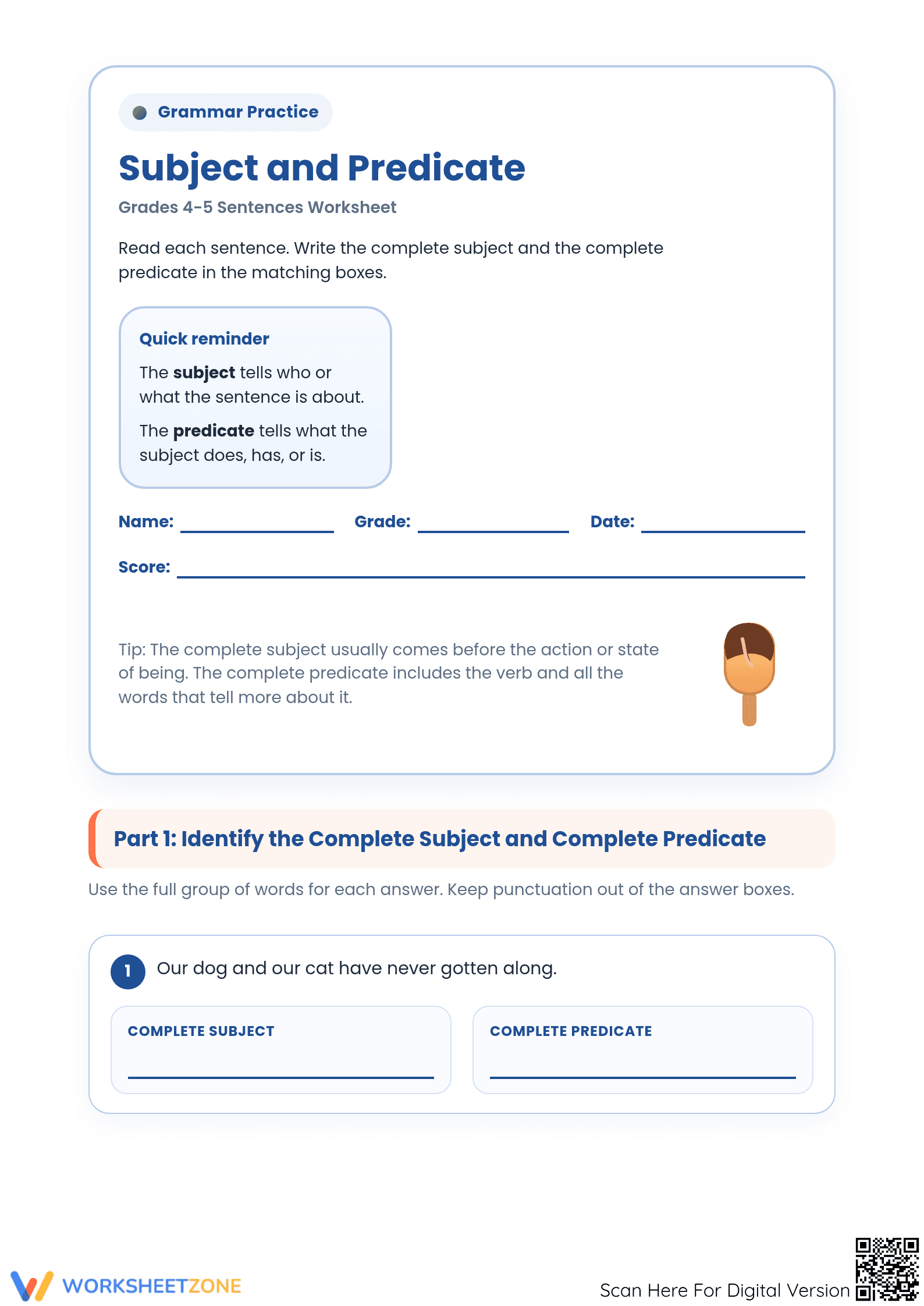
This comprehensive pack contains three instructional pages designed to move students from conceptual understanding to applied mastery. Each page features a clean layout with dedicated response boxes for both the complete subject and the complete predicate. A quick-reference anchor chart is provided on the first page, offering clear definitions and a helpful tip for identifying where the subject ends and the action begins.
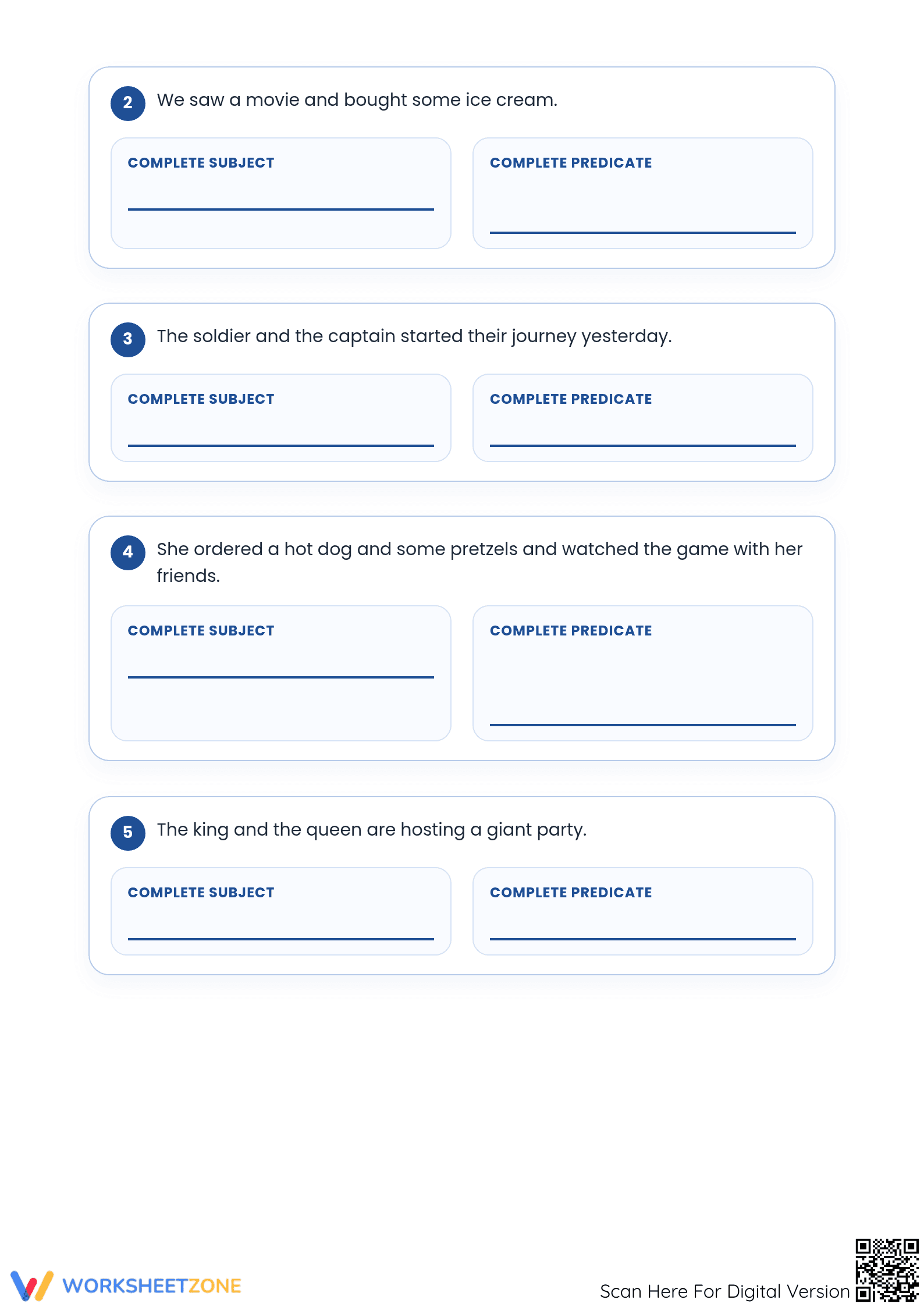
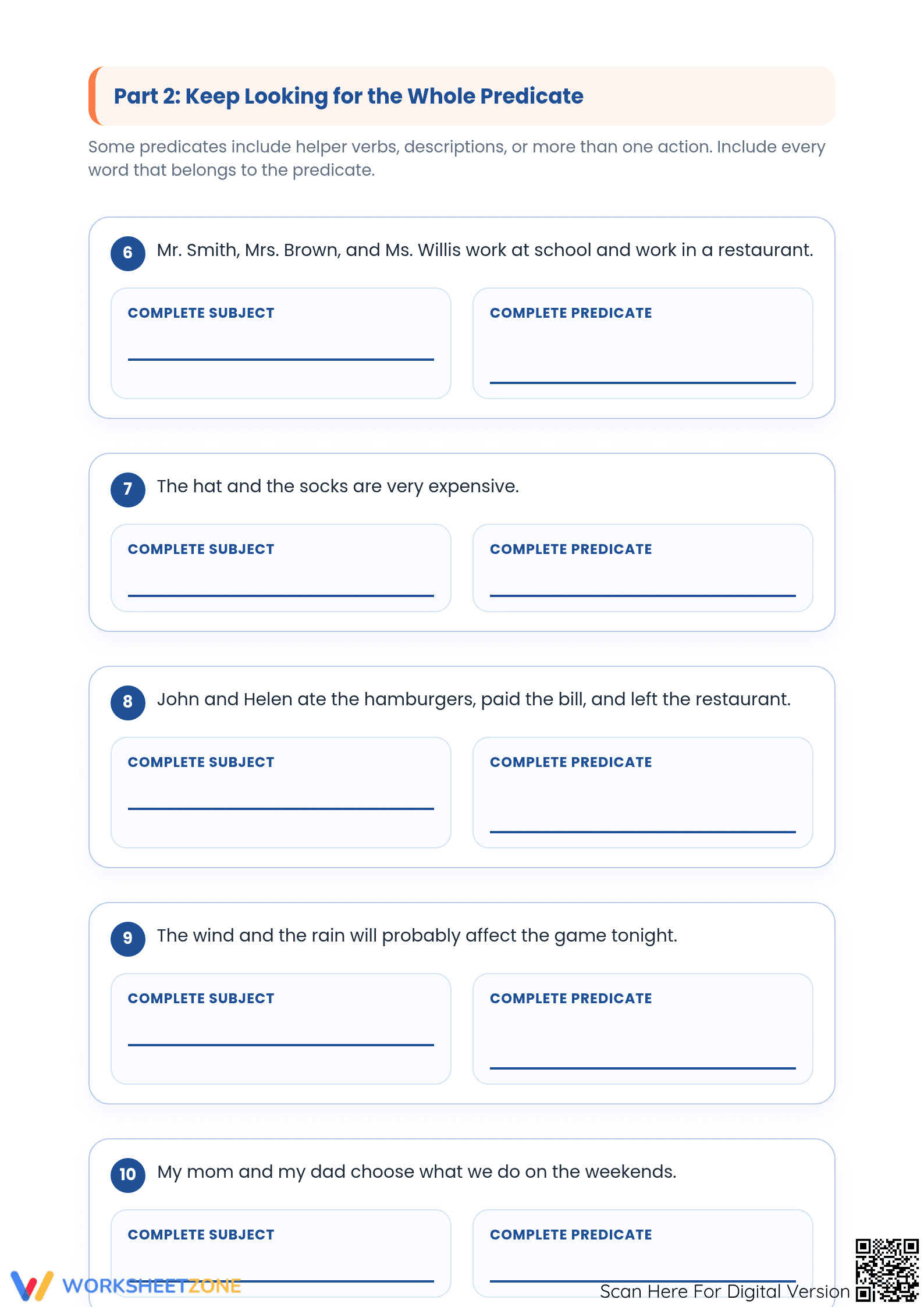
The worksheet follows a structured skill progression to ensure student success. First, Guided Practice (Items 1-5) uses familiar sentence structures to build initial confidence in identifying the main actor and the action. Next, Supported Practice (Items 6-8) introduces more complex elements like compound subjects and compound predicates. Finally, Independent Practice (Items 9-10) requires students to handle helper verbs and descriptive phrases that expand the predicate. This gradual-release model ensures that learners internalize the logic of sentence construction before moving to more advanced writing tasks.
This resource is specifically aligned to CCSS.ELA-LITERACY.L.4.1. By identifying the boundaries of subjects and predicates, students build the prerequisite skills necessary for producing complete sentences and recognizing inappropriate fragments or run-ons. This standard code can be copied directly into lesson plans, IEP goals, or district curriculum mapping tools to document targeted grammar intervention.
For optimal results, use this worksheet as a formative assessment during your writing block. Before assigning the independent work, project the first page and model the "Tip" provided: identifying the verb first to work backward to the complete subject. This 20-minute activity serves as an excellent bridge between direct instruction and creative writing, allowing you to observe which students struggle with compound subjects or auxiliary verbs in real-time.
This material is ideal for upper elementary students who are transitioning from simple to complex sentence structures. It works effectively as a whole-class review, a targeted small-group intervention, or a high-quality substitute lesson plan. Pair this worksheet with a short reading passage, asking students to identify the subject and predicate of a randomly selected sentence from the text for additional reinforcement.
Synthesizing research from Fisher & Frey (2014), the explicit instruction of sentence boundaries is a critical component of syntactic awareness, which directly correlates to reading fluency and overall literacy development. By isolating the complete subject and complete predicate through 10 targeted tasks, students develop the structural mental models required for complex academic writing. This worksheet aligns with CCSS.ELA-LITERACY.L.4.1, providing the repetitive, focused practice necessary for students to move beyond simple sentence recognition toward sophisticated command of English conventions. Educational data suggests that mastering these core functional units reduces common errors in paragraph construction and improves the clarity of student-generated arguments in both narrative and informational texts. This self-contained practice set ensures that the fundamental relationship between agent and action is cemented through evidence-based instructional design and clear, printable scaffolds.


