




























Views
Downloads
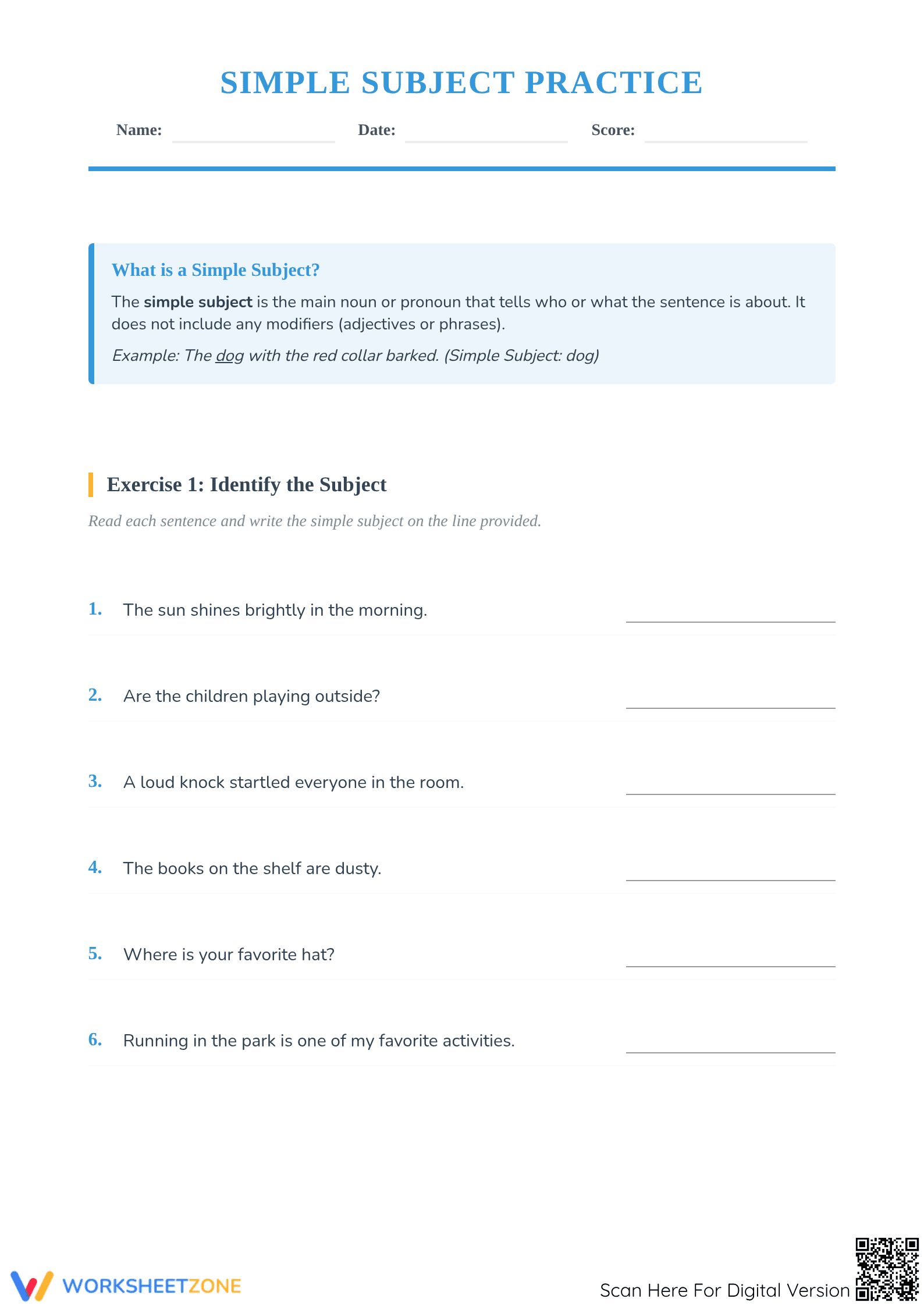


Simple Subject Practice Worksheet | Grade 3-5 Essential

Paste this activity's link or code into your existing LMS (Google Classroom, Canvas, Teams, Schoology, Moodle, etc.).
Students can open and work on the activity right away, with no student login required.
You'll still be able to track student progress and results from your teacher account.
This Grade 3-5 simple subject practice worksheet helps students isolate the core noun or pronoun in various sentence structures. By identifying the primary actor without modifiers, learners strengthen their grasp of sentence mechanics and subject-verb agreement. It provides a clear path from basic identification to creative application in writing.
At a Glance
- Grade: 3-5 · Subject: ELA Grammar
- Standard:
CCSS.ELA-LITERACY.L.3.1— Demonstrate command of the conventions of standard English grammar and usage- Skill Focus: Simple Subject Identification
- Format: 3 pages · 17 problems · Answer key included · PDF
- Best For: Independent practice and grammar reinforcement
- Time: 15–25 minutes
The resource contains three distinct exercises spread across three pages. It begins with a clear instructional header defining a simple subject with a concrete example. The layout includes ten introductory identification tasks, five advanced sentences with inverted structures or prepositional phrases, and two creative writing prompts. A full answer key is provided for quick grading.
Skill Progression
- Guided Practice: The first 10 problems use standard subject-verb-object patterns to build student confidence in isolating the main noun.
- Supported Practice: Tasks 11-15 introduce complexity, including sentences starting with prepositional phrases and inverted word orders to challenge recognition.
- Independent Practice: The final two tasks require students to generate original sentences and self-identify the simple subjects they have created.
This sequence follows a gradual-release model, moving from recognition to analysis and finally to synthesis.
Standards Alignment
This worksheet aligns with `CCSS.ELA-LITERACY.L.3.1`, which requires students to demonstrate command of the conventions of standard English grammar and usage when writing or speaking. Specifically, it supports the foundational understanding of sentence components necessary for mastering subject-verb agreement. Both standard codes can be copied directly into lesson plans, IEP goals, or district curriculum mapping tools.
How to Use It
Use this worksheet as a formative assessment after an introductory lesson on sentence parts. It works effectively as a bridge activity between identifying complete subjects and mastering complex subject-verb agreement. Teachers should observe students during Exercise 2 to see if they mistakenly identify nouns within prepositional phrases as the simple subject. Completion typically takes 20 minutes.
Who It's For
This resource is designed for upper elementary students in Grades 3, 4, and 5 who are refining their grammar skills. It is particularly useful for English Language Learners (ELL) who need to visualize sentence skeletons. Pair this worksheet with a mentor text passage where students can highlight simple subjects in professional writing.
According to Fisher & Frey (2014), the gradual release of responsibility is vital for linguistic mastery, a principle reflected in this worksheet's 17-task progression. By moving from simple identification to creative sentence generation, the resource ensures students do not merely memorize patterns but internalize the logic of English syntax. Research from the RAND AIRS 2024 report emphasizes that targeted grammar interventions, such as isolating simple subjects, significantly improve overall writing clarity in the middle-grade transition. This worksheet provides the structured repetition needed to meet `CCSS.ELA-LITERACY.L.3.1` requirements. By focusing on the simple subject as the core of the sentence, students build the cognitive framework necessary for more advanced syntactic structures. This evidence-based approach ensures that learners can accurately identify the actor of any sentence, regardless of length or complexity.


