




























Views
Downloads
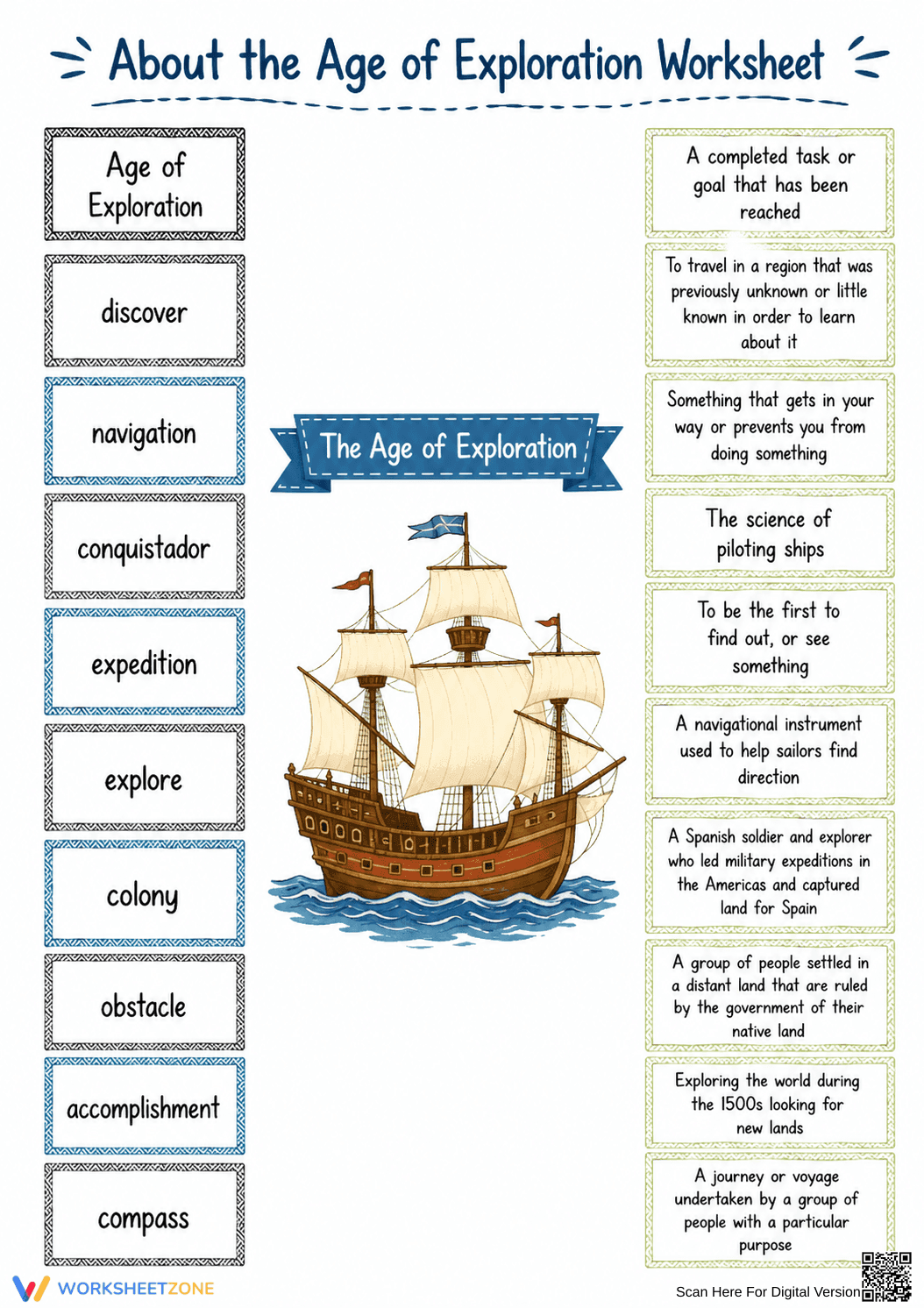

Age of Exploration Vocabulary — Printable Grade 5 Worksheet

Paste this activity's link or code into your existing LMS (Google Classroom, Canvas, Teams, Schoology, Moodle, etc.).
Students can open and work on the activity right away, with no student login required.
You'll still be able to track student progress and results from your teacher account.
This Grade 5 vocabulary matching worksheet helps students master essential historical terminology related to the Age of Exploration. By connecting domain-specific words to their precise definitions, learners build the foundational background knowledge required to comprehend complex social studies texts and historical narratives effectively.
At a Glance
- Grade: 5 · Subject: Social Studies
- Standard:
CCSS.ELA-LITERACY.RI.5.4— Determine the meaning of domain-specific words- Skill Focus: Historical Vocabulary Matching
- Format: 1 page · 10 problems · Answer key included · PDF
- Best For: Independent practice and review
- Time: 10–15 minutes
This single-page resource features 10 targeted vocabulary matching tasks centered around early global exploration. Students connect key terms like "conquistador" and "navigation" on the left to correct definitions on the right. The worksheet includes a central ship illustration to anchor the theme, and a complete answer key is provided.
Zero-Prep Workflow
- Print (1 minute): Simply download the PDF and print a class set. The clean layout ensures high-quality copies in both color and black-and-white.
- Distribute (1 minute): Hand out the worksheets at the start of your social studies block or place them in independent work folders.
- Review (3 minutes): Use the included answer key to quickly check student responses or project it on the board for self-correction.
With under two minutes of total teacher prep time, this self-explanatory activity is an excellent addition to any emergency sub plan.
Standards Alignment
This resource is directly aligned to CCSS.ELA-LITERACY.RI.5.4, requiring students to determine the meaning of general academic and domain-specific words and phrases in a text relevant to a grade 5 topic or subject area. By mastering these specific historical terms, students are better equipped to tackle primary and secondary source documents. Both standard codes can be copied directly into lesson plans, IEP goals, or district curriculum mapping tools.
How to Use It
Pre-Reading Vocabulary Build: Assign this worksheet before starting a new textbook chapter about early explorers. Familiarizing students with terms like "obstacle" and "accomplishment" in a historical context reduces cognitive load during reading. Expected completion time is 10 to 15 minutes.
Formative Assessment Station: Place this activity in a literacy or history center. As students work, observe whether they rely on process of elimination for challenging words like "conquistador" or if they immediately recognize the definitions, which provides immediate feedback on their vocabulary retention.
Who It's For
This worksheet is designed primarily for fifth-grade students, though it serves as an excellent review for sixth graders or a challenge for advanced fourth graders. For students requiring accommodations, teachers can pre-match three of the more difficult terms to reduce the field of choices. It pairs perfectly with an introductory direct instruction lesson on European exploration or a read-aloud of a historical biography.
Mastering domain-specific vocabulary is a critical component of reading comprehension in content areas like social studies. Aligned with CCSS.ELA-LITERACY.RI.5.4, this resource requires students to determine the meaning of domain-specific words, supporting their ability to process historical texts. According to Fisher & Frey (2014), explicit vocabulary instruction combined with multiple exposures to target words significantly improves students' academic language acquisition. When students engage in targeted matching activities, they actively process the relationship between terms and definitions, moving beyond rote memorization. This foundational knowledge is essential for analyzing historical events like the Age of Exploration. By integrating structured vocabulary practice, educators provide learners with the linguistic tools to succeed.


