


























Views
Downloads
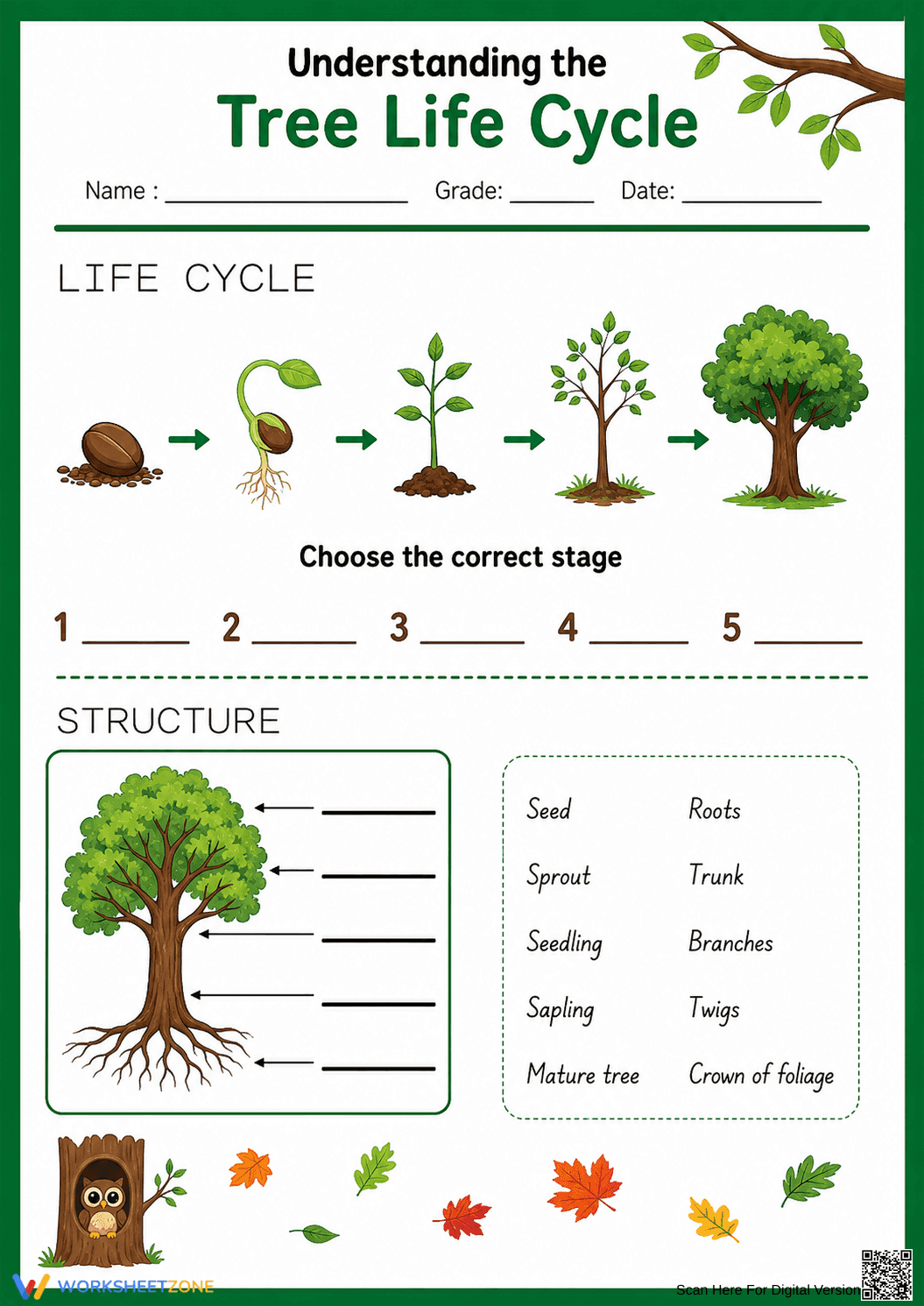

Grade 3 Tree Life Cycle — Printable No-Prep Worksheet
Paste this activity's link or code into your existing LMS (Google Classroom, Canvas, Teams, Schoology, Moodle, etc.).
Students can open and work on the activity right away, with no student login required.
You'll still be able to track student progress and results from your teacher account.
This Grade 3 science worksheet helps students master plant biology by identifying the distinct stages of a tree's life cycle and labeling its anatomical structures. By sequencing growth phases and mapping key parts like roots and the crown of foliage, young learners build essential foundational knowledge of living organisms.
At a Glance
- Grade: 3 · Subject: Science
- Standard:
3-LS1-1— Describe the unique and diverse life cycles of organisms- Skill Focus: Life cycles and plant anatomy
- Format: 1 page · 10 problems · Answer key included · PDF
- Best For: Independent practice or science centers
- Time: 15–20 minutes
This single-page resource features two distinct, visually engaging activities. The top section requires students to sequence five stages of a tree's life cycle, from seed to mature tree. The bottom section includes a detailed diagram where students use a provided word bank to label five structural components of a tree. A complete answer key is included for quick grading.
Designed for immediate classroom use, this resource requires minimal teacher setup.
- Print (1 minute): Simply download the PDF and print a class set.
- Distribute (1 minute): Hand out the sheets along with pencils; the clear instructions and word bank make it self-explanatory.
- Review (3 minutes): Use the included answer key to quickly check student work or project it for self-grading.
Total teacher prep time is under two minutes, making this an excellent option for emergency sub plans or quick science center rotations.
This worksheet aligns with 3-LS1-1, requiring students to develop models to describe that organisms have unique and diverse life cycles but all have in common birth, growth, reproduction, and death. It also supports general elementary science standards regarding plant structures and functions. Both standard codes can be copied directly into lesson plans, IEP goals, or district curriculum mapping tools.
Deploy this worksheet during a broader unit on plant biology or seasonal changes. It works perfectly as an independent practice activity following direct instruction on how plants grow. Teachers can also use the labeling section as a quick formative assessment to check if students understand basic plant anatomy before moving on to more complex photosynthesis concepts. Expect students to complete the tasks in 15 to 20 minutes.
This resource is ideal for third-grade students, though it can easily be adapted for second or fourth graders reviewing basic life science concepts. The visual cues and word bank provide built-in scaffolding for English Language Learners and students needing extra vocabulary support. Pair this worksheet with a hands-on seed planting activity or an anchor chart detailing the parts of a plant.
Understanding biological processes requires clear, sequential models. This worksheet targets 3-LS1-1 by having students describe the unique and diverse life cycles of organisms through visual sequencing and anatomical labeling. According to a 2024 report by EdReports, science materials that integrate visual models with domain-specific vocabulary significantly improve student retention of complex biological concepts. By combining a life cycle progression with a structural diagram, this resource reinforces the critical connection between how an organism grows and the physical parts that support its survival. The dual-task format ensures students do not just memorize terms, but actively apply them to a biological model. This approach builds the foundational scientific literacy required for later, more advanced studies in ecology and environmental science.


