


























Views
Downloads

Essential Plant Life Cycle Guide | Grade 3 Science
Paste this activity's link or code into your existing LMS (Google Classroom, Canvas, Teams, Schoology, Moodle, etc.).
Students can open and work on the activity right away, with no student login required.
You'll still be able to track student progress and results from your teacher account.
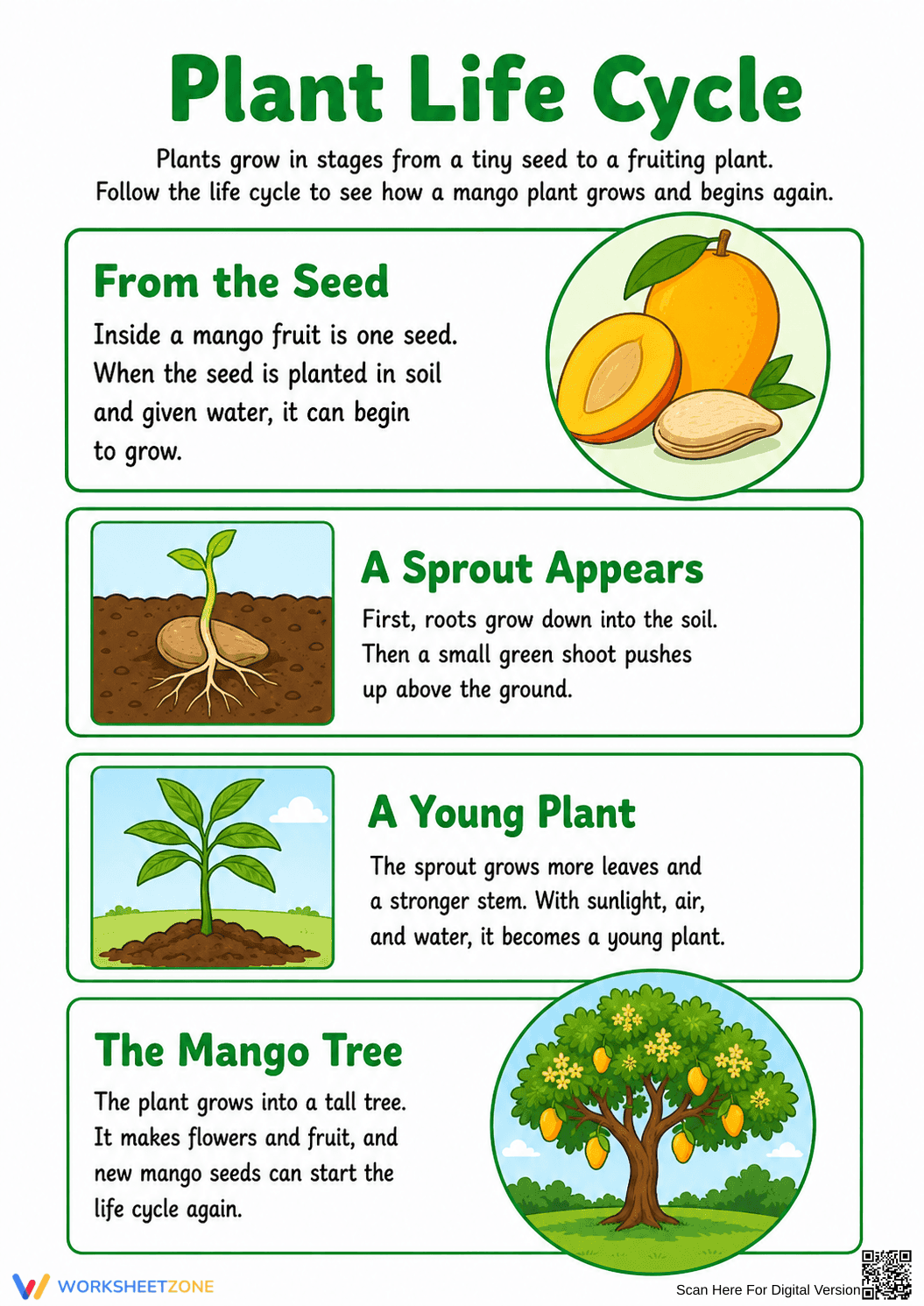
This Grade 3 science resource provides a clear, visual explanation of the plant life cycle using the specific example of a mango tree. Students observe how a single seed transforms through sequential stages into a fruit-bearing adult. This guide ensures learners understand the biological progression of growth and reproduction in the natural world.
At a Glance
- Grade: 3 · Subject: Science
- Standard:
3-LS1-1— Develop models to describe that organisms have unique and diverse life cycles- Skill Focus: Plant growth stages
- Format: 1 page · 4 sections · Informational Guide · PDF
- Best For: Science centers and introductory lessons
- Time: 10–15 minutes
Inside this informational worksheet, you will find a structured four-part breakdown of the mango tree's development. The page includes vibrant illustrations and descriptive text for each phase: the initial seed, the emergence of a sprout, the development of a young plant, and the final maturity of the mango tree. This single-page PDF serves as both a reading comprehension tool and a visual anchor chart for the classroom.
The zero-prep workflow for this resource is designed for maximum efficiency in busy classrooms. First, print the single-page guide (30 seconds). Second, distribute the copies to students for independent reading or small-group discussion (30 seconds). Third, review the key vocabulary terms like "shoot," "sprout," and "fruiting" as a whole class (1 minute). This resource is an ideal candidate for emergency sub plans or as a quick supplement to a larger botany unit.
This resource aligns with the primary standard `3-LS1-1`: "Develop models to describe that organisms have unique and diverse life cycles but all have in common birth, growth, reproduction, and death." By focusing on the mango tree, students can compare this specific cycle to other plants they have studied. This standard code can be copied directly into lesson plans, IEP goals, or district curriculum mapping tools.
To use this effectively, assign it during the "Explain" phase of a 5E instructional model. Have students read the descriptions and then draw their own version of the cycle in their science journals to demonstrate mastery. As a formative assessment, observe if students can correctly identify which environmental factors (water, sunlight, air) are mentioned in the text as requirements for growth. Expected completion for a reading and discussion session is 15 minutes.
This worksheet is designed for third-grade students but is highly accessible for English Language Learners (ELLs) due to the strong visual-to-text correlation. It pairs naturally with a hands-on seed germination experiment or a classroom anchor chart about plant parts. The clear headings and numbered progression support students who benefit from structured, predictable text layouts.
According to research by Fisher & Frey (2014), the use of complex informational graphics paired with concise text significantly improves content-area literacy in elementary science. This worksheet utilizes that exact scaffolding by providing a visual model of the `3-LS1-1` standard, allowing students to internalize the concept of biological continuity. By tracing the journey from a seed inside a mango to a tree that produces new seeds, learners grasp the circular nature of life. This resource provides the necessary background knowledge for more advanced biological concepts in later grades, such as photosynthesis and pollination. The inclusion of specific botanical vocabulary ensures that students are meeting the linguistic demands of the Next Generation Science Standards while engaging with high-interest natural phenomena. This document serves as a reliable evidence-based tool for achieving mastery in life science curriculum goals.


