


























Views
Downloads

Tree Life Cycle Worksheet | Grade 3 Printable
Paste this activity's link or code into your existing LMS (Google Classroom, Canvas, Teams, Schoology, Moodle, etc.).
Students can open and work on the activity right away, with no student login required.
You'll still be able to track student progress and results from your teacher account.
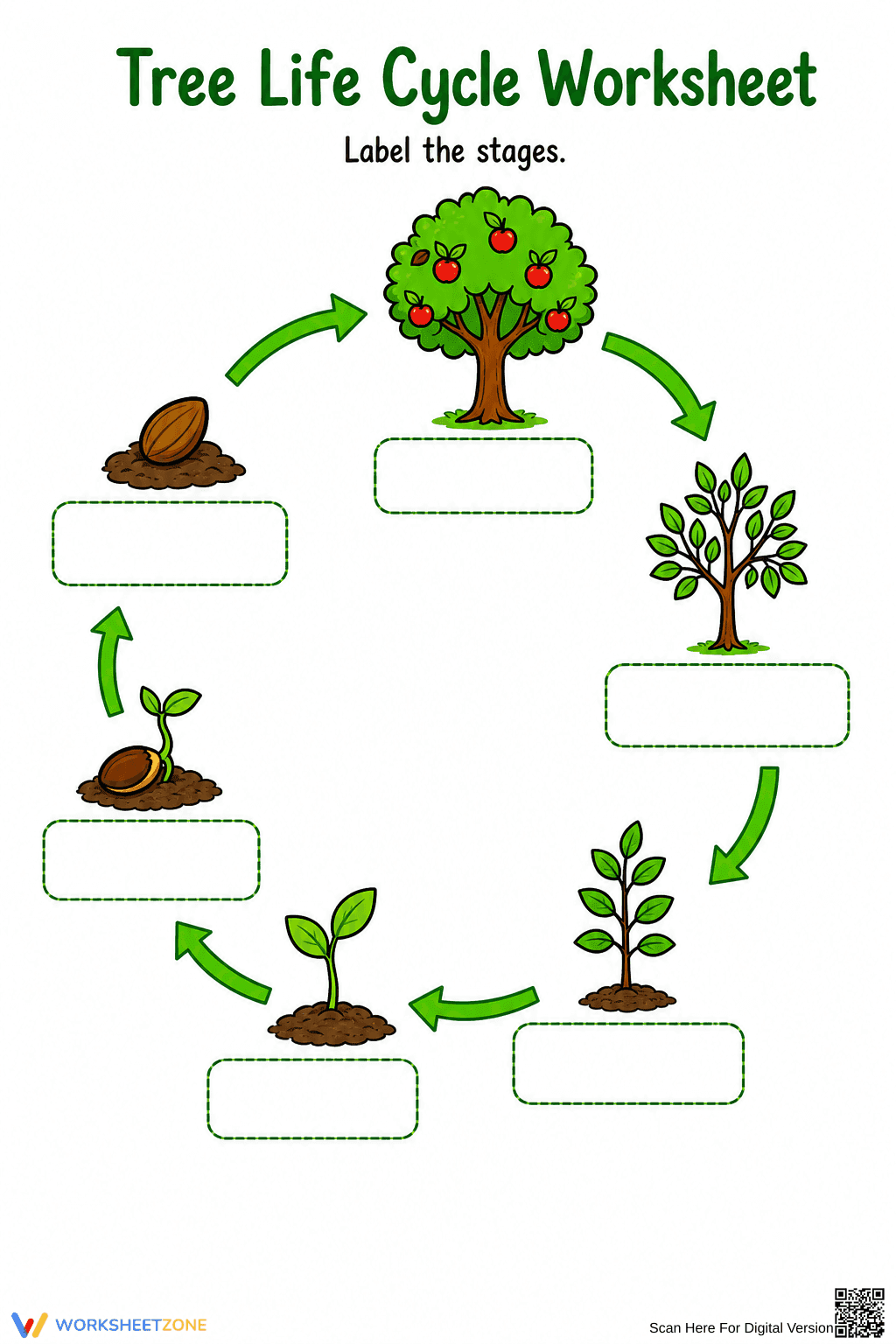
This Grade 3 science worksheet helps students master the stages of plant growth by labeling a clear, circular diagram of a tree's life cycle. By completing this visual model, young learners solidify their understanding of how organisms grow, reproduce, and continue the cycle of life.
At a Glance
- Grade: 3 · Subject: Science
- Standard:
3-LS1-1— Develop models to describe organism life cycles.- Skill Focus: Labeling plant life cycle stages
- Format: 1 page · 6 problems · Answer key included · PDF
- Best For: Independent practice or review
- Time: 10–15 minutes
This single-page resource features a vibrant, easy-to-read circular diagram illustrating the continuous growth process of an apple tree. Students are tasked with filling in six blank boxes corresponding to specific developmental stages, from a seed in the soil to a mature, fruit-bearing tree. A complete answer key is provided to ensure quick and accurate grading.
Zero-Prep Workflow
- Print (1 minute): Simply download the PDF and print the required number of copies. No special materials or cutting are needed.
- Distribute (1 minute): Hand out the worksheet as a quick warm-up, science center activity, or independent assignment.
- Review (3 minutes): Use the included answer key to quickly check student responses or project it on the board for self-correction.
With a total teacher prep time of under two minutes, this resource is highly effective for busy educators and makes an excellent addition to any substitute teacher plan.
Standards Alignment
This activity is directly aligned with 3-LS1-1: Develop models to describe that organisms have unique and diverse life cycles but all have in common birth, growth, reproduction, and death. By labeling the diagram, students actively engage with a scientific model demonstrating these universal stages. Both standard codes can be copied directly into lesson plans, IEP goals, or district curriculum mapping tools.
How to Use It
Deploy this worksheet after a direct instruction lesson on plant biology to reinforce new vocabulary. Alternatively, use it as a formative assessment tool at the end of a life cycles unit. While students work, observe whether they correctly sequence the transition from seedling to sapling, which often requires targeted redirection. Expected completion time is 10 to 15 minutes.
Who It's For
This resource is designed for third-grade science students, though it serves as an excellent review for fourth graders or a guided activity for advanced second graders. For students needing extra support, provide a word bank on the board. It pairs perfectly with a hands-on seed planting activity or a read-aloud book about botany.
Understanding biological progression is a foundational element of early elementary science education. When students engage with visual models aligned to 3-LS1-1, they develop models to describe organism life cycles with greater accuracy and long-term retention. According to EdReports 2024, utilizing clear, sequential diagrams in science instruction significantly improves students' ability to grasp abstract biological concepts like continuous growth, reproduction, and decay. By actively labeling the six distinct stages of the tree life cycle, learners transition from passive observation to active conceptualization. This structured interaction reinforces the cyclical nature of life, ensuring that core scientific principles are firmly established before students advance to more complex ecological studies in upper elementary grades. Consistent practice with these visual frameworks builds essential scientific literacy and analytical skills.


