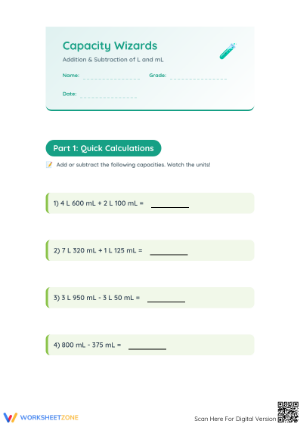
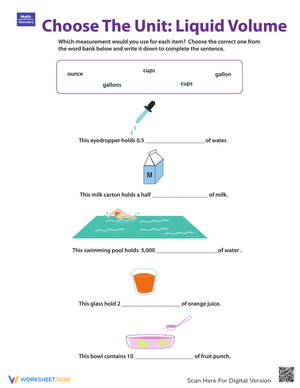
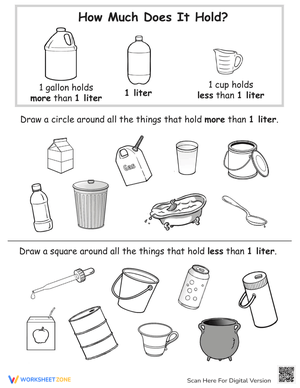
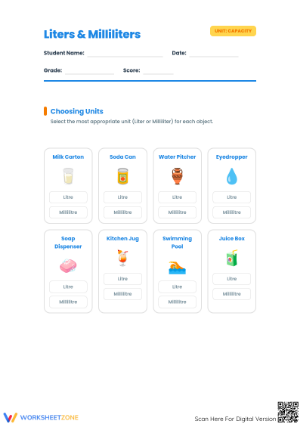
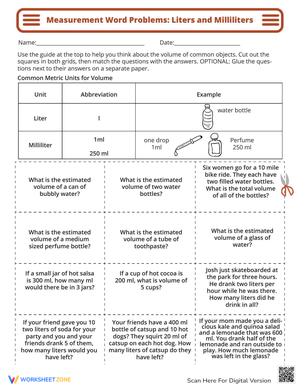
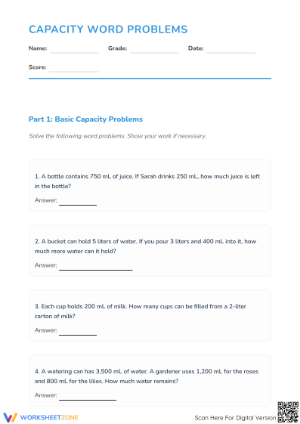
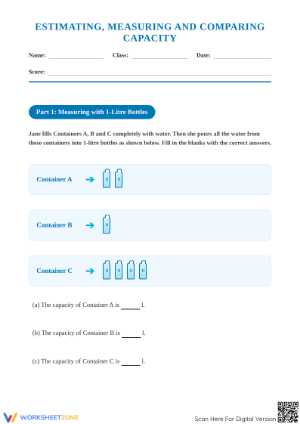
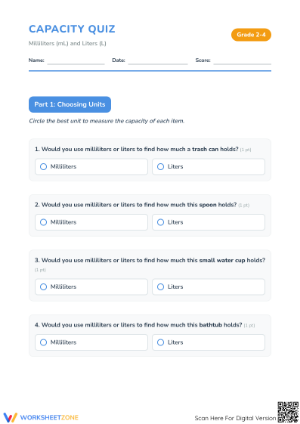
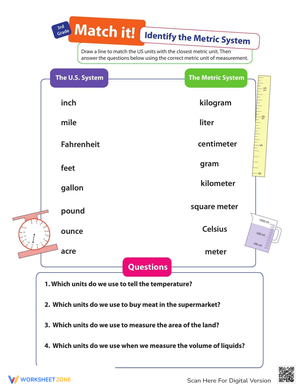
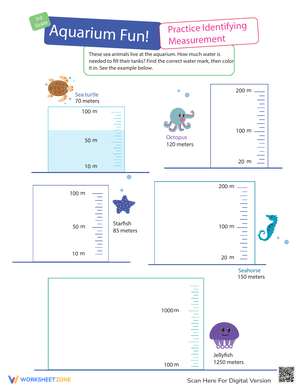
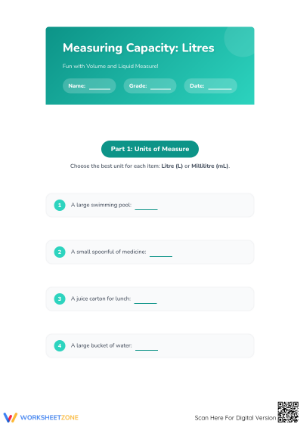
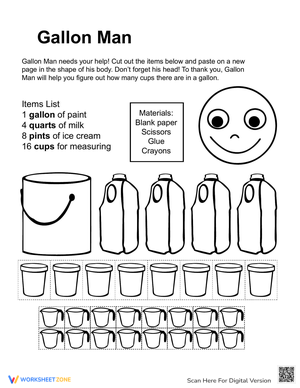
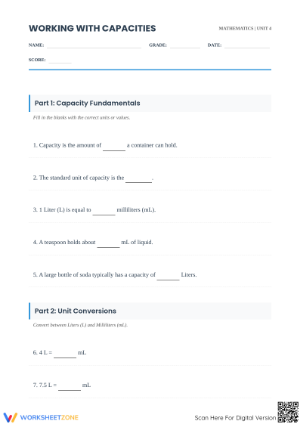
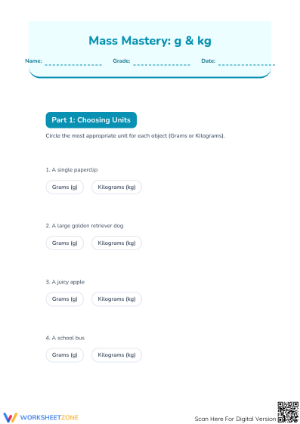
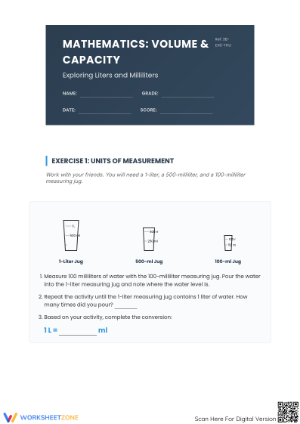
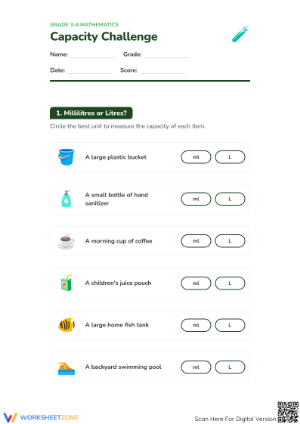
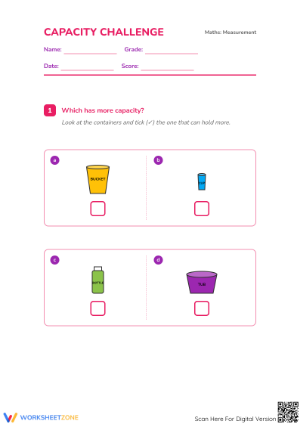
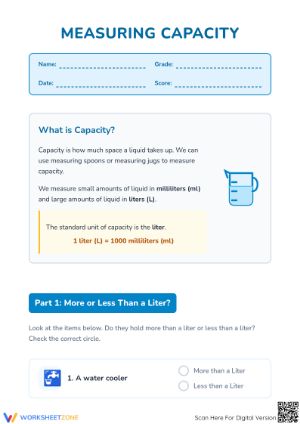
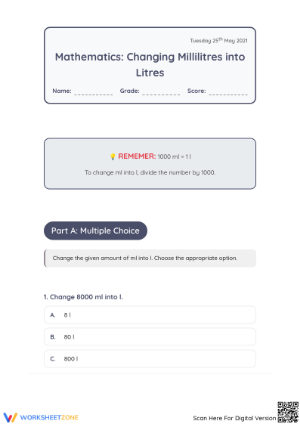
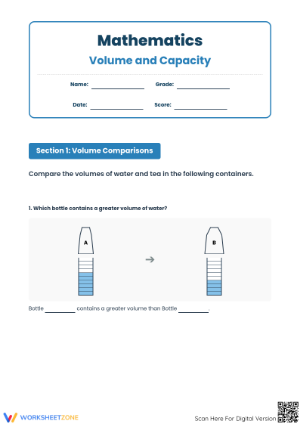
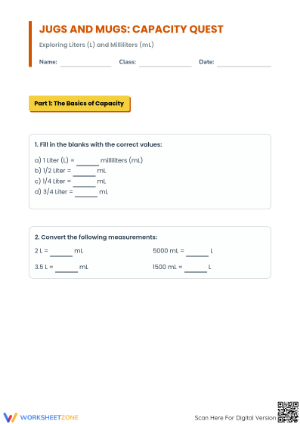
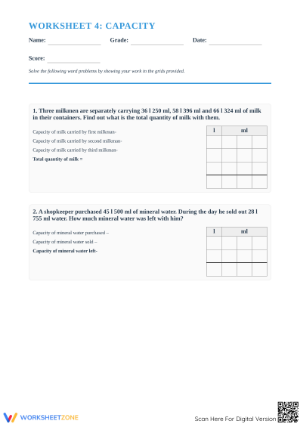
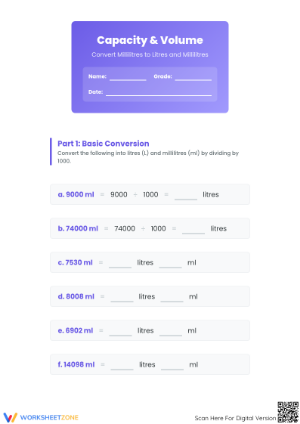
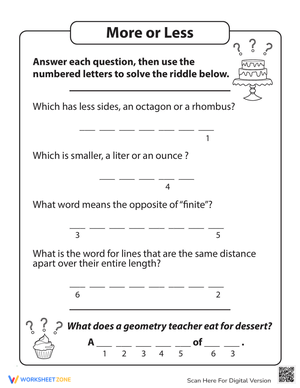
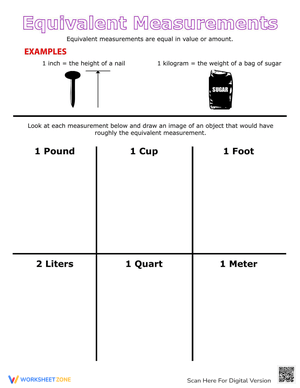
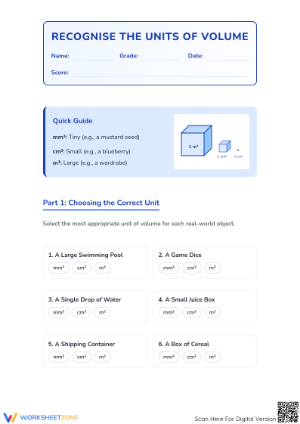
These 3rd grade measuring volume worksheets resources land at a genuinely tricky transition — the point in the math year when students leave behind measuring what they can see and mark on a ruler, and start reasoning about a substance that fills whatever container it's poured into. Each worksheet targets a distinct slice of the 3.MD.A.2 progression: building unit intuition around the liter, reading graduated cylinder scales at labeled and unlabeled intervals, estimating real-world container capacities, and solving one-step word problems with all four operations.
Concepts and Skills Across the Set
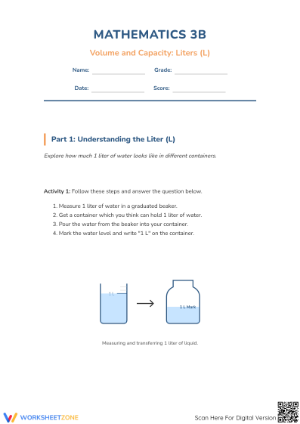
Unit sense comes first, and everything else depends on it. Students who cannot picture one liter can still read a scale by counting marks, but they will fail at estimation entirely — and estimation is where the standard expects them to apply judgment rather than procedure. Several worksheets pair a 1-liter reference container with a set of unfamiliar objects — a bucket, a soup pot, a juice box — and ask students to sort by capacity or decide whether each holds less than 1 liter, about 1 liter, or significantly more. That kind of reasoning requires an internalized mental model, not a formula.
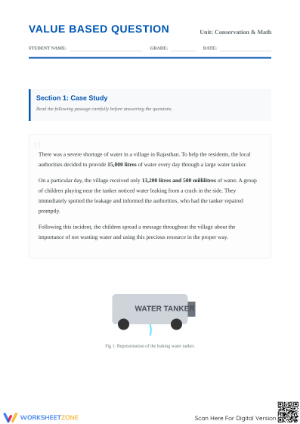
The 3rd grade measuring volume worksheets set then moves into scale reading, following a careful sequence: cylinders where the liquid lands exactly on a numbered mark come before items that require students to determine an interval value first. That ordering matters because students who learn only to read labeled marks hit a wall in later grades when measuring tools carry more precision. The word problem worksheets close the set — problems like a water tank that begins at 18 liters, loses 6 through a drain, and receives 4 more from a hose, or four identical buckets that together hold 24 liters and must be divided equally. Some require a single operation; others ask students to choose which operation fits before computing.
Student Errors That Appear Reliably in This Unit
The most consistent mistake is scale-interval miscount. When students see a cylinder with major marks at 0, 10, 20, and 30 liters — with four small lines between each pair — many assume each small line equals 1 liter. Because the spacing resembles a number line, they count from the major mark rather than computing what each interval is worth. The result: they read 14 liters when the correct answer is 18, and because 14 looks plausible, they rarely catch it themselves. Asking students to narrate their counting aloud while you circulate surfaces this error immediately.
The subtler problem is harder to catch on paper. Some eight-year-olds still believe a taller container holds more than a shorter, wider one regardless of actual volume — a developmental issue, not a knowledge gap. Conservation of liquid volume is a late-arriving milestone for a meaningful portion of third graders, and no amount of written practice resolves it faster than a brief physical demonstration. Estimation worksheets that pair a tall, narrow vase against a short, wide mixing bowl will reveal which students are reasoning from height alone. When you see that pattern in completed work, three minutes of in-class pouring does more than another round of practice items.
Standard Alignment
CCSS.MATH.CONTENT.3.MD.A.2 asks third graders to measure and estimate liquid volumes in standard units — specifically liters — and to solve one-step word problems involving all four operations with those measurements. The standard sits in the Measurement and Data domain. In most Grade 3 pacing guides it appears in the second or third unit, after place value consolidation and early multiplication work but before the main fraction strand. That placement is intentional: students need some multiplication and division fluency to access the harder word problems, so this set works best once basic facts are in active practice, not before operations instruction has begun.
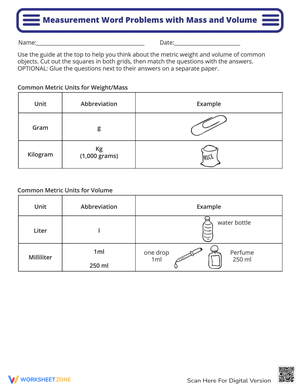
Milliliters are not part of 3.MD.A.2. Students encounter them on water bottles and medicine labels, but the standard specifies liters only at this grade. Every worksheet in the set stays within that boundary, so teachers do not need to pre-teach unit conversion or field milliliter questions before this unit is complete.
Fitting These Worksheets Into the Measurement Sequence
Different worksheet types belong at different moments in the unit, and placement makes a real difference:
- Unit sense and estimation worksheets work best as a two-day introduction before any measuring tools appear — pair them with a brief in-class pouring demonstration while the physical memory is still fresh.
- Scale-reading worksheets belong after direct instruction on how to determine interval value. Assigning them before that instruction produces wrong answers with no framework for self-correction.
- Word problem worksheets fit the back half of the unit, once both scale reading and basic operation fluency are active. They also hold up well as homework since the problems are self-contained and require no manipulatives.
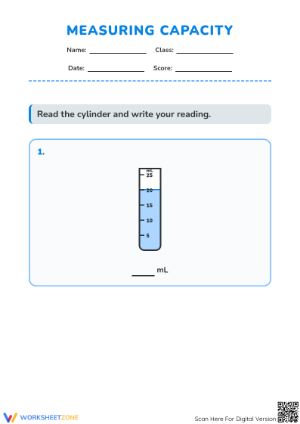
For math center rotation, laminated scale-reading worksheets used with dry-erase markers extend the material without additional printing. The 3rd grade measuring volume worksheets set holds up well in that format because the graduated cylinder illustrations stay clear after lamination, and students can solve, check, and erase rather than moving through printed copies quickly. Students who finish word problem worksheets early can write a second version of the same problem with different numbers — that task requires them to understand the problem's structure rather than simply execute the arithmetic, and it produces ready-made review items for the following day.
Supporting Learners at Different Points in This Skill
Students who stall on unlabeled scale intervals respond well to an interim step: have them write the value of every small mark on the cylinder before attempting to read the liquid level. Filling in "10, 12, 14, 16, 18, 20" along a scale turns interval calculation into simple reading. That written step can be faded once a student demonstrates consistent accuracy across several items, and most students need it for only a week or two before the process becomes automatic.
Students who read scales easily but lose ground on word problems usually have a different gap — they struggle to identify which operation applies, not with the arithmetic itself. Underlining the action word in each problem ("uses," "fills," "splits equally," "adds") before writing a number sentence redirects attention to the language rather than the numbers, and accuracy tends to improve right away. At the other end, advanced students move through the set quickly and benefit from an extension that asks them to build their own scale, fill it to a chosen level, and write a matching word problem. Working backward from a measurement to a scale and a story requires meaningfully deeper understanding than reading one that's already drawn.
Frequently Asked Questions
What unit do these worksheets use, and will students encounter milliliters?
Every worksheet uses liters (L), which is the unit specified in CCSS.MATH.CONTENT.3.MD.A.2. Milliliters are not part of the Grade 3 standard. Students sometimes notice them on water bottles or medicine labels and ask — a brief explanation that milliliters are much smaller than liters satisfies most of the curiosity without derailing the lesson.
My students can read a scale when the liquid is on a numbered mark but not when it falls between marks. What is the actual problem?
Students are reading rather than calculating — they scan for the nearest printed number and estimate from there instead of determining what each interval is worth. The fix is to make the calculation explicit: identify the two major marks surrounding the liquid level, find the difference, count the intervals between those marks, then divide to find each interval's value. Writing those steps once or twice makes the method visible, and most students transfer it accurately within a few practice items.
Can these worksheets serve as a formative assessment, or are they best used for practice only?
They work for both. Completed scale-reading worksheets give specific diagnostic information: a student who misreads every unlabeled interval by the same margin has a counting error, not a conceptual misunderstanding of volume. A student who reads scales correctly but consistently misses word problems has a different gap — usually in operation selection rather than in measurement understanding. Reviewing a small stack of completed worksheets is typically enough to group the class for targeted reteaching. The 3rd grade measuring volume worksheets set provides enough variation across item types to show you which skill is actually lagging, rather than leaving you with only a total score to work from.













 Interactive Worksheet Maker
 Quiz Maker
 Word Search Maker
 Crossword Puzzle Maker
 Word Scramble Generator
 Sentence Scramble Generator
 Handwriting Worksheet Generator
 Name Tracing Generator
 Fill In The Blank Generator