




























Views
Downloads




Printable Capacity Worksheet | Grade 3 Math

Paste this activity's link or code into your existing LMS (Google Classroom, Canvas, Teams, Schoology, Moodle, etc.).
Students can open and work on the activity right away, with no student login required.
You'll still be able to track student progress and results from your teacher account.
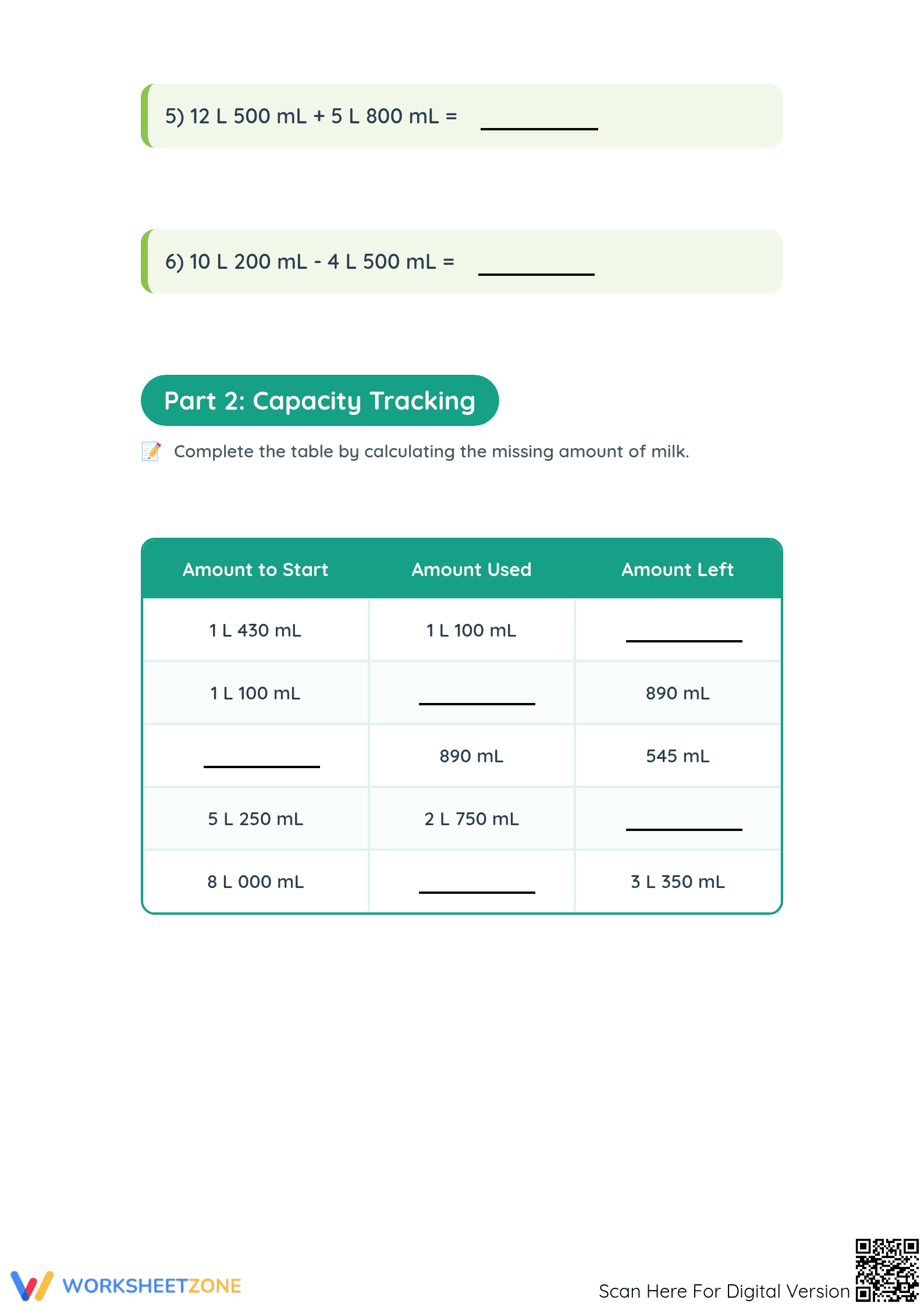
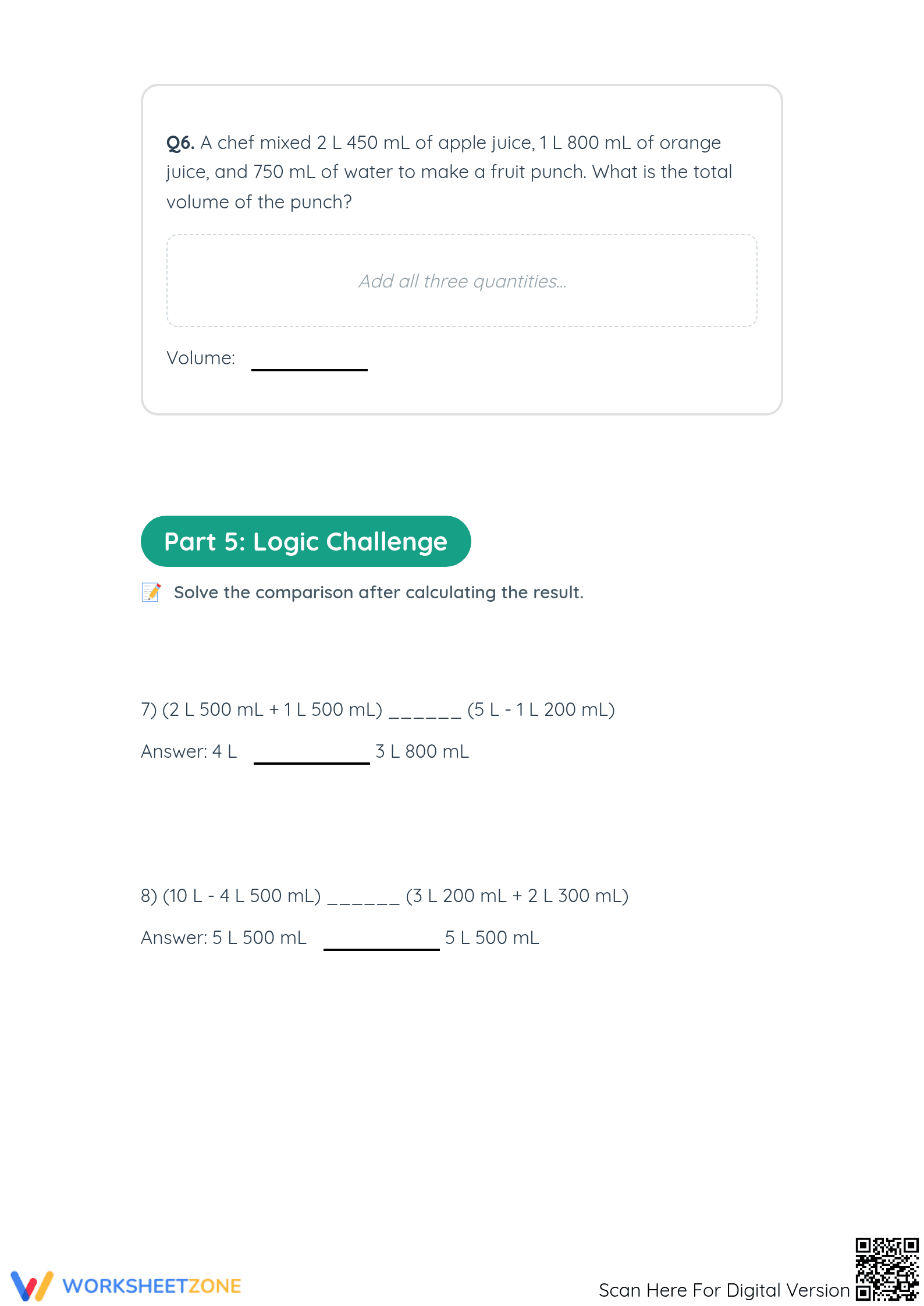
This Grade 3 math worksheet provides focused practice on adding and subtracting liquid volume. Students will work with liters and milliliters to solve 27 problems, including straightforward calculations and word problems. It’s an essential tool for helping learners master measurement concepts and apply them to real-world contexts, building a strong foundation in capacity.
At a Glance
- Grade: 3 · Subject: Math
- Standard:
CCSS.MATH.CONTENT.3.MD.A.2— Solve one-step word problems involving liquid volumes given in the same units.- Skill Focus: Adding and Subtracting Capacity (Liters/Milliliters)
- Format: 5 pages · 27 problems · Answer key included · PDF
- Best For: Independent practice, skill reinforcement, or homework.
- Time: 25–40 minutes
What's Inside
This resource contains a three-page worksheet and a two-page answer key. The tasks are varied, beginning with simple addition and subtraction of capacities. The difficulty progresses to include multi-step calculations and five word problems that challenge students to apply their understanding in practical scenarios.
Skill Progression
The worksheet uses a gradual release structure.
- Guided Practice: The first section has 8 simple addition problems, providing a clear entry point to build confidence.
- Supported Practice: Subsequent sections introduce subtraction and mixed operations, requiring students to manage both numbers and units (L and mL).
- Independent Practice: The final five word problems demand that students independently read, interpret, and solve scenarios, aligning with an I Do, We Do, You Do model.
Standards Alignment
This worksheet is directly aligned with CCSS.MATH.CONTENT.3.MD.A.2, which requires students to solve one-step word problems involving liquid volumes. It also supports foundational skills for 4.MD.A.2 by building fluency with measurement. Both standard codes can be copied directly into lesson plans, IEP goals, or district curriculum mapping tools.
How to Use It
This worksheet is effective as independent practice after a direct instruction lesson. It can also serve as a homework assignment. For formative assessment, observe if students are correctly aligning units before calculating; this is a common challenge. Most students will complete the worksheet in 25 to 40 minutes.
Who It's For
This resource is for Grade 3 students studying measurement. It is also suitable for Grade 4 students needing review or advanced Grade 2 learners. To support struggling learners, pair this worksheet with a visual anchor chart showing the relationship between liters and milliliters (1 L = 1,000 mL).
Foundational skills in measurement, such as those addressed in standard CCSS.MATH.CONTENT.3.MD.A.2, are critical for developing mathematical reasoning. This worksheet provides targeted practice in adding and subtracting liquid volumes, a key component of this standard. Research highlighted by Fisher & Frey (2014) emphasizes the importance of moving students from procedural fluency to application through problem-solving, a progression embedded in this resource's design. The inclusion of 27 distinct problems allows for sufficient practice to build automaticity, which frees up cognitive load for more complex tasks. By providing clear, contextualized problems involving liters and milliliters, this resource helps students connect abstract mathematical concepts to tangible, real-world measurements, a practice supported by numerous educational studies as essential for deep, lasting comprehension in elementary mathematics. The worksheet serves as a practical tool for data collection on student mastery.


