


























Views
Downloads

CCSS.3.MD.A.2 Worksheet: Volume & Capacity Aligned
Paste this activity's link or code into your existing LMS (Google Classroom, Canvas, Teams, Schoology, Moodle, etc.).
Students can open and work on the activity right away, with no student login required.
You'll still be able to track student progress and results from your teacher account.
This comprehensive math test helps third-grade students demonstrate their understanding of liquid volume and capacity. Through a series of 18 targeted problems, learners will practice comparing containers, measuring volume using standard and non-standard units, and solving word problems, reinforcing key measurement concepts outlined in the Common Core standards.
At a Glance
- Grade: 3 · Subject: Math
- Standard:
CCSS.MATH.CONTENT.3.MD.A.2— Measure, estimate, and solve word problems with liquid volumes.- Skill Focus: Liquid Volume & Capacity
- Format: 4 pages · 18 problems · Answer key included · PDF
- Best For: Summative assessment or test prep
- Time: 25–40 minutes
What's Inside
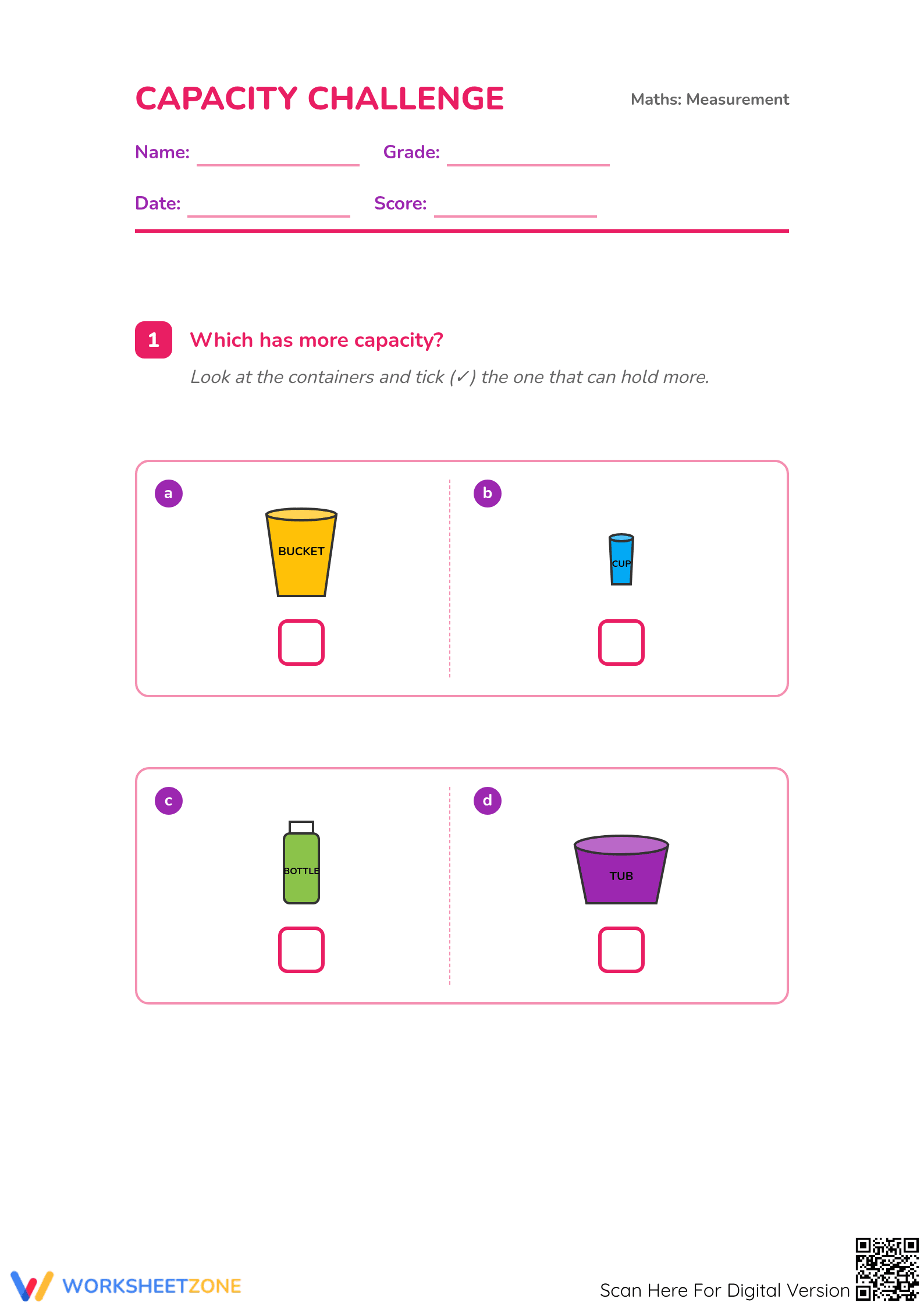
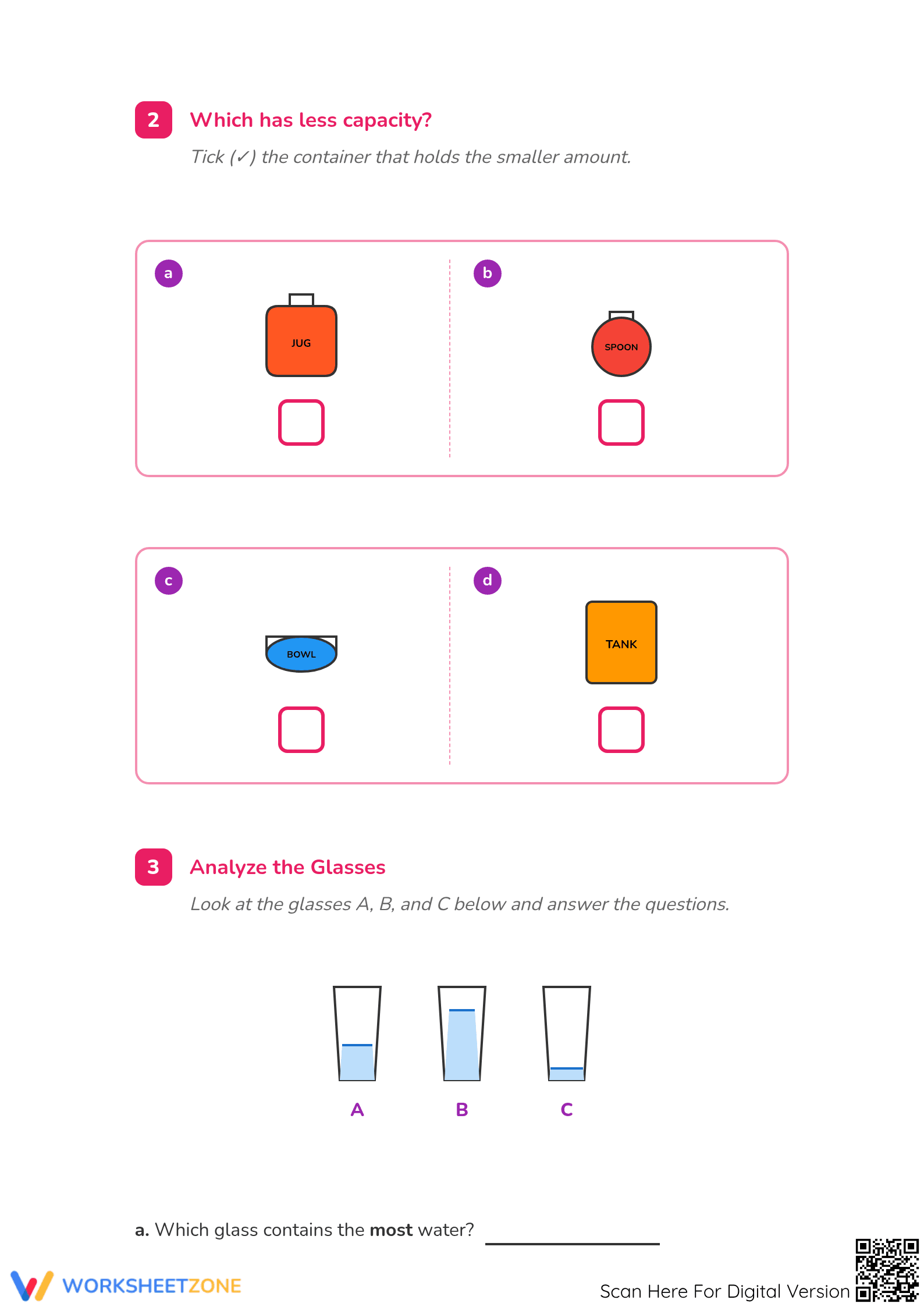
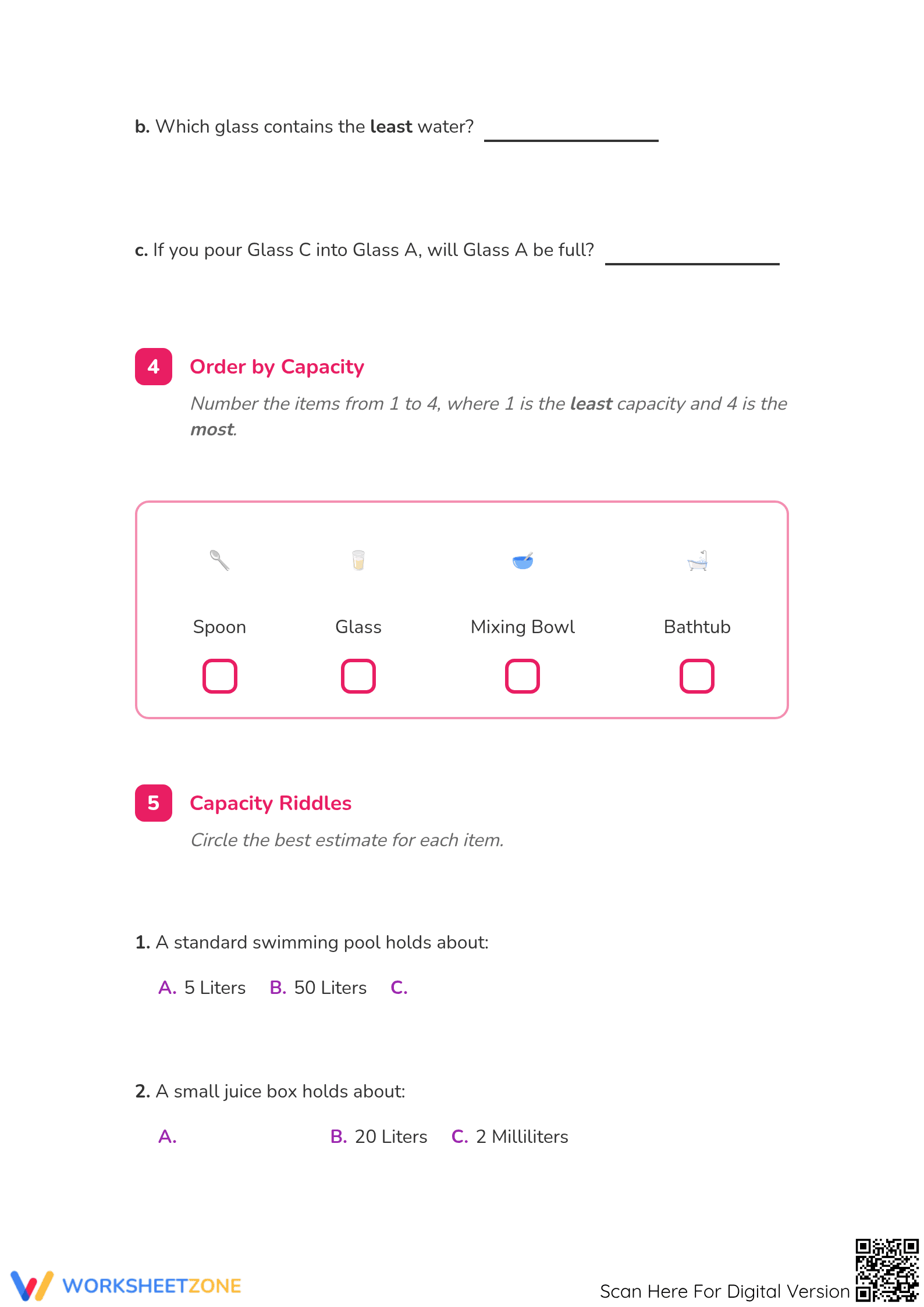
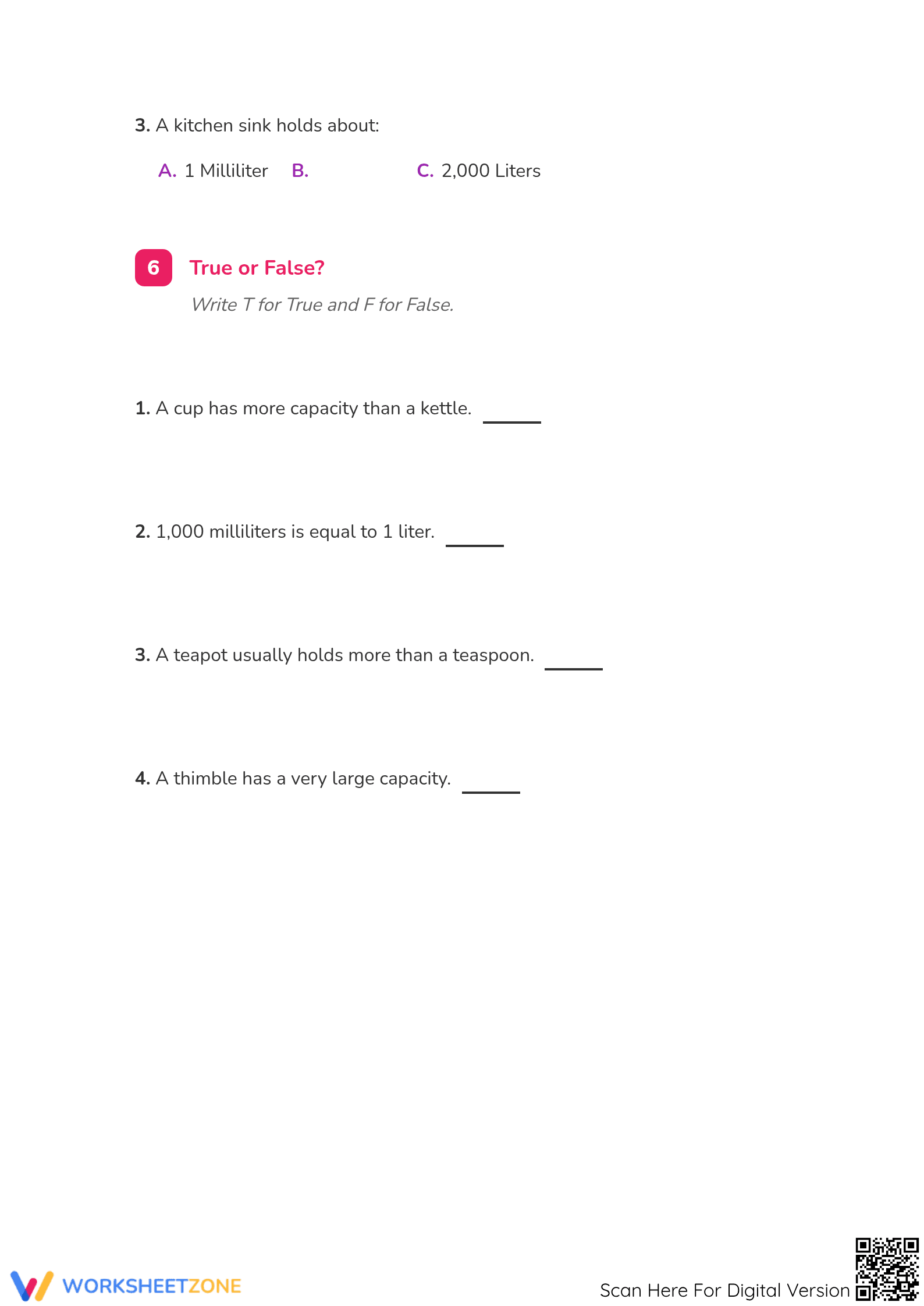
This four-page PDF is a complete assessment for liquid volume. The first pages have students visually compare and order containers. The third page involves reading measurements, and the final page presents four word problems. A full answer key is included for easy grading.
Evidence of Mastery
This assessment provides evidence of mastery for CCSS.MATH.CONTENT.3.MD.A.2. Tasks map to sub-skills: comparing capacity (Approaching), reading measurements (Meeting), and solving volume word problems (Exceeding). Teachers can use performance on the 18 tasks to identify student needs. The score is a reliable data point for standards-based grading, making it simple to track progress.
Standards Alignment
This worksheet is directly aligned with CCSS.MATH.CONTENT.3.MD.A.2, which requires students to "Measure and estimate liquid volumes and masses of objects using standard units of grams (g), kilograms (kg), and liters (l). Add, subtract, multiply, or divide to solve one-step word problems involving masses or volumes that are given in the same units". The activities also support foundational kindergarten standards like K.MD.A.2 (directly comparing objects). Both standard codes can be copied directly into lesson plans, IEP goals, or district curriculum mapping tools.
How to Use It
Use this resource as a summative assessment after a unit on liquid volume, with an expected completion time of 25-40 minutes. It functions perfectly as an end-of-unit test or as a pre-assessment to gauge prior knowledge. For formative assessment, observe which tool students struggle with: visual comparison, reading a scaled instrument, or deconstructing a word problem. This can inform targeted re-teaching. It can also serve as a focused review packet before standardized testing.
Who It's For
Designed for Grade 3 students, this test is also useful for advanced 2nd graders or as review for 4th graders. For students needing support, complete the first page as a guided review. This assessment pairs well with a hands-on measurement lesson using real containers to connect abstract concepts to the physical world.
Evaluating student proficiency in measurement, as targeted by CCSS.MATH.CONTENT.3.MD.A.2, is crucial for developing real-world numeracy. This assessment provides a reliable tool for measuring skills in estimating, measuring, and solving problems with liquid volumes. Research consistently shows that applying mathematical concepts to tangible attributes like volume improves retention and understanding. According to the NAEP framework, procedural fluency and problem-solving are distinct but equally important facets of mathematical proficiency. This worksheet assesses both, moving from direct comparison to complex application. By asking students to solve word problems, it bridges the gap between calculation and reasoning, a key indicator of deep conceptual knowledge that is a focus of mathematics education reform. Educators can use the results to validate that students are prepared for more advanced topics in proportional reasoning and unit conversion.


