


























Views
Downloads


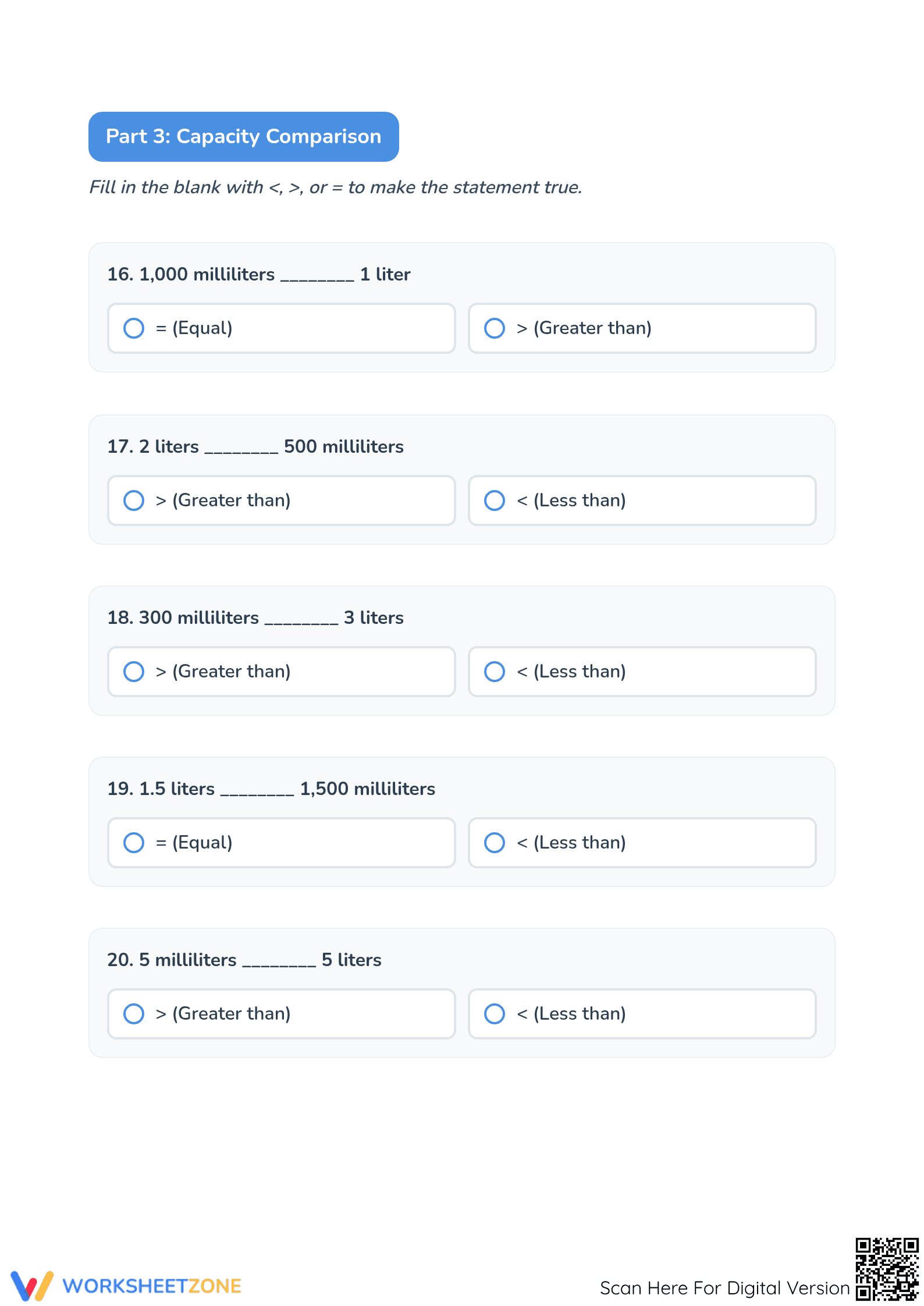


Printable Capacity Worksheet | Grade 3 Math
Paste this activity's link or code into your existing LMS (Google Classroom, Canvas, Teams, Schoology, Moodle, etc.).
Students can open and work on the activity right away, with no student login required.
You'll still be able to track student progress and results from your teacher account.
This Grade 3 math worksheet offers targeted practice on estimating and comparing liquid volume. Students will work through 20 problems designed to solidify their understanding of liters and milliliters, a foundational skill for measurement mastery. The activities guide learners from identifying appropriate units to directly comparing different capacities, ensuring a comprehensive review.
At a Glance
- Grade: 3 · Subject: Math
- Standard:
CCSS.MATH.CONTENT.3.MD.A.2— Measure and estimate liquid volumes using standard units.- Skill Focus: Estimating and comparing liquid volume (L/mL)
- Format: 4 pages · 20 problems · Answer key included · PDF
- Best For: Unit review, formative assessment, independent practice
- Time: 20–30 minutes
What's Inside
This resource contains a four-page worksheet with 20 problems and a one-page answer key. Pages 1-2 have 12 tasks asking students to choose the correct unit (L or mL). Pages 3-4 feature 8 tasks where students compare capacities using <, >, or =. The clean layout provides ample workspace.
A Clear Path to Mastery
The worksheet uses a gradual-release model to build student skill.
- Guided Practice: The first 12 problems reinforce the core concept by asking students to identify the most reasonable unit of measure (L or mL) for familiar objects.
- Supported Practice: The comparison problems on pages three and four provide implicit support. Students apply their unit understanding to compare two given quantities.
- Independent Practice: The 20-problem set is ideal for independent work after a lesson on capacity, allowing students to demonstrate their grasp of the skill with minimal teacher support.
Standards-Aligned for Your Classroom
This worksheet is aligned with Common Core standard CCSS.MATH.CONTENT.3.MD.A.2, which requires students to "Measure and estimate liquid volumes...using standard units of...liters (l)." This activity focuses specifically on that liquid volume component. The standard code can be copied directly into lesson plans, IEP goals, or curriculum maps.
Flexible for Any Lesson Plan
This worksheet is effective for independent practice after a direct instruction lesson on liters and milliliters. It can also be used as a formative assessment; circulate and note which students hesitate on comparison problems, as this can reveal misconceptions. Most students will complete the worksheet in 20-30 minutes.
Perfect for Primary Learners
This resource is designed for third-grade students learning metric capacity but also serves as a review for fourth graders or an extension for advanced second graders. Its focus on a single skill makes it excellent for targeted intervention. Pair it with a hands-on activity using real beakers to connect the abstract concepts to the physical world.
Targeted practice in foundational measurement skills is critical for building mathematical proficiency. This worksheet, aligned with CCSS.MATH.CONTENT.3.MD.A.2, provides students with structured opportunities to estimate and compare liquid volumes, a key requirement of the standard. Research consistently shows that repeated, focused practice on specific procedural skills is necessary for automaticity. According to the RAND AIRS 2024 report on elementary math instruction, students who achieve fluency in foundational concepts like measurement are better equipped to tackle complex, multi-step problems later on. By providing 20 discrete tasks on liters and milliliters, this resource helps students build the procedural fluency needed to confidently apply their knowledge of liquid capacity in more demanding mathematical contexts. This approach supports a well-rounded instructional strategy that balances conceptual understanding with necessary skill practice.


