


























Views
Downloads

Printable Units of Volume Worksheet | Grade 5 Math
Paste this activity's link or code into your existing LMS (Google Classroom, Canvas, Teams, Schoology, Moodle, etc.).
Students can open and work on the activity right away, with no student login required.
You'll still be able to track student progress and results from your teacher account.
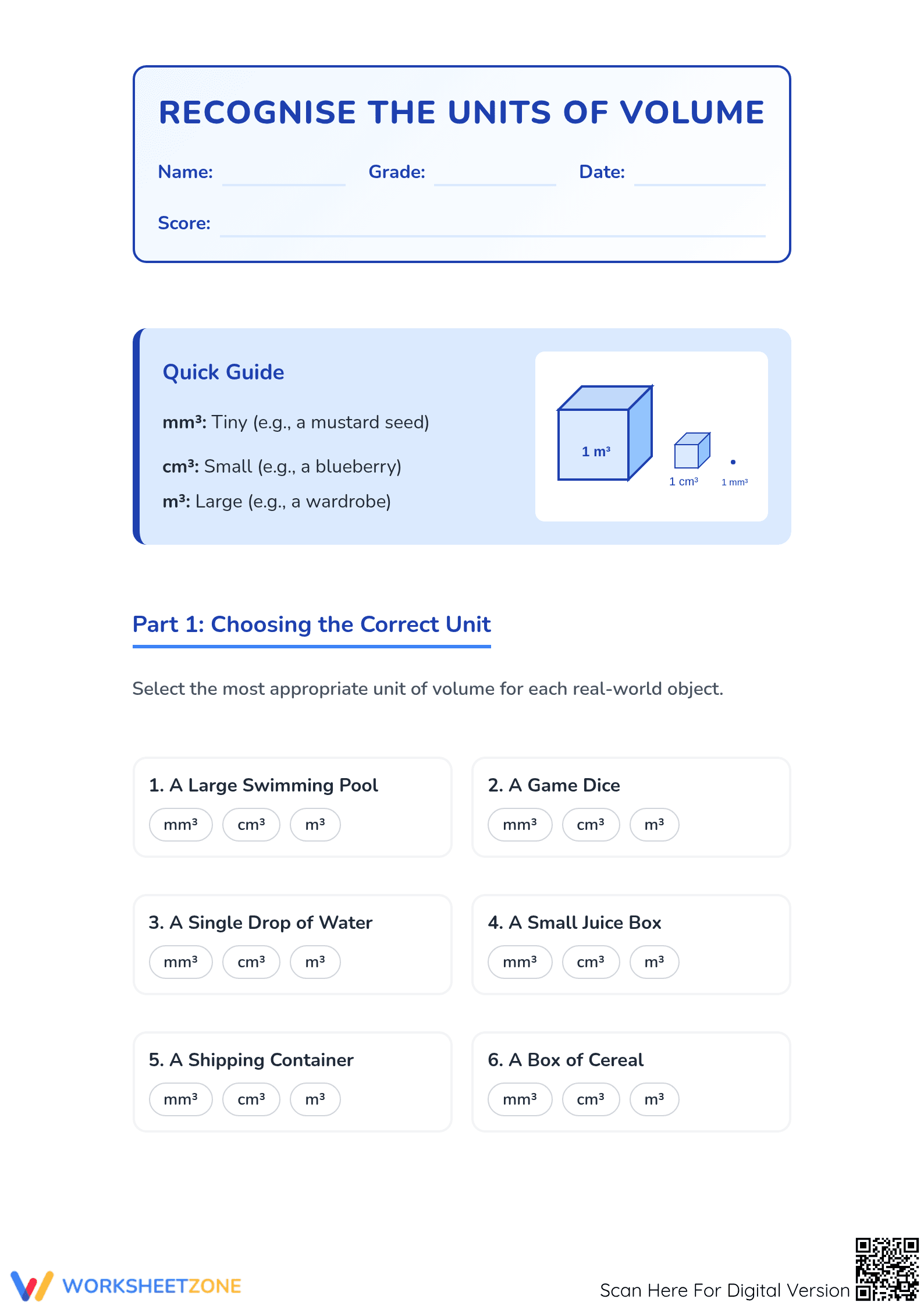
This comprehensive Grade 5 math worksheet provides essential practice for students learning to identify and apply metric units of volume. By connecting abstract cubic measurements to real-world objects like swimming pools and dice, students build a concrete internal scale for cubic millimeters, centimeters, and meters. This resource ensures students can accurately estimate and compare volumes in various contexts.
At a Glance
- Grade: 5 · Subject: Math
- Standard:
CCSS.MATH.CONTENT.5.MD.C.3— Recognize volume as an attribute of solid figures and understand measurement concepts- Skill Focus: Identifying and comparing cubic metric units
- Format: 3 pages · 18 problems · Answer key included · PDF
- Best For: Independent practice and real-world estimation skills
- Time: 20–30 minutes
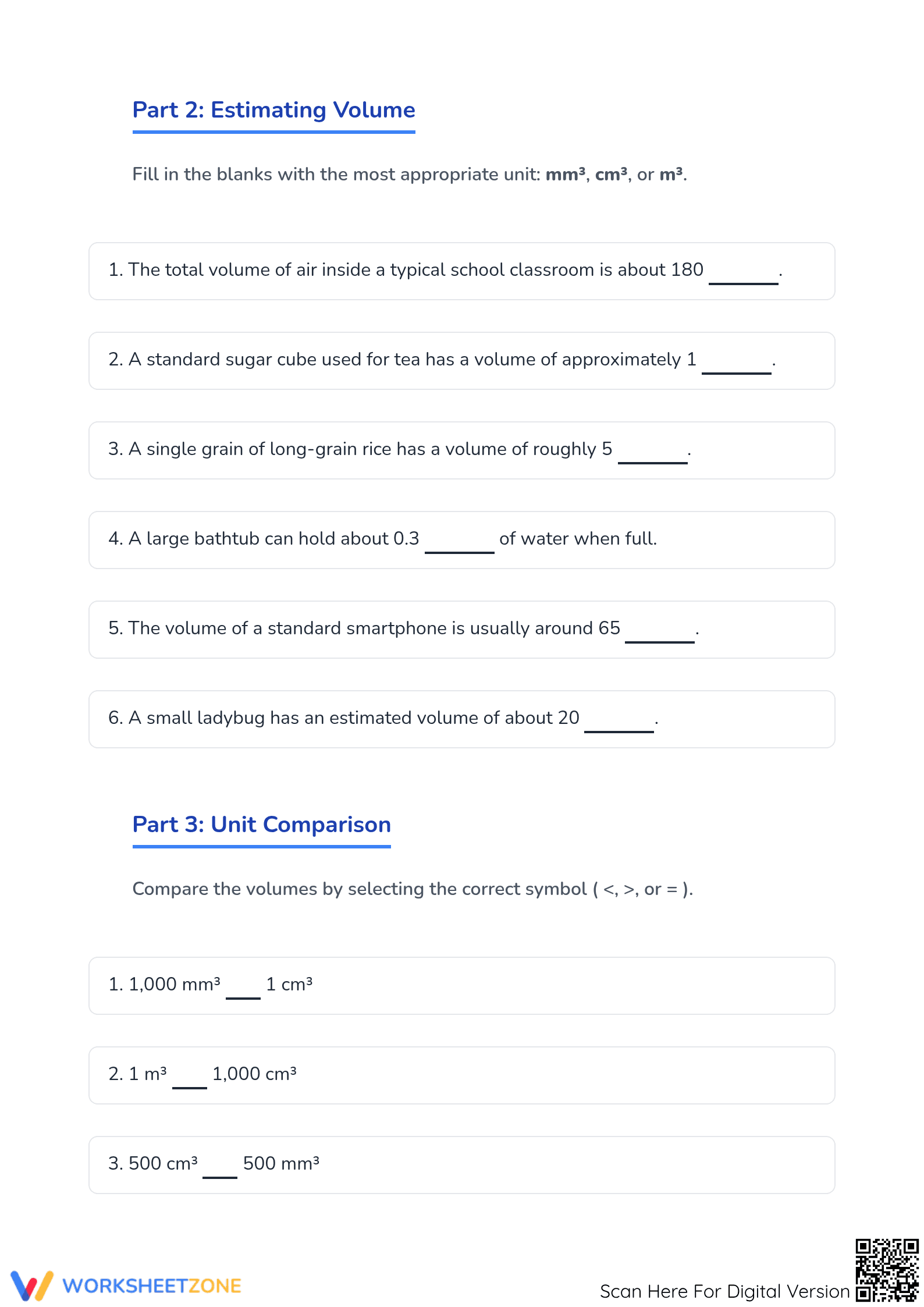
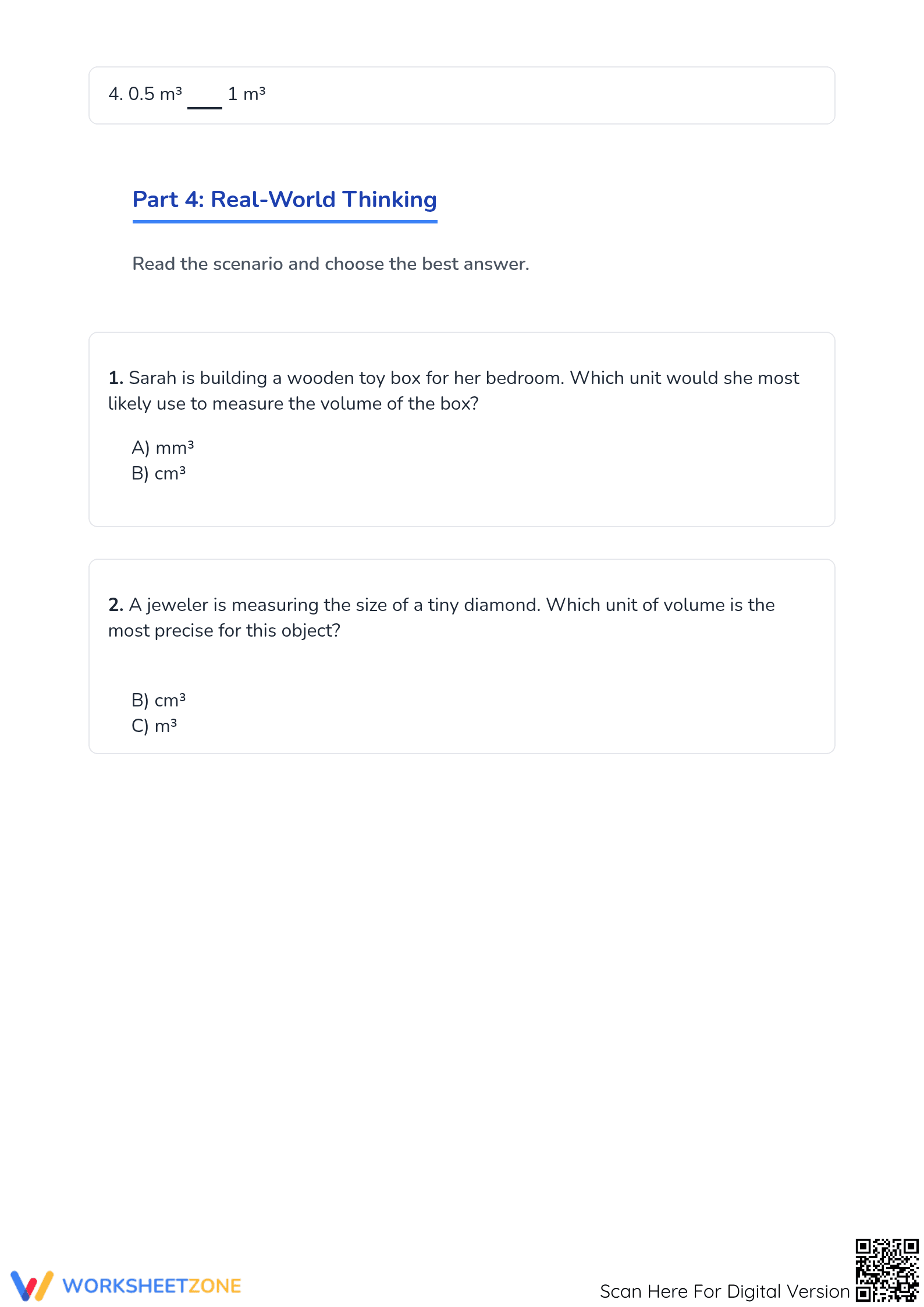
What's Inside: This 3-page PDF set includes a visual "Quick Guide" anchor to help students visualize the scale of each unit. The 18 total tasks are divided into four logical sections: unit selection for objects, estimation within sentences, numerical unit comparisons using symbols, and real-world scenario thinking. A full answer key is included to facilitate immediate feedback and student self-correction.
The Zero-Prep Workflow: This resource is designed for immediate classroom deployment. First, print the three pages for your students, which takes approximately 30 seconds. Next, distribute the sheets and allow students to use the Quick Guide for the first few problems. Finally, review the completed work using the provided answer key during the last 5 minutes of class. Total teacher preparation time is under 2 minutes, making this an ideal choice for sub plans or emergency math blocks.
Standards Alignment: This worksheet is primarily aligned to `CCSS.MATH.CONTENT.5.MD.C.3`, which requires students to recognize volume as an attribute of solid figures and understand concepts of volume measurement. It also supports `CCSS.MATH.CONTENT.5.MD.A.1` by encouraging the application of unit knowledge in problem-solving. Both standard codes can be copied directly into lesson plans, IEP goals, or district curriculum mapping tools to document evidence-based instructional alignment.
How to Use It: Deploy this worksheet as a mid-lesson formative assessment after introducing the concept of cubic measurement. It works exceptionally well during the "You Do" phase of a gradual release model. Teachers should observe students during Part 3 (Unit Comparison) to see if they understand the relationship between 1,000 cubic millimeters and 1 cubic centimeter. Expect most students to complete the three-page set within 25 minutes of focused work time.
Who It's For: This resource is specifically crafted for fifth-grade students mastering the Measurement and Data domain. It provides necessary scaffolds for students who struggle with spatial reasoning by providing concrete reference objects. For best results, pair this worksheet with physical manipulatives such as base-ten blocks or a meter stick to bridge the gap between the printable page and three-dimensional reality.
According to the RAND AIRS 2024 analysis of mathematics instruction, students who engage with varied representational tasks—such as the estimation and comparison problems featured here—show significantly higher retention rates in measurement concepts compared to those who only perform rote calculations. By asking students to choose between cubic millimeters for a ladybug and cubic meters for a school classroom, this worksheet reinforces the conceptual framework required for higher-level geometry. The inclusion of the CCSS.MATH.CONTENT.5.MD.C.3 standard ensures that the 18 problems provided directly map to the cognitive demands of state assessments. Fisher & Frey (2014) highlight the importance of such scaffolded practice in developing mathematical fluency. This zero-prep PDF serves as a reliable tool for establishing a strong foundation in metric volume, allowing educators to transition from basic recognition to complex volume calculations with confidence and instructional precision.


