


























Views
Downloads
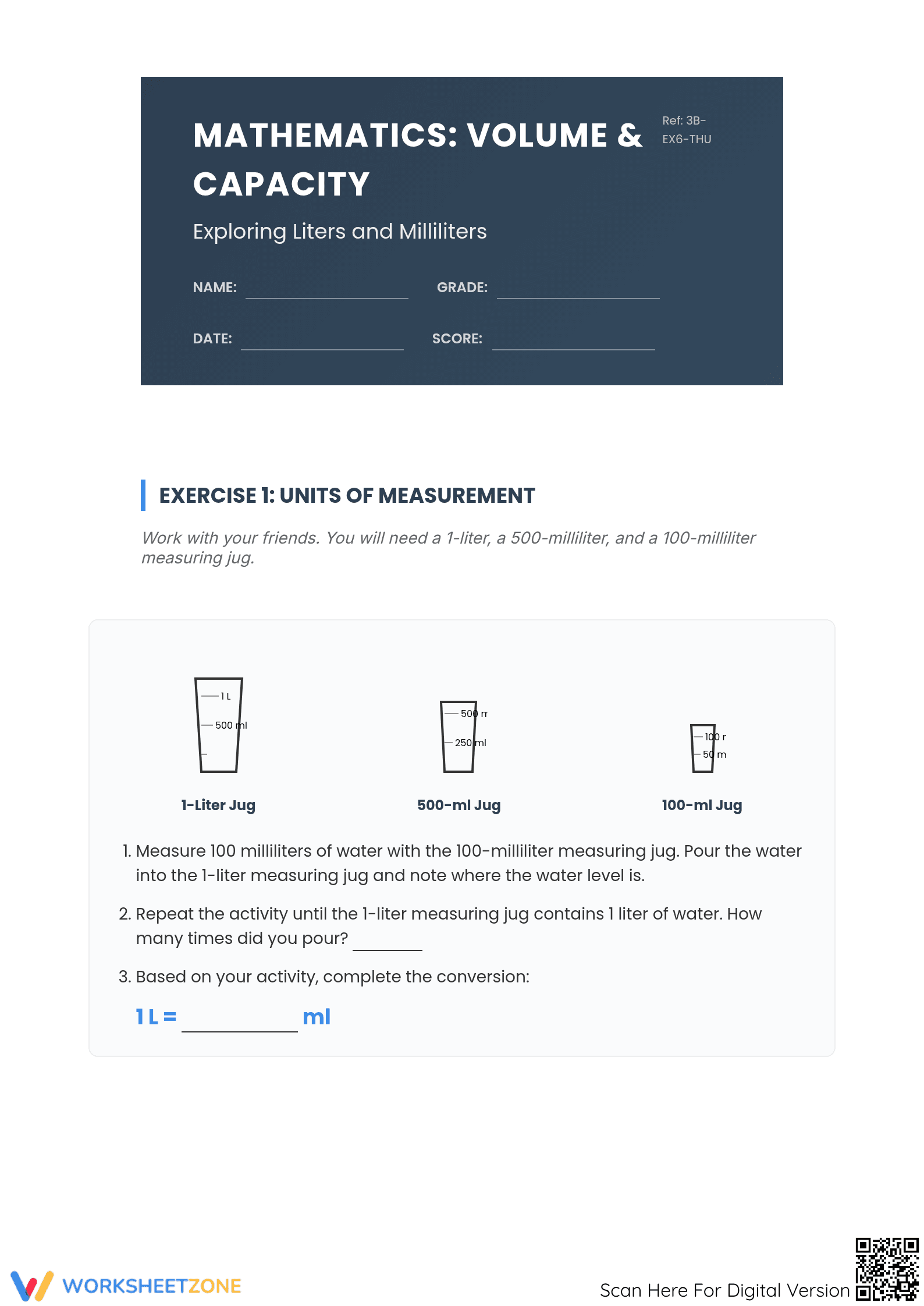
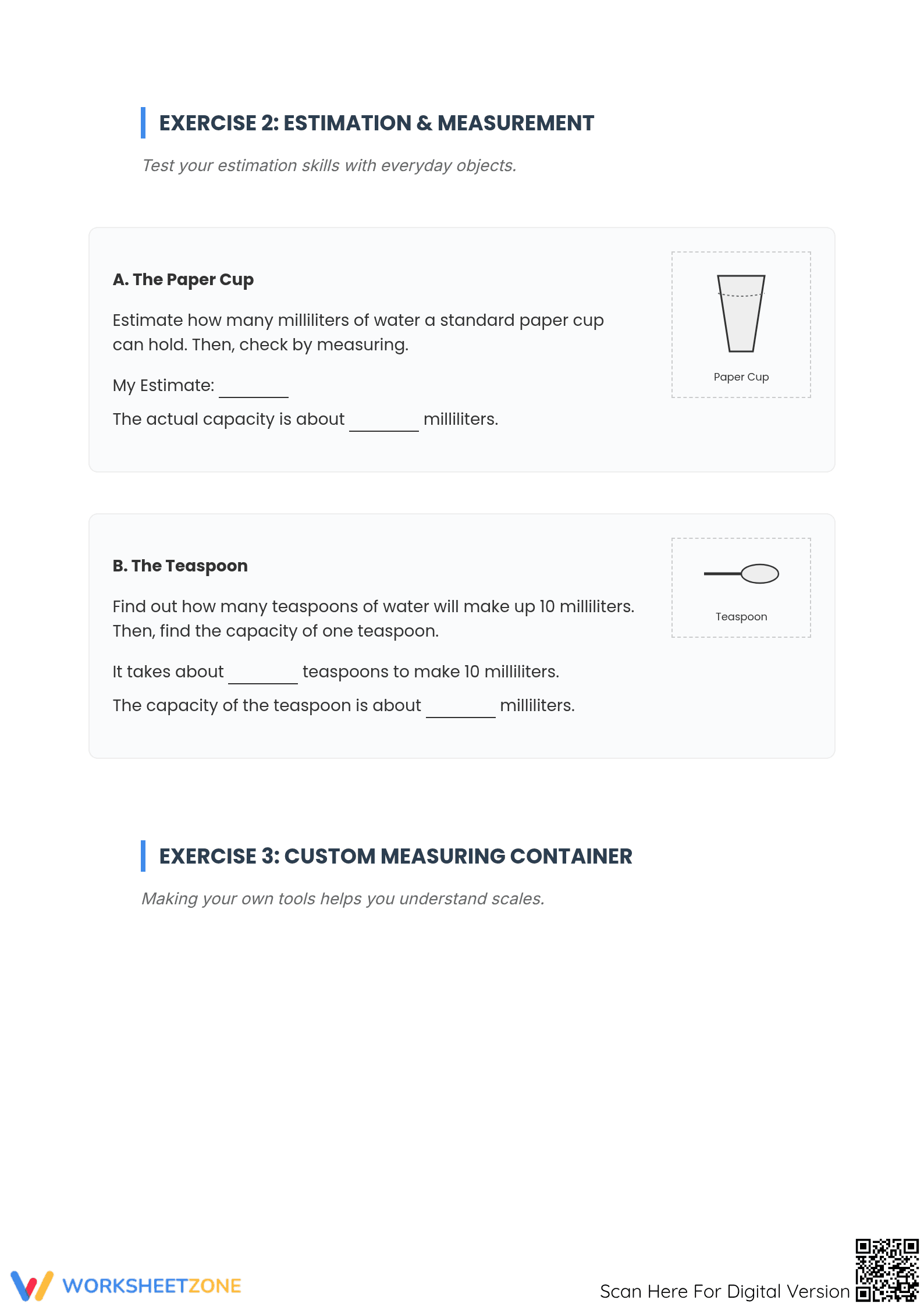
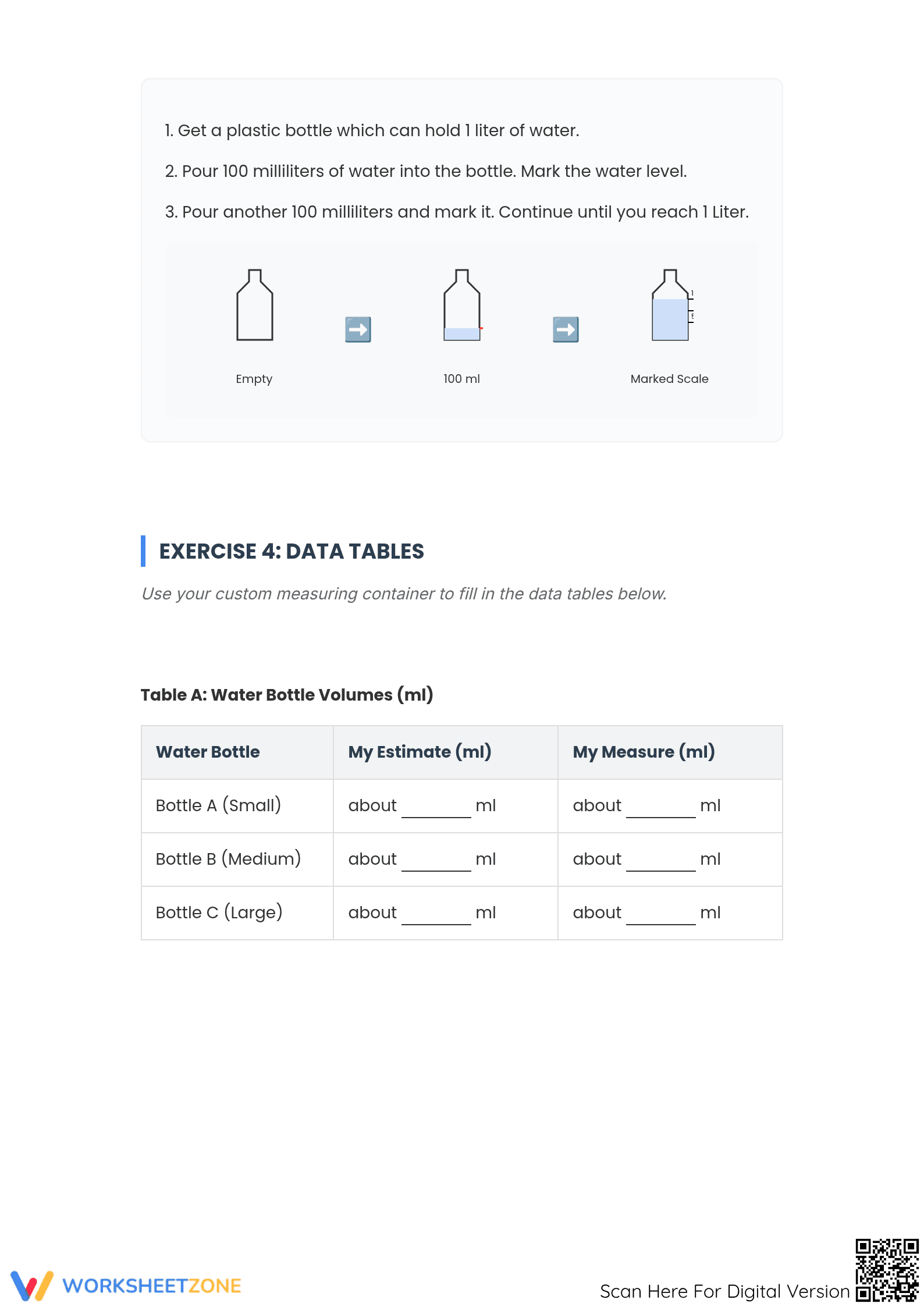
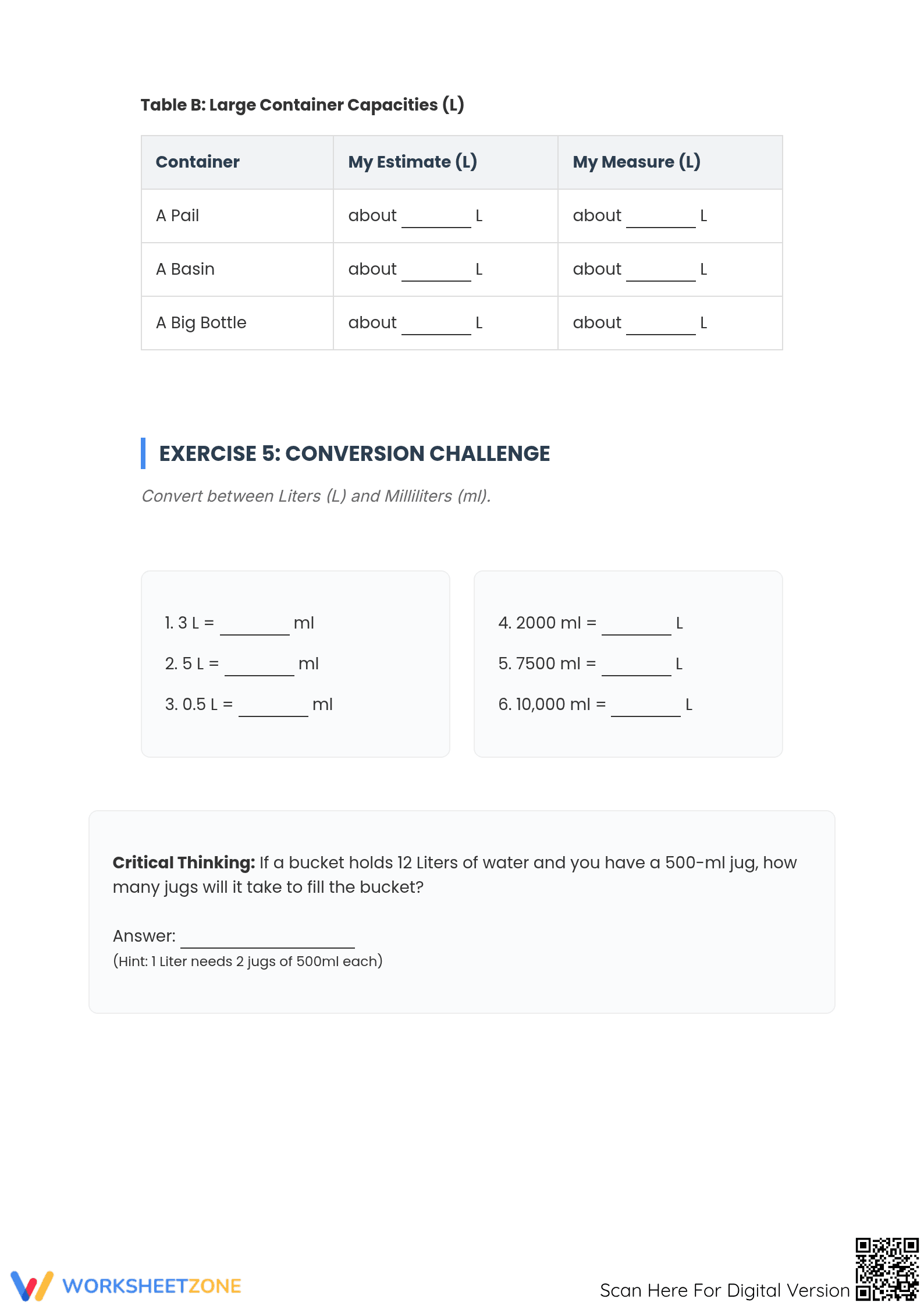

Printable Estimating Volume Worksheet | Grade 3 Math
Paste this activity's link or code into your existing LMS (Google Classroom, Canvas, Teams, Schoology, Moodle, etc.).
Students can open and work on the activity right away, with no student login required.
You'll still be able to track student progress and results from your teacher account.
Mastering Measurement: Estimating Liquid Volume
This worksheet provides focused practice for Grade 3 students on the essential skill of estimating liquid capacity and volume. Through a series of structured tasks, learners will build their intuition for standard metric units, including liters (L) and milliliters (mL). The exercises are designed to move students from conceptual understanding to practical application, helping them confidently judge the volume of liquids in everyday containers.
At a Glance
- Grade: 3 · Subject: Math
- Standard:
CCSS.MATH.CONTENT.3.MD.A.2— Measure and estimate liquid volumes using standard units like liters.- Skill Focus: Estimating Capacity and Volume
- Format: 4 pages · 12 problems · Answer key included · PDF
- Best For: Independent practice, homework, or formative assessment
- Time: 20–30 minutes
What's Inside
This four-page resource contains a targeted set of 12 problems that challenge students to apply their knowledge of capacity. The worksheet includes multiple-choice questions and fill-in-the-blank tasks that require students to select the most reasonable estimate for various containers, from a small cup to a large fish tank. Visual cues and relatable scenarios help ground the abstract concepts in real-world contexts. A complete answer key is provided on separate pages for quick and easy grading.
A Scaffolded Skill Progression
The worksheet follows a gradual release model to build student confidence and independence. The activities are sequenced to support a clear learning path:
- Guided Practice: The first few problems often provide strong visual anchors and clear choices, helping students establish a baseline for liters and milliliters.
- Supported Practice: Subsequent tasks reduce the scaffolding, asking students to compare containers or choose from a wider range of possible volumes.
- Independent Practice: The final exercises require students to apply their estimation skills with minimal prompting, demonstrating true mastery of the concept.
Standards Alignment
This resource is directly aligned with Common Core State Standard CCSS.MATH.CONTENT.3.MD.A.2, which requires students to "Measure and estimate liquid volumes and masses of objects using standard units of grams (g), kilograms (kg), and liters (l)." This worksheet specifically targets the liquid volume component of the standard. Using this material ensures that your instruction is aligned with key grade-level expectations. Both standard codes can be copied directly into lesson plans, IEP goals, or district curriculum mapping tools.
How to Use It
This worksheet is a versatile tool for any Grade 3 math classroom. It can be used as independent practice after a direct instruction lesson on liquid volume, allowing students to solidify their new knowledge. Alternatively, assign it as a homework assignment to reinforce concepts covered in class. You can also use it as a formative assessment tool; by observing which problems students find challenging, you can gain insight into common misconceptions and adjust your future instruction accordingly. Most students will be able to complete the worksheet in approximately 20 to 30 minutes.
Who It's For
This resource is designed for Grade 3 students who are learning about or reviewing the concept of liquid volume. It is particularly helpful for learners who benefit from visual aids and structured practice. The clear layout and focused scope make it an accessible tool for a wide range of students. To extend the lesson, pair this worksheet with a hands-on activity where students can pour water into marked containers to check their estimates against actual measurements.


